
Recent from talks
Simon von Stampfer
Knowledge base stats:
Talk channels stats:
Members stats:
Simon von Stampfer
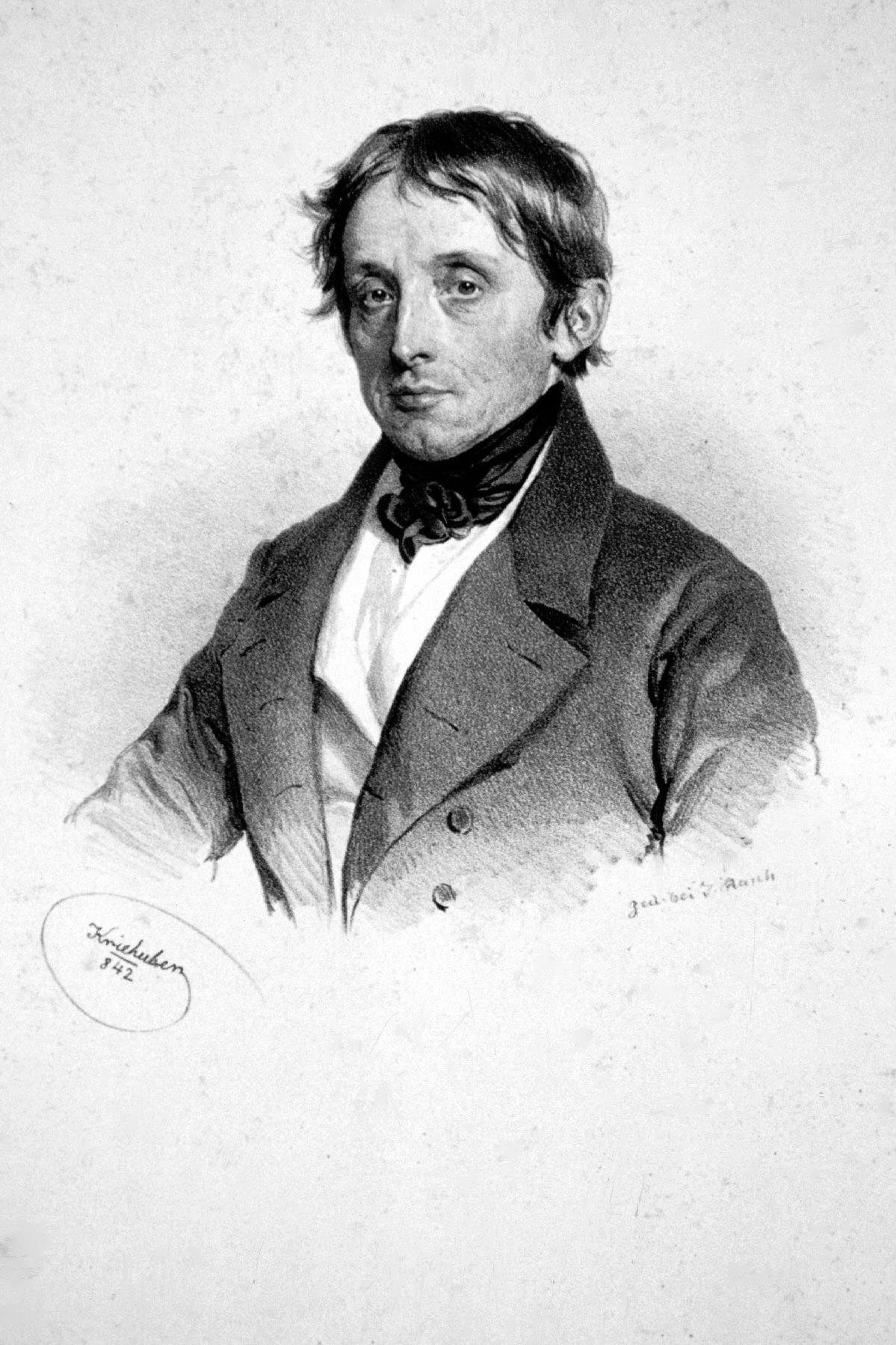
Simon Ritter von Stampfer (26 October 1792 (according to other sources 1790)), in Windisch-Mattrai, Archbishopric of Salzburg, today called Matrei in Osttirol, Tyrol – 10 November 1864 in Vienna) was an Austrian mathematician, surveyor and inventor. His most famous invention is that of the stroboscopic disk which has a claim to be the first device to show moving images. Almost simultaneously, a similar device was developed in Belgium (the phenakistiscope).
Simon Ritter von Stampfer was born in Matrei in Osttirol, and was the first son of Bartlmä Stampfer, a weaver. From 1801 he attended the local school and in 1804 and moved to the Franciscan Gymnasium in Lienz, where he studied until 1807. From there he went to the Lyceum in Salzburg, to study philosophy, however he was not assessed.
In 1814 in Munich, he passed the state examination and applied there as a teacher. He chose, however, to stay in Salzburg, where he was assistant teacher in mathematics, natural history, physics and Greek at the high school. He then moved to the Lyceum, where he taught elementary mathematics, physics and applied mathematics . In 1819 he was also appointed a professor. In his spare time he made geodetic measurements, astronomical observations, experiments on the propagation speed of sound at different heights and measurements using the barometer. Stampfer was often to be seen in the Benedictine Monastery of Kremsmünster which had numerous pieces of astronomical equipment available.
In 1822, von Stampfer married Johanna Wagner. They had a daughter in 1824 (Maria Aloysia Johanna) and in 1825 a son (Anton Josef Simon).
After several unsuccessful applications, in Innsbruck, Stampfer was finally promoted to full professor of pure mathematics in Salzburg. However, at the Polytechnic Institute in Vienna, he was also promoted to the Chair of Practical Geometry. He settled there in December 1825 to replace Franz Josef von Gerstner. He now taught Practical geometry, but was also employed as a physicist and astronomer. He produced a method for the computation of solar eclipses.
He was concerned about his astronomical work with lenses and their accuracy and distortion. This led him to the field of optical illusions. In 1828, he developed test methods for telescopes and methods of measurement to determine the "Krümmungshalbmesser" of lenses and the refractive and dispersion property of the glass. For his work on the theoretical foundations of the production of high quality optics, he turned to the achromatic Fraunhofer lens.
One of his most famous students include Christian Doppler, known for his work in the Doppler Effect
In 1832, Stampfer became aware through the Journal of Physics and Mathematics of experiments by the British physicist, Michael Faraday, on the optical illusion caused by rapidly rotating gears, in which the human eye could not follow the movement of the gear. He repeated Faraday's experiments of looking in a mirror through the openings between the teeth of slotted cardboard wheels, with "very curious effects" if figures were drawn or pasted on the disc's surface. Stampfer turned this into a method that made drawings move in any conceivable manner. He called his animation discs Stroboscopische Scheiben (optische Zauberscheiben) (Stroboscopic Discs, or optical magic discs), coining the term as a combination of the Ancient Greek words στρόβος - strobos, meaning "whirlpool" and σκοπεῖν - skopein, meaning "to look at". In a pamphlet published in July 1833, Stampfer mentioned that the sequence of images could be placed on either a disc, a cylinder (much like the Zoetrope, introduced in 1866) or longer scenes on a looped strip of paper or canvas stretched around two parallel rollers (somewhat similar to film on spools). A disc with pictures could be viewed though a slotted disc on the other side of an axis, but Stampfer found spinning one disc with slots as well as pictures in front of a mirror more simple. He also suggested covering up the view of all but one of the moving figures with a cut-out sheet of cardboard and painting theatrical coulisses and backdrops around the cut-out part (somewhat similar to the later Praxinoscope-Theatre). The patent for the invention also mentions the option of transparent versions. Stampfer and lithographer Mathias Trentsensky chose to publish the invention in the shape of a disc to be viewed in a mirror.
Hub AI
Simon von Stampfer AI simulator
(@Simon von Stampfer_simulator)
Simon von Stampfer
Simon Ritter von Stampfer (26 October 1792 (according to other sources 1790)), in Windisch-Mattrai, Archbishopric of Salzburg, today called Matrei in Osttirol, Tyrol – 10 November 1864 in Vienna) was an Austrian mathematician, surveyor and inventor. His most famous invention is that of the stroboscopic disk which has a claim to be the first device to show moving images. Almost simultaneously, a similar device was developed in Belgium (the phenakistiscope).
Simon Ritter von Stampfer was born in Matrei in Osttirol, and was the first son of Bartlmä Stampfer, a weaver. From 1801 he attended the local school and in 1804 and moved to the Franciscan Gymnasium in Lienz, where he studied until 1807. From there he went to the Lyceum in Salzburg, to study philosophy, however he was not assessed.
In 1814 in Munich, he passed the state examination and applied there as a teacher. He chose, however, to stay in Salzburg, where he was assistant teacher in mathematics, natural history, physics and Greek at the high school. He then moved to the Lyceum, where he taught elementary mathematics, physics and applied mathematics . In 1819 he was also appointed a professor. In his spare time he made geodetic measurements, astronomical observations, experiments on the propagation speed of sound at different heights and measurements using the barometer. Stampfer was often to be seen in the Benedictine Monastery of Kremsmünster which had numerous pieces of astronomical equipment available.
In 1822, von Stampfer married Johanna Wagner. They had a daughter in 1824 (Maria Aloysia Johanna) and in 1825 a son (Anton Josef Simon).
After several unsuccessful applications, in Innsbruck, Stampfer was finally promoted to full professor of pure mathematics in Salzburg. However, at the Polytechnic Institute in Vienna, he was also promoted to the Chair of Practical Geometry. He settled there in December 1825 to replace Franz Josef von Gerstner. He now taught Practical geometry, but was also employed as a physicist and astronomer. He produced a method for the computation of solar eclipses.
He was concerned about his astronomical work with lenses and their accuracy and distortion. This led him to the field of optical illusions. In 1828, he developed test methods for telescopes and methods of measurement to determine the "Krümmungshalbmesser" of lenses and the refractive and dispersion property of the glass. For his work on the theoretical foundations of the production of high quality optics, he turned to the achromatic Fraunhofer lens.
One of his most famous students include Christian Doppler, known for his work in the Doppler Effect
In 1832, Stampfer became aware through the Journal of Physics and Mathematics of experiments by the British physicist, Michael Faraday, on the optical illusion caused by rapidly rotating gears, in which the human eye could not follow the movement of the gear. He repeated Faraday's experiments of looking in a mirror through the openings between the teeth of slotted cardboard wheels, with "very curious effects" if figures were drawn or pasted on the disc's surface. Stampfer turned this into a method that made drawings move in any conceivable manner. He called his animation discs Stroboscopische Scheiben (optische Zauberscheiben) (Stroboscopic Discs, or optical magic discs), coining the term as a combination of the Ancient Greek words στρόβος - strobos, meaning "whirlpool" and σκοπεῖν - skopein, meaning "to look at". In a pamphlet published in July 1833, Stampfer mentioned that the sequence of images could be placed on either a disc, a cylinder (much like the Zoetrope, introduced in 1866) or longer scenes on a looped strip of paper or canvas stretched around two parallel rollers (somewhat similar to film on spools). A disc with pictures could be viewed though a slotted disc on the other side of an axis, but Stampfer found spinning one disc with slots as well as pictures in front of a mirror more simple. He also suggested covering up the view of all but one of the moving figures with a cut-out sheet of cardboard and painting theatrical coulisses and backdrops around the cut-out part (somewhat similar to the later Praxinoscope-Theatre). The patent for the invention also mentions the option of transparent versions. Stampfer and lithographer Mathias Trentsensky chose to publish the invention in the shape of a disc to be viewed in a mirror.
Recent media