
Recent from talks
Sinclair Lewis
Knowledge base stats:
Talk channels stats:
Members stats:
Sinclair Lewis
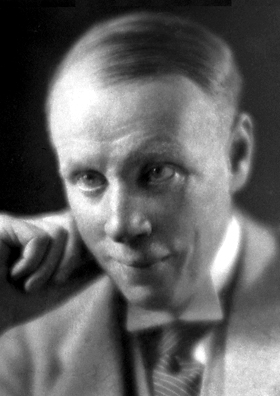
Harry Sinclair Lewis (February 7, 1885 – January 10, 1951) was an American novelist, short-story writer, and playwright. In 1930, he became the first author from the United States (and the first from the Americas) to receive the Nobel Prize in Literature, which was awarded "for his vigorous and graphic art of description and his ability to create, with wit and humor, new types of characters." Lewis wrote six popular novels: Main Street (1920), Babbitt (1922), Arrowsmith (1925), Elmer Gantry (1927), Dodsworth (1929), and It Can't Happen Here (1935).
Several of his notable works were critical of American capitalism and materialism during the interwar period. Lewis is respected for his strong characterizations of modern working women. H. L. Mencken wrote of him, "[If] there was ever a novelist among us with an authentic call to the trade ... it is this red-haired tornado from the Minnesota wilds."
Lewis was born February 7, 1885, in the village of Sauk Centre, Minnesota, to Edwin J. Lewis, a physician of Welsh descent, and Emma Kermott Lewis. He had two older siblings, Fred (born 1875) and Claude (born 1878). His father was a stern disciplinarian, who had difficulty relating to his sensitive, unathletic third son. Lewis's mother died in 1891. The next year Edwin married Isabel Warner, whom young Lewis apparently liked. Lewis began reading books while young, and kept a diary. Throughout his lonely boyhood, the ungainly child—tall, extremely thin, stricken with acne and somewhat pop-eyed—had trouble making friends and pined after local girls. At the age of 13, he ran away from home and unsuccessfully tried to become a drummer boy in the Spanish–American War. In late 1902, Lewis left home for a year at Oberlin Academy (the then-preparatory department of Oberlin College) to qualify for acceptance at Yale University. While at Oberlin, he developed a religious enthusiasm that waxed and waned for much of his remaining teenage years. Lewis later became an atheist. He entered Yale in 1903, but did not receive his bachelor's degree until 1908, taking time off to work at Helicon Home Colony, Upton Sinclair's cooperative-living colony in Englewood, New Jersey, and to travel to Panama. Lewis's undistinguished looks, country manners and seeming self-importance made it difficult for him to win and keep friends at Oberlin and Yale. He did make a few friends among the students and professors, some of whom recognized his promise as a writer.
Lewis's earliest published creative work—romantic poetry and short sketches—appeared in the Yale Courant and the Yale Literary Magazine, of which he became an editor. After graduation Lewis moved from job to job and from place to place in an effort to make ends meet, writing fiction for publication and to chase away boredom. In the summer of 1908, Lewis worked as an editorial writer at a newspaper in Waterloo, Iowa. In September of that year, he moved to the Carmel-by-the-Sea writers' colony near Monterey, California to work for the MacGowan sisters and to meet poet George Sterling in person. He left Carmel after six months, moving to San Francisco where Sterling helped him get a job at the San Francisco Evening Bulletin. Lewis returned to Carmel in spring 1910 and met Jack London.
In fall 1910, Lewis moved to New York to work for Frederick A. Stokes. The next year, he joined the New York chapter of the Socialist Party of America. Among his colleagues in the intellectual wing of the party were Walter Lippmann, William English Walling, Ernest Poole, and John Sloan.
While working for newspapers and publishing houses he developed a facility for turning out shallow, popular stories that were purchased by a variety of magazines. He also earned money by selling plots to London, including one for the latter's unfinished novel The Assassination Bureau, Ltd.
Lewis's first published book was Hike and the Aeroplane, a Tom Swift-style potboiler that appeared in 1912 under the pseudonym Tom Graham.
Sinclair Lewis's first serious novel, Our Mr. Wrenn: The Romantic Adventures of a Gentle Man, appeared in 1914, followed by The Trail of the Hawk: A Comedy of the Seriousness of Life (1915) and The Job (1917). That same year also saw the publication of another potboiler, The Innocents: A Story for Lovers, an expanded version of a serial story that had originally appeared in Woman's Home Companion. Free Air, another refurbished serial story, was published in 1919.
Hub AI
Sinclair Lewis AI simulator
(@Sinclair Lewis_simulator)
Sinclair Lewis
Harry Sinclair Lewis (February 7, 1885 – January 10, 1951) was an American novelist, short-story writer, and playwright. In 1930, he became the first author from the United States (and the first from the Americas) to receive the Nobel Prize in Literature, which was awarded "for his vigorous and graphic art of description and his ability to create, with wit and humor, new types of characters." Lewis wrote six popular novels: Main Street (1920), Babbitt (1922), Arrowsmith (1925), Elmer Gantry (1927), Dodsworth (1929), and It Can't Happen Here (1935).
Several of his notable works were critical of American capitalism and materialism during the interwar period. Lewis is respected for his strong characterizations of modern working women. H. L. Mencken wrote of him, "[If] there was ever a novelist among us with an authentic call to the trade ... it is this red-haired tornado from the Minnesota wilds."
Lewis was born February 7, 1885, in the village of Sauk Centre, Minnesota, to Edwin J. Lewis, a physician of Welsh descent, and Emma Kermott Lewis. He had two older siblings, Fred (born 1875) and Claude (born 1878). His father was a stern disciplinarian, who had difficulty relating to his sensitive, unathletic third son. Lewis's mother died in 1891. The next year Edwin married Isabel Warner, whom young Lewis apparently liked. Lewis began reading books while young, and kept a diary. Throughout his lonely boyhood, the ungainly child—tall, extremely thin, stricken with acne and somewhat pop-eyed—had trouble making friends and pined after local girls. At the age of 13, he ran away from home and unsuccessfully tried to become a drummer boy in the Spanish–American War. In late 1902, Lewis left home for a year at Oberlin Academy (the then-preparatory department of Oberlin College) to qualify for acceptance at Yale University. While at Oberlin, he developed a religious enthusiasm that waxed and waned for much of his remaining teenage years. Lewis later became an atheist. He entered Yale in 1903, but did not receive his bachelor's degree until 1908, taking time off to work at Helicon Home Colony, Upton Sinclair's cooperative-living colony in Englewood, New Jersey, and to travel to Panama. Lewis's undistinguished looks, country manners and seeming self-importance made it difficult for him to win and keep friends at Oberlin and Yale. He did make a few friends among the students and professors, some of whom recognized his promise as a writer.
Lewis's earliest published creative work—romantic poetry and short sketches—appeared in the Yale Courant and the Yale Literary Magazine, of which he became an editor. After graduation Lewis moved from job to job and from place to place in an effort to make ends meet, writing fiction for publication and to chase away boredom. In the summer of 1908, Lewis worked as an editorial writer at a newspaper in Waterloo, Iowa. In September of that year, he moved to the Carmel-by-the-Sea writers' colony near Monterey, California to work for the MacGowan sisters and to meet poet George Sterling in person. He left Carmel after six months, moving to San Francisco where Sterling helped him get a job at the San Francisco Evening Bulletin. Lewis returned to Carmel in spring 1910 and met Jack London.
In fall 1910, Lewis moved to New York to work for Frederick A. Stokes. The next year, he joined the New York chapter of the Socialist Party of America. Among his colleagues in the intellectual wing of the party were Walter Lippmann, William English Walling, Ernest Poole, and John Sloan.
While working for newspapers and publishing houses he developed a facility for turning out shallow, popular stories that were purchased by a variety of magazines. He also earned money by selling plots to London, including one for the latter's unfinished novel The Assassination Bureau, Ltd.
Lewis's first published book was Hike and the Aeroplane, a Tom Swift-style potboiler that appeared in 1912 under the pseudonym Tom Graham.
Sinclair Lewis's first serious novel, Our Mr. Wrenn: The Romantic Adventures of a Gentle Man, appeared in 1914, followed by The Trail of the Hawk: A Comedy of the Seriousness of Life (1915) and The Job (1917). That same year also saw the publication of another potboiler, The Innocents: A Story for Lovers, an expanded version of a serial story that had originally appeared in Woman's Home Companion. Free Air, another refurbished serial story, was published in 1919.
Recent media