
Recent from talks
Skaði
Knowledge base stats:
Talk channels stats:
Members stats:
Skaði
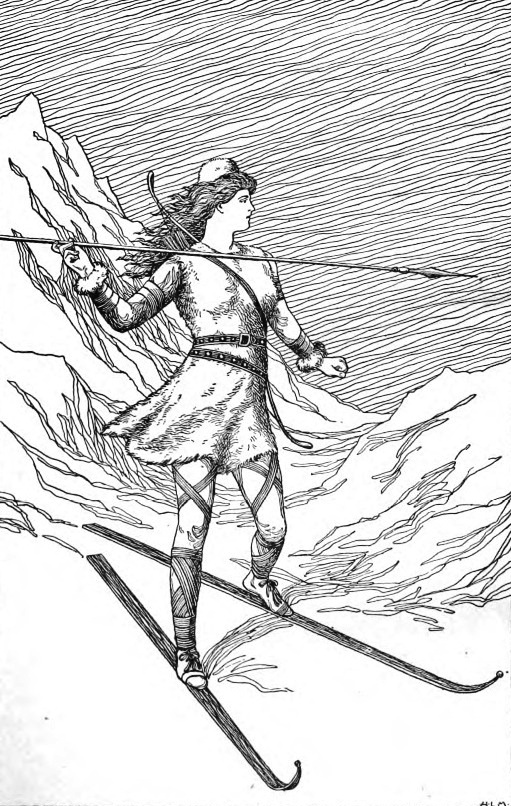
In Norse mythology, Skaði (/ˈskɑːði/; Old Norse: [ˈskɑðe]; sometimes anglicized as Skadi, Skade, or Skathi) is a jötunn and goddess associated with bowhunting, skiing, winter, and mountains. Skaði is attested in the Poetic Edda, compiled in the 13th century from earlier traditional sources; the Prose Edda and in Heimskringla, written in the 13th century by Snorri Sturluson, and in the works of skalds.
Skaði is the daughter of the deceased Þjazi, and Skaði married the god Njörðr as part of the compensation provided by the gods for killing her father Þjazi. In Heimskringla, Skaði is described as having split up with Njörðr and as later having married the god Odin, and that the two produced many children together. In both the Poetic Edda and the Prose Edda, Skaði is responsible for placing the serpent that drips venom onto the bound Loki. Skaði is alternately referred to as Öndurguð (Old Norse 'ski god') and Öndurdís (Old Norse 'ski dís').
The etymology of the name Skaði is uncertain, but may be connected with the original form of Scandinavia. Some place names in Scandinavia refer to Skaði. Scholars have theorized a potential connection between Skaði and the god Ullr (who is also associated with skiing), a particular relationship with the jötunn Loki, and that Scandinavia may be related to the name Skaði (potentially meaning 'Skaði's island') or the name may be connected to Old Norse nouns meaning either 'shadow' or 'harm'. Skaði has inspired various works of art.
The Old Norse name Skaði, along with Sca(n)dinavia and Skáney, may be related to Gothic skadus, Old English sceadu, Old Saxon scado, and Old High German scato (meaning 'shadow') - compare also the Irish Scáthach, a famous woman warrior known as 'the shadowy one'. Scholar John McKinnell comments that this etymology suggests Skaði may have once been a personification of the geographical region of Scandinavia or associated with the underworld.
Georges Dumézil disagrees with the notion of Scadin-avia as etymologically 'the island of the goddess Skaði'. Dumézil comments that the first element Scadin must have had—or once had—a connection to "darkness" "or something else we cannot be sure of". Dumézil says that, rather, the name Skaði derives from the name of the geographical region, which was at the time no longer completely understood. In connection, Dumézil points to a parallel in Ériu, a goddess personifying Ireland that appears in some Irish texts, whose name he says comes from Ireland rather than the other way around.
Alternatively, Skaði may be connected with the Old Norse noun skaði ('harm'), source of the Icelandic and Faroese skaði ('harm, damage') and cognate with English scathe (unscathed, scathing).
Skaði is attested in poems found in the Poetic Edda, in two books of the Prose Edda and in one Heimskringla book.
In the Poetic Edda poem Grímnismál, the god Odin (disguised as Grímnir) reveals to the young Agnarr the existence of twelve locations. Odin mentions the location Þrymheimr sixth in a single stanza. In the stanza, Odin details that the jötunn Þjazi once lived there, and that now his daughter Skaði does. Odin describes Þrymheimr as consisting of "ancient courts" and refers to Skaði as "the shining bride of the gods". In the prose introduction to the poem Skírnismál, the god Freyr has become heartsick for a fair girl (the jötunn Gerðr) he has spotted in Jötunheimr. The god Njörðr asks Freyr's servant Skírnir to talk to Freyr, and in the first stanza of the poem, Skaði also tells Skírnir to ask Freyr why he is so upset. Skírnir responds that he expects harsh words from their son Freyr.
Hub AI
Skaði AI simulator
(@Skaði_simulator)
Skaði
In Norse mythology, Skaði (/ˈskɑːði/; Old Norse: [ˈskɑðe]; sometimes anglicized as Skadi, Skade, or Skathi) is a jötunn and goddess associated with bowhunting, skiing, winter, and mountains. Skaði is attested in the Poetic Edda, compiled in the 13th century from earlier traditional sources; the Prose Edda and in Heimskringla, written in the 13th century by Snorri Sturluson, and in the works of skalds.
Skaði is the daughter of the deceased Þjazi, and Skaði married the god Njörðr as part of the compensation provided by the gods for killing her father Þjazi. In Heimskringla, Skaði is described as having split up with Njörðr and as later having married the god Odin, and that the two produced many children together. In both the Poetic Edda and the Prose Edda, Skaði is responsible for placing the serpent that drips venom onto the bound Loki. Skaði is alternately referred to as Öndurguð (Old Norse 'ski god') and Öndurdís (Old Norse 'ski dís').
The etymology of the name Skaði is uncertain, but may be connected with the original form of Scandinavia. Some place names in Scandinavia refer to Skaði. Scholars have theorized a potential connection between Skaði and the god Ullr (who is also associated with skiing), a particular relationship with the jötunn Loki, and that Scandinavia may be related to the name Skaði (potentially meaning 'Skaði's island') or the name may be connected to Old Norse nouns meaning either 'shadow' or 'harm'. Skaði has inspired various works of art.
The Old Norse name Skaði, along with Sca(n)dinavia and Skáney, may be related to Gothic skadus, Old English sceadu, Old Saxon scado, and Old High German scato (meaning 'shadow') - compare also the Irish Scáthach, a famous woman warrior known as 'the shadowy one'. Scholar John McKinnell comments that this etymology suggests Skaði may have once been a personification of the geographical region of Scandinavia or associated with the underworld.
Georges Dumézil disagrees with the notion of Scadin-avia as etymologically 'the island of the goddess Skaði'. Dumézil comments that the first element Scadin must have had—or once had—a connection to "darkness" "or something else we cannot be sure of". Dumézil says that, rather, the name Skaði derives from the name of the geographical region, which was at the time no longer completely understood. In connection, Dumézil points to a parallel in Ériu, a goddess personifying Ireland that appears in some Irish texts, whose name he says comes from Ireland rather than the other way around.
Alternatively, Skaði may be connected with the Old Norse noun skaði ('harm'), source of the Icelandic and Faroese skaði ('harm, damage') and cognate with English scathe (unscathed, scathing).
Skaði is attested in poems found in the Poetic Edda, in two books of the Prose Edda and in one Heimskringla book.
In the Poetic Edda poem Grímnismál, the god Odin (disguised as Grímnir) reveals to the young Agnarr the existence of twelve locations. Odin mentions the location Þrymheimr sixth in a single stanza. In the stanza, Odin details that the jötunn Þjazi once lived there, and that now his daughter Skaði does. Odin describes Þrymheimr as consisting of "ancient courts" and refers to Skaði as "the shining bride of the gods". In the prose introduction to the poem Skírnismál, the god Freyr has become heartsick for a fair girl (the jötunn Gerðr) he has spotted in Jötunheimr. The god Njörðr asks Freyr's servant Skírnir to talk to Freyr, and in the first stanza of the poem, Skaði also tells Skírnir to ask Freyr why he is so upset. Skírnir responds that he expects harsh words from their son Freyr.
Recent media