


Community hub
Recent from talks
Contribute something
Nothing was collected or created yet.
Freyr
View on Wikipedia

In Norse mythology, Freyr (Old Norse: "(the) Lord") is the god associated with kingship, fertility, peace, prosperity, fair weather, and good harvest. Freyr, sometimes referred to as Yngvi-Freyr, was especially associated with Sweden and seen as an ancestor of the Swedish royal house. According to Adam of Bremen, Freyr was associated with peace and pleasure, and was represented with a phallic statue in the Temple at Uppsala. According to Snorri Sturluson, Freyr was "the most renowned of the æsir", and was venerated for good harvest and peace.
In the mythological stories in the Icelandic books the Poetic Edda and the Prose Edda, Freyr is presented as one of the Vanir, the son of the god Njörðr and his sister-wife, as well as the twin brother of the goddess Freyja. The gods gave him Álfheimr, the realm of the Elves, as a teething present. He rides the shining dwarf-made boar Gullinbursti, and possesses the ship Skíðblaðnir, which always has a favorable breeze and can be folded together and carried in a pouch when it is not being used. Freyr is also known to have been associated with the horse cult. He also kept sacred horses in his sanctuary at Trondheim in Norway.[2] He has the servants Skírnir, Byggvir and Beyla.
The most extensive surviving Freyr myth relates Freyr's falling in love with the female jötunn Gerðr. Eventually, she becomes his wife but first Freyr has to give away his sword, which fights on its own "if wise be he who wields it." Although deprived of this weapon, Freyr defeats the jötunn Beli with an antler. However, lacking his sword, Freyr will be killed by the fire jötunn Surtr during the events of Ragnarök.
Like other Germanic deities, veneration of Freyr was revived during the modern period through the Heathenry movement.
Name
[edit]The Old Norse name Freyr ('lord') is generally thought to descend from a Proto-Norse form reconstructed as *frawjaʀ, stemming from the Proto-Germanic noun *frawjaz ~ *fraw(j)ōn ('lord'), and cognate with Gothic frauja, Old English frēa, or Old High German frō, all meaning 'lord, master'.[3][4] The runic form frohila, derived from an earlier *frōjila, may also be related.[3] Recently, however, an etymology deriving the name of the god from a nominalized form of the Proto-Scandinavian adjective *fraiw(i)a- ('fruitful, generative') has also been proposed.[5][6] According to linguist Guus Kroonen, "within Germanic, the attestation of ON frjar, frjór, frær, Icel. frjór adj. 'fertile; prolific' < *fraiwa- clearly seems to point to a stem *frai(w)- meaning 'fecund'. Both in form and meaning, fraiwa- ('seed') is reminiscent of Freyr 'fertility deity' < *frauja-. The possibility must be considered, therefore, that *fraiwa- was metathesized from *frawja-, a collective of some kind."[7] Freyr is also known by a series of other names which describe his attributes and role in religious practice and associated mythology.
Adam of Bremen
[edit]Written c. 1080, one of the oldest written sources on pre-Christian Scandinavian religious practices is Adam of Bremen's Gesta Hammaburgensis ecclesiae pontificum. Adam claimed to have access to first-hand accounts on pagan practices in Sweden. He refers to Freyr with the Latinized name Fricco and mentions that an image of him at Skara was destroyed by the Christian missionary Bishop Egino.[8] Adam's description of the Temple at Uppsala gives some details on the god.
In hoc templo, quod totum ex auro paratum est, statuas atrium deorum veneratur populus, ita ut potentissimus eorum Thor in medio solium habeat triclinio; hinc et inde locum possident Wodan et Fricco. Quorum significationes eiusmodi sunt: 'Thor', inquiunt, 'praesidet in aere, qui tonitrus et fulmina, ventos ymbresque, serena et fruges gubernat. Alter Wodan, id est furor, bella gerit, hominique ministrat virtutem contra inimicos. Tertius est Fricco, pacem voluptatem que largiens mortalibus'. Cuius etiam simulacrum fingunt cum ingenti priapo.
|
In this temple, entirely decked out in gold, the people worship the statues of three gods in such wise that the mightiest of them, Thor, occupies a throne in the middle of the chamber; Woden and Frikko have places on either side. The significance of these gods is as follows: Thor, they say, presides over the air, which governs the thunder and lightning, the winds and rains, fair weather and crops. The other, Woden—that is, the Furious—carries on war and imparts to man strength against his enemies. The third is Frikko, who bestows peace and pleasure on mortals. His likeness, too, they fashion with an immense phallus.
|
Later in the account Adam states that when a marriage is performed a libation is made to the image of Fricco.
Historians are divided on the reliability of Adam's account.[10]
Prose Edda
[edit]When Snorri Sturluson was writing in 13th century Iceland, the indigenous Germanic gods were still remembered although they had not been openly worshiped for more than two centuries.
Gylfaginning
[edit]In the Gylfaginning section of his Prose Edda, Snorri introduces Freyr as one of the major gods.
|
Njörðr í Nóatúnum gat síðan tvau börn, hét sonr Freyr en dóttir Freyja. Þau váru fögr álitum ok máttug. Freyr er hinn ágætasti af ásum. Hann ræðr fyrir regni ok skini sólar, ok þar með ávexti jarðar, ok á hann er gott at heita til árs ok friðar. Hann ræðr ok fésælu manna. Gylfaginning 24, EB's edition |
Njördr in Nóatún begot afterward two children: the son was called Freyr, and the daughter Freyja; they were fair of face and mighty. Freyr is the most renowned of the Æsir; he rules over the rain and the shining of the sun, and therewithal the fruit of the earth; and it is good to call on him for fruitful seasons and peace. He governs also the prosperity of men. Gylfaginning XXIV, Brodeur's translation |

This description has similarities to the older account by Adam of Bremen but the differences are interesting. Adam assigns control of the weather and produce of the fields to Thor but Snorri says that Freyr rules over those areas. Snorri also omits any explicitly sexual references in Freyr's description. Those discrepancies can be explained in several ways. Adam and Snorri were writing with different goals in mind. It is possible that the Norse gods did not have exactly the same roles in Icelandic and Swedish paganism. Either Snorri or Adam may also have had distorted information.
The only extended myth related to Freyr in the Prose Edda is the story of his marriage.
|
Þat var einn dag er Freyr hafði gengit í Hliðskjálf ok sá of heima alla. En er hann leit í norðrætt, þá sá hann á einum bœ mikit hús ok fagrt, ok til þess húss gekk kona, ok er hon tók upp höndum ok lauk hurð fyrir sér þá lýsti af höndum hennar bæði í lopt ok á lög, ok allir heimar birtusk af henni. Gylfaginning 37, EB's edition |
It chanced one day that Freyr had gone to Hlidskjálf, and gazed over all the world; but when he looked over into the northern region, he saw on an estate a house great and fair. And toward this house went a woman; when she raised her hands and opened the door before her, brightness gleamed from her hands, both over sky and sea, and all the worlds were illumined of her. Gylfaginning XXXVII, Brodeur's translation |
The woman is Gerðr, a beautiful giantess. Freyr immediately falls in love with her and becomes depressed and taciturn. After a period of brooding, he consents to talk to Skírnir, his foot-page. He tells Skírnir that he has fallen in love with a beautiful woman and thinks he will die if he cannot have her. He asks Skírnir to go and woo her for him.
|
Þá svarar Skírnir, sagði svá at hann skal fara sendiferð en Freyr skal fá honum sverð sitt. Þat var svá gott sverð at sjálft vásk. En Freyr lét eigi þat til skorta ok gaf honum sverðit. Þá fór Skírnir ok bað honum konunnar ok fekk heitit hennar, ok níu nóttum síðar skyldi hon þar koma er Barey heitir ok ganga þá at brullaupinu með Frey. Gylfaginning 37, EB's edition |
Then Skírnir answered thus: he would go on his errand, but Freyr should give him his own sword—which is so good that it fights of itself—and Freyr did not refuse, but gave him the sword. Then Skírnir went forth and wooed the woman for him, and received her promise; and nine nights later she was to come to the place called Barrey, and then go to the bridal with Freyr. Gylfaginning XXXVII, Brodeur's translation |
The loss of Freyr's sword has consequences. According to the Prose Edda, Freyr had to fight Beli without his sword, and slew him with an antler. But the result at Ragnarök, the end of the world, will be much more serious. Freyr is fated to fight the fire-giant Surtr, and since he does not have his sword he will be defeated.

Even after the loss of his weapon Freyr still has two magical artifacts, both dwarf-made. One is the ship Skíðblaðnir, which will have favoring breeze wherever its owner wants to go and can also be folded together like a napkin and carried in a pouch. The other is the boar Gullinbursti whose mane glows to illuminate the way for his owner. No myths involving Skíðblaðnir have come down to us but Snorri relates that Freyr rode to Baldr's funeral in a wagon pulled by Gullinbursti.
Skaldic poetry
[edit]Freyr is referred to several times in skaldic poetry. In Húsdrápa, partially preserved in the Prose Edda, he is said to ride a boar to Baldr's funeral.
|
|
In a poem by Egill Skalla-Grímsson, Freyr is called upon along with Njörðr to drive Eric Bloodaxe from Norway. The same skald mentions in Arinbjarnarkviða that his friend has been blessed by the two gods.
|
|
Nafnaþulur
[edit]In Nafnaþulur Freyr is said to ride the horse Blóðughófi (Bloody Hoof).
Poetic Edda
[edit]
Freyr is mentioned in several of the poems in the Poetic Edda. The information there is largely consistent with that of the Prose Edda while each collection has some details not found in the other.
Völuspá
[edit]Völuspá, the best known of the Eddic poems, describes the final confrontation between Freyr and Surtr during Ragnarök.
|
|
Some scholars have preferred a slightly different translation, in which the sun shines "from the sword of the gods". The idea is that the sword which Surtr slays Freyr with is the "sword of the gods" which Freyr had earlier bargained away for Gerðr. This would add a further layer of tragedy to the myth. Sigurður Nordal argued for this view but the possibility represented by Ursula Dronke's translation above is equally possible.
Grímnismál
[edit]Grímnismál, a poem which largely consists of miscellaneous information about the gods, mentions Freyr's abode.
|
|
A tooth-gift was a gift given to an infant on the cutting of the first tooth. Since Alfheimr or Álfheimr means "World of Álfar (Elves)" the fact that Freyr should own it is one of the indications of a connection between the Vanir and the obscure Álfar. Grímnismál also mentions that the sons of Ívaldi made Skíðblaðnir for Freyr and that it is the best of ships.
Lokasenna
[edit]In the poem Lokasenna, Loki accuses the gods of various misdeeds. He criticizes the Vanir for incest, saying that Njörðr had Freyr with his sister. He also states that the gods discovered Freyr and Freyja having sex together. The god Týr speaks up in Freyr's defense.
|
|
Lokasenna also mentions that Freyr has servants called Byggvir and Beyla. They seem to have been associated with the making of bread.
Skírnismál
[edit]
The courtship of Freyr and Gerðr is dealt with extensively in the poem Skírnismál. Freyr is depressed after seeing Gerðr. Njörðr and Skaði ask Skírnir to go and talk with him. Freyr reveals the cause of his grief and asks Skírnir to go to Jötunheimr to woo Gerðr for him. Freyr gives Skírnir a steed and his magical sword for the journey.
|
|
When Skírnir finds Gerðr he starts by offering her treasures if she will marry Freyr. When she declines he forces her to accept by threatening her with destructive magic.
![[icon]](https://en.wikipedia.org/wiki/File:Wiki_letter_w_cropped.svg) | This section needs expansion. You can help by adding to it. (June 2008) |
Ynglinga saga
[edit]

Snorri Sturluson starts his epic history of the kings of Norway with Ynglinga saga, a euhemerized account of the Norse gods. Here Odin and the Æsir are men from Asia who gain power through their prowess in war and Odin's skills. But when Odin attacks the Vanir he bites off more than he can chew and peace is negotiated after the destructive and indecisive Æsir-Vanir War. Hostages are exchanged to seal the peace deal and the Vanir send Freyr and Njörðr to live with the Æsir. At this point the saga, like Lokasenna, mentions that incest was practised among the Vanir.
|
Þá er Njörðr var með Vönum, þá hafði hann átta systur sína, því at þat váru þar lög; váru þeirra börn Freyr ok Freyja. En þat var bannat með Ásum at byggja svá náit at frændsemi. Ynglinga saga 4, Schultz's edition Archived 31 December 2005 at Bibliotheca Alexandrina |
While Njord was with the Vanaland people he had taken his own sister in marriage, for that was allowed by their law; and their children were Frey and Freya. But among the Asaland people it was forbidden to intermarry with such near relations. Ynglinga saga 4, Laing's translation |
Odin makes Njörðr and Freyr priests of sacrifices and they become influential leaders. Odin goes on to conquer the North and settles in Sweden where he rules as king, collects taxes and maintains sacrifices. After Odin's death, Njörðr takes the throne. During his rule there is peace and good harvest and the Swedes come to believe that Njörðr controls these things. Eventually Njörðr falls ill and dies.
|
Freyr tók þá ríki eptir Njörð; var hann kallaðr dróttinn yfir Svíum ok tók skattgjafir af þeim; hann var vinsæll ok ársæll sem faðir hans. Freyr reisti at Uppsölum hof mikit, ok setti þar höfuðstað sinn; lagði þar til allar skyldir sínar, lönd ok lausa aura; þá hófst Uppsala auðr, ok hefir haldizt æ síðan. Á hans dögum hófst Fróða friðr, þá var ok ár um öll lönd; kendu Svíar þat Frey. Var hann því meir dýrkaðr en önnur goðin, sem á hans dögum varð landsfólkit auðgara en fyrr af friðinum ok ári. Gerðr Gýmis dóttir hét kona hans; sonr þeirra hét Fjölnir. Freyr hét Yngvi öðru nafni; Yngva nafn var lengi síðan haft í hans ætt fyrir tignarnafn, ok Ynglingar váru síðan kallaðir hans ættmenn. Freyr tók sótt; en er at honum leið sóttin, leituðu menn sér ráðs, ok létu fá menn til hans koma, en bjoggu haug mikinn, ok létu dyrr á ok 3 glugga. En er Freyr var dauðr, báru þeir hann leyniliga í hauginn, ok sögðu Svíum at hann lifði, ok varðveittu hann þar 3 vetr. En skatt öllum heltu þeir í hauginn, í einn glugg gullinu, en í annan silfrinu, í hinn þriðja eirpenningum. Þá hélzt ár ok friðr. Ynglinga saga 12, Schultz's edition Archived 31 December 2005 at Bibliotheca Alexandrina |
Frey took the kingdom after Njord, and was called drot by the Swedes, and they paid taxes to him. He was, like his father, fortunate in friends and in good seasons. Frey built a great temple at Upsal, made it his chief seat, and gave it all his taxes, his land, and goods. Then began the Upsal domains, which have remained ever since. Then began in his days the Frode-peace; and then there were good seasons, in all the land, which the Swedes ascribed to Frey, so that he was more worshipped than the other gods, as the people became much richer in his days by reason of the peace and good seasons. His wife was called Gerd, daughter of Gymir, and their son was called Fjolne. Frey was called by another name, Yngve; and this name Yngve was considered long after in his race as a name of honour, so that his descendants have since been called Ynglinger. Frey fell into a sickness; and as his illness took the upper hand, his men took the plan of letting few approach him. In the meantime they raised a great mound, in which they placed a door with three holes in it. Now when Frey died they bore him secretly into the mound, but told the Swedes he was alive; and they kept watch over him for three years. They brought all the taxes into the mound, and through the one hole they put in the gold, through the other the silver, and through the third the copper money that was paid. Peace and good seasons continued. Ynglinga saga 12, Laing's translation |
|
Þá er allir Svíar vissu, at Freyr var dauðr, en hélzt ár ok friðr, þá trúðu þeir, at svá mundi vera, meðan Freyr væri á Svíþjóð, ok vildu eigi brenna hann, ok kölluðu hann veraldar goð ok blótuðu mest til árs ok friðar alla ævi síðan. Ynglinga saga 13, Schultz's edition Archived 31 December 2005 at Bibliotheca Alexandrina |
When it became known to the Swedes that Frey was dead, and yet peace and good seasons continued, they believed that it must be so as long as Frey remained in Sweden; and therefore they would not burn his remains, but called him the god of this world, and afterwards offered continually blood-sacrifices to him, principally for peace and good seasons. Ynglinga saga 13, Laing's translation |
Freyr had a son named Fjölnir, who succeeds him as king and rules during the continuing period of peace and good seasons. Fjölnir's descendants are enumerated in Ynglingatal which describes the mythological kings of Sweden.
Ögmundar þáttr dytts
[edit]The 14th century Icelandic Ögmundar þáttr dytts contains a tradition of how Freyr was transported in a wagon and administered by a priestess, in Sweden. Freyr's role as a fertility god needed a female counterpart in a divine couple (McKinnell's translation 1987[12]):
Great heathen sacrifices were held there at that time, and for a long while Frey had been the god who was worshipped most there – and so much power had been gained by Frey's statue that the devil used to speak to people out of the mouth of the idol, and a young and beautiful woman had been obtained to serve Frey. It was the faith of the local people that Frey was alive, as seemed to some extent to be the case, and they thought he would need to have a sexual relationship with his wife; along with Frey she was to have complete control over the temple settlement and all that belonged to it.
In this short story, a man named Gunnar was suspected of manslaughter and escaped to Sweden, where Gunnar became acquainted with this young priestess. He helped her drive Freyr's wagon with the god effigy in it, but the god did not appreciate Gunnar and so attacked him and would have killed Gunnar if he had not promised himself to return to the Christian faith if he would make it back to Norway. When Gunnar had promised this, a demon jumped out of the god effigy and so Freyr was nothing but a piece of wood. Gunnar destroyed the wooden idol and dressed himself as Freyr, then Gunnar and the priestess travelled across Sweden where people were happy to see the god visiting them. After a while he made the priestess pregnant, but this was seen by the Swedes as confirmation that Freyr was truly a fertility god and not a scam. Finally, Gunnar had to flee back to Norway with his young bride and had her baptized at the court of Olaf Tryggvason.
Other Icelandic sources
[edit]Worship of Freyr is alluded to in several Icelanders' sagas.
The protagonist of Hrafnkels saga is a priest of Freyr. He dedicates a horse to the god and kills a man for riding it, setting in motion a chain of fateful events.
In Gísla saga a chieftain named Þorgrímr Freysgoði is an ardent worshipper of Freyr. When he dies he is buried in a howe.
|
Varð og sá hlutur einn er nýnæmum þótti gegna að aldrei festi snæ utan og sunnan á haugi Þorgríms og eigi fraus; og gátu menn þess til að hann myndi Frey svo ávarður fyrir blótin að hann myndi eigi vilja að freri á milli þeirra.[13] |
And now, too, a thing happened which seemed strange and new. No snow lodged on the south side of Thorgrim's howe, nor did it freeze there. And men guessed it was because Thorgrim had been so dear to Frey for his worship's sake that the god would not suffer the frost to come between them. -[14] |
Hallfreðar saga, Víga-Glúms saga and Vatnsdœla saga also mention Freyr.
Other Icelandic sources referring to Freyr include Íslendingabók, Landnámabók, and Hervarar saga.
Íslendingabók, written c. 1125, is the oldest Icelandic source that mentions Freyr, including him in a genealogy of Swedish kings. Landnámabók includes a heathen oath to be sworn at an assembly where Freyr, Njörðr, and "the almighty áss" are invoked. Hervarar saga mentions a Yuletide sacrifice of a boar to Freyr.
Gesta Danorum
[edit]The 12th Century Danish Gesta Danorum describes Freyr, under the name Frø, as the "viceroy of the gods".
|
Frø quoque deorum satrapa sedem haud procul Upsala cepit, ubi veterem litationis morem tot gentibus ac saeculis usurpatum tristi infandoque piaculo mutavit. Siquidem humani generis hostias mactare aggressus foeda superis libamenta persolvit. Gesta Danorum 3, Olrik's edition |
There was also a viceroy of the gods, Frø, who took up residence not far from Uppsala and altered the ancient system of sacrifice practised for centuries among many peoples to a morbid and unspeakable form of expiation. He delivered abominable offerings to the powers above by instituting the slaughter of human victims. Gesta Danorum 3, Fisher's translation |
That Freyr had a cult at Uppsala is well confirmed from other sources. The reference to the change in sacrificial ritual may also reflect some historical memory. There is archaeological evidence for an increase in human sacrifices in the late Viking Age[15] though among the Norse gods human sacrifice is most often linked to Odin. Another reference to Frø and sacrifices is found earlier in the work, where the beginning of an annual blót to him is related. King Hadingus is cursed after killing a divine being and atones for his crime with a sacrifice.
|
Siquidem propitiandorum numinum gratia Frø deo rem divinam furvis hostiis fecit. Quem litationis morem annuo feriarum circuitu repetitum posteris imitandum reliquit. Frøblot Sueones vocant. Gesta Danorum 1, Olrik's edition |
[I]n order to mollify the divinities he did indeed make a holy sacrifice of dark-coloured victims to the god Frø. He repeated this mode of propitiation at an annual festival and left it to be imitated by his descendants. The Swedes call it Frøblot. Gesta Danorum 1, Fisher's translation |
The sacrifice of dark-coloured victims to Freyr has a parallel in Ancient Greek religion where the chthonic fertility deities preferred dark-coloured victims to lighter ones.
In book 9, Saxo identifies Frø as the "king of Sweden" (rex Suetiae):
|
Quo tempore rex Suetiae Frø, interfecto Norvagiensium rege Sywardo, coniuges necessariorum eius prostibulo relegatas publice constuprandas exhibuit. Gesta Danorum 9, Olrik's edition |
About this time the Swedish ruler Frø, after killing Sivard, king of the Norwegians, removed the wives of Sivard's relatives to a brothel and exposed them to public prostitution. Gesta Danorum 9, Fisher's translation |
The reference to public prostitution may be a memory of fertility cult practices. Such a memory may also be the source of a description in book 6 of the stay of Starcatherus, a follower of Odin, in Sweden.
|
Mortuo autem Bemono, Starcatherus ab athletis Biarmensibus ob virtutem accitus, cum plurima apud eos memoratu digna edidisset facinora, Sueonum fines ingreditur. Ubi cum filiis Frø septennio feriatus ab his tandem ad Haconem Daniae tyrannum se contulit, quod apud Upsalam sacrificiorum tempore constitutus effeminatos corporum motus scaenicosque mimorum plausus ac mollia nolarum crepitacula fastidiret. Unde patet, quam remotum a lascivia animum habuerit, qui ne eius quidem spectator esse sustinuit. Adeo virtus luxui resistit. Gesta Danorum 6, Olrik's edition |
After Bemoni's death Starkather, because of his valour, was summoned by the Biarmian champions and there performed many feats worthy of the tellings. Then he entered Swedish territory where he spent seven years in a leisurely stay with the sons of Frø, after which he departed to join Haki, the lord of Denmark, for, living at Uppsala in the period of sacrifices, he had become disgusted with the womanish body movements, the clatter of actors on the stage and the soft tinkling of bells. It is obvious how far his heart was removed from frivolity if he could not even bear to watch these occasions. A manly individual is resistant to wantonness. Gesta Danorum 6, Fisher's translation |
Yngvi
[edit]A strophe of the Anglo-Saxon rune poem (c. 1100) records that:
- Ing was first among the East Danes seen by men
This may refer to the origins of the worship of Ingui in the tribal areas that Tacitus mentions in his Germania as being populated by the Inguieonnic tribes. A later Danish chronicler lists Ingui was one of three brothers that the Danish tribes descended from. The strophe also states that "then he (Ingui) went back over the waves, his wagon behind him" which could connect Ingui to earlier conceptions of the wagon processions of Nerthus and the later Scandinavian conceptions of Freyr's wagon journeys.
Ingui is mentioned also in some later Anglo-Saxon literature under varying forms of his name, such as "For what doth Ingeld have to do with Christ" and the variants used in Beowulf to designate the kings as 'leader of the friends of Ing'. The compound Ingui-Frea (OE) and Yngvi-Freyr (ON) likely refer to the connection between the god and the Germanic kings' role as priests during the sacrifices in the pagan period, as Frea and Freyr are titles meaning 'Lord'.
The Swedish royal dynasty was known as the Ynglings from their descent from Yngvi-Freyr. This is supported by Tacitus, who wrote about the Germans: "In their ancient songs, their only way of remembering or recording the past they celebrate an earth-born god Tuisco, and his son Mannus, as the origin of their race, as their founders. To Mannus they assign three sons, from whose names, they say, the coast tribes are called Ingaevones; those of the interior, Herminones; all the rest, Istaevones".
Archaeological record
[edit]Rällinge statuette
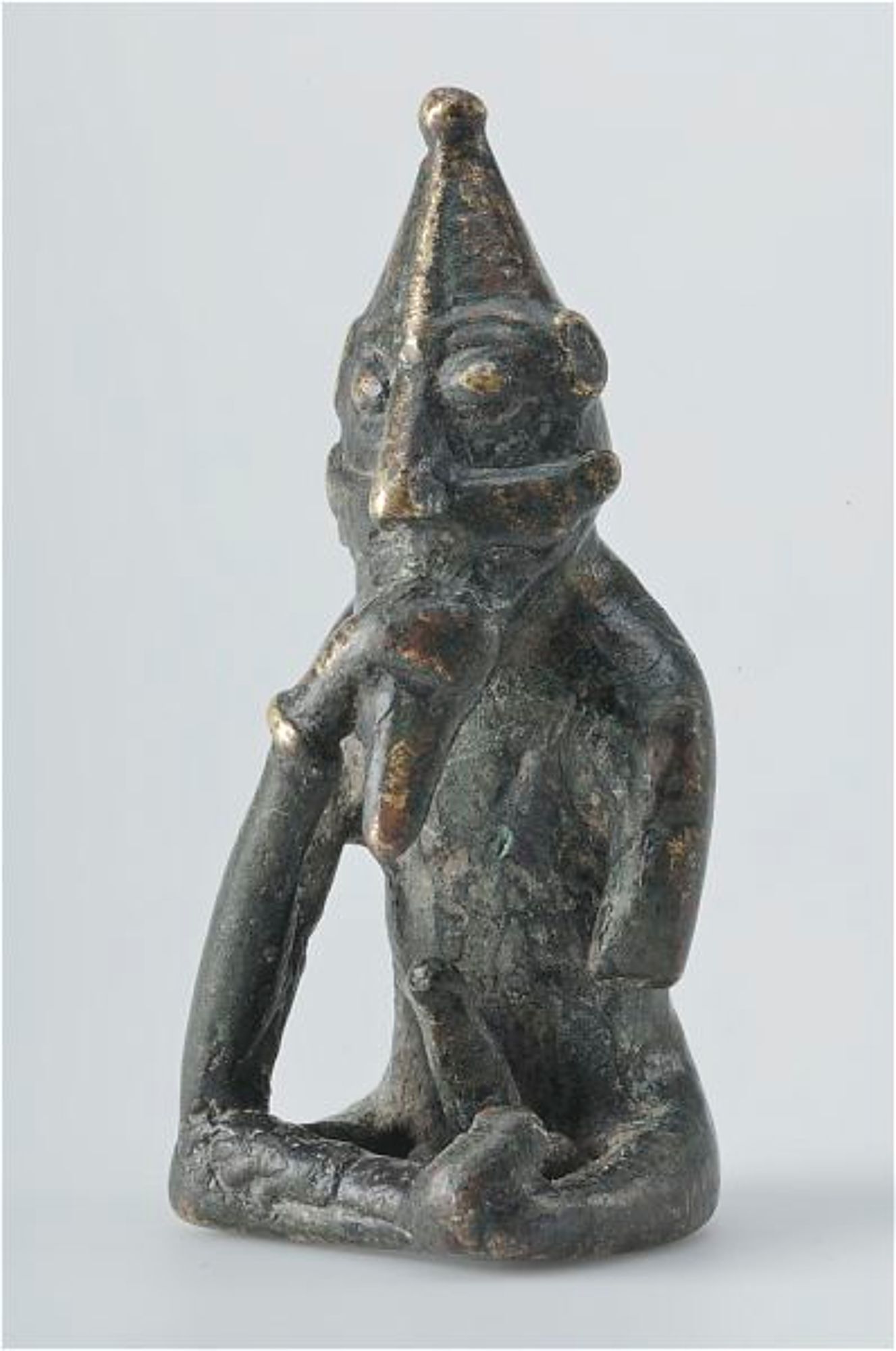
[edit]In 1904, a Viking Age statuette identified as a depiction of Freyr was discovered on the farm Rällinge in Lunda, Södermanland parish in the province of Södermanland, Sweden. The depiction features a cross-legged seated, bearded male with an erect penis. He is wearing a pointed cap or helmet and stroking his triangular beard. The seven-centimeter-tall statue is displayed at the Swedish Museum of National Antiquities.[16]
Skog tapestry
[edit]A part of the Swedish Skog tapestry depicts three figures that have been interpreted as allusions to Odin, Thor, and Freyr,[17] but also as the three Scandinavian holy kings Canute, Eric and Olaf. The figures coincide with 11th century descriptions of statue arrangements recorded by Adam of Bremen at the Temple at Uppsala and written accounts of the gods during the late Viking Age. The tapestry is originally from Hälsingland, Sweden but is now housed at the Swedish Museum of National Antiquities.
Gullgubber
[edit]Small pieces of gold foil featuring engravings dating from the Migration Period into the early Viking Age (known as gullgubber) have been discovered in various locations in Scandinavia, at one site almost 2,500. The foil pieces have been found largely on the sites of buildings, only rarely in graves. The figures are sometimes single, occasionally an animal, sometimes a man and a woman with a leafy bough between them, facing or embracing one another. The human figures are almost always clothed and are sometimes depicted with their knees bent. Scholar Hilda Ellis Davidson says that it has been suggested that the figures are taking part in a dance, and that they may have been connected with weddings, as well as linked to the Vanir group of gods, representing the notion of a divine marriage, such as in the Poetic Edda poem Skírnismál; the coming together of Gerðr and Freyr.[18]
-

-
 The Skog Church Tapestry portion possibly depicting Odin, Thor and Freyr
 -
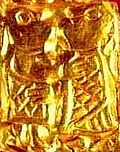 An example of the small gold pieces of foil that may depict Gerðr and Freyr


Toponyms
[edit]- Freysakr ("Freyr's field") - name of two old farms in Gol Municipality and Torpa Municipality.
- Freyshof ("Freyr's temple") - name of two old farms in Hole Municipality and Trøgstad Municipality.
- Freysland ("Freyr's land/field") - name of six old farms in Feda Municipality, Halse og Harkmark Municipality, Førde Municipality, Sogndal Municipality, Søgne Municipality, and Torpa Municipality.[citation needed]
- Freyslíð ("Freyr's hill") - name of two old farms in Lunner Municipality and Torpa Municipality.
- Freysnes ("Freyr's headland") - name of an old farm in Sandnes Municipality.
- Freyssetr ("Freyr's farm") - name of two old farms in Masfjorden Municipality and Soknedal Municipality.
- Freyssteinn ("Freyr's stone") - name of an old farm in Lista Municipality.
- Freysteigr ("Freyr's field") - name of an old farm in Ramnes Municipality.
- Freysvík ("Freyr's inlet/bay") - name of two old farms in Vik Municipality and Ullensvang Municipality.
- Freysvin ("Freyr's meadow") - name of four old farms in Hole Municipality, Lom Municipality, Sunnylven Municipality, and Østre Gausdal Municipality.
- Freysvǫllr ("Freyr's field") - name of an old farm in Sør-Odal Municipality.
- Freysþveit ("Freyr's thwaite") - name of an old farm in Hedrum Municipality.
- Fröslunda ("Freyr's grove") - Uppland
- Frösåker ("Freyr's field") - Uppland
- Frösön ("Freyr's island") - Jämtland
- Fröseke ("Freyr's oak forest") - Småland
- Frösve ("Freyr's sanctuary") - Västergötland
- Frösakull ("Freyr's hill") – Halland
- Frøs Herred ("Freyr's Shire") - Southern Jutland
Modern influence
[edit]Freyr appears in numerous works of modern art and literature. He appears, for example, alongside numerous other figures from Norse mythology in the Danish poet Adam Gottlob Oehlenschläger's Nordens Guder (1819). He also appears in Icelandic poet Gerður Kristný's Blóðhófnir (2010),[19] a feminist retelling of the Eddic poem Skírnismál that won the 2010 Icelandic Literature Award.[20]
See also
[edit]
Notes
[edit]- ^ Lindow 2001, p. 121.
- ^ Davidson 1964, pp. 96–97.
- ^ a b de Vries 1962, p. 142.
- ^ Orel 2003, p. 112.
- ^ Elmevik 2003.
- ^ Sundqvist 2013, p. 26.
- ^ Kroonen 2013, pp. 152–153.
- ^ Tschan 2002, p. 192 (Book 4, ix (9))
- ^ Tschan 2002, p. 207 (Book 4, xxvi (26))
- ^ Haastrup 2004, pp. 18–24.
- ^ A kenning meaning "fire".
- ^ "Heinrichs, Anne: The Search for Identity: A Problem after the Conversion, in alvíssmál 3. pp. 54–55" (PDF). Archived (PDF) from the original on 10 June 2004. Retrieved 22 May 2020.
- ^ "Gísla saga Súrssonar". www.snerpa.is. Retrieved 22 May 2020.
- ^ "The Story of Gisli The Outlaw". Northvegr. Archived from the original on 5 June 2008.
- ^ Davidson 1999, Vol. II, p. 55.
- ^ Swedish Museum of National Antiquities inventory number 14232. Viewable online: [1]
- ^ Leiren, Terje I. (1999). From Pagan to Christian: The Story in the 12th-Century Tapestry of the Skog Church. Published online: http://faculty.washington.edu/leiren/vikings2.html Archived 31 December 2007 at the Wayback Machine
- ^ Davidson 1988, p. 121.
- ^ Kristný, Gerður (2010). Blóðhófnir. Mál og menning.
- ^ Crocker, Christopher; Geeraert, Dustin (2022). Cultural legacies of Old Norse literature: new perspectives. Cambridge: D. S. Brewer. ISBN 978-1-84384-638-3.
References
[edit]- Ásgeir Blöndal Magnússon (1989). Íslensk orðsifjabók. Reykjavík: Orðabók Háskólans.
- Berger, Pamela (1988). Goddess Obscured: Transformation of the Grain Protectress from Goddess to Saint. Beacon Press. ISBN 978-0-8070-6723-9.
- Brodeur, Arthur Gilchrist (tr.) (1916). The Prose Edda by Snorri Sturluson. New York: The American-Scandinavian Foundation. Available online
- Davidson, Hilda E. (1964). Gods and Myths of Northern Europe. Penguin. ISBN 978-0-14-194150-9.
{{cite book}}: ISBN / Date incompatibility (help) - Davidson, H. R. Ellis (1988). Myths and Symbols in Pagan Europe: Early Scandinavian and Celtic Religions. Manchester University Press. ISBN 978-0-7190-2579-2.
- de Vries, Jan (1962). Altnordisches Etymologisches Worterbuch (1977 ed.). Brill. ISBN 978-90-04-05436-3.
{{cite book}}: ISBN / Date incompatibility (help) - Dronke, Ursula (1997). The Poetic Edda: Mythological poems. Oxford University Press, USA. ISBN 978-0-19-811181-8.
- Dumézil, Georges (1973). From Myth to Fiction: The Saga of Hadingus. University of Chicago Press. ISBN 978-0-226-16972-9.
- Elmevik, Lennart (2003). "Freyr, Freyja, och Freyfaxi". Studia Anthroponymica Scandinavica. 21: 5–13.
- Eysteinn Björnsson (ed.) (2005). Snorra-Edda: Formáli & Gylfaginning : Textar fjögurra meginhandrita. Published online: GYLFAGINNING
- Finnur Jónsson (1913). Goðafræði Norðmanna og Íslendinga eftir heimildum. Reykjavík: Hið íslenska bókmentafjelag.
- Finnur Jónsson (1931). Lexicon Poeticum. København: S. L. Møllers Bogtrykkeri.
- Guðni Jónsson (ed.) (1949). Eddukvæði : Sæmundar Edda. Reykjavík: Íslendingasagnaútgáfan.
- Kaspersen, Søren; Haastrup, Ulla. (2004). Images of Cult and Devotion: Function and Reception of Christian Images in Medieval and Post-Medieval E Urope. Museum Tusculanum Press. ISBN 978-87-7289-903-9.
- Kroonen, Guus (2013). Etymological Dictionary of Proto-Germanic. Brill. ISBN 978-9004183407.
- Lee Milton Hollander (1986). The Poetic Edda. University of Texas Press. ISBN 978-0-292-76499-6.
- Leiren, Terje I. (1999). From Pagan to Christian: The Story in the 12th-Century Tapestry of the Skog Church. Published online: [2] Archived 31 December 2007 at the Wayback Machine
- Lindow, John (2001). Norse Mythology: A Guide to Gods, Heroes, Rituals, and Beliefs. Oxford University Press. ISBN 978-0-19-983969-8.
- Orel, Vladimir E. (2003). A Handbook of Germanic Etymology. Brill. ISBN 978-90-04-12875-0.
- "Rällinge-Frö" Historiska museet. Retrieved 6 February 2006, from the World Wide Web. Rällinge-Frö
- Sundqvist, Olof (2020). "Freyr". In Schjødt, Jens Peter; Lindow, John; Andrén, Andres (eds.). The Pre-Christian Religions of the North: History and Structures. Vol. 3, ch. 43. Turnhout: Brepols. pp. 1195–1245.
- Sundqvist, Olof (2013). "On Freyr: The 'Lord' or 'The Fertile One'? Some Comments on the Discussion of Etymology from the Historian of Religions' Point of View". Onoma. 48: 11–35.
- Thordeman, Bengt (ed.) (1954) Erik den helige : historia, kult, reliker. Stockholm: Nordisk rotogravyr.
- Thorpe, Benjamin (tr.) (1866). Edda Sæmundar Hinns Froða : The Edda of Sæmund The Learned. (2 vols.) London: Trübner & Co. Available online
Primary sources
[edit]- Adam of Bremen (edited by G. Waitz) (1876). Gesta Hammaburgensis Ecclesiae Pontificum. Berlin. Available online Translation of the section on the Temple at Uppsala available at The Temple at Old Uppsala: Adam of Bremen
- Adam of Bremen (2002). History of the archbishops of Hamburg-Bremen. Tschan, Francis J. (trans.). Columbia University Press. ISBN 978-0-231-12575-8.
- Saxo, Grammaticus (1979). The History of the Danes. DS Brewer. ISBN 978-0-85991-502-1.
- Olrik, J. and H. Ræder (1931). Saxo Grammaticus : Gesta Danorum. Available online
| International | |
|---|---|
| National | |
| People | |
| Other | |

Freyr
View on GrokipediaName and etymology
Etymology
The name Freyr in Old Norse derives from the Proto-Germanic term frawjaz, which signifies "lord" or "master," denoting authority and dominion. This reconstruction is supported by comparative linguistics, tracing the root to a Proto-Indo-European base associated with leading or advancing, as evidenced in attested forms across Germanic languages.[5] Cognates illustrate the term's widespread use for denoting high status: in Gothic, frauja means "lord," while in Old High German, frô carries a similar connotation of mastery or ruler. In Old Norse, the name evolved to Freyr, the masculine counterpart to the feminine Freyja ("lady"), reflecting gendered linguistic patterns that parallel the deities' complementary roles in bestowing prosperity and abundance. The etymology connects to broader themes of fertility and peace through semantic associations in Old Norse vocabulary; for instance, fræ denotes "seed," evoking reproductive and generative forces akin to Freyr's domain, while related terms like friðr ("peace") underscore harmonious prosperity.[6] This linguistic framework sometimes compounds with Yngvi to form theonymic variants, emphasizing ancestral lordship.Alternative names and epithets
Freyr, whose name derives from the Proto-Germanic *frawjaz meaning "lord," appears under various compound forms and epithets in Norse texts that emphasize his sovereignty and benevolence.[3] A prominent alternative name is Yngvi-Freyr, which connects the deity to the Yngling dynasty of Swedish kings, portraying him as their mythical ancestor and progenitor.[2] This compound, rooted in the Proto-Scandinavian *Ingwaz, is interpreted as "Lord of the Ingvaeones," referring to a North Germanic tribal confederation associated with fertility and prosperity cults.[7] The Ynglings invoked Yngvi-Freyr in royal genealogies to legitimize their rule, blending divine and earthly lineage.[8] In skaldic poetry and prose sources, Freyr bears epithets underscoring his exalted status, such as veraldar goð ("god of the world"), a title bestowed by the Swedes in recognition of his role as chief deity ensuring cosmic harmony and abundance. Another kenning, goðin spøi ("prized by the gods"), appears in sagas to highlight his favor among the divine assembly, reflecting his integration into the Aesir pantheon post-Vanir war.[8] Across related Germanic traditions, Freyr merges with human figures like the Danish king Frodi, dubbed "peace-Freyr" (friðar-Freyr) for embodying an idyllic era of fróðifrithr (Frodi's peace), where abundance reigned without conflict. This euhemerized identification underscores Freyr's cultic ties to kingship and agrarian prosperity in Danish lore.[8] Additionally, Freyr is occasionally paired with Hœnir in ritual contexts, as both Vanir emissaries symbolize the post-war alliance between Aesir and Vanir, with Hœnir's indecisiveness contrasting Freyr's decisive fertility.[8]Mythological attributes
Role as fertility and prosperity deity
Freyr, a prominent deity in Norse paganism, held dominion over essential natural forces that ensured agricultural success and societal well-being. He governed rain and sunshine, which were crucial for bountiful harvests and the prosperity of the land, reflecting his core association with fertility in agrarian communities.[4][9] This role positioned him as a benevolent figure who promoted abundance, with worshippers invoking him for "ár ok friðr" (good seasons and peace) to secure both material wealth and social harmony.[3] Symbolizing male virility and generative power, Freyr was often represented through phallic imagery, such as the erect figure in the Rällinge statue from Sweden, which underscored his patronage of human and crop fertility.[4][9] His connection to sacral kingship further emphasized this, as rulers traced their legitimacy to Freyr's lineage, embodying prosperity through divine favor in rituals and governance.[3] As a member of the Vanir, a group of gods tied to earth and fertility, Freyr's attributes contrasted sharply with those of Odin, the Æsir war god focused on conflict and esoteric knowledge, highlighting Freyr's emphasis on peaceful, earth-bound abundance.[4][3] Rituals dedicated to Freyr reinforced his role in fostering fertility and frith (peace), involving sacrifices of livestock like boars, oxen, and horses to invoke his blessings for virility and prosperous yields.[4][9] These practices, often conducted at sacred sites or during seasonal festivals, aimed to maintain cosmic and social order, prioritizing communal harmony over martial pursuits.[3]Family relations and Vanir origin
Freyr is attested as the son of the Vanir god Njörðr and his unnamed sister-wife in the medieval Icelandic texts, with the latter figure often identified by scholars as corresponding to the Germanic earth goddess Nerthus described by the Roman historian Tacitus in the 1st century CE. This union reflects Vanir customs allowing sibling marriage, which was prohibited among the Æsir after the two pantheons merged. Freyr's twin sister is the goddess Freyja, with whom he shares parentage and a prominent role in Vanir worship centered on fertility and prosperity. The Vanir are portrayed in Norse sources as a distinct tribe of deities originating from Vanaheimr, emphasizing agricultural abundance, seership, and natural cycles in contrast to the more martial Æsir of Ásgarðr. This distinction culminates in the Æsir–Vanir War, a mythical conflict detailed in the Prose Edda, where initial hostilities arose from disputes over a shared figure, possibly the seeress Gullveig. The war ended in a stalemate, leading to a peace treaty sealed by an exchange of hostages: the Vanir sent Njörðr, Freyr, and Freyja to live among the Æsir, integrating Vanir elements into the Æsir pantheon and establishing Freyr's dual association with both groups. In euhemerized accounts of Norse history, such as the Ynglinga saga, Freyr's kinship extends through his marriage to the giantess Gerðr, with whom he fathers Fjölnir, the legendary progenitor of Swedish kings and the first in his line not deified as a god. This lineage underscores Freyr's role in sacral kingship traditions, linking divine Vanir heritage to earthly rulership and prosperity.Key myths and narratives
Courtship of Gerðr
In the myth recounted in the Skírnismál, Freyr, the Vanir god of fertility, ascends to Hliðskjálf, Óðinn's high seat, from where he gazes into the realms of the giants and spies the beautiful giantess Gerðr walking in her father's garden in Jötunheimar.[10] Struck by overwhelming desire, Freyr falls into a profound lovesickness, characterized by deep grief, isolation, and physical torment, refusing food and drink as he languishes in his chamber.[10][11] His father Njörðr, concerned by his son's condition, dispatches Skírnir, Freyr's faithful servant and messenger, to uncover the cause; upon learning of Gerðr, Freyr entrusts Skírnir with his magical horse and his prized sword—that fights giants on its own—to woo the giantess on his behalf.[10] Skírnir rides to Gymir's hall, Gerðr's home, where he first encounters her fierce hound and a blazing barrier of fire, symbols of the untamed wilderness.[10] Initially offering gifts to entice her—eleven golden apples of eternal youth and the multiplying ring Draupnir, once Óðinn's—Skírnir's approach turns coercive when Gerðr rejects them, threatening her with curses of isolation, madness, and unfulfilled erotic longing using a magic wand and runes if she refuses Freyr's suit.[10][11] Overcome, Gerðr relents and pledges to meet Freyr in nine nights at the grove of Barri, sealing an oath that binds her to the union, after which Skírnir returns to inform a still-impatient Freyr of the success.[10] Scholars interpret this courtship as rich in symbolic layers tied to Freyr's domain. Gerðr, daughter of the giant Gymir and the sea-giantess Aurboða, embodies the earth or vegetation in its wild, resistant form, her integration into Freyr's world representing the fertile union of sky and soil that ensures seasonal renewal and agricultural prosperity.[12] The gifts underscore fertility motifs: the apples evoke bountiful harvests and perpetual vitality, while Draupnir's generative multiplication mirrors the god's role in abundance.[10][11] The nine-night delay aligns with lunar or seasonal cycles, suggesting a ritualistic progression from winter's dormancy to spring's awakening, with the oath at Barri ("barley isle") evoking the promise of grain growth.[12] Freyr's sacrifice of his sword to Skírnir carries ominous undertones, foreshadowing his vulnerability; deprived of this weapon, he will face Surtr unarmed at Ragnarök, highlighting themes of desire's cost and the god's willing forfeiture of martial power for erotic and generative fulfillment.[12] The narrative's erotic elements—Freyr's consuming passion and Skírnir's threats of denied pleasure—blend courtship with coercion, reflecting archaic Indo-European motifs of love as a noble yet perilous affliction that drives cosmic harmony through fertility's triumph over chaos.[11]Role in Ragnarök and other prophecies
In the prophetic vision of Völuspá, a central poem in the Poetic Edda, Freyr is foretold to confront the fire giant Surtr during the cataclysmic events of Ragnarök, the apocalyptic battle marking the end of the current world order.[13] As the slayer of the giant Beli, Freyr seeks out Surtr on the battlefield of Vígríðr, but this encounter results in his death, underscoring the god's vulnerability in the final conflict.[13] This fate is elaborated in the Prose Edda (Gylfaginning), where Freyr's demise is explicitly linked to his lack of a sword, a weapon he had previously relinquished in pursuit of his bride Gerðr.[14] The text states that Freyr will contend fiercely with Surtr but fall because he no longer possesses his good sword, which he gave to his servant Skírnir, highlighting the consequences of his earlier choices in the broader cosmological narrative.[14] This unarmed combat symbolizes the termination of Freyr's dominion over fertility and prosperity, as the fire giant's victory ushers in the world's fiery renewal. Post-Ragnarök prophecies in the Eddic corpus evoke themes of rebirth that align with Freyr's attributes, though his personal survival is not affirmed. In Grímnismál, the hall of Gimlé is described as a gilded abode in the heavens where the righteous will dwell in the renewed world after the destruction, evoking a restoration of peace and abundance reminiscent of Freyr's pre-apocalyptic realm.[15] While surviving gods like Baldr and Höðr repopulate the divine halls on Íðavöllr, Freyr's absence from these accounts reinforces the irrevocable end of the Vanir's fertile era, transitioning to a new cosmic cycle.[13] In euhemerized accounts like the Ynglinga saga, Freyr's mythological role intersects with prophetic decline through his deified kingship over the Swedes. During his reign at Uppsala, Freyr brings unparalleled peace, good harvests, and wealth, establishing a golden age tied to his cult.[16] Upon his death, his body is preserved in a barrow to perpetuate this prosperity, with ongoing sacrifices ensuring continued abundance; however, the saga portrays this as illusory, as revelation of his mortality signals the dynasty's eventual falls, with successors facing famine, war, and unnatural deaths that mirror the prophesied collapse of Freyr's benevolent influence.[16] This narrative frames the Yngling lineage's decline as an earthly echo of Ragnarök's cosmic upheaval, where Freyr's era of plenty yields to inevitable entropy.Literary sources
Poetic Edda
In the Poetic Edda, Freyr appears in several poems, where his depictions emphasize his Vanir heritage, fertility associations, and vulnerabilities through poetic kennings such as "Beli's slayer" and "gold-breaker." These verses employ alliterative imagery to portray him as a prosperous deity intertwined with themes of love, conflict, and cosmic fate. Völuspá briefly references Freyr during the Ragnarök prophecy, portraying him as a swordless combatant in the final battle. In stanza 53, the seeress describes how "Beli’s fair slayer seeks out Surt," identifying Freyr—known for slaying the giant Beli with his bare fist—as confronting the fire giant Surtr without his famed sword, which he had earlier traded away.[13] This encounter underscores Freyr's doomed role in the apocalyptic fray, highlighting his sacrifice for love over martial prowess.[13] Grímnismál lists Freyr among the gods, associating him with realms of peace and abundance rather than strife. Stanza 5 notes that the gods granted Alfheim to Freyr as a "tooth-gift" in ancient times, establishing it as his hall in the elven homeland and symbolizing his gentle dominion over light and growth.[15] Further, stanza 43 praises the craftsmanship of Skíðblaðnir, the finest ship fashioned for "the bright god Freyr, the noble son of Njörðr," which always catches a fair wind and folds into a pocket, evoking kennings of Freyr as a bringer of prosperity and serene voyages.[15] These details emphasize Freyr's peaceful attributes, contrasting with the warlike halls of other deities. Lokasenna features Freyr as a target of Loki's vitriolic taunts, focusing on his marriage to Gerðr and implied impotence. In stanzas 41–42, Loki mocks Freyr for purchasing "the daughter of Gymir [Gerðr] with gold" and surrendering his sword in the process, prophesying that "when Muspell's sons through Myrkwood ride, thou shalt weaponless wait, poor wretch."[17] This exchange uses the sword as a kenning for virility, portraying Freyr's passion for the giantess as a fatal weakness that leaves him defenseless in Ragnarök. Freyr responds briefly by invoking Fenrir's bonds, but the flyting exposes his emotional vulnerabilities amid the assembly of gods.[17] Skírnismál provides the most extended narrative of Freyr in the Poetic Edda, detailing his lovesick quest for Gerðr through a dramatic dialogue that blends romance, coercion, and mythic symbolism. The poem opens with Freyr ascending Hliðskjálf and spying Gerðr in Gymir's hall, plunging him into grief: "Long is one night, longer are two; how then shall I bear three?" (stanza 6).[10] Njörðr urges his son to confide in Skírnir, Freyr's servant, who learns of the infatuation and agrees to woo her in exchange for Freyr's horse and sword—items that later prove pivotal (stanzas 8–9).[10] Skírnir's journey to Jötunheimr involves overcoming guardians with threats and magic, culminating in his confrontation with Gerðr. He first offers gifts: eleven golden apples of eternal youth and the ring Draupnir, which multiplies itself (stanzas 19–21).[10] Upon her refusal, Skírnir escalates to curses, invoking isolation, madness, and withered desire—"May thorns grow on thy cheeks, and thy face turn blue; may thy flesh wither like weeds" (stanzas 26–35)—weaving a spell of erotic torment to compel acceptance.[10] Gerðr relents, agreeing to meet Freyr at Barri grove in nine nights (stanza 38).[10] The poem closes with Freyr's renewed lament upon Skírnir's return, awaiting the union that costs him his sword and foreshadows his Ragnarök fate (stanza 43).[10] Through kennings like "shining god" and vivid threats, Skírnismál illustrates Freyr's passionate nature, blending fertility motifs with the darker edges of desire.[10]Prose Edda
In Snorri Sturluson's Prose Edda, composed in the early 13th century, Freyr is systematically described as a prominent member of the Æsir pantheon, emphasizing his Vanir origins and divine attributes through prose narrative and embedded skaldic verses. In the Gylfaginning section, Freyr is introduced as the son of Njörðr, the god of the sea and wealth, and brother to Freyja, both begotten in Nóatún; he is portrayed as fair of face and mighty, ruling over rain, sunshine, and the fruits of the earth to ensure fruitful seasons and peace.[18] Snorri ranks Freyr among the chief gods, following Odin and Thor, as one of the most renowned Æsir who governs human prosperity and is invoked for bountiful harvests.[18] Freyr's possessions are highlighted as symbols of his dominion over fertility and travel. He receives the enchanted ship Skíðblaðnir from the dwarves, sons of Ívaldi, which is large enough for all the Æsir, always catches favorable winds, and can be folded into a pouch when not in use; a skaldic verse by Þjódólfr of Hvinir illustrates this: "Ívaldi’s offspring / In ancient days / Went to shape Skíðblaðnir, / Foremost of ships, / Fairly for Freyr, / Choicely for Njörðr’s child."[19] Additionally, Freyr owns the golden-bristled boar Gullinborsti (also called Gold-Mane or Fearful-Tusk), crafted by the dwarves Brokkr and Eitri, which draws his chariot with unmatched speed and illuminates the night with its shining bristles; it appears in accounts of Baldr's funeral procession, where "the battle-bold Freyr rideth / First on the golden-bristled / Barrow-boar to the bale-fire / Of Baldr."[18][19] Freyr also rules over Álfheimr as a tooth-gift from the gods, underscoring his light-associated aspects.[18] The Skáldskaparmál section integrates skaldic poetry to elaborate Freyr's kennings and periphrases, aiding poets in composing verse. Common kennings include "Freyr of the sword" (referring to his lost weapon given to Skírnir) and "harvest-god," reflecting his role in prosperity; he is periphrased as "Son of Njörðr," "Brother of Freyja," "God of the Vanir," "Kinsman of the Vanir," "God of the Fertile Season," and "God of Wealth-Gifts," with examples from poets like Eyvindr skáldaspillir: "When the Earl’s foe / Wished to inhabit / The outer bounds / Of Beli’s hater," identifying Freyr as the "Adversary of Beli."[19] These poetic devices draw from older traditions, embedding Freyr's mythological attributes into mnemonic aids for skalds.[19] In the Nafnaþulur, an appended catalog of poetic synonyms in some manuscripts of the Prose Edda, Freyr's names expand on his epithets, listing him primarily as Yngvi-Freyr among the Æsir and sons of Óðinn (though of Vanir descent), alongside rarer heiti like those evoking his fertility role, such as "God of the Fertile Season."[19] This section serves as a reference for kennings, reinforcing Freyr's identity through concise lists rather than narrative.[19]Historical sagas and chronicles
Ynglinga saga
In the Ynglinga saga, the initial part of Snorri Sturluson's Heimskringla, Freyr is euhemerized as Yngvi-Freyr, succeeding his father Njörðr as the first king of the Swedes and establishing the Yngling dynasty.[20] Portrayed as a wise and beloved ruler titled drot (sovereign), he collected taxes and fostered a period known as the Frode-peace, during which the land enjoyed abundant good seasons and prosperity, allowing the people to grow richer through enhanced agricultural yields and stability.[20] The Swedes attributed these blessings directly to Freyr, elevating his status above other gods and associating him with the foundations of peaceful governance and fertile cultivation.[20] Freyr constructed a grand temple at Uppsala, designating it his primary residence and endowing it with his lands, taxes, and possessions, thereby initiating the Uppsala domains that persisted in Swedish tradition.[20] He married Gerðr, daughter of Gymir, and their son Fjölnir succeeded him upon his death from illness, continuing rule over the Swedes and the Uppsala territories.[20] To maintain the illusion of his ongoing presence and ensure continued fortune, Freyr's attendants secretly interred his body in a nearby mound equipped with three portals for receiving tribute—gold, silver, and copper—while publicly claiming he lived on; this deception lasted three years until his death was revealed.[20] Following the revelation, the Swedes refrained from cremating Freyr's remains, instead venerating him as "the god of this world" and instituting regular blood-sacrifices (blót) at the Uppsala temple to secure enduring peace and bountiful harvests.[20] This depiction in the saga reflects and connects to attested historical cult practices at Uppsala, where major communal blót rituals occurred every nine years, involving offerings to deities including Freyr (identified as Fricco) for prosperity and well-being.[21]Gesta Danorum and other continental accounts
In the Gesta Danorum, the 12th-century Danish chronicler Saxo Grammaticus euhemerizes Norse deities, presenting Freyr (Latinized as Fricco or Fro) as a historical king or regent associated with prosperity and ritual practices in Sweden. In Book 3, Saxo describes Freyr as a regent of the gods near Uppsala who introduced human sacrifices, replacing earlier customs of animal offerings, thereby linking him to generative and fertility-oriented rites that ensured abundance.[22] This portrayal underscores Freyr's role in continental adaptations of Scandinavian mythology, where divine figures are recast as mortal rulers promoting societal order through cultic observances. Saxo further connects Freyr to peace and kingship through the figure of Frotho I (also known as Frode), a legendary Danish king in Books 5 and 6 renowned for establishing an era of unparalleled tranquility across Europe, during which weapons were unused and prosperity flourished without theft or conflict. Frotho's laws, such as leaving gold unguarded as a test of public virtue and enforcing severe penalties for dishonesty, reflect ideals of frith (peace) akin to Freyr's attributes as a deity of harmony and fertility, though Saxo does not explicitly equate the two.[23] In Book 1, Chapter 5, Haddingus (a predecessor) performs sacrifices of "dusky victims" to Freyr, instituting the Froblod (Freyr's blood feast) at Uppsala to avert curses and restore peace, highlighting fertility rites tied to agricultural renewal and divine favor.[24] Additionally, in Book 8, Saxo identifies brave Swedes as "kindred of Freyr," emphasizing his foundational role in Swedish identity and heroic lineages.[25] The 11th-century German cleric Adam of Bremen provides one of the earliest continental accounts of Freyr's cult in his Gesta Hammaburgensis ecclesiae pontificum (Book 4, Chapter 26), describing the grand temple at Uppsala as a gilded structure encircled by a golden chain, housing statues of three principal gods on a triple throne. Freyr, called Fricco, occupies the left seat as the god of peace and carnal pleasure, depicted with an enormous phallus symbolizing virility and fertility, while Thor and Odin flank him as patrons of weather and war, respectively.[21] Adam notes that every nine years, a nine-day festival required the sacrifice of nine males of every living creature—humans, horses, and dogs—whose bodies were hung from trees in a nearby sacred grove to propitiate the gods and ensure prosperity.[21] In other medieval texts, such as the 14th-century Icelandic Ögmundar þáttr dytts (part of the Flateyjarbók manuscript), Freyr appears as a potent idol providing magical aid during adventures, blending continental ritual elements with Norse narrative. The tale recounts how the Norwegian hero Gunnarr helmingr encounters a wooden statue of Freyr transported on a wagon by Swedish priests, which animates to fight intruders but ultimately aids Gunnarr after he defeats it; later, Gunnarr disguises himself in the idol's garments with the help of a priestess, impersonating Freyr to deceive and assist his companions in evading pursuit, portraying the god as a mobile emblem of plenitude and protective power.[26] This episode illustrates Freyr's adaptation in saga literature as a tangible ally in heroic exploits, distinct from purely mythic depictions.Archaeological evidence
Statuettes and figurines
One of the most notable archaeological artifacts associated with Freyr is the Rällinge statuette, a small bronze figure unearthed in 1904 at Rällinge farm in Lunda parish, Södermanland, Sweden. Dating to the Viking Age around the 11th century, the approximately 7 cm tall seated male figure is depicted nude save for a pointed conical headdress, featuring an erect phallus, prominent bulbous eyes, a long mustache extending to the earlobes, and a goatee beard grasped in the right hand; the left arm is broken at the elbow, and the legs are disproportionately small. This ithyphallic representation is widely interpreted as Freyr, emphasizing his attributes of fertility and prosperity, as the exaggerated genitalia symbolize generative power and abundance in agricultural and human contexts.[27][28] The statuette's design echoes descriptions of Freyr's temple idol at Uppsala recorded by Adam of Bremen in the 1070s, where the god was portrayed with an oversized phallus to invoke bountiful harvests and peace. Similar Viking Age ithyphallic or armed miniature figures, often cast in bronze or silver, have been recovered from sites like Hedeby in northern Germany and Lejre in Denmark, interpreted as devotional objects tied to fertility and prosperity cults, though direct attributions to Freyr remain debated due to stylistic variations and lack of inscriptions.[27] These Norse representations exhibit iconographic parallels to Roman fertility deities, particularly Priapus, who was similarly depicted as an ithyphallic figure guarding gardens and embodying virility; such similarities suggest potential classical influences on Scandinavian craftsmanship during periods of trade and cultural exchange in the Viking Age.[29]Gold foils and textiles
Gold foils known as gullgubber, thin sheets of gold alloy embossed with figural motifs, provide key archaeological evidence for depictions associated with Freyr in ritual contexts during the late Iron Age. These artifacts, typically measuring 1-2 cm in size, often feature single figures or couples in embracing poses, sometimes accompanied by processional elements such as trees or attendants, interpreted by scholars as symbolizing sacred unions or divine marriages. A prominent example is the motif of a male and female figure facing each other, which Magnus Olsen linked in 1909 to the myth of Freyr's courtship of the giantess Gerðr, representing fertility and cosmic harmony.[30] The largest concentration of gullgubber has been unearthed at Sorte Muld on Bornholm, Denmark, where over 2,300 examples were recovered, many depicting couples or processional scenes that evoke divine rituals. At Helgö in Uppland, Sweden, 26 such foils were found, exclusively portraying embracing couples without accompanying patrices (dies), suggesting their use as votive offerings in a central cult site. These motifs, including single male figures possibly representing Freyr alone, underscore themes of fertility and union, with Gro Steinsland further interpreting the couples as embodying the hieros gamos (sacred marriage) of Freyr and Gerðr on multiple symbolic levels.[30][31][30] Dated primarily to the 6th-8th centuries AD, spanning the Migration and Vendel periods, gullgubber appear at over 40 sites across Scandinavia, from northern Norway to southern Denmark and eastern Sweden, including major centers like Gudme, Uppåkra, and Borg. This widespread distribution, concentrated at high-status settlements and potential cult locations, indicates the dissemination of Freyr's cult through elite networks and ritual practices during a time of social and religious consolidation. In 2023, 35 additional gullgubber were discovered at Vingrom in Innlandet, Norway, during road construction near a potential pagan temple site, depicting figural motifs possibly representing divine couples like Freyr and Gerðr, marking the largest such find in the country.[32][30][33] Textile evidence extends these motifs into the medieval period, as seen in the Skog tapestry from Hälsingland, Sweden, dated to the late 13th century. This wool-on-linen work, discovered in 1912 within Skog Church, incorporates pagan imagery amid Christian elements, including a triad of figures interpreted as Odin, Thor, and Freyr, with one mounted on what may evoke his boar Gullinbursti, reflecting the persistence of mythological themes in post-conversion art. Such depictions highlight Freyr's enduring association with fertility and divine processions, bridging pre-Christian rituals and Christian-era expression.[8][34]Cult and worship
Historical descriptions
In the 11th-century Gesta Hammaburgensis ecclesiae pontificum, Adam of Bremen describes the grand pagan temple at Uppsala in Sweden as a central site of worship for three principal deities: Thor, Odin, and Frikko (Freyr). Freyr's idol was placed on a throne to the left of Thor's central position, depicted with an immense phallus symbolizing fertility and virility, and was revered as the god who bestowed peace and sensual pleasures upon mortals.[35] The temple's rituals included annual processions every nine years, where participants from all provinces gathered, bearing gifts to the gods without exemption, and poured libations—likely including ale—before the idols to invoke blessings for marriages and prosperity under Freyr's domain.[21] Saxo Grammaticus, in his early 13th-century Gesta Danorum, recounts the legendary Danish king Hadding (Hadingus) instituting sacrifices to Fro (the Danish form of Freyr) as an act of expiation following a sacrilegious slaying that incurred divine wrath, including storms and battlefield defeats. To restore heavenly favor and secure victory in ongoing wars, Hadding offered "dusky victims"—dark-colored animals—to Freyr, establishing an annual festival known as the Fróblót, which the Swedes termed Froblod, emphasizing Freyr's role in granting peace, prosperity, and bountiful harvests.[25] This rite underscored Freyr's association with both martial success through divine reconciliation and agricultural abundance, as the god was invoked to end famines and ensure fertile yields in Danish tradition.[36] Icelandic medieval texts, particularly the 13th-century Landnámabók (Book of Settlements), document blóts—sacrificial rituals—to Freyr performed by Norse settlers to promote the fertility of newly claimed lands. Settlers from regions associated with the Vanir, such as Auðun from Høyanger—a goði whose forefathers hailed from a Vanir-linked area—conducted these offerings to secure prosperous farms and abundant harvests in Iceland's harsh environment, reflecting Freyr's enduring Vanir attributes of peace and agricultural bounty amid the challenges of colonization. Freyr was also invoked in pagan oaths sworn by settlers, alongside Njörðr and "the almighty god," to affirm commitments during the landnám.[37] Such practices, often involving animal sacrifices at makeshift shrines, were integral to establishing thriving communities, with Freyr's worship tied directly to the land's productivity and the settlers' survival.Toponyms in Scandinavia
Place names derived from Freyr, often incorporating elements like *Frō- or *Frøy- meaning "lord," provide evidence of his cult's distribution across Scandinavia, particularly in agricultural regions where fertility worship was prominent. These toponyms, analyzed through onomastic studies, reveal a concentration in areas associated with the Vanir god's attributes of prosperity and peace.[8] In Norway, Freyr-related names are prevalent in southeastern and central districts, such as Oppland and Buskerud, reflecting a fertility-oriented cult tied to the Yngling dynasty's legendary origins. Notable examples include Frøyhov in Buskerud, interpreted as "Freyr's temple" or "hill," a site yielding a bronze figurine with an early runic inscription possibly invoking the god, linking it to Yngling royal sites. Other compounds like Frøyland (17 occurrences, e.g., in Rogaland) and Frøyset (12 instances, e.g., in Hordaland) emphasize farm and settlement names, totaling around 20 documented cases that suggest widespread local veneration.[38][39] Sweden exhibits the densest cluster of Freyr toponyms, centered in the Mälaren Valley near Uppsala, the heart of his cult, with suffixes like -frö indicating sacred enclosures or fields. Areas around Frövi and Täby feature names such as Fröslunda ("Freyr's grove") in Uppland and Frösåker ("Freyr's field") in Uppland, part of a broader pattern of -tuna and -vi formations denoting cultic sites. Frövi itself derives from *Frōwī, "Freyr's shrine," underscoring the region's role in his public worship, as mapped in toponymic surveys. These names, often paired with those of Freyja, highlight Freyr's prominence in eastern Sweden's landscape.[40][38][39] In Denmark, Freyr's influence appears in the southern Jutland region, associated with the Ingvaeonic tribes where he manifests as Yngvi-Freyr, suggesting a spread through cultural and migratory networks. Examples include Frejlev, meaning "Freyr's shelter" from Old Norse *Frēys hlēif, and Frøs Herred in Sønderjylland, "Freyr's district," indicating localized veneration with implications for ritual continuity in coastal and fertile zones. These toponyms, though fewer than in Sweden or Norway, point to Freyr's integration into early Germanic naming practices.[2][38]Modern reception
Cultural depictions
During the Renaissance, interest in Old Norse mythology revived in Northern Europe, particularly in Scandinavia and Germany, where Freyr was reimagined as a symbol of fertility and Germanic heritage amid political and cultural shifts toward national identity. Scholars and artists drew from medieval sources like Adam of Bremen's accounts to embody Freyr in literary and visual forms, often blending his Vanir attributes with local traditions to emphasize prosperity and peace. This period saw Freyr's fertility myths adapted into discussions of divine triads, influencing early modern representations that portrayed him as a benevolent agrarian deity rather than a warrior god.[41] In the 19th century, Romantic artists across Scandinavia depicted Freyr as a noble figure of fertility and harvest, reflecting broader nationalist revivals of Norse themes. Swedish painter Hugo Hamilton's early 19th-century work Yngvi-Freyr Constructs the Temple at Uppsala illustrates Freyr overseeing sacred architecture, symbolizing prosperity and divine kingship. Similarly, Nils Johan Olsson Blommér's The Lovesickness of Freyr (1850s) captures his longing for the giantess Gerðr, humanizing him as a passionate fertility god amid lush, idyllic landscapes. Richard Wagner's Ring Cycle, inspired by Norse sagas including Vanir elements, indirectly shaped these portrayals by popularizing Germanic mythology in opera, where gods like Freyr were evoked as embodiments of natural abundance and heroic nobility, influencing subsequent Romantic stagings and scores that highlighted fertility motifs.[42][43] In modern literature, Neil Gaiman's American Gods (2001) integrates Norse deities into a contemporary American context, portraying figures like Freyr through themes of faded prosperity and immigrant gods struggling for relevance, underscoring his role as a bringer of wealth and peace in a secular world. Marvel Comics adaptations, such as those in Thor series since the 1960s, depict Frey (Freyr) as a Vanir leader and god of fertility with superhuman strength and agricultural powers, emphasizing prosperity through his golden boar Gullinbursti and alliances with Asgardians that promote abundance and harmony. In the 2022 video game God of War Ragnarök, Freyr appears as Freya's brother and a noble Vanir leader who aids the protagonists, highlighting themes of peace, sacrifice, and fertility in a narrative of reconciliation and environmental harmony. These portrayals adapt Freyr's mythological attributes to explore modern narratives of growth and societal wealth. Swedish Midsummer celebrations, observed annually around the summer solstice, preserve echoes of Freyr's harvest role through rituals tied to fertility and agrarian bounty. The maypole dances and floral crowns symbolize phallic growth and crop success, historically invoking Freyr alongside his sister Freyja for prosperous yields, as seen in 19th- and 20th-century folk practices that blend Christian and pre-Christian elements. Bonfires and feasts during these rites continue to honor themes of sunlight and abundance, reflecting Freyr's enduring association with peaceful plenty in Scandinavian culture.[44][45]Contemporary paganism
In contemporary Ásatrú and Heathenry, movements that emerged in the early 20th century and gained momentum post-World War II, Freyr is revered as a central Vanir deity embodying fertility, prosperity, and peace.[46] Organizations such as The Troth, founded in 1987 as an inclusive Heathen group, emphasize Freyr's role in fostering abundance and harmony, invoking him in rituals to seek blessings for personal and communal well-being.[47] Similarly, the Asatru Folk Assembly (AFA), which adheres to a folkish approach in Heathenry that emphasizes ancestral European heritage in contrast to inclusive groups open to all backgrounds, worships Freyr as a significant deity, operating a dedicated hof to him named Freyshof in Austintown, Ohio.[48][49][50] His worship often centers on symbolic offerings to honor his fertility attributes, adapting ancient practices to modern ethical standards that prohibit animal sacrifice.[51] Blóts dedicated to Freyr typically involve libations of mead or ale, shared meals, and invocations for bountiful harvests and relational harmony, performed during seasonal festivals like the summer solstice or autumn equinox.[52] In these rites, participants may incorporate phallic symbols—such as carved wooden figures or antlers—to represent Freyr's virility and life-giving energies, drawing from archaeological depictions while emphasizing consent and joy in contemporary contexts.[53] Modern gatherings evoking historical sites, including annual events near Gamla Uppsala in Sweden, blend public rituals with educational workshops, where Heathens recite poetry and offer natural items like grains or honey to Freyr for ecological balance.[54] Within inclusive Heathen communities like The Troth, Freyr is increasingly regarded as a patron of LGBTQ+ individuals, interpreted through his mythological associations with fluid sexuality, peace, and the rejection of rigid gender norms in Vanir lore.[55] This perspective aligns with the organization's commitment to anti-racist and queer-affirming spirituality, where Freyr's embrace of diverse expressions of love supports eco-spiritual practices that promote sustainability and interconnectedness. His invocation in rituals often extends to environmental advocacy, viewing him as a guardian of fertile lands amid climate challenges. In contrast, within the Asatru Folk Assembly (AFA), which emphasizes a folkish approach focused on ancestral European heritage, Freyr is revered as the god of masculinity, heterosexual fertility, agricultural abundance, and family growth.[49][56] He is seen as blessing followers with increasing numbers of families and children, embodying the bountiful harvest, celebration, and the peace brought by prosperity, as well as masculine will that perseveres against resistance.[49][56] Worship in this context encourages honoring Freyr through traditional roles such as husbands and fathers, seeking his blessings for endless generations of descendants and communal abundance.[49][56] Scholarly discussions on reconstructing Vanir deities like Freyr highlight tensions between historical sources and 21st-century adaptations, particularly how his nature-centric attributes resonate with environmentalism.[57] Researchers note that modern pagans emphasize Freyr's role in promoting ecological harmony, critiquing Æsir-dominated narratives in favor of Vanir themes of growth and reciprocity to address contemporary sustainability crises. This reconstruction fosters debates on authenticity, with proponents arguing that Freyr's worship aids in cultivating earth stewardship within Heathenry.[58]References
- https://en.wiktionary.org/wiki/Reconstruction:Proto-Germanic/frawjaz