



Community hub
Recent from talks
Contribute something to knowledge base
Content stats: 0 posts, 0 articles, 1 media, 0 notes
Members stats: 0 subscribers, 0 contributors, 0 moderators, 0 supporters
Subscribers
Supporters
Contributors
Moderators
Hub AI
Skin cancer AI simulator
(@Skin cancer_simulator)
Hub AI
Skin cancer AI simulator
(@Skin cancer_simulator)
Skin cancer
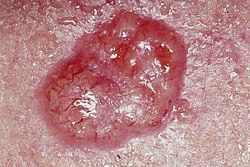
Skin cancers are cancers that arise from the skin. They are due to the development of abnormal cells that have the ability to invade or spread to other parts of the body. It occurs when skin cells grow uncontrollably, forming malignant tumors. The primary cause of skin cancer is prolonged exposure to ultraviolet (UV) radiation from the sun or tanning devices. Skin cancer is the most commonly diagnosed form of cancer in humans. There are three main types of skin cancers: basal-cell skin cancer (BCC), squamous-cell skin cancer (SCC) and melanoma. The first two, along with a number of less common skin cancers, are known as nonmelanoma skin cancer (NMSC). Basal-cell cancer grows slowly and can damage the tissue around it but is unlikely to spread to distant areas or result in death. It often appears as a painless raised area of skin that may be shiny with small blood vessels running over it or may present as a raised area with an ulcer. Squamous-cell skin cancer is more likely to spread. It usually presents as a hard lump with a scaly top but may also form an ulcer. Melanomas are the most aggressive. Signs include a mole that has changed in size, shape, color, has irregular edges, has more than one color, is itchy or bleeds.
More than 90% of cases are caused by exposure to ultraviolet radiation from the Sun. This exposure increases the risk of all three main types of skin cancer. Such exposure has increased since the beginning of the industrial revolution, partly due to ozone depletion. Tanning beds are another common source of ultraviolet radiation. For melanomas and basal-cell cancers, exposure during childhood is particularly harmful. For squamous-cell skin cancers, total exposure, irrespective of when it occurs, is more important. Between 20% and 30% of melanomas develop from moles. People with lighter skin are at higher risk as are those with poor immune function such as from medications or HIV/AIDS. Diagnosis is by biopsy.
Decreasing exposure to ultraviolet radiation and the use of sunscreen appear to be effective methods of preventing melanoma and squamous-cell skin cancer. It is not clear if sunscreen affects the risk of basal-cell cancer. Nonmelanoma skin cancer is usually curable. Treatment is generally by surgical removal but may, less commonly, involve radiation therapy or topical medications such as fluorouracil. Treatment of melanoma may involve some combination of surgery, chemotherapy, radiation therapy and targeted therapy. In those people whose disease has spread to other areas of the body, palliative care may be used to improve quality of life. Melanoma has one of the higher survival rates among cancers, with over 86% of people in the UK and more than 90% in the United States surviving more than 5 years.
Skin cancer is the most common form of cancer, globally accounting for at least 40% of cancer cases. The most common type is nonmelanoma skin cancer, which occurs in at least 2–3 million people per year. This is a rough estimate; good statistics are not kept. Of nonmelanoma skin cancers, about 80% are basal-cell cancers and 20% squamous-cell skin cancers. Basal-cell and squamous-cell skin cancers rarely result in death. In the United States, they were the cause of less than 0.1% of all cancer deaths. Globally in 2012, melanoma occurred in 232,000 people and resulted in 55,000 deaths. White people in Australia, New Zealand and South Africa have the highest rates of melanoma in the world. The three main types of skin cancer have become more common since late 20th century, especially in regions where the population is predominantly white.
There are three main types of skin cancer: basal-cell skin cancer (basal-cell carcinoma) (BCC), squamous-cell skin cancer (squamous-cell carcinoma) (SCC) and malignant melanoma.
Basal-cell carcinomas are most commonly present on sun-exposed areas of the skin, especially the face. They rarely metastasize and rarely cause death. They are easily treated with surgery or radiation. Squamous-cell skin cancers are also common, but much less common than basal-cell cancers. They metastasize more frequently than BCCs. Even then, the metastasis rate is quite low, with the exception of SCC of the lip or ear, and in people who are immunosuppressed. Melanoma are the least frequent of the three common skin cancers. They frequently metastasize, and can cause death once they spread.
Less common skin cancers include: Merkel cell carcinoma, Paget's disease of the breast, atypical fibroxanthoma, porocarcinoma, spindle cell tumors, sebaceous carcinomas, microcystic adnexal carcinoma, keratoacanthoma, and skin sarcomas, such as angiosarcoma, dermatofibrosarcoma protuberans, Kaposi's sarcoma, leiomyosarcoma.
BCC and SCC often carry a UV-signature mutation indicating that these cancers are caused by UVB radiation via direct DNA damage. However, malignant melanoma is predominantly caused by UVA radiation via indirect DNA damage. The indirect DNA damage is caused by free radicals and reactive oxygen species. Research indicates that the absorption of three sunscreen ingredients into the skin, combined with a 60-minute exposure to UV, leads to an increase of free radicals in the skin, if applied in too little quantity and too infrequently. However, the researchers add that newer creams often do not contain these specific compounds, and that the combination of other ingredients tends to retain the compounds on the surface of the skin. They also add that frequent re-application reduces the risk of radical formation.
Skin cancer
Skin cancers are cancers that arise from the skin. They are due to the development of abnormal cells that have the ability to invade or spread to other parts of the body. It occurs when skin cells grow uncontrollably, forming malignant tumors. The primary cause of skin cancer is prolonged exposure to ultraviolet (UV) radiation from the sun or tanning devices. Skin cancer is the most commonly diagnosed form of cancer in humans. There are three main types of skin cancers: basal-cell skin cancer (BCC), squamous-cell skin cancer (SCC) and melanoma. The first two, along with a number of less common skin cancers, are known as nonmelanoma skin cancer (NMSC). Basal-cell cancer grows slowly and can damage the tissue around it but is unlikely to spread to distant areas or result in death. It often appears as a painless raised area of skin that may be shiny with small blood vessels running over it or may present as a raised area with an ulcer. Squamous-cell skin cancer is more likely to spread. It usually presents as a hard lump with a scaly top but may also form an ulcer. Melanomas are the most aggressive. Signs include a mole that has changed in size, shape, color, has irregular edges, has more than one color, is itchy or bleeds.
More than 90% of cases are caused by exposure to ultraviolet radiation from the Sun. This exposure increases the risk of all three main types of skin cancer. Such exposure has increased since the beginning of the industrial revolution, partly due to ozone depletion. Tanning beds are another common source of ultraviolet radiation. For melanomas and basal-cell cancers, exposure during childhood is particularly harmful. For squamous-cell skin cancers, total exposure, irrespective of when it occurs, is more important. Between 20% and 30% of melanomas develop from moles. People with lighter skin are at higher risk as are those with poor immune function such as from medications or HIV/AIDS. Diagnosis is by biopsy.
Decreasing exposure to ultraviolet radiation and the use of sunscreen appear to be effective methods of preventing melanoma and squamous-cell skin cancer. It is not clear if sunscreen affects the risk of basal-cell cancer. Nonmelanoma skin cancer is usually curable. Treatment is generally by surgical removal but may, less commonly, involve radiation therapy or topical medications such as fluorouracil. Treatment of melanoma may involve some combination of surgery, chemotherapy, radiation therapy and targeted therapy. In those people whose disease has spread to other areas of the body, palliative care may be used to improve quality of life. Melanoma has one of the higher survival rates among cancers, with over 86% of people in the UK and more than 90% in the United States surviving more than 5 years.
Skin cancer is the most common form of cancer, globally accounting for at least 40% of cancer cases. The most common type is nonmelanoma skin cancer, which occurs in at least 2–3 million people per year. This is a rough estimate; good statistics are not kept. Of nonmelanoma skin cancers, about 80% are basal-cell cancers and 20% squamous-cell skin cancers. Basal-cell and squamous-cell skin cancers rarely result in death. In the United States, they were the cause of less than 0.1% of all cancer deaths. Globally in 2012, melanoma occurred in 232,000 people and resulted in 55,000 deaths. White people in Australia, New Zealand and South Africa have the highest rates of melanoma in the world. The three main types of skin cancer have become more common since late 20th century, especially in regions where the population is predominantly white.
There are three main types of skin cancer: basal-cell skin cancer (basal-cell carcinoma) (BCC), squamous-cell skin cancer (squamous-cell carcinoma) (SCC) and malignant melanoma.
Basal-cell carcinomas are most commonly present on sun-exposed areas of the skin, especially the face. They rarely metastasize and rarely cause death. They are easily treated with surgery or radiation. Squamous-cell skin cancers are also common, but much less common than basal-cell cancers. They metastasize more frequently than BCCs. Even then, the metastasis rate is quite low, with the exception of SCC of the lip or ear, and in people who are immunosuppressed. Melanoma are the least frequent of the three common skin cancers. They frequently metastasize, and can cause death once they spread.
Less common skin cancers include: Merkel cell carcinoma, Paget's disease of the breast, atypical fibroxanthoma, porocarcinoma, spindle cell tumors, sebaceous carcinomas, microcystic adnexal carcinoma, keratoacanthoma, and skin sarcomas, such as angiosarcoma, dermatofibrosarcoma protuberans, Kaposi's sarcoma, leiomyosarcoma.
BCC and SCC often carry a UV-signature mutation indicating that these cancers are caused by UVB radiation via direct DNA damage. However, malignant melanoma is predominantly caused by UVA radiation via indirect DNA damage. The indirect DNA damage is caused by free radicals and reactive oxygen species. Research indicates that the absorption of three sunscreen ingredients into the skin, combined with a 60-minute exposure to UV, leads to an increase of free radicals in the skin, if applied in too little quantity and too infrequently. However, the researchers add that newer creams often do not contain these specific compounds, and that the combination of other ingredients tends to retain the compounds on the surface of the skin. They also add that frequent re-application reduces the risk of radical formation.
Recent media
Recent media