


Community hub
Recent from talks
Contribute something
Nothing was collected or created yet.
Slenderness ratio
View on Wikipedia
In architecture, the slenderness ratio, or simply slenderness, is an aspect ratio, the quotient between the height and the width of a building.
In structural engineering, slenderness is used to calculate the propensity of a column to buckle. It is defined as where is the effective length of the column and is the least radius of gyration, the latter defined by where is the area of the cross-section of the column and is the second moment of area of the cross-section. The effective length is calculated from the actual length of the member considering the rotational and relative translational boundary conditions at the ends. Slenderness captures the influence on buckling of all the geometric aspects of the column, namely its length, area, and second moment of area. The influence of the material is represented separately by the material's modulus of elasticity .


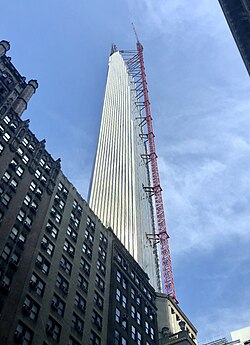
Structural engineers generally consider a skyscraper as slender if the height:width ratio exceeds 10:1 or 12:1. Slim towers require the adoption of specific measures to counter the high strengths of wind in the vertical cantilever, like including additional structures to endow greater rigidity to the building or diverse types of tuned mass dampers to avoid unwanted swinging.[1]
Tall buildings with high slenderness ratio are sometime referred to as pencil towers.[2]
Examples
[edit]
| Building | Location | Floors | Height (m) | Slenderness | Year |
|---|---|---|---|---|---|
| 111 West 57th Street | New York, NY | 82 | 438 | 24:1 | 2018 |
| Highcliff | Happy Valley, Hong Kong | 73 | 252 | 20:1 | 2003 |
| 150 North Riverside | Chicago, Illinois | 54 | 228 | 20:1 at base | 2017 |
| 220 Central Park South | New York, NY | 70 | 290 | 18:1 | 2019 |
| Collins House (Melbourne) | Melbourne, Australia | 61 | 190 | 16.25:1 | 2019 |
| 432 Park Avenue | New York, NY | 85 | 426 | 15:1 | 2015 |
| One Madison Park | New York, NY | 50 | 188 | 12:1 | 2016 |
| Sky House | New York, NY | 55 | 179 | Between 12:1 and 20:1[3] | 2008 |
| Icon | New York, NY | 42 | 158 | Between 15:1 and 18:1[4] | 2009 |
References
[edit]- ^ Willis, Carol. "The Skyscraper Museum: SKY HIGH & the logic of luxury WALKTHROUGH". Retrieved 2016-01-24.
- ^ Wainwright, Oliver (5 February 2019). "Super-tall, super-skinny, super-expensive: the 'pencil towers' of New York's super-rich". The Guardian. Retrieved 1 December 2020.
- ^ "Sky House". CVU Skyscraper Center.
- ^ "Icon". CVU Skyscraper Center.
External links
[edit]Slenderness ratio
View on GrokipediaFundamentals
Definition
In structural engineering, columns are vertical compressive members designed to support axial loads, but they are susceptible to instability known as buckling when subjected to high compressive forces.[7] The slenderness ratio serves as a key dimensionless parameter to quantify the geometric proportions of such members, indicating their vulnerability to buckling.[8] The slenderness ratio, denoted as , is primarily defined as the ratio of the effective length to the least radius of gyration of the cross-section: , where is the effective length factor accounting for end support conditions, is the unsupported length of the column, and is the radius of gyration given by , with as the minimum moment of inertia and as the cross-sectional area.[7][9] This formulation yields a dimensionless value, enabling direct comparisons of stability across different column sizes and materials without regard to absolute scale.[10] In architectural contexts, particularly for tall buildings, the slenderness ratio is more simply interpreted as the aspect ratio of height to width, diverging from the gyration-based measure used in engineering analysis.[11]Significance
The slenderness ratio plays a pivotal role in structural engineering by distinguishing between primary failure modes in compression members: for low values, failure occurs primarily through material crushing or yielding, where the column's strength is governed by its compressive yield stress without significant lateral deflection; in contrast, high slenderness leads to buckling, an elastic instability that causes sudden lateral deformation and collapse under loads well below the yield capacity.[1] This differentiation is essential for predicting behavior and selecting appropriate design approaches, as short columns rely on material properties alone, while slender ones demand consideration of geometric stability to prevent catastrophic failure.[12] The ratio profoundly influences the critical load capacity of a column, with higher slenderness resulting in a reduction inversely with the square of the slenderness ratio in load-bearing ability due to the inverse square relationship inherent in elastic buckling theory, such as Euler's critical load benchmark for high slenderness cases.[13] This decline means that even modest increases in effective length or reductions in cross-sectional stiffness can drastically lower the safe load, necessitating careful proportioning to maintain structural integrity under service conditions.[1] Threshold values for slenderness ratio, typically denoted as λ = KL/r, indicate buckling dominance when exceeding 50 to 100, though this varies by material properties like yield strength and modulus of elasticity; for example, in steel design per AISC standards, buckling governs prominently above approximately 114 for common grades (derived from 4.71√(E/F_y)).[1] These thresholds guide engineers in classifying members and applying relevant strength equations, ensuring designs transition appropriately from yielding to buckling considerations. Beyond failure prediction, the slenderness ratio has broader implications for material efficiency, as optimized ratios allow minimal cross-sections without excessive buckling risk, thereby reducing weight and resource use in construction. It also informs safety factors, such as the 0.90 resistance factor in AISC provisions, to account for uncertainties in buckling analysis, and enhances economic viability by recommending limits like KL/r ≤ 200 to avoid uneconomically low critical stresses below 6.3 ksi.[1] This balance promotes safer, more cost-effective structures across applications like building frames and bridges.[12]Mathematical Formulation
Effective Length
The effective length of a column, denoted as , represents the length of an equivalent pinned-pinned column that would exhibit the same buckling behavior under axial compression, where is the actual unsupported length and is the effective length factor accounting for end restraint conditions.[14] This factor adjusts the physical length to reflect the influence of boundary conditions on the column's stability.[4] Theoretically, is derived from the buckling mode shapes obtained through Euler's critical load analysis, where the mode shape determines the distance between inflection points in the deflected column, ensuring the effective length captures the actual instability wavelength rather than the geometric span.[4] For ideal end conditions, theoretical values of are established as follows:| End Condition | Theoretical |
|---|---|
| Pinned-pinned | 1.0 |
| Fixed-fixed | 0.5 |
| Fixed-pinned | 0.699 |
| Fixed-free | 2.0 |