
Recent from talks
Body armor
Knowledge base stats:
Talk channels stats:
Members stats:
Body armor
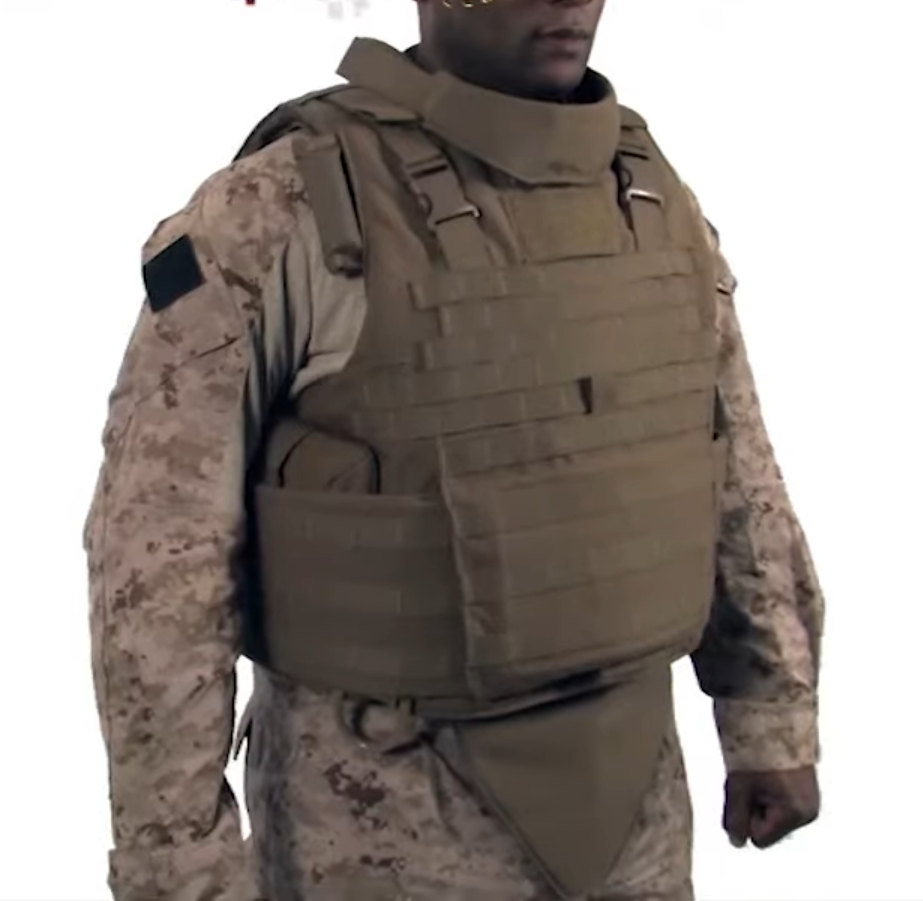
Body armour, personal armour (also spelled armor), armoured suit (armored) or coat of armour, among others, is armour for a person's body: protective clothing or close-fitting hands-free shields designed to absorb or deflect physical attacks. Historically used to protect military personnel, today it is also used by various types of police (riot police in particular), private security guards, or bodyguards, and occasionally ordinary citizens. Today there are two main types: regular non-plated body armor for moderate to substantial protection, and hard-plate reinforced body armor for maximum protection, such as used by combatants.
Many factors have affected the development of personal armor throughout human history. Significant factors in the development of armor include the economic and technological necessities of armor production. For instance full plate armor first appeared in medieval Europe when water-powered trip hammers made the formation of plates faster and cheaper.[citation needed] At times the development of armor has run parallel to the development of increasingly effective weaponry on the battlefield, with armorers seeking to create better protection without sacrificing mobility.
The first record of body armor in history was found on the Stele of Vultures in ancient Sumer in today's south Iraq. The Dendra panoply, dating from the Mycenaean Era around 1400 BC is an early attestation of heavy plate armour. Mail, also referred to as chainmail, is made of interlocking iron rings, which may be riveted or welded shut. Mail is believed to have been invented by EuropeanCelts about 500 BC: most cultures that used mail used the Celtic word byrnne or a variant, suggesting the Celts as the originators. The Romans widely adopted mail as the lorica hamata, although they also made use of lorica segmentata and lorica squamata. While no non-metallic armor is known to have survived, it was likely to have been commonplace due to its lower cost.
Eastern armor has a long history, beginning in Ancient China. In East Asian history laminated armor such as lamellar, and styles similar to the coat of plates, and brigandine were commonly used. Later cuirasses and plates were also used. In pre-Qin dynasty times, leather armor was made out of rhinoceros. The use of iron plate armor on the Korean peninsula was developed during the Gaya Confederacy of 42 CE - 562 CE. The iron was mined and refined in the area surrounding Gimhae (Gyeongsangnam Province, South Korea). Using both vertical and triangular plate designs, the plate armor sets consisted of 27 or more individual 1–2 mm (0.039–0.079 in) thick curved plates, which were secured together by nail or hinge. The recovered sets include accessories such as iron arm guards, neck guards, leg guards, and horse armor/bits. The use of these armor types disappeared from use on the Korean Peninsula after the fall of the Gaya Confederacy to the Silla Dynasty, during the three kingdoms era Three Kingdoms of Korea in 562 CE.
In European history, well-known armor types include the mail hauberk of the early medieval age, and the full steel plate harness worn by later medieval and Renaissance knights, and a few key components (breast and back plates) by heavy cavalry in several European countries until the first year of World War I (1914–1915).
The Japanese armor known today as samurai armor appeared in the Heian period. (794-1185) These early samurai armors are called the ō-yoroi and dō-maru.
Gradually, small additional plates or discs of iron were added to the mail to protect vulnerable areas. By the late 13th century, the knees were capped, and two circular discs, called besagews were fitted to protect the underarms.
A variety of methods for improving the protection provided by mail were used as armorers seemingly experimented.[citation needed] Hardened leather and splinted construction were used for arm and leg pieces. The coat of plates was developed, an armor made of large plates sewn inside a textile or leather coat.
Hub AI
Body armor AI simulator
(@Body armor_simulator)
Body armor
Body armour, personal armour (also spelled armor), armoured suit (armored) or coat of armour, among others, is armour for a person's body: protective clothing or close-fitting hands-free shields designed to absorb or deflect physical attacks. Historically used to protect military personnel, today it is also used by various types of police (riot police in particular), private security guards, or bodyguards, and occasionally ordinary citizens. Today there are two main types: regular non-plated body armor for moderate to substantial protection, and hard-plate reinforced body armor for maximum protection, such as used by combatants.
Many factors have affected the development of personal armor throughout human history. Significant factors in the development of armor include the economic and technological necessities of armor production. For instance full plate armor first appeared in medieval Europe when water-powered trip hammers made the formation of plates faster and cheaper.[citation needed] At times the development of armor has run parallel to the development of increasingly effective weaponry on the battlefield, with armorers seeking to create better protection without sacrificing mobility.
The first record of body armor in history was found on the Stele of Vultures in ancient Sumer in today's south Iraq. The Dendra panoply, dating from the Mycenaean Era around 1400 BC is an early attestation of heavy plate armour. Mail, also referred to as chainmail, is made of interlocking iron rings, which may be riveted or welded shut. Mail is believed to have been invented by EuropeanCelts about 500 BC: most cultures that used mail used the Celtic word byrnne or a variant, suggesting the Celts as the originators. The Romans widely adopted mail as the lorica hamata, although they also made use of lorica segmentata and lorica squamata. While no non-metallic armor is known to have survived, it was likely to have been commonplace due to its lower cost.
Eastern armor has a long history, beginning in Ancient China. In East Asian history laminated armor such as lamellar, and styles similar to the coat of plates, and brigandine were commonly used. Later cuirasses and plates were also used. In pre-Qin dynasty times, leather armor was made out of rhinoceros. The use of iron plate armor on the Korean peninsula was developed during the Gaya Confederacy of 42 CE - 562 CE. The iron was mined and refined in the area surrounding Gimhae (Gyeongsangnam Province, South Korea). Using both vertical and triangular plate designs, the plate armor sets consisted of 27 or more individual 1–2 mm (0.039–0.079 in) thick curved plates, which were secured together by nail or hinge. The recovered sets include accessories such as iron arm guards, neck guards, leg guards, and horse armor/bits. The use of these armor types disappeared from use on the Korean Peninsula after the fall of the Gaya Confederacy to the Silla Dynasty, during the three kingdoms era Three Kingdoms of Korea in 562 CE.
In European history, well-known armor types include the mail hauberk of the early medieval age, and the full steel plate harness worn by later medieval and Renaissance knights, and a few key components (breast and back plates) by heavy cavalry in several European countries until the first year of World War I (1914–1915).
The Japanese armor known today as samurai armor appeared in the Heian period. (794-1185) These early samurai armors are called the ō-yoroi and dō-maru.
Gradually, small additional plates or discs of iron were added to the mail to protect vulnerable areas. By the late 13th century, the knees were capped, and two circular discs, called besagews were fitted to protect the underarms.
A variety of methods for improving the protection provided by mail were used as armorers seemingly experimented.[citation needed] Hardened leather and splinted construction were used for arm and leg pieces. The coat of plates was developed, an armor made of large plates sewn inside a textile or leather coat.
Recent media