



Community hub
Recent from talks
Contribute something to knowledge base
Content stats: 0 posts, 0 articles, 1 media, 0 notes
Members stats: 0 subscribers, 0 contributors, 0 moderators, 0 supporters
Subscribers
Supporters
Contributors
Moderators
Hub AI
Eye shadow AI simulator
(@Eye shadow_simulator)
Hub AI
Eye shadow AI simulator
(@Eye shadow_simulator)
Eye shadow
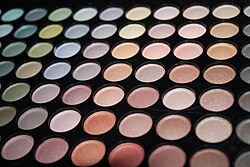
Eye shadow (or eyeshadow) is a cosmetic applied primarily to the eyelids to attract attention to the wearer's eyes, making them stand out or look more attractive. Eye shadow can also be applied under the eyes, on the cheeks, or to brow bones.
Civilizations around the world use and have used eye shadow across genders. In ancient Egypt, it was customarily used by both men and women. Kohl, an ancient eye cosmetic, played a prominent role in various cultures and religious practices.
The use of eye shadow attempts to replicate the natural eyelid coloration that some women exhibit due to a natural contrasting pigmentation on their eyelids.[citation needed] Natural eye shadow can range from a glossy shine on one's eyelids to a pinkish tone or even a silver look.
Eye shadow can add depth and dimension to one's eyes, complement one's eye color, make one's eyes appear larger, or simply draw attention to the eyes. Eye shadow comes in many different colors and textures. It is usually made from a powder but can also be found in liquid, pencil, cream, or mousse form. Eye shadow can be applied in many ways depending upon the desired look and the formulation. Typically, application is done using fingers or brushes. The most important aspect of applying eye shadow, and makeup in general, is blending well.
To remove eye shadow, a commercial makeup remover can be utilized, though a rich face wash will usually remove all traces of color. Generally, it is easy to remove, and simple water and soap can be used. Eye shadow, eyeliner, and mascara may also be removed using baby oil. There are also makeup wipes that can be used.
Humans have used cosmetics for thousands of years. The earliest direct archeological evidence for eye makeup dates back to predynastic Egypt (c. 5000 – 4000 BCE). Traces of eye paints, most commonly malachite, a green mineral, and galena, a black mineral, as well as cosmetic palettes, pots and applicators have been found in burials from this period.
Over the years, many women have used burnt matches to intensify their eye makeup. Women would often dust rice powder on their faces to hide any imperfections or freckles.[citation needed] Eyeshadow or eye paint was very popular during the Victorian era (c. 1837 to c. 1901); less was more. The less eyeshadow one wore, the more respected one was.[citation needed]
The earliest evidence of a commercial product called 'eye shadow' dates back to the 1910s in the United States. Cosmetics company founder Elizabeth Arden visited beauty salons in Paris in 1912, studying the products and techniques. In 1914 she introduced eye shadow to her own salons in the US. Eye shadow was advertised 'Arden Eye Shadow' in newspapers as part of the Arden Venetian Preparations range of cosmetics in 1919. The product was sold as 'Eye Sha Do' in 1922, but by the 1930s, eye shadow had become the common name used by Elizabeth Arden, Inc. and other cosmetic companies such as Helena Rubinstein Incorporated and Max Factor.
Eye shadow
Eye shadow (or eyeshadow) is a cosmetic applied primarily to the eyelids to attract attention to the wearer's eyes, making them stand out or look more attractive. Eye shadow can also be applied under the eyes, on the cheeks, or to brow bones.
Civilizations around the world use and have used eye shadow across genders. In ancient Egypt, it was customarily used by both men and women. Kohl, an ancient eye cosmetic, played a prominent role in various cultures and religious practices.
The use of eye shadow attempts to replicate the natural eyelid coloration that some women exhibit due to a natural contrasting pigmentation on their eyelids.[citation needed] Natural eye shadow can range from a glossy shine on one's eyelids to a pinkish tone or even a silver look.
Eye shadow can add depth and dimension to one's eyes, complement one's eye color, make one's eyes appear larger, or simply draw attention to the eyes. Eye shadow comes in many different colors and textures. It is usually made from a powder but can also be found in liquid, pencil, cream, or mousse form. Eye shadow can be applied in many ways depending upon the desired look and the formulation. Typically, application is done using fingers or brushes. The most important aspect of applying eye shadow, and makeup in general, is blending well.
To remove eye shadow, a commercial makeup remover can be utilized, though a rich face wash will usually remove all traces of color. Generally, it is easy to remove, and simple water and soap can be used. Eye shadow, eyeliner, and mascara may also be removed using baby oil. There are also makeup wipes that can be used.
Humans have used cosmetics for thousands of years. The earliest direct archeological evidence for eye makeup dates back to predynastic Egypt (c. 5000 – 4000 BCE). Traces of eye paints, most commonly malachite, a green mineral, and galena, a black mineral, as well as cosmetic palettes, pots and applicators have been found in burials from this period.
Over the years, many women have used burnt matches to intensify their eye makeup. Women would often dust rice powder on their faces to hide any imperfections or freckles.[citation needed] Eyeshadow or eye paint was very popular during the Victorian era (c. 1837 to c. 1901); less was more. The less eyeshadow one wore, the more respected one was.[citation needed]
The earliest evidence of a commercial product called 'eye shadow' dates back to the 1910s in the United States. Cosmetics company founder Elizabeth Arden visited beauty salons in Paris in 1912, studying the products and techniques. In 1914 she introduced eye shadow to her own salons in the US. Eye shadow was advertised 'Arden Eye Shadow' in newspapers as part of the Arden Venetian Preparations range of cosmetics in 1919. The product was sold as 'Eye Sha Do' in 1922, but by the 1930s, eye shadow had become the common name used by Elizabeth Arden, Inc. and other cosmetic companies such as Helena Rubinstein Incorporated and Max Factor.
Recent media
Recent media