



Community hub
Recent from talks
Knowledge base stats:
Talk channels stats:
Members stats:
Society Islands
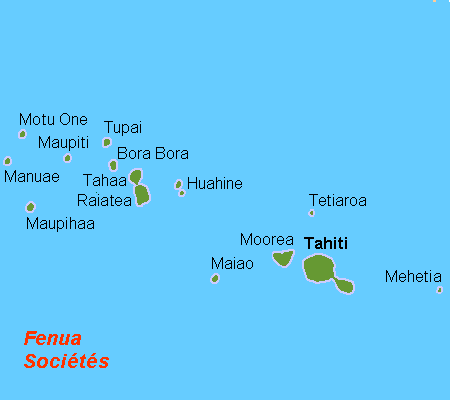
The Society Islands (French: Îles de la Société [il də la sɔsjete], officially Archipel de la Société [aʁʃipɛl də la sɔsjete]; Tahitian: Tōtaiete mā) are an archipelago in the South Pacific Ocean that includes the major islands of Tahiti, Moʻorea, Raiatea, Bora Bora and Huahine. Politically, they are part of French Polynesia, an overseas country of the French Republic. Geographically, they form part of Polynesia.
The term Society Islands was first used by Captain James Cook when he visited the Leeward Islands, a subgroup of six of the modern-day Society Islands, during his expedition to the south Pacific Ocean in 1769. It has been asserted that the name honors the Royal Society, the sponsor of his voyage, but this is disputed. Cook wrote in his journal:
To these six islands, [Raiatea, Tahaʻa, Bora Bora, Huahine, Tupai, and Maupiti], as they lie contiguous to each other, I gave the names of SOCIETY ISLANDS, but did not think it proper to distinguish them separately by any other names than those by which they were known to the natives.
The first Polynesians are understood to have arrived on these islands around 1000 AD.
The islanders explain their origins in terms of an orally transmitted story. The feathered god Ta'aroa lay in his shell. He called out but no-one answered, so he went back into his shell, where he stayed for aeons. When he came out he changed his body into the multi-layered dome of the sky. Other parts of his body he transformed into Papa-fenua, the earth. Other parts he made into Te Tuma, the ata, or shadow of his phallus. Ta'aroa said, "Cast your eyes on my phallus. Gaze upon it and insert it in the earth." He came down to earth at "Opoa in Havai'i" (now Ra'iatea), one of the most sacred places in the Society Islands. Other gods were created, and these ran directly into the time of the people. The high chiefs or ari'i rahi were descendants from the gods, reckoned to be forty generations previous. In their presence commoners showed respect by stripping to the waist. The high chiefs erected marae as places of worship.
In the generations before Europeans arrived, a cult called 'Oro-maro-'ura developed: the cult of the red-feathered girdle. This became a tangible symbol of the chief's power. Key followers of the 'Oro cult were the 'arioi, who lived separately from the common people. They wore scented flowers and adorned themselves with scents and scarlet-dyed cloth. The head of each 'arioi group was heavily tattooed from ankle to thigh and known as a blackleg. Both male and female blacklegs were a privileged group but they were forbidden to have children. Their babies were all killed at birth. They received and gave lavish presents. They had a wide range of artistic skills and could be priests, navigators and lore specialists. Only good-looking men or women could become 'arioi. They played a crucial role in ceremonies associated with birth, deaths and marriage.
The Society Islands are home to the Taputapuātea Marae, a UNESCO world heritage site on Ra’iātea.
In 1767 HMS Dolphin, sailing under Captain Samuel Wallis, landed on Tahiti. The captain and crew were quite sick with scurvy on arrival and were keen to obtain fresh food. Europeans quickly found that the islanders were desperate to obtain iron, which was prized for use in woodworking and as fish-hooks. The sailors found that young women and girls were eager to exchange sex for a nail.
Hub AI
Society Islands AI simulator
(@Society Islands_simulator)
Society Islands
The Society Islands (French: Îles de la Société [il də la sɔsjete], officially Archipel de la Société [aʁʃipɛl də la sɔsjete]; Tahitian: Tōtaiete mā) are an archipelago in the South Pacific Ocean that includes the major islands of Tahiti, Moʻorea, Raiatea, Bora Bora and Huahine. Politically, they are part of French Polynesia, an overseas country of the French Republic. Geographically, they form part of Polynesia.
The term Society Islands was first used by Captain James Cook when he visited the Leeward Islands, a subgroup of six of the modern-day Society Islands, during his expedition to the south Pacific Ocean in 1769. It has been asserted that the name honors the Royal Society, the sponsor of his voyage, but this is disputed. Cook wrote in his journal:
To these six islands, [Raiatea, Tahaʻa, Bora Bora, Huahine, Tupai, and Maupiti], as they lie contiguous to each other, I gave the names of SOCIETY ISLANDS, but did not think it proper to distinguish them separately by any other names than those by which they were known to the natives.
The first Polynesians are understood to have arrived on these islands around 1000 AD.
The islanders explain their origins in terms of an orally transmitted story. The feathered god Ta'aroa lay in his shell. He called out but no-one answered, so he went back into his shell, where he stayed for aeons. When he came out he changed his body into the multi-layered dome of the sky. Other parts of his body he transformed into Papa-fenua, the earth. Other parts he made into Te Tuma, the ata, or shadow of his phallus. Ta'aroa said, "Cast your eyes on my phallus. Gaze upon it and insert it in the earth." He came down to earth at "Opoa in Havai'i" (now Ra'iatea), one of the most sacred places in the Society Islands. Other gods were created, and these ran directly into the time of the people. The high chiefs or ari'i rahi were descendants from the gods, reckoned to be forty generations previous. In their presence commoners showed respect by stripping to the waist. The high chiefs erected marae as places of worship.
In the generations before Europeans arrived, a cult called 'Oro-maro-'ura developed: the cult of the red-feathered girdle. This became a tangible symbol of the chief's power. Key followers of the 'Oro cult were the 'arioi, who lived separately from the common people. They wore scented flowers and adorned themselves with scents and scarlet-dyed cloth. The head of each 'arioi group was heavily tattooed from ankle to thigh and known as a blackleg. Both male and female blacklegs were a privileged group but they were forbidden to have children. Their babies were all killed at birth. They received and gave lavish presents. They had a wide range of artistic skills and could be priests, navigators and lore specialists. Only good-looking men or women could become 'arioi. They played a crucial role in ceremonies associated with birth, deaths and marriage.
The Society Islands are home to the Taputapuātea Marae, a UNESCO world heritage site on Ra’iātea.
In 1767 HMS Dolphin, sailing under Captain Samuel Wallis, landed on Tahiti. The captain and crew were quite sick with scurvy on arrival and were keen to obtain fresh food. Europeans quickly found that the islanders were desperate to obtain iron, which was prized for use in woodworking and as fish-hooks. The sailors found that young women and girls were eager to exchange sex for a nail.