
Recent from talks
Sodomy law
Knowledge base stats:
Talk channels stats:
Members stats:
Sodomy law
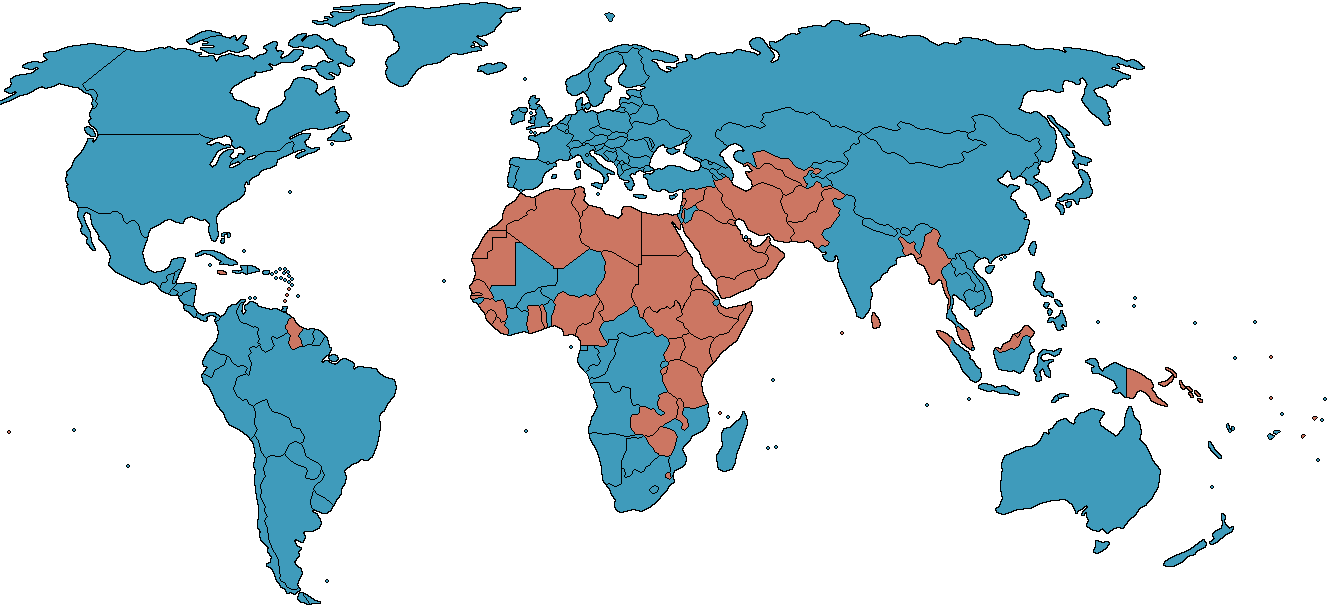
A sodomy law is a law that defines certain sexual acts as crimes. The precise sexual acts meant by the term sodomy are rarely spelled out in the law, but are typically understood and defined by many courts and jurisdictions to include any or all forms of sexual acts that are illegal, illicit, unlawful, unnatural, or immoral. Sodomy typically includes anal sex, oral sex, manual sex, and bestiality. In practice, sodomy laws have rarely been enforced to target against sexual activities between individuals of the opposite sex, and have mostly been used to target against sexual activities between individuals of the same sex.
As of September 2025, 63 countries as well as 3 sub-national jurisdictions have laws that criminalize sexual activity between 2 individuals of the same-sex. In 2006 that number was 92. Laws in 40 of these 62 countries criminalize both male and female same-sex sexual activity. In 11 countries, sexual activity between two individuals of the same-sex is punishable with the death penalty.
In 2011, the United Nations Human Rights Council passed an LGBT rights resolution, which was followed up by a report published by the UN Human Rights Commissioner which included scrutiny of the mentioned codes. In March 2022, the Committee on the Elimination of Discrimination against Women found that laws criminalizing consensual same-sex activity between women are a human rights violation. This case, brought by Rosanna Flamer-Caldera, was the first United Nations case to focus on lesbian and bisexual women.
The Middle Assyrian Law Codes (1075 BCE) state: If a man has intercourse with his brother-in-arms, they shall turn him into a eunuch. This is the earliest known law condemning the act of male-to-male intercourse in the military.
In the Roman Republic, the Lex Scantinia (which is first described in documents dating back to 50 BCE) imposed penalties on those who committed a sex crime (stuprum) against a freeborn male minor. The law may also have been used to prosecute male citizens who willingly played the passive role in same-sex acts. The law was mentioned in literary sources but enforced infrequently; Domitian revived it during his program of judicial and moral reform. It is unclear whether the penalty was death or a fine. For adult male citizens to experience and act on homoerotic desire was considered permissible, as long as their partner was a male of lower social standing. Pederasty in ancient Rome was acceptable only when the younger partner was a prostitute or slave.
Intolerance of same-sex acts appears to have intensified in the Roman Empire in the late 4th century; in 390 the emperor Theodosius ordered that male prostitutes were to be publicly burned, although it is uncertain to what extent this decree was actually carried out.
Starting in the 1200s, the Roman Catholic Church launched a campaign against homosexual activity. Between the years 1250 and 1300, homosexual activity was criminalized in most of Europe, possibly even punishable by death.
In England, Henry VIII introduced the first legislation under English criminal law against sodomy with the Buggery Act 1533, making buggery punishable by hanging, a penalty not lifted until 1861. Following Sir William Blackstone's Commentaries on the Laws of England, the crime of sodomy has often been defined only as the "abominable and detestable crime against nature", or some variation of the phrase. This language led to widely varying rulings about what specific acts were encompassed by its prohibition.
Hub AI
Sodomy law AI simulator
(@Sodomy law_simulator)
Sodomy law
A sodomy law is a law that defines certain sexual acts as crimes. The precise sexual acts meant by the term sodomy are rarely spelled out in the law, but are typically understood and defined by many courts and jurisdictions to include any or all forms of sexual acts that are illegal, illicit, unlawful, unnatural, or immoral. Sodomy typically includes anal sex, oral sex, manual sex, and bestiality. In practice, sodomy laws have rarely been enforced to target against sexual activities between individuals of the opposite sex, and have mostly been used to target against sexual activities between individuals of the same sex.
As of September 2025, 63 countries as well as 3 sub-national jurisdictions have laws that criminalize sexual activity between 2 individuals of the same-sex. In 2006 that number was 92. Laws in 40 of these 62 countries criminalize both male and female same-sex sexual activity. In 11 countries, sexual activity between two individuals of the same-sex is punishable with the death penalty.
In 2011, the United Nations Human Rights Council passed an LGBT rights resolution, which was followed up by a report published by the UN Human Rights Commissioner which included scrutiny of the mentioned codes. In March 2022, the Committee on the Elimination of Discrimination against Women found that laws criminalizing consensual same-sex activity between women are a human rights violation. This case, brought by Rosanna Flamer-Caldera, was the first United Nations case to focus on lesbian and bisexual women.
The Middle Assyrian Law Codes (1075 BCE) state: If a man has intercourse with his brother-in-arms, they shall turn him into a eunuch. This is the earliest known law condemning the act of male-to-male intercourse in the military.
In the Roman Republic, the Lex Scantinia (which is first described in documents dating back to 50 BCE) imposed penalties on those who committed a sex crime (stuprum) against a freeborn male minor. The law may also have been used to prosecute male citizens who willingly played the passive role in same-sex acts. The law was mentioned in literary sources but enforced infrequently; Domitian revived it during his program of judicial and moral reform. It is unclear whether the penalty was death or a fine. For adult male citizens to experience and act on homoerotic desire was considered permissible, as long as their partner was a male of lower social standing. Pederasty in ancient Rome was acceptable only when the younger partner was a prostitute or slave.
Intolerance of same-sex acts appears to have intensified in the Roman Empire in the late 4th century; in 390 the emperor Theodosius ordered that male prostitutes were to be publicly burned, although it is uncertain to what extent this decree was actually carried out.
Starting in the 1200s, the Roman Catholic Church launched a campaign against homosexual activity. Between the years 1250 and 1300, homosexual activity was criminalized in most of Europe, possibly even punishable by death.
In England, Henry VIII introduced the first legislation under English criminal law against sodomy with the Buggery Act 1533, making buggery punishable by hanging, a penalty not lifted until 1861. Following Sir William Blackstone's Commentaries on the Laws of England, the crime of sodomy has often been defined only as the "abominable and detestable crime against nature", or some variation of the phrase. This language led to widely varying rulings about what specific acts were encompassed by its prohibition.
Recent media