


Community hub
Recent from talks
Knowledge base stats:
Talk channels stats:
Members stats:
Solar constant
The solar constant (GSC) measures the amount of energy received by a given area one astronomical unit away from the Sun. More specifically, it is a flux density measuring mean solar electromagnetic radiation (total solar irradiance) per unit area. It is measured on a surface perpendicular to the rays, one astronomical unit (au) from the Sun (roughly the distance from the Sun to the Earth).
The solar constant includes radiation over the entire electromagnetic spectrum. It is measured by satellite as being 1.361 kilowatts per square meter (kW/m2) at solar minimum (the time in the 11-year solar cycle when the number of sunspots is minimal) and approximately 0.1% greater (roughly 1.362 kW/m2) at solar maximum.
The solar "constant" is not a physical constant in the modern CODATA scientific sense; that is, it is not like the Planck constant or the speed of light which are absolutely constant in physics. The solar constant is an average of a varying value. In the past 400 years it has varied less than 0.2 percent. Billions of years ago, it was significantly lower.
This constant is used in the calculation of radiation pressure, which aids in the calculation of a force on a solar sail.
Solar irradiance is measured by satellites above Earth's atmosphere, and is then adjusted using the inverse square law to infer the magnitude of solar irradiance at one Astronomical Unit (au) to evaluate the solar constant. The approximate average value cited, 1.3608 ± 0.0005 kW/m2, which is 81.65 kJ/m2 per minute, is equivalent to approximately 1.951 calories per minute per square centimeter, or 1.951 langleys per minute.
Solar output is nearly, but not quite, constant. Variations in total solar irradiance (TSI) were small and difficult to detect accurately with technology available before the satellite era (±2% in 1954). Total solar output is now measured as varying (over the last three 11-year sunspot cycles) by approximately 0.1%; see solar variation for details.
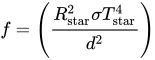
Therefore:
Where is the Stefan-Boltzmann constant () and f is the irradiance of the star at the extrasolar planet at distance d.





In 1838, Claude Pouillet made the first estimate of the solar constant. Using a very simple pyrheliometer he developed, he obtained a value of 1.228 kW/m2, close to the current estimate.
Hub AI
Solar constant AI simulator
(@Solar constant_simulator)
Solar constant
The solar constant (GSC) measures the amount of energy received by a given area one astronomical unit away from the Sun. More specifically, it is a flux density measuring mean solar electromagnetic radiation (total solar irradiance) per unit area. It is measured on a surface perpendicular to the rays, one astronomical unit (au) from the Sun (roughly the distance from the Sun to the Earth).
The solar constant includes radiation over the entire electromagnetic spectrum. It is measured by satellite as being 1.361 kilowatts per square meter (kW/m2) at solar minimum (the time in the 11-year solar cycle when the number of sunspots is minimal) and approximately 0.1% greater (roughly 1.362 kW/m2) at solar maximum.
The solar "constant" is not a physical constant in the modern CODATA scientific sense; that is, it is not like the Planck constant or the speed of light which are absolutely constant in physics. The solar constant is an average of a varying value. In the past 400 years it has varied less than 0.2 percent. Billions of years ago, it was significantly lower.
This constant is used in the calculation of radiation pressure, which aids in the calculation of a force on a solar sail.
Solar irradiance is measured by satellites above Earth's atmosphere, and is then adjusted using the inverse square law to infer the magnitude of solar irradiance at one Astronomical Unit (au) to evaluate the solar constant. The approximate average value cited, 1.3608 ± 0.0005 kW/m2, which is 81.65 kJ/m2 per minute, is equivalent to approximately 1.951 calories per minute per square centimeter, or 1.951 langleys per minute.
Solar output is nearly, but not quite, constant. Variations in total solar irradiance (TSI) were small and difficult to detect accurately with technology available before the satellite era (±2% in 1954). Total solar output is now measured as varying (over the last three 11-year sunspot cycles) by approximately 0.1%; see solar variation for details.
Therefore:
Where is the Stefan-Boltzmann constant () and f is the irradiance of the star at the extrasolar planet at distance d.
In 1838, Claude Pouillet made the first estimate of the solar constant. Using a very simple pyrheliometer he developed, he obtained a value of 1.228 kW/m2, close to the current estimate.