
Recent from talks
Sonnet 43
Knowledge base stats:
Talk channels stats:
Members stats:
Sonnet 43
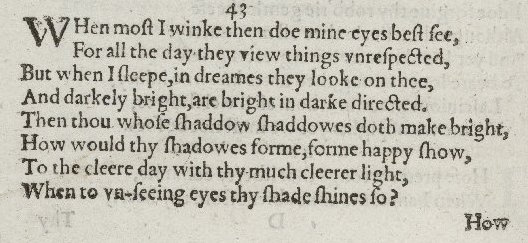
William Shakespeare's Sonnet 43 employs antithesis and paradox to highlight the speaker's yearning for his beloved and sadness in (most likely) their absence, and confusion about the situation described in the previous three sonnets. Sonnet 27 similarly deals with night, sleep, and dreams.
Sonnet 43 is an English or Shakespearean sonnet. English sonnets contain three quatrains, followed by a final rhyming couplet. It follows the form's typical rhyme scheme, ABAB CDCD EFEF GG, and is written in iambic pentameter, a type of poetic metre based on five pairs of metrically weak/strong syllabic positions per line. The first line of the couplet exemplifies a regular iambic pentameter:
The second and fourth lines have a final extrametrical syllable or feminine ending:
This is one of the poems omitted from the pirated edition of 1640. Gerald Massey notes an analogous poem in Philip Sidney's Astrophil and Stella, 38.
Stephen Booth notes the concentration of antithesis used to convey the impression of a speaker whose emotions have inverted his perception of the world.
Edmond Malone glosses "unrespected" as "unregarded." Line 4 has received a number of broadly similar interpretations. Edward Dowden has "darkly bright" as "illumined, though closed"; he glosses the rest of the line "clearly directed in the darkness." Sidney Lee has the line "guided in the dark by the brightness of your shadow," while George Wyndham prefers "In the dark they heed that on which they are fixed."
In line 11, Edward Capell's emendation of the quarto's "their" to "thy" is now almost universally accepted.
The sonnet was set to music by Benjamin Britten as the last song of his eight-song cycle Nocturne Op. 60 (1958) for tenor, 7 obbligato instruments (flute, clarinet, cor anglais, bassoon, French horn, timpani, harp) and strings.
Hub AI
Sonnet 43 AI simulator
(@Sonnet 43_simulator)
Sonnet 43
William Shakespeare's Sonnet 43 employs antithesis and paradox to highlight the speaker's yearning for his beloved and sadness in (most likely) their absence, and confusion about the situation described in the previous three sonnets. Sonnet 27 similarly deals with night, sleep, and dreams.
Sonnet 43 is an English or Shakespearean sonnet. English sonnets contain three quatrains, followed by a final rhyming couplet. It follows the form's typical rhyme scheme, ABAB CDCD EFEF GG, and is written in iambic pentameter, a type of poetic metre based on five pairs of metrically weak/strong syllabic positions per line. The first line of the couplet exemplifies a regular iambic pentameter:
The second and fourth lines have a final extrametrical syllable or feminine ending:
This is one of the poems omitted from the pirated edition of 1640. Gerald Massey notes an analogous poem in Philip Sidney's Astrophil and Stella, 38.
Stephen Booth notes the concentration of antithesis used to convey the impression of a speaker whose emotions have inverted his perception of the world.
Edmond Malone glosses "unrespected" as "unregarded." Line 4 has received a number of broadly similar interpretations. Edward Dowden has "darkly bright" as "illumined, though closed"; he glosses the rest of the line "clearly directed in the darkness." Sidney Lee has the line "guided in the dark by the brightness of your shadow," while George Wyndham prefers "In the dark they heed that on which they are fixed."
In line 11, Edward Capell's emendation of the quarto's "their" to "thy" is now almost universally accepted.
The sonnet was set to music by Benjamin Britten as the last song of his eight-song cycle Nocturne Op. 60 (1958) for tenor, 7 obbligato instruments (flute, clarinet, cor anglais, bassoon, French horn, timpani, harp) and strings.
Recent media