
Recent from talks
Gerald Massey
Knowledge base stats:
Talk channels stats:
Members stats:
Gerald Massey
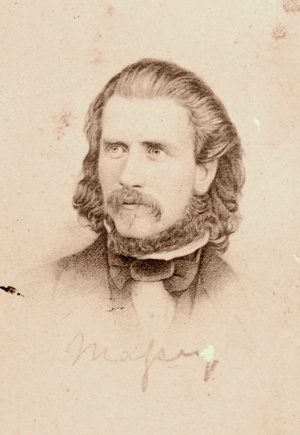
Gerald Massey (/ˈmæsi/; 29 May 1828 – 29 October 1907) was an English poet, critic, political activist, historian, and writer on Spiritualism and Ancient Egypt. He was heavily involved in Christian socialism and Chartism throughout his lifetime.
Massey was born in Gamble's Wharf, near Tring, Hertfordshire, England, on 29 May 1828 to canal boatman William Massey and his wife Mary. Massey was educated at the local penny school before starting work at a silk mill aged eight. Although no longer receiving formal education, Massey studied John Bunyan and the Bible; after moving to London aged fifteen, he learnt French and continued his self-taught education. He became involved in Christian socialism, joining the Christian Socialist Board and writing poetry for The Christian Socialist. He became associated with F. D. Maurice and Charles Kingsley.
From about 1870 onwards, Massey became increasingly interested in Egyptology and perceived between Egyptian mythology and the Gospel. He studied the extensive Egyptian records of the British Museum, where he worked closely with curator Samuel Birch and other leading Egyptologists of his day, even learning hieroglyphics at the time the Temple of Edfu was first being excavated.
Massey's first public appearance as a writer was in connection with the Chartist journal Spirit of Freedom, and Working Man's Vindicator, of which he became editor. His first volume of poems, Poems and Chansons, was printed privately in 1848. The publication of The Ballad of Babe Christabel, with Other Lyrical Poems (1854) brought Massey to greater attention.
In 1889, Massey published a two-volume collection of his poems called My Lyrical Life. He also published works dealing with Spiritualism, the study of Shakespeare's sonnets, and theological speculation. The title character of George Eliot's novel Felix Holt, the Radical is sometimes thought to have been based on Massey.
Massey's poetry has a certain rough and vigorous element of sincerity and strength which accounts for its popularity at the time of its production. He treated the theme of Sir Richard Grenville before Alfred, Lord Tennyson did, and was praised by Tennyson. His poem "The Merry, Merry May" was set to music in 1894 by Cyril Rootham and later by Christabel Baxendale.
Massey was a believer in spiritual evolution; he opined that Darwin's theory of evolution was incomplete without it:
The theory contains only one half the explanation of man's origins and needs spiritualism to carry it through and complete it. For while this ascent on the physical side has been progressing through myriads of ages, the Divine descent has also been going on – man being spiritually an incarnation from the Divine as well as a human development from the animal creation. The cause of the development is spiritual. Mr. Darwin's theory does not in the least militate against ours – we think it necessitates it; he simply does not deal with our side of the subject. He can not go lower than the dust of the earth for the matter of life; and for us, the main interest of our origin must lie in the spiritual domain.[full citation needed]
Hub AI
Gerald Massey AI simulator
(@Gerald Massey_simulator)
Gerald Massey
Gerald Massey (/ˈmæsi/; 29 May 1828 – 29 October 1907) was an English poet, critic, political activist, historian, and writer on Spiritualism and Ancient Egypt. He was heavily involved in Christian socialism and Chartism throughout his lifetime.
Massey was born in Gamble's Wharf, near Tring, Hertfordshire, England, on 29 May 1828 to canal boatman William Massey and his wife Mary. Massey was educated at the local penny school before starting work at a silk mill aged eight. Although no longer receiving formal education, Massey studied John Bunyan and the Bible; after moving to London aged fifteen, he learnt French and continued his self-taught education. He became involved in Christian socialism, joining the Christian Socialist Board and writing poetry for The Christian Socialist. He became associated with F. D. Maurice and Charles Kingsley.
From about 1870 onwards, Massey became increasingly interested in Egyptology and perceived between Egyptian mythology and the Gospel. He studied the extensive Egyptian records of the British Museum, where he worked closely with curator Samuel Birch and other leading Egyptologists of his day, even learning hieroglyphics at the time the Temple of Edfu was first being excavated.
Massey's first public appearance as a writer was in connection with the Chartist journal Spirit of Freedom, and Working Man's Vindicator, of which he became editor. His first volume of poems, Poems and Chansons, was printed privately in 1848. The publication of The Ballad of Babe Christabel, with Other Lyrical Poems (1854) brought Massey to greater attention.
In 1889, Massey published a two-volume collection of his poems called My Lyrical Life. He also published works dealing with Spiritualism, the study of Shakespeare's sonnets, and theological speculation. The title character of George Eliot's novel Felix Holt, the Radical is sometimes thought to have been based on Massey.
Massey's poetry has a certain rough and vigorous element of sincerity and strength which accounts for its popularity at the time of its production. He treated the theme of Sir Richard Grenville before Alfred, Lord Tennyson did, and was praised by Tennyson. His poem "The Merry, Merry May" was set to music in 1894 by Cyril Rootham and later by Christabel Baxendale.
Massey was a believer in spiritual evolution; he opined that Darwin's theory of evolution was incomplete without it:
The theory contains only one half the explanation of man's origins and needs spiritualism to carry it through and complete it. For while this ascent on the physical side has been progressing through myriads of ages, the Divine descent has also been going on – man being spiritually an incarnation from the Divine as well as a human development from the animal creation. The cause of the development is spiritual. Mr. Darwin's theory does not in the least militate against ours – we think it necessitates it; he simply does not deal with our side of the subject. He can not go lower than the dust of the earth for the matter of life; and for us, the main interest of our origin must lie in the spiritual domain.[full citation needed]
Recent media