Hubbry Logo
search
logo
1671989

Sorting (sediment)

logo
Community Hub0 Subscribers

Wikipedia

from Wikipedia
Sediment consisting of well sorted grains (left) compared with poorly sorted grains (right).
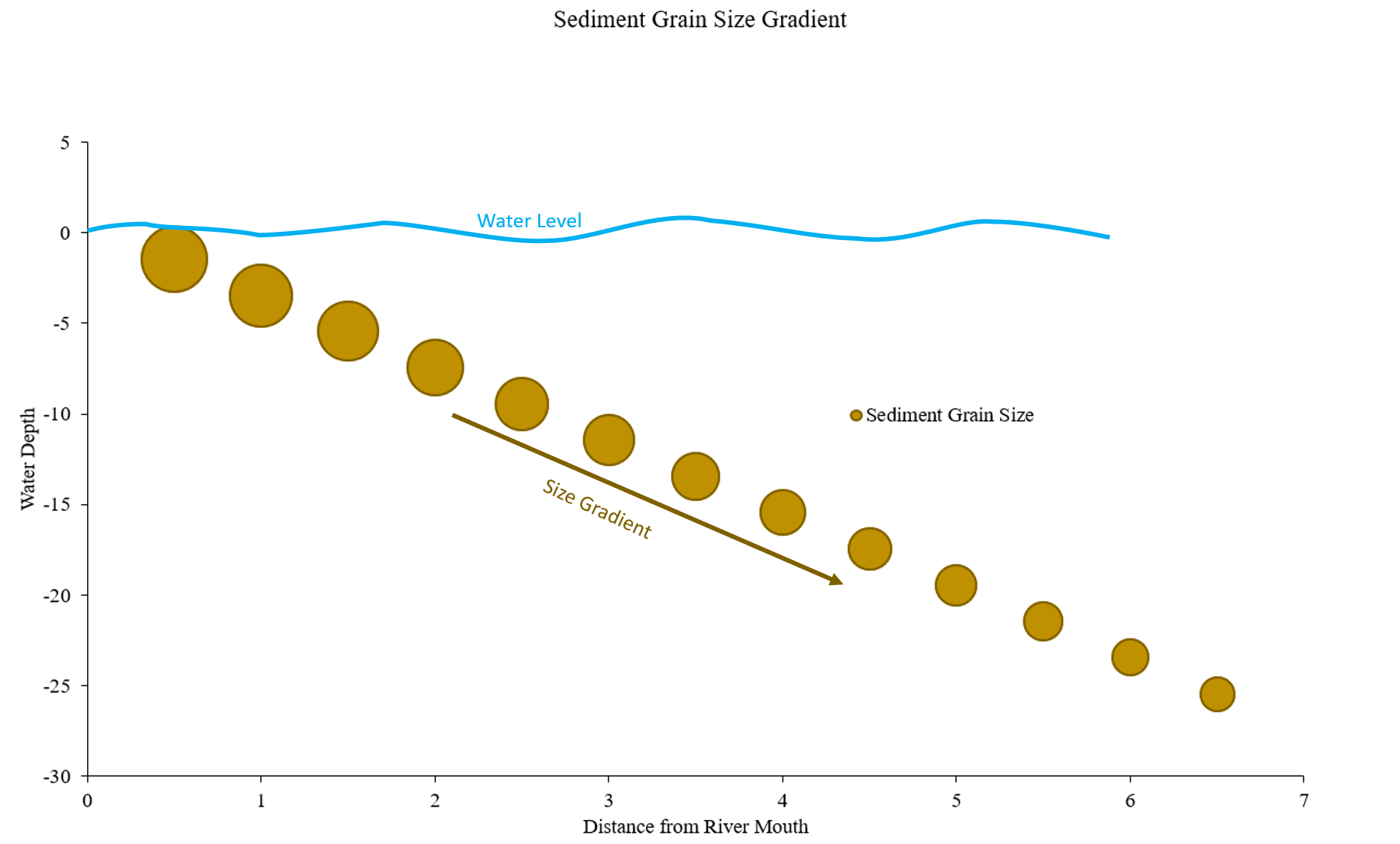
Distribution of grain sizes based on water depth and distance from river mouth.

Sorting describes the distribution of grain size of sediments, either in unconsolidated deposits or in sedimentary rocks. The degree of sorting is determined by the range of grain sizes in a sediment deposit and is the result of various transport processes (rivers, debris flow, wind, glaciers, etc.). This should not be confused with crystallite size, which refers to the individual size of a crystal in a solid. Crystallite is the building block of a grain.

Sorting parameters

[edit]

The terms describing sorting in sediments – very poorly sorted, poorly sorted, moderately sorted, well sorted, very well sorted – have technical definitions and semi-quantitatively describe the amount of variance seen in particle sizes.Very poorly sorted indicates that the sediment sizes are mixed (large variance); whereas well sorted indicates that the sediment sizes are similar (low variance). In the field, sedimentologists use graphical charts to accurately describe the sorting of a sediment using one of these terms.[1]

Tangential sorting is the result of sediment being deposited in same direction as flow. Normal tangential sorting results in a gradient of sediment sizes deposited from largest to finest as they travel downstream.[2] When sediments are deposited from smallest to largest as they travel downstream, this is referred to as reverse sorting.[2]

Rocks derived from well sorted sediments are commonly both porous and permeable, while poorly sorted rocks have low porosity and low permeability, particularly when fine grained.

Processes involved in sorting

[edit]

Sediment sorting is influenced by: grain sizes of sediment, processes involved in grain transport, deposition, and post-deposition processes such as winnowing.[3] As a result, studying the degree of sorting in deposits of sediment can give insight into the energy, rate, and/or duration of deposition, as well as the transport process responsible for laying down the sediment.[3]

Aeolian processes

[edit]

In reference to windblown sediment, a wide range of conditions such as distance and height of transport and varying wind patterns at the sediment source can affect grain size, rate of transport and distribution of sediment.[3] Windblown sediment travels one of three ways--rolling, saltation or suspension in the air.

Loess that is reworked by fluvial processes tends to have more poorly sorted sediment as compared to sediment sorted by only Aeolian processes because loess particles become mixed with preexisting sediment of varying grain sizes within bodies of water.[3]

See also

[edit]

References

[edit]

Grokipedia

from Grokipedia
In sedimentology, sorting refers to the degree to which sediment grains of varying sizes, shapes, and densities become segregated and distributed during transport and deposition by natural agents such as water, wind, or ice, leading to deposits that range from uniform in grain size to highly heterogeneous.[1][2] This process primarily occurs as particles settle differentially based on the energy of the transporting medium, with higher-energy environments capable of carrying larger grains farther while lower-energy settings favor deposition of coarser material first.[1][2] The mechanisms of sorting are influenced by factors including the duration and intensity of transport, the nature of the depositional environment, and post-depositional reworking such as winnowing, which removes finer particles.[1] For instance, well-sorted sediments, characterized by grains of similar size and shape, typically result from prolonged transport in consistent high-energy settings like beaches or dunes, indicating significant distance from the source rock and selective deposition.[3][2] In contrast, poorly sorted sediments, featuring a mix of grain sizes, often form in low-energy or chaotic environments such as glacial deposits, landslides, or short-distance fluvial transport, where variable energy prevents effective segregation.[3][1] Sediment sorting is quantitatively assessed using the phi (φ) scale, a logarithmic measure of grain diameter defined as φ = −log₂(d), where d is the diameter in millimeters, allowing statistical analysis of grain-size distributions.[4][5] Sorting is commonly expressed as the inclusive graphic standard deviation (σ_φ) in phi units, calculated from percentiles of the cumulative grain-size curve (e.g., σ_φ = (φ₈₄ − φ₁₆)/4 + (φ₉₅ − φ₅)/6.6), with values below 0.5 φ indicating well-sorted sediments and those above 1.0 φ denoting poor sorting.[4] This metric, along with others like Trask's sorting coefficient, helps classify sorting categories from very well sorted (<0.35 φ) to extremely poorly sorted (>4.0 φ).[5][4] Understanding sorting is crucial for interpreting depositional environments, reconstructing paleocurrents, and tracing sediment provenance in sedimentary rocks, as it reflects the transport history and energy conditions that shaped ancient landscapes.[1][2] Well-sorted deposits often signal mature sediments from stable settings conducive to lithification, while poorly sorted ones may preserve evidence of rapid burial events, aiding in geological mapping and resource exploration.[3][5]

Fundamentals

Definition

In sedimentology, sorting refers to the degree of uniformity in the grain size distribution within unconsolidated sediments or sedimentary rocks. It quantifies the range of particle sizes present, ranging from well-sorted sediments, which exhibit a narrow size distribution with grains of similar dimensions, to poorly sorted ones, characterized by a broad spectrum of sizes from fine to coarse. Moderately sorted sediments fall between these extremes, showing some variation but not as extreme as in poorly sorted deposits.[6][5] Additional concepts related to sorting include inverse sorting or inverse grading, where finer grains are concentrated at the base and coarser ones toward the top, contrasting with normal grading. These patterns arise from specific depositional dynamics but are integral to understanding textural maturity in sediments. Grain sizes in sorting assessments are typically referenced using scales like the Wentworth scale or the phi scale, which provide standardized classifications for particle diameters.[7][8] The concept of sorting was formalized in early 20th-century sedimentology, building on foundational work in grain size analysis by geologists such as J.A. Udden, whose 1898 study on the mechanical composition of wind deposits introduced systematic approaches to particle classification. Sorting primarily develops during sediment transport and deposition, as physical processes separate grains based on their size, shape, and density, leading to the observed textural variations in resulting deposits.[9][10]

Importance

Sorting in sediments serves as a key diagnostic indicator of the energy levels and stability of depositional environments. Well-sorted sediments, characterized by a narrow range of grain sizes, typically form in high-energy settings where selective transport mechanisms, such as waves or wind, efficiently separate particles by size, leading to uniform deposition.[11] In contrast, poorly sorted sediments reflect low-energy or rapidly changing conditions, such as those in glacial or debris flow environments, where a wide variety of grain sizes are deposited together without significant segregation.[12] This textural attribute allows geologists to infer the duration and intensity of transport processes, providing insights into the hydrodynamic conditions at the time of deposition.[1] The analysis of sorting plays a crucial role in paleoenvironmental reconstruction, enabling scientists to identify ancient depositional settings from the rock record. For instance, well-sorted sands in stratigraphic sequences often signal former beach or dune environments, while variably sorted conglomerates may indicate ancient riverbeds or alluvial fans, aiding in the mapping of sequence stratigraphy and basin evolution.[13] By integrating sorting data with stratigraphic context, researchers can reconstruct past landscapes, track sea-level changes, and understand tectonic influences on sedimentation patterns.[2] Economically and environmentally, sediment sorting significantly influences resource management and exploration. In aquifers, well-sorted sands exhibit higher permeability due to interconnected pore spaces, facilitating efficient groundwater flow and recharge, whereas poorly sorted materials impede transmission and reduce yield.[14] Similarly, in petroleum geology, sorting is a primary control on reservoir quality; well-sorted sandstones form superior reservoirs with enhanced porosity and permeability, optimizing hydrocarbon storage and recovery, as seen in many conventional oil and gas fields.[15][16] Sorting interacts with other sediment properties, such as grain roundness and composition, to provide a more refined interpretation of environmental signals, though it remains a fundamental proxy for transport duration and medium. For example, high roundness combined with good sorting suggests prolonged abrasion in aqueous or aeolian transport, enhancing the overall textural maturity assessment.[17] This interplay helps distinguish subtle variations in provenance and depositional history without relying solely on compositional analysis.

Parameters and Measurement

Qualitative Assessment

Qualitative assessment of sediment sorting relies on visual inspection to categorize the uniformity of grain sizes without numerical analysis. Common classification systems describe sorting using descriptive terms based on the observed spread of grain sizes: very well-sorted (highly uniform grains with minimal variation), well-sorted (grains of similar size with little diversity), moderately sorted (noticeable but not extreme variation in sizes), poorly sorted (wide range of grain sizes present), and very poorly sorted (highly diverse sizes spanning multiple categories).[18] These categories provide a quick, non-quantitative framework for evaluating how effectively transport and deposition processes have segregated grains by size.[18] In the field, geologists use simple tools such as a hand lens (typically 10x magnification) to examine sediment samples and estimate the range of grain sizes by comparing them directly to reference sieves or visual charts. Comparison charts, including specialized visual comparators designed to mimic two- and three-dimensional grain arrangements, allow for rapid approximation of sorting by matching observed textures to standardized images of known sorting degrees. These techniques are particularly useful during initial reconnaissance or when laboratory equipment is unavailable, enabling on-site decisions about sediment characteristics. Despite their practicality, qualitative methods have inherent limitations, as assessments are subjective and heavily influenced by the observer's experience and training. They are especially imprecise for fine-grained sediments like silts and clays, where individual grains are too small to resolve visually without magnification beyond a hand lens.[19] Qualitative sorting evaluations are frequently integrated with assessments of grain roundness to infer broad environmental conditions, such as transport distance or energy levels, while maintaining focus on size uniformity as the primary indicator. These visual determinations can be subsequently validated using quantitative statistical measures for greater precision.[18]

Quantitative Measures

Quantitative measures of sediment sorting rely on standardized grain size scales and statistical parameters derived from particle size distributions to provide precise, numerical assessments of uniformity. The phi (φ) scale, introduced by Krumbein, transforms grain diameters into a logarithmic unit for easier statistical analysis, defined as φ = -log₂(d), where d is the grain diameter in millimeters.[4] This scale facilitates the representation of sediment sizes from coarse gravel (negative φ values) to fine clay (positive φ >9), emphasizing the geometric progression of particle classes in sedimentary analysis.[4] Sorting coefficients quantify the spread of grain sizes, typically calculated from percentiles obtained from cumulative grain size distributions. Trask's sorting coefficient, proposed in 1930, is given by S₀ = √(d₇₅ / d₂₅), where d₂₅ and d₇₅ are the grain diameters (in mm) at the 25th and 75th percentiles of the cumulative weight percent finer curve, respectively; values less than 2 indicate well-sorted sediments, around 3 normally sorted, and greater than 4.5 poorly sorted.[20] A more widely adopted measure is the Folk and Ward inclusive graphic standard deviation (1957), which approximates the standard deviation in phi units as σ_φ = \frac{\phi_{84} - \phi_{16}}{4} + \frac{\phi_{95} - \phi_{5}}{6.6}, where φ₁₆, φ₈₄, φ₅, and φ₉₅ are the phi sizes at the 16th, 84th, 5th, and 95th percentiles; this method accounts for both the central 68% and outer tails of the distribution for robust sorting estimates across varied sediment types.[5] These coefficients are often derived using graphical methods, where cumulative frequency curves of grain size data are plotted on probability paper to linearize lognormal distributions and extract percentiles directly.[17] Straight-line segments on such plots indicate normal distributions, allowing rapid calculation of sorting indices like σ_φ from key points (e.g., φ₁₆ and φ₈₄ for the inner quartile range).[17] Modern quantitative approaches employ automated tools such as laser diffraction analysis, which measures particle size distributions by scattering laser light off suspended grains, enabling high-resolution data for statistical moments including mean size and variance (sorting as the standard deviation in phi units).[21] Image analysis software further supports this by processing digital photographs of sediments to compute size histograms and derive sorting parameters efficiently.[21] These methods yield sorting values that align with traditional visual categories, such as σ_φ < 0.35 for very well-sorted, 0.35–0.50 for well-sorted, 0.50–0.71 for moderately well-sorted, 0.71–1.00 for moderately sorted, 1.00–2.00 for poorly sorted, and >2.00 for very poorly sorted sediments.[4]

Depositional Processes

Fluvial Processes

In fluvial environments, sediment sorting occurs primarily through hydraulic mechanisms driven by water flow velocity and turbulence in rivers and streams. Selective entrainment begins when flow exceeds the critical shear stress for individual grain sizes, with coarser particles requiring higher velocities to initiate motion, as illustrated by the Hjulström curve, which demonstrates that gravel and coarse sand demand velocities around 50-100 cm/s for erosion, while finer silts and clays require higher velocities due to cohesive forces for erosion but settle more readily once entrained.[22] This process results in downstream fining, where larger grains are progressively left behind as transport capacity decreases with distance or reduced velocity.[23] Sediments are transported in two main modes: bedload and suspended load, each contributing differently to sorting. Bedload consists of coarser sands and gravels (typically >0.0625 mm) that move along the channel bed via rolling, sliding, or saltation, forming traction carpets that enhance local sorting; in braided rivers, these deposits create moderately sorted gravel bars where fines are winnowed out during high flows.[24] Suspended load, comprising finer silts and clays (<0.0625 mm), is carried within the water column by turbulence and often remains poorly sorted as the wash load, with minimal size segregation due to uniform suspension across flow stages.[25] This bimodal transport leads to overall moderate sorting in fluvial deposits, with standard deviation values (σ_φ) typically ranging from 0.5 to 1.0 for sands.[26] Channel morphology influences sorting through dynamic deposition patterns. In meandering rivers, helical flow directs coarser bedload toward outer bends, while inner point bars accrete finer sediments during overbank flows, producing vertical fining-upward sequences with improving sorting from coarse basal layers to finer tops.[27] Flood events amplify this by eroding and redepositing materials, enhancing downstream grading as velocity wanes. For instance, alluvial fans exhibit poor sorting near the apex due to rapid debris flow deposition of heterogeneous debris, transitioning to better sorted fluvial sands distally as channelization increases selective transport.[28] The modern Mississippi River exemplifies this, with bed sediments fining from coarse sands upstream to silty deposits downstream, reflecting progressive hydraulic sorting over 740 km.[29] Discharge variability, characteristic of fluvial systems, further moderates sorting by alternating high-energy erosion of mixed sizes with low-flow deposition favoring fines. In variable regimes, such as semi-arid rivers prone to flash floods, this intermittency prevents extreme sorting, yielding deposits with σ_φ around 1.0-1.5, unlike more uniform flows that could produce better segregation.[30] Overall, these processes ensure fluvial sorting reflects a balance between entrainment selectivity and depositional winnowing, distinct from constant-flow environments.[31]

Aeolian Processes

Aeolian sediment transport occurs primarily through three modes: saltation, suspension, and surface creep, each selective for specific grain sizes and resulting in pronounced size sorting. Saltation dominates for medium sands (0.1–0.5 mm), where grains bounce along the surface in short trajectories, accounting for about 75% of total sediment flux and efficiently sorting these sizes due to optimal aerodynamic entrainment.[32] Suspension carries finer particles (<0.1 mm) high into the atmosphere for long-distance transport, while surface creep moves coarser grains (>0.5 mm) by rolling or sliding near the bed, further segregating size fractions and enhancing overall selectivity compared to less discriminatory processes.[33] In dune formation, wind-driven processes produce well-sorted cross-bedded sands through mechanisms like avalanching on lee slopes and the migration of wind ripples, which concentrate uniform grain sizes in depositional layers. Avalanching during dune slipface collapse selectively deposits medium sands, forming grainflow cross-strata with high sorting due to size-based segregation during flow.[34] Ripple migration on the stoss side transports saltating grains that settle into sorted laminations, while deflationwind removal of fine particles—further refines the remaining deposit by winnowing silts and clays, increasing grain uniformity in the surface armor.[35] Arid environmental conditions strongly favor excellent aeolian sorting by minimizing moisture and vegetation that could bind sediments, allowing unimpeded wind selection; for instance, a highly mobile dune in SW Spain exhibits sorting coefficients (σ_φ) as low as 0.5–0.78, indicating very well-sorted sands.[36] In contrast, increased vegetation cover or surface moisture in semi-arid zones dampens transport efficiency, leading to poorer sorting by trapping fines and reducing selective entrainment.[37] Representative examples include loess deposits, which form well-sorted silt layers (typically 0.02–0.05 mm) from winds reworking glacial outwash, as seen in mid-latitude plains where uniform particle sizes reflect prolonged suspension transport.[38] Modern eolianites in the Arabian Peninsula, such as the Quaternary Dammam Eolianite, consist of well-sorted fine to medium sands derived from coastal reworking, with cross-bedding preserving the selective aeolian signature.[39] A distinctive feature of aeolian sorting is the occurrence of bimodal grain size distributions, arising from the mixing of saltation-transported medium sands and suspension-delivered fines, which create dual peaks in histograms without the density-based fractionation prominent in aqueous environments.[40] This size-selective dominance in wind transport contrasts with water flows, emphasizing aerodynamic thresholds over hydraulic density effects.[41]

Marine Processes

In marine environments, sediment sorting is primarily driven by wave and tidal actions, which selectively transport and deposit grains based on size, shape, and density through oscillatory and unidirectional flows. On beaches, the orbital motion of waves generates swash and backwash that winnow finer particles, leading to well-sorted fine sands in berm deposits, particularly during fair-weather conditions where wave energy is moderate.[42] Longshore currents, induced by waves approaching at an oblique angle, further grade sediments along shorelines by transporting coarser grains downdrift while finer materials settle closer to the shore, resulting in lateral variations in grain size distribution.[43] Tidal currents enhance this process in intertidal zones, promoting rhythmic sorting patterns that reflect the interplay of ebb and flood flows with wave dominance.[44] On continental shelves and in deep-sea settings, sorting is influenced by density-driven flows and biological activity. Turbidity currents deposit graded beds in submarine environments, with poorly sorted coarse sands and gravels at the base transitioning upward to better-sorted fine sands and silts as flow velocity decreases, a process evident in turbidite sequences.[45] Biogenic reworking by benthic organisms, such as burrowing worms and clams, homogenizes shelf muds by mixing grains and removing fines, thereby improving overall sorting and creating more uniform textures in otherwise heterogeneous deposits.[46] Bottom currents contribute to this refinement by eroding loose fines and redistributing sediments across the shelf.[47] Deltaic environments exhibit variable sorting due to the progradation of fluvial sediments into marine realms, where wave and tidal reworking interact with riverine inputs. In such settings, like the Mississippi Delta, distributary mouth bars and channel fills consist of moderately sorted fine sands and silts, reflecting the blending of poorly sorted fluvial loads with marine winnowing that selectively removes clays.[48] This mixing produces transitional deposits with moderate textural uniformity, contrasting with the more homogeneous sorting in purely marine areas. Representative examples illustrate these processes: barrier island sands, such as those on Padre Island, achieve excellent sorting through repeated wave winnowing, yielding uniform medium to fine quartz grains that support dune formation.[49] In submarine fans, Bouma sequences capture sorting evolution, beginning with massive, poorly sorted divisions (Ta) from high-energy deposition and progressing to finely laminated, well-sorted pelagics (Te) as flows decelerate across the fan lobe.[50] Additional factors like salinity gradients and density stratification influence sorting by creating buoyant plumes that segregate sediments beyond size alone; freshwater inputs form hypopycnal flows that deposit finer particles first, enhancing size-based separation in estuarine-marine transitions.[51] Storm events disrupt this uniformity by generating high-energy surges that resuspend and redistribute mixed grain sizes, temporarily worsening sorting before post-storm settling restores gradients.[52]

Glacial Processes

Glaciers entrain sediment through mechanical processes such as plucking, where ice freezes to bedrock and pulls away fragments during basal sliding, and abrasion, where debris embedded in the ice base grinds against the underlying surface, producing a wide spectrum of particle sizes from clay to boulders.[53] This non-selective transport results in till, an unsorted diamicton deposit characterized by poor sorting due to the lack of hydraulic separation, with sediment mixtures spanning multiple phi units.[54] Freeze-thaw cycles at the glacier bed further enhance plucking by exploiting cracks in bedrock, but they contribute to mixing rather than segregation of grain sizes, contrasting with fluid-dominated processes that promote separation.[55] Diamicton deposits from glacial action include lodgement till, formed by direct compression and release of debris beneath the ice, which remains very poorly sorted owing to minimal post-entrainment reorganization, and flow till, derived from deformation and downslope movement of supraglacial material, exhibiting slightly improved sorting from limited shear-induced segregation.[54] In Pleistocene glacial tills across North America, such as those in the Great Lakes region, sorting coefficients often exceed 2.0 phi standard deviation (σ_φ), reflecting the broad grain-size distribution from dominant mechanical mixing over selective transport.[5] Basal sliding facilitates the incorporation of diverse debris without size-based filtering, emphasizing homogenization in these deposits. Meltwater interactions introduce some sorting in subglacial and proglacial environments, where high-velocity streams rework till into outwash plains, depositing coarser gravels and sands proximally while fines are carried farther downstream, though overall sorting remains coarser and less refined than in typical fluvial systems due to the sediment load's glacial origin.[56] Features like eskers and kames, formed in braided meltwater channels, display moderate sorting with stratified gravels, as turbulent flows selectively deposit particles by size in subglacial tunnels or ice-marginal mounds.[57] These processes highlight how glacial transport prioritizes bulk mixing, with sorting limited to meltwater-mediated reworking.

References

User Avatar
No comments yet.