Hubbry Logo
MagnificationMagnificationMain
Open search
Magnification
Community hub
Magnification
logo
8 pages, 0 posts
0 subscribers
Be the first to start a discussion here.
Contribute something
Magnification
Magnification
from Wikipedia
The postage stamp appears larger with the use of a magnifying glass.
Stepwise magnification by 6% per frame into a 39-megapixel image. In the final frame, at about 170x, an image of a bystander is seen reflected in the man's cornea.

Magnification is the process of enlarging the apparent size, not physical size, of something. This enlargement is quantified by a size ratio called optical magnification. When this number is less than one, it refers to a reduction in size, sometimes called de-magnification.

Typically, magnification is related to scaling up visuals or images to be able to see more detail, increasing resolution, using microscope, printing techniques, or digital processing. In all cases, the magnification of the image does not change the perspective of the image.

Examples of magnification

[edit]

Some optical instruments provide visual aid by magnifying small or distant subjects.

  • A magnifying glass, which uses a positive (convex) lens to make things look bigger by allowing the user to hold them closer to their eye.
  • A telescope, which uses its large objective lens or primary mirror to create an image of a distant object and then allows the user to examine the image closely with a smaller eyepiece lens, thus making the object look larger.
  • A microscope, which makes a small object appear as a much larger image at a comfortable distance for viewing. A microscope is similar in layout to a telescope except that the object being viewed is close to the objective, which is usually much smaller than the eyepiece.
  • A slide projector, which projects a large image of a small slide on a screen. A photographic enlarger is similar.
  • A zoom lens, a system of camera lens elements for which the focal length and angle of view can be varied.

Size ratio (optical magnification)

[edit]

Optical magnification is the ratio between the apparent size of an object (or its size in an image) and its true size, and thus it is a dimensionless number. Optical magnification is sometimes referred to as "power" (for example "10× power"), although this can lead to confusion with optical power.

Linear or transverse magnification

[edit]

For real images, such as images projected on a screen, size means a linear dimension (measured, for example, in millimeters or inches).

Angular magnification

[edit]

For optical instruments with an eyepiece, the linear dimension of the image seen in the eyepiece (virtual image at infinite distance) cannot be given, thus size means the angle subtended by the object at the focal point (angular size). Strictly speaking, one should take the tangent of that angle (in practice, this makes a difference only if the angle is larger than a few degrees). Thus, angular magnification is given by:
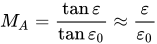
where is the angle subtended by the object at the front focal point of the objective and is the angle subtended by the image at the rear focal point of the eyepiece.

For example, the mean angular size of the Moon's disk as viewed from Earth's surface is about 0.52°. Thus, through binoculars with 10× magnification, the Moon appears to subtend an angle of about 5.2°.

By convention, for magnifying glasses and optical microscopes, where the size of the object is a linear dimension and the apparent size is an angle, the magnification is the ratio between the apparent (angular) size as seen in the eyepiece and the angular size of the object when placed at the conventional closest distance of distinct vision: 25 cm from the eye.

A thin lens where black dimensions are real, the greys are virtual.

By instrument

[edit]

Single lens

[edit]

The linear magnification of a thin lens is

where is the focal length, is the distance from the lens to the object, and as the distance of the object with respect to the front focal point. A sign convention is used such that and (the image distance from the lens) are positive for real object and image, respectively, and negative for virtual object and images, respectively. of a converging lens is positive while for a diverging lens it is negative.

For real images, is negative and the image is inverted. For virtual images, is positive and the image is upright.

With being the distance from the lens to the image, the height of the image and the height of the object, the magnification can also be written as:

Note again that a negative magnification implies an inverted image.

The image magnification along the optical axis direction , called longitudinal magnification, can also be defined. The Newtonian lens equation is stated as , where and as on-axis distances of an object and the image with respect to respective focal points, respectively. is defined as

and by using the Newtonian lens equation,

The longitudinal magnification is always negative, means that, the object and the image move toward the same direction along the optical axis. The longitudinal magnification varies much faster than the transverse magnification, so the 3-dimensional image is distorted.

Photography

[edit]

The image recorded by a photographic film or image sensor is always a real image and is usually inverted. When measuring the height of an inverted image using the cartesian sign convention (where the x-axis is the optical axis) the value for hi will be negative, and as a result M will also be negative. However, the traditional sign convention used in photography is "real is positive, virtual is negative".[1] Therefore, in photography: Object height and distance are always real and positive. When the focal length is positive the image's height, distance and magnification are real and positive. Only if the focal length is negative, the image's height, distance and magnification are virtual and negative. Therefore, the photographic magnification formulae are traditionally presented as[2]

Magnifying glass

[edit]

The maximum angular magnification (compared to the naked eye) of a magnifying glass depends on how the glass and the object are held, relative to the eye. If the lens is held at a distance from the object such that its front focal point is on the object being viewed, the relaxed eye (focused to infinity) can view the image with angular magnification

Here, is the focal length of the lens in centimeters. The constant 25 cm is an estimate of the "near point" distance of the eye—the closest distance at which the healthy naked eye can focus. In this case the angular magnification is independent from the distance kept between the eye and the magnifying glass.

If instead the lens is held very close to the eye and the object is placed closer to the lens than its focal point so that the observer focuses on the near point, a larger angular magnification can be obtained, approaching

A different interpretation of the working of the latter case is that the magnifying glass changes the diopter of the eye (making it myopic) so that the object can be placed closer to the eye resulting in a larger angular magnification.

Microscope

[edit]

The angular magnification of a microscope is given by

where is the magnification of the objective and the magnification of the eyepiece. The magnification of the objective depends on its focal length and on the distance between objective back focal plane and the focal plane of the eyepiece (called the tube length):

The magnification of the eyepiece depends upon its focal length and is calculated by the same equation as that of a magnifying glass:

Note that both astronomical telescopes as well as simple microscopes produce an inverted image, thus the equation for the magnification of a telescope or microscope is often given with a minus sign.[citation needed]

Telescope

[edit]

The angular magnification of an optical telescope is given by

in which is the focal length of the objective lens in a refractor or of the primary mirror in a reflector, and is the focal length of the eyepiece.

Measurement of telescope magnification

[edit]

Measuring the actual angular magnification of a telescope is difficult, but it is possible to use the reciprocal relationship between the linear magnification and the angular magnification, since the linear magnification is constant for all objects.

The telescope is focused correctly for viewing objects at the distance for which the angular magnification is to be determined and then the object glass is used as an object the image of which is known as the exit pupil. The diameter of this may be measured using an instrument known as a Ramsden dynameter which consists of a Ramsden eyepiece with micrometer hairs in the back focal plane. This is mounted in front of the telescope eyepiece and used to evaluate the diameter of the exit pupil. This will be much smaller than the object glass diameter, which gives the linear magnification (actually a reduction), the angular magnification can be determined from

Maximum usable magnification

[edit]

With any telescope, microscope or lens, a maximum magnification exists beyond which the image looks bigger but shows no more detail. It occurs when the finest detail the instrument can resolve is magnified to match the finest detail the eye can see. Magnification beyond this maximum is sometimes called "empty magnification".

For a good quality telescope operating in good atmospheric conditions, the maximum usable magnification is limited by diffraction. In practice it is considered to be 2× the aperture in millimetres or 50× the aperture in inches; so, a 60 mm diameter telescope has a maximum usable magnification of 120×.[citation needed]

With an optical microscope having a high numerical aperture and using oil immersion, the best possible resolution is 200 nm corresponding to a magnification of around 1200×. Without oil immersion, the maximum usable magnification is around 800×. For details, see limitations of optical microscopes.

Small, cheap telescopes and microscopes are sometimes supplied with the eyepieces that give magnification far higher than is usable.

The maximum relative to the minimum magnification of an optical system is known as zoom ratio.

"Magnification" of displayed images

[edit]

Magnification figures on pictures displayed in print or online can be misleading. Editors of journals and magazines routinely resize images to fit the page, making any magnification number provided in the figure legend incorrect. Images displayed on a computer screen change size based on the size of the screen. A scale bar (or micron bar) is a bar of stated length superimposed on a picture. When the picture is resized the bar will be resized in proportion. If a picture has a scale bar, the actual magnification can easily be calculated. Where the scale (magnification) of an image is important or relevant, including a scale bar is preferable to stating magnification.

See also

[edit]

References

[edit]
Revisions and contributorsEdit on WikipediaRead on Wikipedia
from Grokipedia
Magnification is the process by which the apparent size of an object is increased through optical means, such as lenses or mirrors, to facilitate detailed beyond the limits of the unaided eye. In , it is fundamentally quantified as either linear (transverse) magnification, defined as the ratio of the image height to the object height (m = h_i / h_o), or angular magnification, which is the ratio of the angle subtended by the image at the observer's eye to the angle subtended by the object when viewed directly at a standard distance. These measures enable the use of instruments like microscopes and telescopes to reveal fine details in small or distant objects, though magnification alone does not improve resolution, which is constrained by the of and the system's . Optical magnification finds essential applications in scientific, medical, and astronomical contexts. Simple magnifiers, such as handheld lenses, achieve angular magnification by allowing objects to be placed closer to the eye than the eye's near point, typically yielding magnifications of 2 to 20 times depending on the lens focal length and viewing conditions. Compound microscopes combine an objective lens, which produces a real enlarged intermediate image, with an eyepiece acting as a magnifier, resulting in total magnification as the product of the two components—often reaching 1000x or more in modern systems for biological and materials analysis. Telescopes, by contrast, primarily employ angular magnification to enlarge the apparent size of celestial bodies, with refracting designs using objective and eyepiece lenses to achieve powers from 20x in basic models to over 1000x in professional instruments. Beyond these, magnification principles extend to photography and digital imaging, where lens systems or software algorithms simulate enlargement while preserving optical fidelity. The development of magnification traces back to ancient civilizations, with early references in from the 8th century BCE depicting simple magnifying devices made from crystals or polished stones. Practical advancements emerged in the 13th century when Italian crafted convex glass lenses, known as "reading stones," for aiding vision in manuscripts, marking the of corrective and magnifying . The late brought revolutionary compound systems: Dutch spectacle-makers Hans and are credited with inventing the compound microscope around 1590, enabling magnifications of 3x to 9x through multiple lenses, while Hans Lippershey patented a basic in 1608. Italian astronomer refined the in 1609, achieving 20-30x magnification that allowed groundbreaking observations of Jupiter's moons and Saturn's rings, fundamentally advancing astronomy and . Subsequent innovations, including achromatic lenses in the 18th century and electron microscopy in the 20th, have pushed magnification limits while addressing aberrations and resolution challenges. Despite its power, magnification has inherent limitations that prevent indefinite enlargement without loss of utility. The useful range of total magnification in a , for instance, is bounded by the system's (NA), with the maximum effective power approximately 1000-1500 times the NA to avoid "empty magnification," where images blur due to limits rather than revealing new details. In telescopes, atmospheric and size cap practical angular magnification to avoid dim, unstable views, typically limiting instruments to 50x per inch of diameter. These constraints underscore that true optical progress relies on balancing magnification with resolution, illumination, and contrast for meaningful scientific insight.

Core Concepts

Definition and Principles

Magnification in refers to the factor by which the apparent size of an object is enlarged or reduced compared to its actual size when viewed through an optical system. This process relies on the manipulation of rays by lenses or mirrors to form an that alters the object's perceived dimensions. At its core, magnification involves the formation of either real or . Real images occur where light rays physically converge after passing through the optical element, resulting in an inverted image that can be projected onto a screen. , in contrast, form when rays appear to diverge from a virtual point behind the optical element, producing an upright image that cannot be projected but is visible to the eye. The degree of magnification qualitatively depends on the —the distance from the optical element to the point where parallel rays converge—and the object's position relative to this length; for example, positioning an object inside the of a converging lens yields a larger than the object. As a ratio of sizes, magnification is dimensionless, often denoted without units (e.g., 10x indicates an ten times the object's ).

Linear Magnification

Linear magnification, also referred to as transverse or lateral magnification, quantifies the scaling of an object's in the relative to its actual , specifically for dimensions perpendicular to the . It is defined as the of the hh' to the object hh, expressed as m=hhm = \frac{h'}{h}. This measure applies primarily to paraxial approximations in systems, where rays are close to the . In optical conventions, such as the , the sign of mm indicates the image orientation: positive values correspond to upright (erect) images, while negative values denote inverted images. This convention aligns with the standard , where object distance uu is negative for objects on the incident side, and image distance vv is positive for real on the opposite side. The is given by 1v1u=1f,\frac{1}{v} - \frac{1}{u} = \frac{1}{f}, where ff is the focal length (positive for converging lenses). From similar triangles formed by principal rays—such as the ray parallel to the axis refracting through the focal point and the ray through the optical center undeviated—the magnification emerges as m=vum = \frac{v}{u}. The negative sign for real images accounts for inversion, ensuring consistency with the sign convention. For a convex (converging) lens forming a , consider an object placed at a u=15u = -15 cm from a lens with f=10f = 10 cm. Using the lens equation, 1v=1f+1u=0.1+(115)=0.10.0667=0.0333,\frac{1}{v} = \frac{1}{f} + \frac{1}{u} = 0.1 + \left( -\frac{1}{15} \right) = 0.1 - 0.0667 = 0.0333, so v=30v = 30 cm. Then m=vu=3015=2m = \frac{v}{u} = \frac{30}{-15} = -2, indicating an inverted twice the object height. In ray diagrams for this setup, the object is positioned between one and two focal lengths from the lens. A ray from the object top parallel to the axis passes through the lens and bends toward the focal point on the other side, intersecting the axis at the location 30 cm away. Another ray from the top through the lens center remains straight, and a third from the top through the focal point emerges parallel. These intersect to form an inverted, enlarged . As the object distance increases toward , |m| approaches zero, shrinking the size. When |m| < 1, the process is termed demagnification, occurring for objects placed beyond twice the from a converging lens, resulting in a real, inverted, and reduced . For instance, with the same lens (f=10f = 10 cm) and object at u=30u = -30 cm, 1v=0.1+130=0.10.0333=0.0667,v=15 cm,\frac{1}{v} = 0.1 + \frac{1}{-30} = 0.1 - 0.0333 = 0.0667, \quad v = 15 \ \text{cm}, yielding m=1530=0.5m = \frac{15}{-30} = -0.5, a halved size. Such demagnification is common in imaging s like cameras, where large scenes are projected onto smaller sensors. In projectors, while the overall often achieves enlargement from slide to screen, intermediate stages may involve demagnification in objective lenses to focus the path efficiently.

Angular Magnification

Angular magnification quantifies the apparent enlargement of an object as perceived by the through an , defined as the ratio of the angle subtended by the (θ\theta') to the angle subtended by the object (θ\theta) when viewed unaided at the of the eye, typically 25 cm: M=θ/θM = \theta' / \theta. This measure is particularly relevant for instruments like magnifiers and telescopes, where the final is virtual and observed directly, emphasizing the observer's rather than physical dimensions. The value of angular magnification depends on whether the eye is relaxed (accommodated for , with the image at ) or focused at the least distance of distinct vision (25 cm). For a relaxed eye using a simple magnifier, the object is placed at the focal point of the lens, yielding M=D/fM = D / f, where D=25D = 25 cm is the near-point and ff is the in cm. In contrast, for the normal eye with the image at 25 cm, the magnification is higher: M=1+D/fM = 1 + D / f. These formulas apply specifically to a simple positive lens acting as a magnifier, with practical values often ranging from 5× to 25× depending on the lens design. Angular magnification is preferred over linear magnification for near objects or direct-view instruments because it directly relates to the eye's of size, where the unaided angular subtense is maximized by holding the object close (at 25 cm). Linear magnification, which measures transverse size ratios, becomes impractical or infinite for virtual images at , failing to capture the effective visual enlargement. This angular approach is essential when no is projected on a screen, as in viewing. Historically, angular magnification played a key role in early telescope design, as Johannes Kepler analyzed visual angles in his 1611 treatise Dioptrice, proposing a configuration with convex objective and eyepiece lenses that enhanced apparent size through increased angular subtense, laying the foundation for the Keplerian telescope.

Illustrative Examples

Everyday Applications

Magnification plays a crucial role in everyday activities by enhancing visibility for tasks that exceed the natural capabilities of the human eye. The unaided adult eye can accommodate for clear focus from about 25 cm to infinity, providing effectively 1x magnification for distant objects but struggling with finer details at closer ranges due to limited lens flexibility. As people age, presbyopia reduces this accommodation amplitude to around 2-4 diopters, often necessitating aids to restore comfortable near vision without strain. Reading glasses are a common solution for , typically offering 1.5x to 3x magnification through lens powers of +1.00 to +3.00 diopters, allowing users to read small print or perform detailed handiwork at arm's length. Similarly, makeup mirrors with curved concave surfaces provide 3x to 5x enlargement, enabling precise application of by reflecting a larger, closer view of facial features without requiring additional tools. In cultural contexts, magnification appears through optical illusions like anamorphic drawings, where distorted images on flat surfaces create apparent enlargement or three-dimensionality when viewed from a specific angle, as seen in techniques that play with perspective to deceive the eye. Modern consumer devices extend this accessibility; for instance, smartphone macro lenses or built-in modes achieve 5x to 10x magnification for casual , capturing intricate details of everyday subjects like flowers or textures with minimal setup. These applications highlight how magnification bridges the gap between human perception limits and practical needs, paving the way for more specialized uses in science and technology.

Scientific and Technical Examples

In forensic , microscopes with magnifications typically ranging from 20x to 50x are employed to examine , such as fibers, hairs, and paint chips, allowing investigators to identify and compare minute details without altering the samples. This range provides sufficient resolution for initial screening while maintaining a wide , essential for linking evidence to scenes. In , loupes offering 10x to 30x magnification are standard for inspecting inclusions, enabling gemologists to assess clarity by revealing internal flaws like feathers or pinpoints that affect a stone's value and durability. The 10x level, endorsed by organizations like the , serves as the benchmark for grading, as it balances detail visibility with practical for professional evaluations. Industrial in relies on microscopes with 100x or higher magnification to inspect microchips for defects, such as issues or contamination on integrated circuits, ensuring reliability in production. These higher magnifications allow precise of features in the micrometer range, critical for detecting failures that could impact device . In medical diagnostics, dermatoscopes provide approximately 10x magnification to visualize skin lesions, aiding in the early detection of conditions like by highlighting subsurface structures such as pigment networks and vascular patterns. This level of enlargement improves diagnostic accuracy by reducing surface reflections and revealing details invisible to the . For biological sample viewing, 40x magnification on compound microscopes standardizes the observation of prepared slides, such as tissue sections or cell cultures, by providing clear resolution of cellular structures like nuclei and organelles without excessive distortion./01:_Labs/1.04:_Microscopy) This objective lens power, combined with a 10x , yields an effective total magnification suited for routine analysis in and cytology.

Optical Instruments

Magnifying Glass and Simple Lenses

A , also known as a simple magnifier, consists of a single convex lens typically held close to the eye or the object being viewed. When the object is placed within the of the lens, it forms a virtual, upright, and enlarged that appears farther from the lens than the object itself. This configuration allows the eye to perceive the more comfortably, often at or beyond the of distinct vision. The invention of the dates back to the 13th century, with early forms developed by Italian monks who crafted semi-shaped ground lenses resembling reading stones to aid in manuscript reading. In , advanced optical studies around the same period, experimenting with glass spheres as magnifiers, which predated more complex compound optical systems. The magnification achieved by a simple is primarily angular, comparing the angle subtended by the through the lens to the angle subtended by the object viewed directly at the . For a relaxed eye, where the final is at , the angular magnification MM is given by M=25fM = \frac{25}{f} where ff is the of the lens in centimeters, and 25 cm represents the conventional least distance of distinct vision for a normal eye. This formula indicates that shorter focal lengths yield higher magnification; for example, a lens with f=5f = 5 cm provides M=5M = 5, making small details appear five times larger angularly. To apply it, measure the by focusing parallel rays (such as from a distant object) onto a screen, then compute MM directly, ensuring the lens is positioned to keep the virtual and the eye relaxed. Simple magnifying glasses have inherent limitations that restrict their utility. The field of view is inherently narrow, particularly at higher magnifications, as increased power reduces the observable area—for instance, at 10x magnification, the field may shrink to about 0.5 inches in diameter. Additionally, inexpensive lenses often exhibit , where different wavelengths of focus at slightly different points, causing color fringing around edges due to the varying refractive indices of for different colors. Modern variants address these issues through aspheric lenses, which feature non-spherical surfaces to minimize distortion and , providing clearer images across the field in reading aids and hand-held magnifiers. These designs allow for higher magnification with reduced edge-to-edge warping, improving for tasks like detailed inspection or low-vision assistance.

Microscopes

Microscopes achieve high magnification through optical systems, primarily using an objective lens to form a real, inverted intermediate image of the specimen, which is then further magnified by the acting as a simple magnifier for viewing at a comfortable . This two-stage process allows for total linear magnification far exceeding that of single lenses, enabling detailed observation of microscopic structures. The linear magnification of the objective lens, mobjectivem_{\text{objective}}, is approximated by mobjective=Lfobjectivem_{\text{objective}} = -\frac{L}{f_{\text{objective}}}, where LL is the tube (typically 16 cm in standard designs) and fobjectivef_{\text{objective}} is the of the objective; the negative sign indicates an inverted . The angular magnification of the , MeyepieceM_{\text{eyepiece}}, for relaxed viewing ( at infinity) is Meyepiece=25feyepieceM_{\text{eyepiece}} = \frac{25}{f_{\text{eyepiece}}}, with feyepiecef_{\text{eyepiece}} in cm and 25 cm being the least distance of distinct vision. The total magnification is the product m=mobjective×Meyepiecem = m_{\text{objective}} \times M_{\text{eyepiece}}, yielding typical values of 100× to 1000× for standard optical compound microscopes, depending on lens combinations such as 10× with 10×, 40×, or 100× objectives. Optical microscopes encompass designs for high-resolution , while microscopes provide lower-power, three-dimensional viewing with magnifications typically ranging from 10× to 50×, suitable for larger specimens like or circuit boards. Magnification in microscopes is limited by resolution, governed by the of ; useful magnification is generally up to about 1000× the (NA) of the objective, beyond which "empty magnification" occurs, enlarging the image without revealing additional detail due to unresolved blur. For typical high-NA objectives (NA ≈ 1.4), this caps practical optical magnification at around 1500×, as further increase merely amplifies indistinct features. Post-1990s advancements include , which uses a pinhole to eliminate out-of-focus , enhancing resolution and enabling three-dimensional imaging with effective magnifications integrated into optical sections thinner than 1 μm. Digital microscopy further integrates magnification with software for image processing, capture, and analysis via CCD cameras and computational tools, allowing post-acquisition enhancement and quantification since the late 1990s.

Telescopes

Telescopes are optical instruments designed to increase the angular size of distant objects, allowing observers to discern finer details in celestial bodies or terrestrial features by magnifying their apparent angular extent. Unlike microscopes, which focus on linear magnification of nearby specimens, telescopes emphasize angular magnification for , often employing an similar to that in microscopes to further enlarge the intermediate image formed by the objective. There are two primary types of telescopes: refracting telescopes, which use a convex objective lens to gather and focus incoming rays through , and reflecting telescopes, which employ a concave primary mirror to reflect to a focus, often with a secondary mirror to redirect the beam to an . Reflecting designs are preferred for larger apertures due to the ease of fabricating large mirrors without the chromatic aberrations inherent in lenses. The angular magnification MM of a is fundamentally given by the ratio of the focal length of fof_o to the focal length of the fef_e, expressed as M=fo/feM = f_o / f_e. In the standard astronomical configuration, where the final image is inverted, the magnification is M=fo/feM = -f_o / f_e, with the negative sign indicating the orientation. For terrestrial telescopes, which produce an erect (upright) image suitable for viewing earthly objects, an additional erecting lens or prism system is inserted between and , effectively lengthening the tube while maintaining the magnification magnitude as M=fo/feM = f_o / f_e. To measure a telescope's angular magnification practically, observers can use a reticle—a scaled graticule etched into the eyepiece focal plane—to compare the apparent angular separation of known features against their actual angular sizes. For instance, the angular diameters of double stars or lunar craters, such as the Moon's prominent crater Tycho with a known angular size of about 0.5 degrees from Earth, can be observed both unaided and through the telescope; the ratio of the apparent sizes yields the magnification. The historical development of telescope magnification began with Galileo Galilei's in 1609, which achieved approximately 20x magnification and enabled groundbreaking observations of Jupiter's moons and lunar phases. Modern professional telescopes far surpass early designs in revealing distant cosmic structures through advanced and . Accessories like the , a diverging lens placed between and , increase the effective of , thereby boosting magnification (typically by 2x or more) without requiring a shorter-focal-length , which helps maintain a wider .

Photographic and Imaging Systems

In photographic systems, magnification refers to the size of the image projected onto the film or relative to the actual object size, determined primarily by the lens's and the subject distance. The linear magnification mm for a photographic lens is given by the formula m=fsfm = \frac{f}{s - f}, where ff is the and ss is the subject distance from the lens. This equation derives from the formula and applies to the image formation at the focal plane, with higher values achieved by decreasing ss closer to ff. The , often expressed as a like 1:1 or 1:2, quantifies this magnification on the recording medium; for instance, a 1:2 means the image height on the is half the object's actual height. Macro lenses are designed to achieve at least 1:1 reproduction, allowing imaging of small subjects directly on the without additional . These lenses typically offer minimum focus distances that enable such ratios, with examples like the 100mm f/2.8L Macro providing exactly 1:1 at close range. In , sensor size introduces a that alters effective magnification compared to full-frame (35mm) equivalents. sensors, with a of approximately 1.5x, crop the , effectively increasing magnification for the same lens and subject distance by narrowing the field of view. For macro work, this means a 1:1 reproduction on an sensor yields an effective 1.5:1 relative to full-frame, enhancing detail capture on smaller subjects. To extend magnification beyond a lens's native capabilities, photographers use accessories like extension tubes for close-up work and teleconverters for distant subjects. Extension tubes, placed between the lens and camera body, increase the lens-to-sensor distance, reducing minimum focus and boosting reproduction ratios; for example, a 50mm tube on a standard lens can achieve 0.5x or more additional magnification. Teleconverters multiply the by factors such as 1.4x or 2x, thereby increasing angular magnification for telephoto shots while reducing light transmission; a 2x converter on a 300mm lens effectively provides 600mm reach with doubled image scale. The evolution of magnification in reflects advances in and computation. Early processes in the , using simple achromatic lenses like those developed by Charles Chevalier, focused primarily on portraits with modest magnifications due to long exposure times and basic lens designs. By the 2020s, smartphone cameras leverage and AI for enhanced magnification, such as Google's Super Res Zoom, which uses multi-frame processing and to upscale digital zooms beyond optical limits, achieving effective magnifications up to 8x or more with minimal quality loss.

Limitations and Extensions

Maximum Usable Magnification

The maximum usable magnification in optical systems is fundamentally constrained by the resolution limit, primarily dictated by the Rayleigh criterion, which defines the smallest separable distance between two point sources as approximately 0.61λ / NA for microscopes, where λ is the of and NA is the . This physical limit ensures that beyond a certain magnification, further enlargement yields "empty magnification," where the image appears larger but reveals no additional detail, only amplifying the inherent blur from . For microscopes, the practical maximum useful magnification is typically 500 to 1000 times the objective's NA, as higher values exceed the system's resolving power and result in diminished image clarity. In telescopes, the -limited resolution is given by approximately 1.22λ / D, where D is the diameter, leading to a rule-of-thumb maximum useful magnification of 50 to 60 times the aperture in inches under ideal conditions. Several factors impose these limits. The diffraction limit arises from wave optics, preventing resolution finer than about λ / (2 NA) for high-NA systems, beyond which the Airy disk patterns overlap indistinguishably. For ground-based telescopes, atmospheric seeing—turbulence causing image blurring to 1–3 arcseconds—further restricts usable magnification to around 200× in typical conditions, regardless of aperture size, as higher powers simply enlarge the seeing disk without gaining detail. A practical guideline for telescopes is to limit magnification to about twice the reciprocal of the resolution in arcseconds (e.g., for 1-arcsecond seeing, up to 200×), ensuring the smallest resolvable features subtend a visible angle to the observer's eye. Exceeding these limits through over-magnification leads to significant degradation, including loss of contrast due to reduced throughput and smaller exit pupils, as well as the visibility of diffraction-induced graininess or in the . In microscopes, this manifests as a blurry, low-contrast view where fine structures merge, while in telescopes, the becomes dimmer and more susceptible to atmospheric scintillation, rendering faint details undetectable. Technological improvements have extended these boundaries. , developed and deployed on large telescopes since the 1990s, corrects for atmospheric distortions in real-time using deformable mirrors, achieving near-diffraction-limited performance and enabling magnifications exceeding 1000× on apertures over 8 meters under favorable seeing. For microscopes, objectives increase the effective NA to 1.4–1.6 by matching the of (n ≈ 1.52), pushing useful magnification to around 1000–1500× for visible light wavelengths. techniques, such as depletion (STED), structured illumination microscopy (SIM), and photoactivated localization microscopy (PALM), overcome the classical diffraction limit, achieving resolutions of 20–100 nm in light microscopes. These methods allow useful magnifications several times higher than conventional limits, often up to 5,000× or more, by exploiting or single-molecule localization, though they require specialized equipment and may increase or acquisition times. Non-optical systems like microscopes circumvent visible light's diffraction limit by using beams with de Broglie wavelengths as short as 0.002–0.004 nm at 100–300 keV accelerating voltages, achieving resolutions down to 0.1 nm and magnifications up to 1,000,000× or more. However, magnification in is defined differently, often as the ratio of image size to specimen scale rather than angular enlargement, emphasizing resolution over pure optical scaling.

Magnification in Digital and Displayed Images

In digital imaging, magnification is often achieved through digital zoom, which differs fundamentally from optical zoom. Optical zoom physically adjusts the lens to enlarge the field of view without losing detail, whereas digital zoom simulates enlargement by cropping the image sensor's capture and interpolating pixels to fill the frame, resulting in potential quality degradation such as pixelation or softness. This process is limited by the sensor's native resolution; for instance, on a 4K (3840x2160 pixel) display, effective digital zoom is typically useful up to 2-4x before noticeable loss of sharpness occurs, as further cropping reduces the available pixel data. Software-based magnification extends these capabilities through image processing tools. In applications like , scaling enlarges images via or similar algorithms, but traditional methods introduce blurring at higher factors. Post-2020 advancements in AI-driven upscaling, such as Enhanced Super-Resolution Generative Adversarial Networks (ESRGAN) from 2018, achieve perceived magnification of 2-4x with minimal artifacts by learning to generate realistic textures from low-resolution inputs, outperforming prior models in visual fidelity as demonstrated in blind tests. Real-ESRGAN, an extension released in 2021, further improves practical applicability by handling real-world degradations like noise, enabling higher-quality enlargements in editing workflows. As of 2025, newer diffusion model-based tools like Magnific AI (launched 2023) push effective magnification up to 16x while maintaining high perceptual quality through prompt-guided detail generation and creative reconstruction, representing ongoing advancements in the . The apparent magnification of digital images on displays is influenced by device characteristics, particularly dots per inch (DPI) or pixels per inch (PPI). At a standard 96 display setting, viewing an at 100% scale equates to 1x magnification, where the on-screen size matches the pixel dimensions; however, higher-DPI displays like Apple's (typically 200-300 PPI) render the same with greater sharpness, altering perceptual magnification by making details appear finer without actual increase. This perceptual shift is crucial in user interfaces, where zoom factors (e.g., 150% or 200%) mathematically scale content relative to the , enhancing on high-resolution screens. Beyond , digital magnification applies in non-optical contexts such as and scientific imaging. In , zoom factors define mathematical enlargement, allowing users to interact with scaled vector or raster elements without altering underlying data, as seen in tools like DraftSight where factors optimize sheet viewing. In scanning electron microscopy (SEM), digital scaling post-acquisition enlarges images beyond hardware limits by resampling pixel data, enabling detailed analysis of microstructures; however, magnification values are relative to the scan field size rather than absolute, with modern systems prioritizing resolution over nominal zoom. Key limitations of digital magnification include and information loss when exceeding , as cannot recover uncaptured details, leading to artifacts in prolonged zooms. AI advancements in the 2020s, including GAN-based and diffusion models, mitigate these by synthesizing plausible details, pushing effective magnification limits while maintaining perceptual quality, though they remain bounded by computational demands and potential hallucinations in generated content.

References

Add your contribution
Related Hubs
Contribute something
User Avatar
No comments yet.