
Recent from talks
Southeastern Ceremonial Complex
Knowledge base stats:
Talk channels stats:
Members stats:
Southeastern Ceremonial Complex
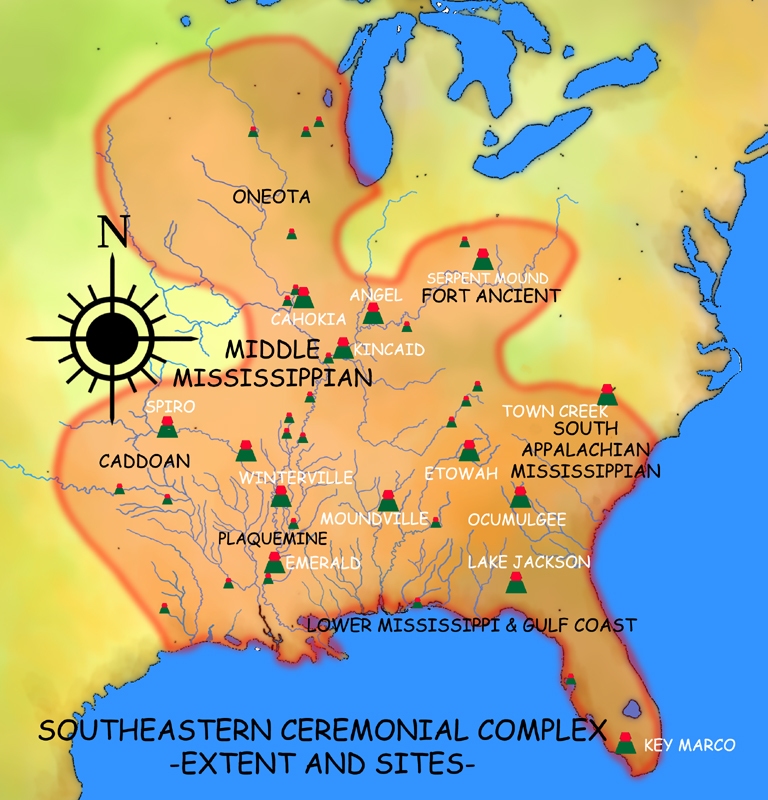
Southeastern Ceremonial Complex (formerly Southern Cult, Southern Death Cult or Buzzard Cult), abbreviated S.E.C.C., is the name given by modern scholars to the regional stylistic similarity of artifacts, iconography, ceremonies, and mythology of the Mississippian culture. It coincided with their adoption of maize agriculture and chiefdom-level complex social organization from 1200 to 1650 CE.
Due to some similarities between S.E.C.C. and contemporary Mesoamerican cultures (i.e., artwork with similar aesthetics or motifs; maize-based agriculture; and the development of sophisticated cities with large pyramidal structures), scholars from the late 1800s to mid-1900s suspected there was a connection between the two locations. One hypothesis was that Meso-Americans enslaved by conquistador Tristán de Luna y Arellano (1510–1573) may have spread artistic and religious elements to North America. However, later research indicates the two cultures have no direct links and that their civilizations developed independently.
The S.E.C.C. was first defined in 1945 by the archaeologists Antonio Waring and Preston Holder as a series of four lists of traits, which they categorized as the Southeastern (centered) Ceremonial Complex. Their concept was of a complex of a specific cult manifestation that originated with Muskogean-speaking peoples in the southern United States.
Since then scholars have expanded the original definition, while using its trait lists as a foundation for critical analysis of the entire concept.
In 1989 scholars proposed a more archaeologically-based definition for the Mississippian artistic tradition. Jon Muller of Southern Illinois University proposes the classification of the complex into five horizons, with each as a discrete tradition defined by the origin of specific motifs and ritual objects, and the specific developments in long-distance exchange and political structures.
Due to the seemingly rapid spread of S.E.C.C. traits, early scholarship described the S.E.C.C. as "a kind of religious revival in the lower Mississippi Valley" and nearby regions. As of 2004, theories suggest that the complex developed from pre-existing beliefs spread over the midwest and southeast by the Hopewell Interaction Sphere from 100 BCE to 500 CE.
Other research shows the complex operated as an exchange network. This kind of network may be illustrated by a pair of shell gorgets whose representation is so similar as to suggest that they were made by the same artist. One was found in southeast Missouri and the other found hundreds of miles away in Spiro Mounds in Oklahoma, suggesting the items were used as gifts or exchange across a wide region. Numerous other pairs of extremely similar gorgets serve to link sites across the entire Southeast.
The social organization of the Mississippian culture was based on warfare, which was represented by an array of motifs and symbols in articles made from costly raw materials, such as conches from Florida, copper from the Great Lakes area and Appalachian Mountains, lead from northern Illinois and Iowa, pottery from Tennessee, and stone tools sourced from Kansas, Texas, and southern Illinois. Such objects occur in elite burials, together with war axes, maces, and other weapons. These warrior symbols occur alongside other artifacts, which bear cosmic imagery depicting animals, humans, and legendary creatures. This symbolic imagery bound together warfare, cosmology, and nobility into a coherent whole. Some of these categories of artifacts were used as markers of chiefly office, which varied from one location to another. The term Southeast Ceremonial Complex refers to a complex, highly variable set of religious mechanisms that supported the authority of local chiefs.
Hub AI
Southeastern Ceremonial Complex AI simulator
(@Southeastern Ceremonial Complex_simulator)
Southeastern Ceremonial Complex
Southeastern Ceremonial Complex (formerly Southern Cult, Southern Death Cult or Buzzard Cult), abbreviated S.E.C.C., is the name given by modern scholars to the regional stylistic similarity of artifacts, iconography, ceremonies, and mythology of the Mississippian culture. It coincided with their adoption of maize agriculture and chiefdom-level complex social organization from 1200 to 1650 CE.
Due to some similarities between S.E.C.C. and contemporary Mesoamerican cultures (i.e., artwork with similar aesthetics or motifs; maize-based agriculture; and the development of sophisticated cities with large pyramidal structures), scholars from the late 1800s to mid-1900s suspected there was a connection between the two locations. One hypothesis was that Meso-Americans enslaved by conquistador Tristán de Luna y Arellano (1510–1573) may have spread artistic and religious elements to North America. However, later research indicates the two cultures have no direct links and that their civilizations developed independently.
The S.E.C.C. was first defined in 1945 by the archaeologists Antonio Waring and Preston Holder as a series of four lists of traits, which they categorized as the Southeastern (centered) Ceremonial Complex. Their concept was of a complex of a specific cult manifestation that originated with Muskogean-speaking peoples in the southern United States.
Since then scholars have expanded the original definition, while using its trait lists as a foundation for critical analysis of the entire concept.
In 1989 scholars proposed a more archaeologically-based definition for the Mississippian artistic tradition. Jon Muller of Southern Illinois University proposes the classification of the complex into five horizons, with each as a discrete tradition defined by the origin of specific motifs and ritual objects, and the specific developments in long-distance exchange and political structures.
Due to the seemingly rapid spread of S.E.C.C. traits, early scholarship described the S.E.C.C. as "a kind of religious revival in the lower Mississippi Valley" and nearby regions. As of 2004, theories suggest that the complex developed from pre-existing beliefs spread over the midwest and southeast by the Hopewell Interaction Sphere from 100 BCE to 500 CE.
Other research shows the complex operated as an exchange network. This kind of network may be illustrated by a pair of shell gorgets whose representation is so similar as to suggest that they were made by the same artist. One was found in southeast Missouri and the other found hundreds of miles away in Spiro Mounds in Oklahoma, suggesting the items were used as gifts or exchange across a wide region. Numerous other pairs of extremely similar gorgets serve to link sites across the entire Southeast.
The social organization of the Mississippian culture was based on warfare, which was represented by an array of motifs and symbols in articles made from costly raw materials, such as conches from Florida, copper from the Great Lakes area and Appalachian Mountains, lead from northern Illinois and Iowa, pottery from Tennessee, and stone tools sourced from Kansas, Texas, and southern Illinois. Such objects occur in elite burials, together with war axes, maces, and other weapons. These warrior symbols occur alongside other artifacts, which bear cosmic imagery depicting animals, humans, and legendary creatures. This symbolic imagery bound together warfare, cosmology, and nobility into a coherent whole. Some of these categories of artifacts were used as markers of chiefly office, which varied from one location to another. The term Southeast Ceremonial Complex refers to a complex, highly variable set of religious mechanisms that supported the authority of local chiefs.
Recent media