


Community hub
Recent from talks
Contribute something to knowledge base
Content stats: 0 posts, 0 articles, 1 media, 0 notes
Members stats: 0 subscribers, 0 contributors, 0 moderators, 0 supporters
Subscribers
Supporters
Contributors
Moderators
Hub AI
Southern brown kiwi AI simulator
(@Southern brown kiwi_simulator)
Hub AI
Southern brown kiwi AI simulator
(@Southern brown kiwi_simulator)
Southern brown kiwi
The southern brown kiwi, tokoeka, or common kiwi (Apteryx australis) is a species of kiwi from South Island of New Zealand. Until 2000 it was considered conspecific with the North Island brown kiwi, and still is by some authorities.
Apteryx australis is based on Greek and Latin. Apteryx means "A-" without "pterux" wings, and "australis" from "auster" the south wind, and "-alis" relating to. The southern brown kiwi belongs to the kiwi family and it is a ratite, and a member of the order Apterygiformes. Like all ratites, its sternum has no keel, it is flightless, and it has a distinctive palate.
The holotype specimen of Apteryx australis Shaw (Nat. Miscell., 24,1813, pl1057) is held in the collections of National Museums Liverpool at World Museum, with accession number NML-VZ D180. The specimen was collected by Captain Barclay at Dusky Sound, South Island, New Zealand and came to the Liverpool national collection via the 13th Earl of Derby's collection which was bequeathed to the people of Liverpool.
The southern brown kiwi is divided into two subspecies, with some conservationists arguing for a third:
A specimen described as Apteryx occidentalis in 1893 is often considered a junior synonym of Apteryx owenii, but a study in 2002 indicated this may be a hybrid between Apteryx australis and Apteryx owenii.
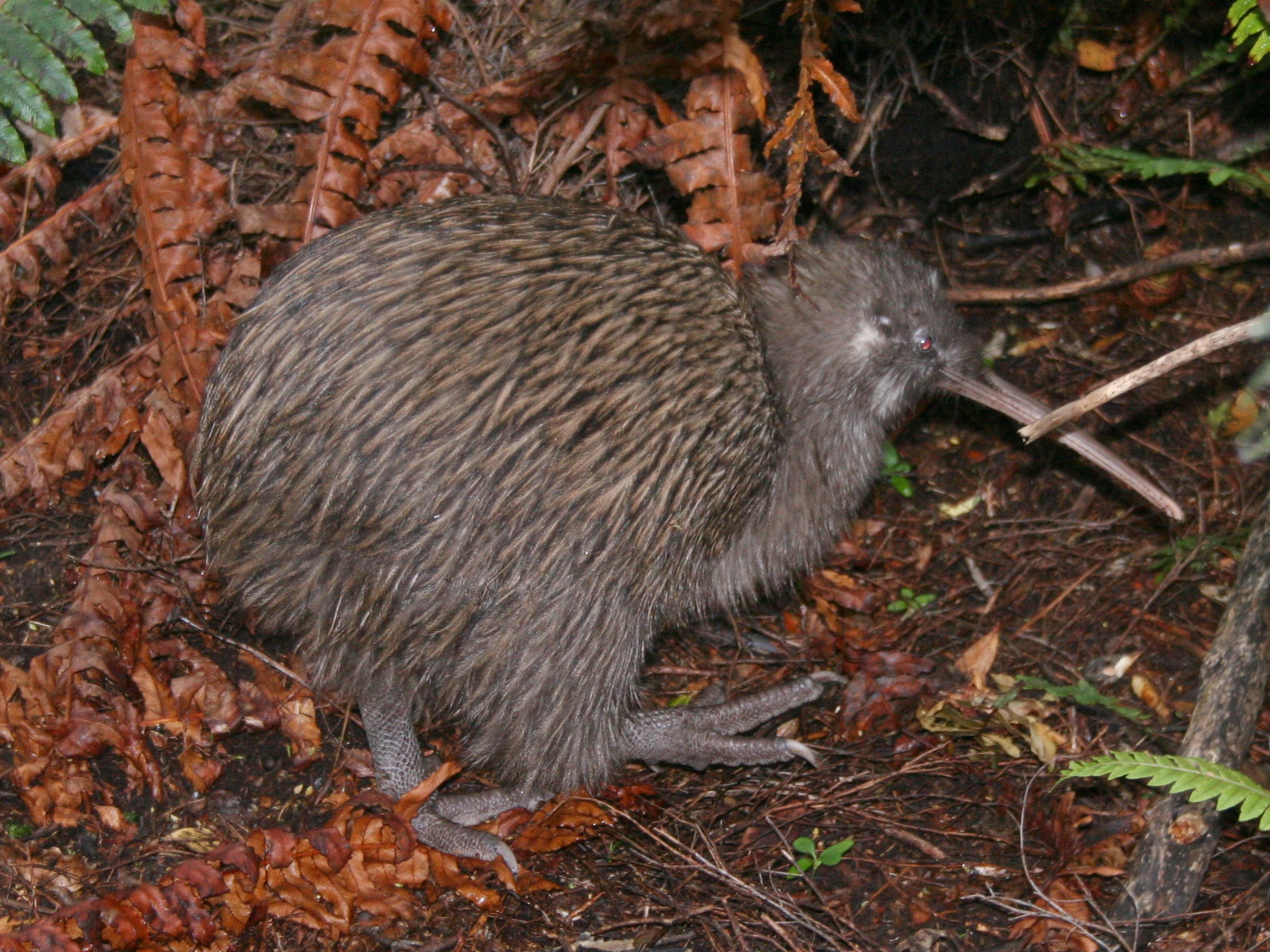
It has no preen gland, and its feathers have no aftershafts and no barbules. There are large vibrissae around its gape, and it has no tail, only a pygostyle. It has a length of 45 to 55 cm (18–22 in) and the female weighs 2.1 to 3.9 kg (4.6–8.6 lb) and the male weighs 1.6 to 2.8 kg (3.5–6.2 lb). Its bill is long and slender with a slight down-curve. Like other kiwis it is nocturnal. The colour of its plumage is rufous with some streaking.
Southern brown kiwi communicate vocally to aid in defending their territory. They will also sing duets with each other, with the male shrill "kee-wee" or "kee-kee" and the females hoarse "kurr kurr". Males are more vocal and they both call in an upright position with their legs stretched out and their bill pointing up.
The southern brown kiwi has a long slender bill with lateral nostrils at the tip, which helps give them their keen sense of smell. They utilise this, more than sight and sound, to forage in dirt for invertebrates, including earthworms, beetle larvae, snails, crayfish, spiders, centipedes, and orthoptera, as well as eels and amphibians. Its gizzard is weak, and underutilised due to the lack of plant matter. Its caeca are long and narrow and aid in digestion.
Southern brown kiwi
The southern brown kiwi, tokoeka, or common kiwi (Apteryx australis) is a species of kiwi from South Island of New Zealand. Until 2000 it was considered conspecific with the North Island brown kiwi, and still is by some authorities.
Apteryx australis is based on Greek and Latin. Apteryx means "A-" without "pterux" wings, and "australis" from "auster" the south wind, and "-alis" relating to. The southern brown kiwi belongs to the kiwi family and it is a ratite, and a member of the order Apterygiformes. Like all ratites, its sternum has no keel, it is flightless, and it has a distinctive palate.
The holotype specimen of Apteryx australis Shaw (Nat. Miscell., 24,1813, pl1057) is held in the collections of National Museums Liverpool at World Museum, with accession number NML-VZ D180. The specimen was collected by Captain Barclay at Dusky Sound, South Island, New Zealand and came to the Liverpool national collection via the 13th Earl of Derby's collection which was bequeathed to the people of Liverpool.
The southern brown kiwi is divided into two subspecies, with some conservationists arguing for a third:
A specimen described as Apteryx occidentalis in 1893 is often considered a junior synonym of Apteryx owenii, but a study in 2002 indicated this may be a hybrid between Apteryx australis and Apteryx owenii.
It has no preen gland, and its feathers have no aftershafts and no barbules. There are large vibrissae around its gape, and it has no tail, only a pygostyle. It has a length of 45 to 55 cm (18–22 in) and the female weighs 2.1 to 3.9 kg (4.6–8.6 lb) and the male weighs 1.6 to 2.8 kg (3.5–6.2 lb). Its bill is long and slender with a slight down-curve. Like other kiwis it is nocturnal. The colour of its plumage is rufous with some streaking.
Southern brown kiwi communicate vocally to aid in defending their territory. They will also sing duets with each other, with the male shrill "kee-wee" or "kee-kee" and the females hoarse "kurr kurr". Males are more vocal and they both call in an upright position with their legs stretched out and their bill pointing up.
The southern brown kiwi has a long slender bill with lateral nostrils at the tip, which helps give them their keen sense of smell. They utilise this, more than sight and sound, to forage in dirt for invertebrates, including earthworms, beetle larvae, snails, crayfish, spiders, centipedes, and orthoptera, as well as eels and amphibians. Its gizzard is weak, and underutilised due to the lack of plant matter. Its caeca are long and narrow and aid in digestion.
Recent media
Recent media