Hubbry Logo
PygostylePygostyleMain
Open search
Pygostyle
Community hub
Pygostyle
logo
8 pages, 0 posts
0 subscribers
Be the first to start a discussion here.
Contribute something
Pygostyle
Pygostyle
from Wikipedia
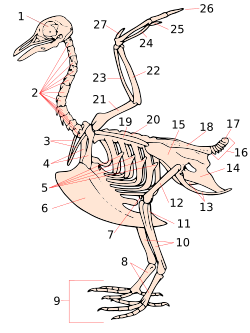
Pigeon skeleton with "plowshare"-type pygostyle (number 17)
Confuciusornis sanctus with "rod"-type pygostyle and the two central tail feathers

Pygostyle (/ˈpɡəˌstl/; from Ancient Greek πυγή [pugḗ] 'tail, rump' and στῦλος [stûlos] 'pillar, column') is a skeletal condition in which the final few caudal vertebrae are fused into a single ossification, supporting the tail feathers and musculature. In modern birds, the rectrices attach to these. The pygostyle is the main component of the uropygium, a structure colloquially known as the bishop's nose, parson's nose, pope's nose, or sultan's nose. This is the fleshy protuberance visible at the posterior end of a bird (most commonly a chicken or turkey) that has been dressed for cooking. It has a swollen appearance because it also contains the uropygial gland that produces preen oil.

Evolution

[edit]

Pygostyles probably began to evolve very early in the Cretaceous period, perhaps 140 – 130 million years ago. The earliest known species to have evolved a pygostyle were members of the Confuciusornithidae.[citation needed] The structure provided an evolutionary advantage, as a completely mobile tail as found in species such as Archaeopteryx is detrimental to its use for flight control. Modern birds still develop longer caudal vertebrae in their embryonic state, which later fuse to form a pygostyle.

There are two main types of pygostyle:[citation needed] one, found in Confuciusornithidae, Enantiornithes, and some other Mesozoic birds, as well as in some oviraptorosaurs like Nomingia, is long and rod- or dagger blade-like. None of the known fossils with such pygostyles show traces of well-developed rectrices. The tail feathers in these animals consisted of downy fuzz and sometimes 2–4 central "streamers" such as those found in some specimens of Confuciusornis or in Paraprotopteryx.[1]

By contrast, the function of the pygostyle in the terrestrial Nomingia is not known. It is notable however that its older relative Caudipteryx had no pygostyle but a "fan" of symmetrical feathers which were probably used in social display. Perhaps such ornaments were widespread in Caenagnathoidea and their relatives, and ultimately the oviraptorosaurian pygostyle evolved to help support them. The related Similicaudipteryx, described in 2008, also had a rod-like pygostyle, associated with a fan of tail feathers.[2]

Yixianornis grabaui, one of the oldest known species with a pygostyle like that in living birds

The other pygostyle type is plowshare-shaped. It is found in Ornithurae (living birds and their closest relatives), and in almost all flying species is associated with an array of well-developed rectrices used in maneuvering. The central pair of these attach directly to the pygostyle, just as in Confuciusornis. The other rectrices of Ornithurae are held in place and moved by structures called bulbi rectricium (rectricial bulbs), a complex feature of fat and muscles located on either side of the pygostyle. The oldest known species with such a pygostyle is Hongshanornis longicresta.[3]

As evidenced by the oviraptorosaurian cases, the pygostyle evolved at least twice, and rod-shaped pygostyles seem to have evolved several times, in association with shortening of the tail but not necessarily with a retractable fan of tail feathers. In other words, the pygostyles of oviraptorosaurs and Confuciusornis were likely weight-saving measures, and the specialized "true" pygostyles of ornithurans were adapted from these later to improve flight performance.[1]

The bird clade Pygostylia was named in 1996, by Luis Chiappe, for the presence of this feature and roughly corresponds to its appearance in the bird family tree, though the feature itself is not included in its definition.[4] In 2001, Jacques Gauthier and Kevin de Queiroz (2001) re-defined Pygostylia to refer specifically to the apomorphy of a short tail bearing an avian pygostyle.

Etymology

[edit]

"Pygostyle" is formed from Ancient Greek words, literally meaning "rump pillar".

The insulting equation of the pygostyle with the noses of dignitaries dates back to 18th century Britain where pope's nose first appears (in 1786). The form parson's nose appears much later, dated to 1839. The usage is somewhat dependent on either a Catholic or Protestant viewpoint.[5]

The forms bishop's nose and sultan's nose are 20th century variants.

As food

[edit]

Turkey tail or turkey butt has an international exportation market in places such as Micronesia, Samoa, and Ghana. The turkey tail is commonly exported from America because it is considered unhealthy and cut off the normal turkey.[6] After World War II, cheap imported turkey tails became popular in Samoa. Because the cut has a very high fat content, it was banned from 2007 to 2013 to combat obesity, only allowed back when Samoa joined the World Trade Organization. The meat is otherwise used in pet food.[7]

Footnotes

[edit]

References

[edit]
Revisions and contributorsEdit on WikipediaRead on Wikipedia
from Grokipedia
The pygostyle is a fused skeletal structure at the distal end of the vertebral column in , formed by the of the final several caudal vertebrae into a compact, triangular or ploughshare-shaped . This element anchors the rectrices, or tail feathers, and the associated musculature, enabling precise control of the tail as a for steering, braking, and stability during flight, particularly in maneuvers. In avian anatomy, the pygostyle's rigidity contrasts with the flexible tails of reptilian ancestors, reflecting adaptations for powered flight where a fan-shaped tail provides aerodynamic surfaces rather than a prehensile or balancing . The pygostyle's evolutionary origins trace to the transition from long-tailed theropod dinosaurs to short-tailed avialans, with fusion occurring independently in some non-avian maniraptorans but becoming a defining synapomorphy of the among crown-group birds and their close relatives. Fossil evidence indicates that early birds like retained elongate caudal series without fusion, while later forms developed the pygostyle alongside rectricial bulbs—fibroadipose structures supporting vanes—for enhanced fanning. Ontogenetically, pygostyle formation involves progressive vertebral fusion post-hatching, with trabecular remodeling that eliminates intervertebral discs while preserving a spinal cord channel, underscoring its role in lightweight skeletal efficiency. This structure's morphology varies phylogenetically, correlating with arrangements and ecological niches, such as dorsoventrally stacked rectrices in certain arboreal or foraging birds.

Anatomy and Morphology

Structure and Composition

The pygostyle forms the terminal element of the avian vertebral column, resulting from the co- of the final 4 to 6 caudal vertebrae into a single, rigid bony structure unique to birds within Pygostylians. This fusion yields a laterally compressed, ploughshare-shaped , often triangular in outline with a flattened dorsoventral profile that tapers caudally. Key anatomical features include a central hemal canal traversing the structure to house the caudal , , and associated nerves. Transverse processes, most developed at the cranial margin, project laterally to provide anchorage for musculature. The ventral surface features an expanded area supporting the rectricial , a fibroadipose complex anchoring the proximal calami of rectrices, while the dorsal surface interfaces with follicles and overlying . Empirical assessments in extant reveal the pygostyle's brevity relative to overall skeletal proportions, with its length comprising approximately 5-15% of length—a standard body size surrogate—contrasting the elongate, discrete vertebrae of non-avian theropod tails. This compact form enhances structural integrity over the modular composition of unfused caudal elements, though specific metrics remain underexplored in comparative studies.

Variations in Avian Groups

Palaeognaths, including ratites like ostriches, typically exhibit a pygostyle with incomplete fusion of the caudal vertebrae, resulting in a shorter and less rigidly integrated structure compared to neognaths. Neognaths, by contrast, display a more compact and fully fused pygostyle, particularly evident in small-bodied clades such as passerines, where the structure supports precise maneuverability in perching and flight. Morphometric analyses reveal correlations between pygostyle morphology and ecological adaptations, such as foraging styles, across avian taxa. Aerial and pursuit-oriented foragers, including certain insectivores and divers, tend to possess elongated pygostyles, facilitating enhanced tail control during dynamic locomotion, whereas ground-dwelling species often feature more robust, shortened forms suited to terrestrial stability. These patterns hold without establishing direct causation, as variations may reflect broader flight and behavioral demands rather than singular ecological drivers. Among extinct avian groups, enantiornithines frequently displayed a plough-shaped pygostyle distinct from the blade-like form typical of ornithuromorphs, the lineage leading to modern birds; however, produced ornithuromorph-like pygostyles in some enantiornithine lineages, such as Cruralispennia, underscoring in tail skeletal adaptations. This morphological convergence highlights repeated selective pressures on pygostyle form independent of shared ancestry.

Development and Ontogeny

Embryonic Formation

The embryonic formation of the pygostyle begins with the segmentation of somites from the tail bud in avian embryos, typically initiating around Hamburger-Hamilton stage 20 in model organisms like the domestic chick (Gallus gallus domesticus), where paraxial cells undergo sequential budding to form caudal somites that give rise to sclerotomes and subsequent vertebral primordia. These somites number approximately 10-12 in the caudal region, producing distinct vertebral elements including centra and neural arches through chondrification and early processes driven by a balance of cellular proliferation, , and differentiation. expression patterns, particularly the collinear activation of posterior paralogs (Hox9-13), establish regional identity and correlate with the progressive slowdown of axis elongation, limiting the total number of caudal vertebrae compared to ancestral reptilian conditions. In chick embryos, the distal caudal vertebrae emerge as unfused, independent structures, with of free caudal centra beginning around embryonic day 18-20 (near at day 21), while the terminal 4-6 elements retain separate morphology as cartilaginous or early bony precursors without . This initial separation sets the developmental stage for postnatal remodeling, as evidenced by histological analyses showing distinct intervertebral discs and no fusion in late-stage embryos. Comparative embryology reveals that embryos, such as those of or crocodilians, generate a longer series of caudal s—often exceeding 20-30 vertebrae—due to extended somitogenesis and sustained Hox-mediated tail bud activity, resulting in persistently unfused tails that contrast with the abbreviated avian pattern. These differences underscore Hox-regulated cessation of somite addition as a key mechanism in avian tail truncation during embryogenesis.

Postnatal Fusion and Inflammation

In extant birds, postnatal fusion of the terminal caudal vertebrae into the pygostyle occurs progressively after hatching, typically completing near skeletal maturity and often post-fledging, as demonstrated by micro-computed (micro-CT) imaging of specimens showing initial unfused centra at 8 days post-hatching with distal-to-proximal coalescence over weeks. This process involves , remodeling of intervertebral discs, and resorption of nuclei pulposi, delaying full pygostyle consolidation until late despite earlier mineralization of individual vertebrae. Sterile inflammation, rather than pathological processes, drives this fusion, as evidenced by histological revealing inflammatory markers and necroptosis—a mechanism—in degenerating disc tissue of developing chicken pygostyles. Experimental suppression of via administration (e.g., prednisolone) delays disc degeneration, reduces necroptosis-related (such as RIPK3), and postpones vertebral fusion, confirming 's causal role without inducing . This non-infectious response facilitates adaptive skeletal remodeling for flight support, distinct from injury-induced healing. Timing varies across avian developmental modes: in precocial species like domestic chickens (Gallus gallus domesticus), fusion initiates shortly post-hatching and advances rapidly alongside early mobility, achieving near-completion by 8 weeks as per micro-CT scans of control groups. Altricial passerines, such as the Eurasian reed warbler (Acrocephalus scirpaceus), exhibit delayed overall skeletal sequences, implying protracted pygostyle fusion relative to body growth, though species-specific micro-CT data remain limited. These differences align with ecological demands, where precocial chicks require earlier tail stabilization for ground-based locomotion and fledging.

Evolutionary History

Precursors in Non-Avian Theropods

In non-avian theropods, particularly within the , evidence reveals partial fusion of distal caudal vertebrae, representing convergent precursors to the avian pygostyle rather than direct homologues. These structures provided increased tail rigidity, likely enhancing balance and postural stability in bipedal locomotion by countering gravitational forces on elongated , as biomechanical analyses of theropod caudal morphology indicate. Such fusions predate the full consolidation seen in avialans and appear sporadically across theropod lineages, underscoring independent evolutionary responses to biomechanical demands rather than a linear progression toward flight. Beipiaosaurus inexpectus, a basal therizinosauroid from the of , China (approximately 125 million years ago), exhibits a pygostyle-like fusion of the five posteriormost caudal vertebrae, characterized by ventrally concave centra and dorsally arched neural arches forming a compact, blade-shaped terminal structure. This fusion, observed in specimen IVPP V11559, contrasts with the more elongate, unfused s of earlier theropods and aligns with reduced caudal counts (around 30 vertebrae total) in derived maniraptorans, facilitating a stiffened tail base for maneuverability. Therizinosauroids like Beipiaosaurus, though herbivorous and not closely related to avialans, demonstrate that distal co-ossification evolved convergently in response to body mass distribution and integumentary loading, independent of aerodynamic specialization. Oviraptorosaurs, another maniraptoran group from the Yixian Formation and equivalent strata, display tail reduction with partial distal fusions, though less extensive than in birds. For instance, specimens of Caudipteryx and Similicaudipteryx feature fewer than 25 caudal vertebrae, with the terminal 2–4 co-ossified into a short, rigid unit sometimes termed a pseudo-pygostyle, providing anchorage for proximal tail feathers and counterbalance during terrestrial agility. In Nomingia, up to four fused terminal vertebrae exhibit widened transverse processes persisting posteriorly, enhancing lateral stability without full pygostyle consolidation. These traits, documented in multiple Yixian taxa dated to 120–130 million years ago, reflect adaptations for brooding behaviors and rapid turns in cluttered environments, as inferred from associated nest fossils and skeletal proportions, rather than precursors to avian tail fanning.

Appearance in Early Avialans and Birds

The pygostyle emerges in the fossil record as a defining feature of the clade within , marking a transition from the elongated, unfused caudal series observed in forms like Archaeopteryx lithographica (circa 150 million years ago) to a condensed terminal fusion in Early Cretaceous avialans. This reduction involved the fusion of the distalmost caudal vertebrae, typically 4-6 elements, into a rigid structure, first evidenced in deposits of the , northeastern , dated to approximately 131-120 million years ago. Earliest definitive pygostylians include Protopteryx fengningensis, an enantiornithine from the 130.7-million-year-old Sichakou Member of the Huajiying Formation, which preserves a short ending in a fused pygostyle, establishing the clade's presence by the stage of the . Similarly, basal taxa such as Sapeornis chaoyangensis from the younger Jiufotang Formation (circa 120 million years ago) display a triangular pygostyle approximately 11-20 mm long, formed by weakly to moderately fused terminal vertebrae, positioning Sapeornis near the base of Pygostylia. These specimens indicate that pygostyle development preceded diversification into major ornithothoracine lineages, with early ornithothoracines like confuciusornithids also bearing this synapomorphy. Confuciusornis sanctus, from the approximately 125-million-year-old , exemplifies incipient pygostyle fusion, where the terminal four caudal vertebrae exhibit partial coalescence, shorter than the preceding unfused elements, highlighting a stepwise morphological progression in tail abbreviation among primitive pygostylians. This pattern underscores the rapid skeletal miniaturization in early avian evolution during the , with evidence from multiple Jehol localities confirming the pygostyle's establishment prior to more derived ornithuromorph configurations.

Coevolution with Tail Feathers

The reduction of the avian tail skeleton into a pygostyle coincided with the elaboration of rectrices into aerodynamic fans, enabling precise control during flight through coordinated skeletal support and muscular actuation. Analysis of extant birds reveals that pygostyle morphology—such as its length, robustness, and presence of processes—correlates directly with rectrix fan shapes (e.g., forked, graduated, or square), reflecting adaptations to locomotor demands like foraging or aerial maneuvering. This pattern supports coevolution, where skeletal shortening compensated for lost vertebral leverage by enhancing muscle anchors for feather deployment. In avialans from the , including specimens dated to approximately 125–120 million years ago, pygostyle variations paralleled rectrix asymmetry and fan development across clades. Enantiornithines typically featured elongated pygostyles with prominent uncinate processes, accommodating simpler tail plumage like elongated ribbons or uncinate feathers rather than fully fanned arrays. In contrast, ornithuromorphs displayed compact, ploughshare-shaped pygostyles, which anchored robust rectricial bulbs and supported asymmetric vanes in fanned rectrices for superior aerodynamic stability. These differences, observed in fossils like Pengornis and Yixianornis, indicate clade-specific evolutionary trajectories in tail function prior to the enantiornithine . Fossil imprints from Yixian ornithuromorphs preserve rectrices emerging from pygostyle-associated , evidencing muscle insertion scars that enabled fanning motions analogous to modern bulbi rectricium. Such preserved morphologies, including vascular impressions on the pygostyle, demonstrate how skeletal compaction facilitated integumentary elaboration without sacrificing control, as corroborated by comparative dissections linking these features to powered flight enhancements.

Functional Adaptations

Skeletal Support for Feathers and Muscles

The pygostyle functions as the principal insertion point for avian tail muscles, enabling precise control over tail posture and feather orientation. Specifically, it anchors the musculus levator caudae, which elevates the tail by contracting dorsally, and the musculus depressor caudae, which lowers it via ventral attachment, with these muscles originating from the and ilium. In pigeons, for instance, these muscles innervate motoneurons that coordinate pygostyle movements, distributing contractile forces across the fused structure to minimize . The pygostyle also supports the rectricial bulbs, paired fibroadipose tissues enveloping the bases of the rectrices (tail feathers), where bulbi rectricium muscles insert to erect and fan the feathers. This arrangement allows biomechanical leverage for feather deployment, as the bulbs affix directly to the pygostyle's ventral and lateral surfaces, transmitting tension without requiring extensive skeletal elongation. Fusion of the terminal 4–6 caudal vertebrae into the pygostyle confers rigidity, concentrating muscle forces onto a single, plow-shaped that resists deformation under load, as demonstrated in dissections of like woodpeckers where expanded ventral surfaces enhance attachment area. This consolidation reduces skeletal mass—typically comprising less than 1% of body weight in many birds—compared to flexible, multi-vertebrate tails, while maintaining structural integrity for force distribution, verifiable through comparative avian where unfused tails demand additional intervertebral stabilizers. In galliform birds such as chickens, tail muscle myology reveals depressor caudae and levator caudae as the dominant components, with masses ranging 0.028–0.329% and 0.120–0.274% of body weight respectively across related species, indicating optimized cross-sectional areas for balanced force application to the pygostyle during locomotion. This setup ensures even load bearing, preventing localized stress concentrations observable in histological sections of attached tendons.

Role in Aerodynamics and Locomotion

The pygostyle anchors the rectrices, enabling birds to fan and adjust the as a dynamic control surface that modulates lift, drag, and stability during flight. By providing a rigid, low-mass terminus to the vertebral column, it allows precise manipulation of conformation to counteract perturbations, generating corrective moments for pitch and yaw, especially critical in low-speed phases like where wing-generated control is limited. Wind-tunnel experiments on avian-inspired tail models quantify this function, showing that deployed tail feathers increase drag coefficients by up to 20-30% at angles of attack typical of perching or ascent, while asymmetric fanning produces yawing moments proportional to sideslip , enhancing without substantial mass penalty. Kinematic studies of live birds, such as pigeons and hummingbirds, further confirm that pygostyle-supported tail movements contribute 10-15% of total aerodynamic in maneuvering flight, minimizing energy expenditure by leveraging the tail's position posterior to the center of . In flightless ratites like ostriches and emus, the pygostyle persists but exhibits reduced size and feather integration relative to volant birds, shifting its primary contribution from aerial control to terrestrial balance during bipedal locomotion, where tail undulation aids in counteracting lateral sway at speeds exceeding 50 km/h. This contrast underscores the pygostyle's adaptive optimization for flight in most taxa, with fusion enabling a compact that prioritizes control surface efficacy over extensibility, as deviations in caudal morphology correlate with flight capability across avian clades.

Paleontological and Scientific Debates

Fossil Evidence and Examples

The earliest documented occurrence of a pygostyle in the avian lineage is in Baminornis zhenghensis, a basal from the Shangshaximiao Formation in Province, , dated to approximately 160–145 million years ago (mya), representing a fusion of the distal caudal vertebrae into a compact supporting feathers. This specimen pushes the fossil record of pygostyles back by about 18 million years compared to prior examples, with micro-computed (micro-CT) scans confirming the bone's integrity and distinguishing it from unfused precursors in more basal theropods. In non-avian theropods, pygostyle-like fusions appear sporadically and independently, such as in the therizinosauroid Beipiaosaurus inexpectus from the (~125 mya), Province, , where the terminal caudal vertebrae exhibit partial co-ossification without associated rectricial feathers, suggesting convergence rather than direct ancestry to avian forms. Scansoriopterygid theropods, like Epidexipteryx and related taxa from the Daohugou Beds (~160 mya), , display shortened tails with distally clustered but unfused vertebrae forming a pygostyle-like rod, revealed through detailed skeletal preparations, though lacking the full fusion seen in crown-group birds. Early Cretaceous avialans from the Jehol Biota (~130–120 mya) provide transitional examples, including Jeholornis prima with a elongate tail of ~20 free caudal vertebrae terminating in a proximal fan of feathers but lacking a pygostyle, indicating an intermediate stage before full tail reduction. In contrast, pygostylian birds like Confuciusornis sanctus from the same Yixian Formation exhibit a rod-shaped pygostyle formed by 5–6 fused vertebrae, supporting a distal feather fan, as confirmed in multiple holotype specimens via radiographic imaging. Enantiornithine birds, such as Cruralispennia scissurrupium (~120 mya, Chaomidianzi Formation), display a ploughshare-shaped pygostyle convergent with ornithuromorphs, with micro-CT analyses of juvenile specimens revealing post-hatching fusion sequences akin to modern birds. Later fossils, including ornithuromorphs like Yixianornis grabaui from the (~125 mya), show more derived, triangular pygostyles with expanded haemal spines for muscle attachment, facilitating enhanced tail control in flight, as detailed in museum-held specimens subjected to high-resolution scanning. These examples, spanning ~160–100 mya, underscore a mosaic pattern of pygostyle , with independent fusions in multiple lineages documented through direct preservation and advanced imaging techniques.

Homology, Convergence, and Evolutionary Implications

The pygostyle exhibits evidence of both homology within and across broader , complicating its role as a defining synapomorphy for Pygostylians. In early birds such as those from the , the pygostyle is interpreted as a homologous structure supporting the reduction of caudal vertebrae to facilitate tail fan formation and aerodynamic control, distinguishing Pygostylians (including and ) from long-tailed basal avialans like Archaeopteryx. However, fossil evidence from non-avialan theropods reveals independent origins of pygostyle-like fusion, as in Beipiaosaurus (a basal therizinosauroid from the Lower Cretaceous ), where distally co-ossified caudal vertebrae resemble the avian condition but likely served herbivorous balance functions rather than flight. This is further supported by analogous structures in oviraptorosaurs and scansoriopterygids, indicating multiple evolutionary acquisitions of caudal fusion driven by selection for lightweight tails, not exclusively aerial locomotion. Within , pygostyle morphology shows convergence on ornithuromorph-like plough-shaped forms, as in Cruralispennia (), where proximal forking and ventral processes evolved independently to anchor rectrices, despite differing phylogenetic positions from crown-group birds. Such instances challenge strict homology across Pygostylians, as enantiornithine pygostyles often retain elongate, forked proximal ends unlike the compact, triangular form in Ornithothoraces, suggesting adaptive convergence tied to fan-shaped tail feathers rather than shared ancestry alone. Empirical morphometric analyses of caudal skeletons further demonstrate shape convergence in diving neornithines, where pygostyle robustness correlates with underwater demands, independent of pygostyle origins in aerial clades. These patterns imply a polyphyletic or homoplastic evolutionary history for the pygostyle, undermining assumptions of gradual, unidirectional progression from theropod tails to avian sterna in bird-dinosaur transitions. Presence in non-volant therizinosaurs critiques over-reliance on pygostyle-feather co-evolution as diagnostic of powered flight, as fusion may primarily reflect mass reduction pressures in diverse ecologies, with aerial refinements as secondary adaptations in avialans. gradients from unfused theropod caudals to fused avian forms support over strict , with 2017–2024 studies emphasizing functional causality—e.g., skeletal support for rectricial bulbs—over phylogenetic , as abrupt appearances in basal records (e.g., Baminornis with pygostyle) highlight rapid selective sweeps rather than incremental steps. This convergence underscores causal realism in tail , prioritizing biomechanical constraints like center-of-mass shifts for flyers over assumed linear homology from non-avian dinosaurs.

Etymology and Cultural Aspects

Terminological Origins

The term pygostyle originates from the roots pygē (πυγή), denoting "rump" or "buttocks," combined with stylos (στῦλος), meaning "pillar" or "column," yielding a of "rump pillar" to describe the fused, supportive structure at the bird's base. This nomenclature emerged in the mid-19th century amid advancements in , with the earliest English attestations recorded between 1870 and 1875, reflecting efforts to standardize avian skeletal terminology through Greco-Latin derivations for precision in scientific discourse. Prior to widespread adoption of pygostyle, early ornithological descriptions often employed more rudimentary or regionally variable terms, such as references to the "fused caudal vertebrae" or descriptive phrases emphasizing its terminal, pillar-like form in bird skeletons, as seen in 18th- and early 19th-century anatomical treatises. Alternative designations like "ploughshare bone," alluding to its flattened, blade-like shape in some species, appeared sporadically in older texts to evoke its supportive role akin to a plow's , though this usage remained informal and less precise than the etymologically grounded pygostyle. Similarly, "uropygial bone" occasionally surfaced in contexts linking it to the uropygium (the rump housing the preen gland), highlighting its positional integration rather than distinct morphology, but such terms yielded to pygostyle as phylogenetic emphasized homologous structures across Aves. The shift toward pygostyle as the dominant term paralleled broader trends in 19th-century , where transitioned from descriptive labels—often tied to gross morphology or function—to systematic compounds facilitating cross-species comparison and , without implying unsubstantiated homologies in non-avian theropods. This underscored a commitment to terminological consistency in , enabling clearer documentation of skeletal reductions in avian tails post-Archaeopteryx.

Culinary and Historical Uses

The pygostyle, known colloquially as the "pope's nose," "parson's nose," or "bishop's nose," refers to the fatty, triangular nub at the base of the tail in such as chickens, turkeys, and ducks, consisting of the fused caudal vertebrae surrounded by and . In culinary preparations, it is typically consumed as part of roasted or whole birds, prized by some for its crispy and rich flavor after cooking, though often left intact during due to its small size and high content. Nutritional of similar poultry tail regions indicates elevated levels of and ; for instance, a comparable serving of turkey tail provides approximately 13 grams of protein and 40 milligrams of calcium, while in the area contributes significant alongside 20 grams of fat per 50-gram portion. Historically, the term "parson's nose" emerged in by the late 18th century, reflecting cultural associations with clerical figures, and the part has been eaten across European and Anglo-American traditions without documented widespread taboos, appearing in household roasts and anecdotal family preferences. In other cultures, such as Japanese yakitori, the equivalent "bonjiri" (fatty tail base) is grilled as a skewered for its juicy texture. Variations like "sultan's nose" suggest broader Eurasian naming, but consumption patterns emphasize its role as an incidental, flavorful byproduct rather than a standalone dish in most Western contexts. In modern poultry processing, the pygostyle region forms part of the or carcass remnants, often separated during evisceration and either rendered for fats, incorporated into pet foods, or discarded, with byproduct yields from processing averaging 10-15% of live weight across categories like heads, feet, and viscera, though tail-specific remains limited to general streams. Empirical studies on utilization highlight its potential in value-added products like hydrolyzed proteins, but routine culinary retention occurs primarily in whole-bird markets rather than industrial deboning lines.

References

Add your contribution
Related Hubs
Contribute something
User Avatar
No comments yet.