



Community hub
Space Shuttle design process
View on Wikipedia

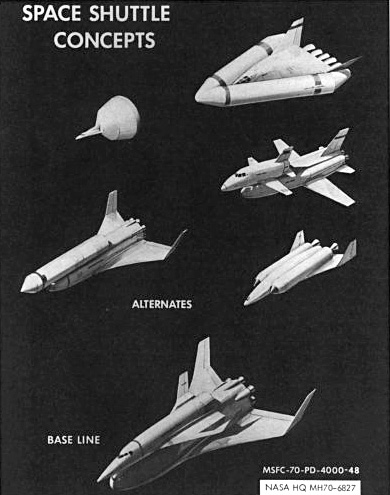
Before the Apollo 11 Moon landing in 1969, NASA began studies of Space Shuttle designs as early as October 1968. The early studies were denoted "Phase A", and in June 1970, "Phase B", which were more detailed and specific. The primary intended use of the Phase A Space Shuttle was supporting the future space station, ferrying a minimum crew of four and about 20,000 pounds (9,100 kg) of cargo, and being able to be rapidly turned around for future flights, with larger payloads like space station modules being lifted by the Saturn V.
Two designs emerged as front-runners. One was designed by engineers at the Manned Spaceflight Center, and championed especially by George Mueller. This was a two-stage system with delta-winged spacecraft, and generally complex. An attempt to re-simplify was made in the form of the DC-3, designed by Maxime Faget, who had designed the Mercury capsule among other vehicles. Numerous offerings from a variety of commercial companies were also considered but generally fell by the wayside as each NASA lab pushed for its own version.
All of this was taking place in the midst of other NASA teams proposing a wide variety of post-Apollo missions, a number of which would cost as much as Apollo or more.[citation needed] As each of these projects fought for funding, the NASA budget was at the same time being severely constrained. Three were eventually presented to United States Vice President Spiro Agnew in 1969. The shuttle project rose to the top, largely due to tireless campaigning by its supporters.[citation needed] By 1970 the shuttle had been selected as the one major project for the short-term post-Apollo time frame.
When funding for the program came into question, there were concerns that the project might be canceled. This became especially pressing as it became clear that the Saturn V would no longer be produced, which meant that the payload to orbit needed to be increased in both mass - all the way to 60,600 pounds (27,500 kg) - and size to supplement its heavy-lift capabilities, necessary for planned interplanetary probes and space station modules, which meant a bigger and costlier vehicle was needed during Phase B. Therefore, NASA tried to interest the US Air Force and a variety of other customers in using the shuttle for their missions as well. To lower the development costs of the proposed designs, boosters were added, a throw-away fuel tank was adopted, and many other changes were made that greatly lowered the reusability and greatly added to the vehicle and operational costs.
Decision-making process
[edit]In 1969, United States Vice President Spiro Agnew chaired the National Aeronautics and Space Council, which discussed post-Apollo options for human space activities.[1] The recommendations of the Council would heavily influence the decisions of the administration. The Council considered four major options:
- A human mission to Mars
- Follow-on lunar program
- A low Earth orbital infrastructure program
- Discontinuing human space activities
Based on the advice of the Space Council, President Nixon made the decision to pursue the low Earth orbital infrastructure option. This program mainly consisted of the construction of a space station, along with the development of a Space Shuttle. Funding restrictions precluded pursuing the development of both programs simultaneously, however. NASA chose to develop the Space Shuttle program first, and then planned to use the shuttle in order to construct and service a space station.
Shuttle design debate
[edit]

During the early shuttle studies, there was a debate over the optimal shuttle design that best-balanced capability, development cost, and operational cost. Initially, a fully reusable design was preferred. This involved a very large winged crewed booster which would carry a smaller winged crewed orbiter. The booster vehicle would lift the orbiter to a certain altitude and speed, then separate. The booster would return and land horizontally, while the orbiter continued into low Earth orbit. After completing its mission, the winged orbiter would re-enter and land horizontally on a runway. The idea was that full reusability would promote lower operating costs.
However, further studies showed a huge booster was needed to lift an orbiter with the desired payload capability. In space and aviation systems, the cost is closely related to mass, so this meant the overall vehicle cost would be very high. Both booster and orbiter would have rocket engines plus jet engines for use within the atmosphere, plus separate fuel and control systems for each propulsion mode. In addition, there were concurrent discussions about how much funding would be available to develop the program.
Another competing approach was maintaining the Saturn V production line and using its large payload capacity to launch a space station in a few payloads rather than many smaller shuttle payloads. A related concept was servicing the space station using the Air Force Titan III-M to launch a larger Gemini capsule, called "Big Gemini", or a smaller "glider" version of the shuttle with no main engines and a 15 ft × 30 ft (4.6 m × 9.1 m) payload bay.
The shuttle supporters answered that given enough launches, a reusable system would have lower overall costs than disposable rockets. If dividing total program costs over a given number of launches, a high shuttle launch rate would result in lower pre-launch costs. This in turn would make the shuttle cost-competitive with or superior to expendable launchers. Some theoretical studies mentioned 55 shuttle launches per year; however, the final design chosen did not support that launch rate. In particular, the maximum external tank production rate was limited to 24 tanks per year at NASA's Michoud Assembly Facility.
The combined space station and Air Force payload requirements were not sufficient to reach desired shuttle launch rates. Therefore, the plan was for all future U.S. space launches—space stations, Air Force, commercial satellites, and scientific research—to use only the Space Shuttle. Most other expendable boosters would be phased out.
The reusable booster was eventually abandoned due to several factors: high price (combined with limited funding), technical complexity, and development risk. Instead, a partially (not fully) reusable design was selected, where an external propellant tank was discarded for each launch, and the booster rockets and shuttle orbiter were refurbished for reuse.
Initially, the orbiter was to carry its own liquid propellant. However, studies showed carrying the propellant in an external tank allowed a larger payload bay in an otherwise much smaller craft. It also meant throwing away the tank after each launch, but this was a relatively small portion of operating costs.
Earlier designs assumed the winged orbiter would also have jet engines to assist maneuvering in the atmosphere after re-entering. However NASA ultimately chose a gliding orbiter, based partially on experience from previous rocket-then-glide vehicles such as the X-15 and lifting bodies. Omitting the jet engines and their fuel would reduce complexity and increase payload.
Another decision was the size of the crew. Some said that the shuttle should not carry more than four, the most that could use ejection seats. A commander, pilot, mission specialist, and payload specialist were sufficient for any mission. NASA expected to carry more space flight participants as payload specialists, so designed the vehicle to carry more.[2]
The last remaining debate was over the nature of the boosters. NASA examined four solutions to this problem: development of the existing Saturn lower stage, simple pressure-fed liquid-fuel engines of a new design, a large single solid rocket, or two (or more) smaller ones. Engineers at NASA's Marshall Space Flight Center (where the Saturn V development was managed) were particularly concerned about solid rocket reliability for crewed missions.
Air Force involvement
[edit]During the mid-1960s the United States Air Force had both of its major piloted space projects, X-20 Dyna-Soar and Manned Orbiting Laboratory, canceled. This demonstrated its need to cooperate with NASA to place military astronauts and payloads in orbit. The Air Force launched more than 200 satellite reconnaissance missions between 1959 and 1970, and the military's large volume of payloads would be valuable in making the shuttle more economical.[3]: 213–216 In turn, by serving Air Force needs, the Shuttle became a truly national system, carrying all military as well as civilian payloads.[4]
NASA sought Air Force support for the shuttle. After the Six-Day War and the Soviet invasion of Czechoslovakia exposed limitations in the United States satellite reconnaissance network, Air Force involvement emphasized the ability to launch spy satellites southward into polar orbit from Vandenberg AFB. This required higher energies than for lower inclination orbits. However, to be able to return to Earth after one orbit, despite the Earth rotating 1,000 miles beneath the orbital track, required a larger delta wing size than the earlier simple "DC-3" shuttle. In addition, the straight-wing configuration favored by Max Faget would've required the vehicle to fly in a stall for most of the reentry and had issues during launch aborts, a situation disliked by NASA. [5] It is a common misconception that the delta wing was solely by demand of the USAF, however that is merely a myth.
Despite the potential benefits for the Air Force, the military was satisfied with its expendable boosters, and had less need for the shuttle than NASA. Because the space agency needed outside support, the Defense Department (DoD) and the National Reconnaissance Office (NRO) gained primary control over the design process. For example, NASA planned a 40-by-15-foot (12.2 by 4.6 m) cargo bay, but NRO specified a 60-by-15-foot (18.3 by 4.6 m) bay because it expected future intelligence satellites to become larger. When Faget again proposed a 12 ft (3.7 m) wide payload bay, the military almost immediately insisted on retaining the 15 ft (4.6 m) width.[3] The Air Force also gained the equivalent of the use of one of the shuttles for free despite not paying for the shuttle's development or construction. In exchange for the NASA concessions, the Air Force testified to the Senate Space Committee on the shuttle's behalf in March 1971.[3]: 216, 232–234 [6]
As another incentive for the military to use the shuttle, Congress reportedly told DoD that it would not pay for any satellites not designed to fit into the shuttle cargo bay.[7] Although NRO did not redesign existing satellites for the shuttle, the vehicle retained the ability to retrieve large cargos such as the KH-9 HEXAGON from orbit for refurbishment, and the agency studied resupplying the satellite in space.[8]
Potential military use of the shuttle—including the possibility of using it to verify Soviet compliance with the SALT II treaty—probably caused President Jimmy Carter to not cancel the shuttle in 1979 and 1980, when the program was years behind schedule and hundreds of millions of dollars over budget.[9] The Air Force planned on having its own fleet of shuttles and re-built a separate launch facility originally derived from the canceled Manned Orbiting Laboratory program at Vandenberg called Space Launch Complex Six (SLC-6). However, for various reasons, due in large part to the loss of Space Shuttle Challenger on January 28, 1986, work on SLC-6 was eventually discontinued and no shuttle launches from that location ever took place. SLC-6 was eventually used for launching the Lockheed Martin-built Athena expendable launch vehicles, which included the successful IKONOS commercial Earth observation satellite in September 1999 before being reconfigured once again to handle the new generation of Boeing Delta IV's. The first launch of the Delta IV heavy from SLC-6 occurred in June 2006, launching NROL-22, a classified satellite for the U.S. National Reconnaissance Office (NRO).
Final design
[edit]
While NASA would likely have chosen liquid boosters had it had complete control over the design, the Office of Management and Budget insisted on less expensive solid boosters due to their lower projected development costs.[3]: 416–423 [10] While a liquid-fueled booster design provided better performance, lower per-flight costs, less environmental impact and less developmental risk, solid boosters were seen as requiring less funding to develop at a time when the Shuttle program had many different elements competing for limited development funds. The final design which was selected was a winged orbiter with three liquid-fueled engines, a large expendable external tank which held liquid propellant for these engines, and two reusable solid rocket boosters.
In the spring of 1972 Lockheed Aircraft, McDonnell Douglas, Grumman, and North American Rockwell submitted proposals to build the shuttle. The NASA selection group thought that Lockheed's shuttle was too complex and too expensive, and the company had no experience with building crewed spacecraft. McDonnell Douglas's was too expensive and had technical issues. Grumman had an excellent design which also seemed too expensive. North American's shuttle had the lowest cost and most realistic cost projections, its design was the easiest for ongoing maintenance, and the Apollo 13 accident involving North American's command and service module demonstrated its experience with electrical system failures. NASA announced its choice of North American on July 26, 1972.[3]: 429–432
The Space Shuttle program used the HAL/S programming language.[11] The first microprocessor used was the 8088 and later the 80386. The Space Shuttle orbiter avionics computer was the IBM AP-101.
Retrospection
[edit]
Opinions differ on the lessons of the Shuttle. It was developed with the original development cost and time estimates given to President Richard M. Nixon in 1971,[12] at a cost of $6.744 billion in 1971 dollars (equivalent to $39.9 billion in 2024)[13] versus an original $5.15 billion estimate.[14] The operational costs, flight rate, payload capacity, and reliability were different than anticipated, however.[12]
See also
[edit]References
[edit]- ^ "Report of the Space Task Group, 1969". NASA. Archived from the original on December 24, 2018. Retrieved August 6, 2009.
- ^ Pincus, Walter (March 5, 1986). "NASA's Push to Put Citizen in Space Overtook Fully 'Operational' Shuttle". Washington Post. ISSN 0190-8286. Archived from the original on August 2, 2017. Retrieved July 14, 2020.
- ^ a b c d e Heppenheimer, T. A. (1998). The Space Shuttle Decision. NASA. Archived from the original on November 7, 2019. Retrieved July 12, 2017.
- ^ Day, Dwayne A. (January 11, 2010). "Big Black and the new bird: the NRO and the early Space Shuttle". The Space Review. Archived from the original on September 29, 2018.
- ^ "Columbia Accident Investigation Board Report: Volume 6, page 224". UNT Digital Library. October 2003.
- ^ Day, Dwayne A. (November 20, 2006). "The spooks and the turkey". The Space Review. Archived from the original on March 15, 2019.
- ^ Aldridge, Edward. C. "Pete" Jr. (c. 1989). Assured Access: 'The Bureaucratic Space War' (PDF) (Technical report). Archived (PDF) from the original on October 28, 2022. Retrieved September 17, 2012.
- ^ Day, Dwayne (February 13, 2017). "Black ops and the shuttle (part 1)". The Space Review. Archived from the original on March 10, 2019. Retrieved February 27, 2017.
- ^ Berger, Eric (July 14, 2016). "A Cold War mystery: Why did Jimmy Carter save the space shuttle?". Ars Technica. Archived from the original on May 19, 2022. Retrieved February 2, 2023.
- ^ Grumman Aerospace Corporation; The Boeing Company (March 15, 1972). Space Shuttle System Program Definition - Phase B Extension - Final Report (PDF) (Technical report). NASA. hdl:2060/19740022195. NASA-CR-134338. Archived (PDF) from the original on April 5, 2023.
- ^ Lytle, P. J. (August 15, 1981). "Current Status of the HAL/S Compiler on the Modcomp Classic 7870 Computer". In Renzetti, N. A. (ed.). The Telecommunications and Data Acquisition Progress Report 42-64 (PDF) (Technical report). JPL, NASA. p. 232. hdl:2060/19810022557. NASA-CR-164695. Archived (PDF) from the original on August 1, 2023. Retrieved August 1, 2023.
- ^ a b "Columbia Accident Investigation Board Public Hearing". Columbia Accident Investigation Board Report (PDF) (Technical report). Vol. VI. Houston, Texas (published October 2003). April 23, 2003. pp. 219–245. Archived from the original (PDF) on May 11, 2023.
- ^ Johnston, Louis; Williamson, Samuel H. (2023). "What Was the U.S. GDP Then?". MeasuringWorth. Retrieved November 30, 2023. United States Gross Domestic Product deflator figures follow the MeasuringWorth series.
- ^ Wade, Mark. "Shuttle". Astronautix.com. Archived from the original on July 12, 2016. Retrieved November 12, 2017.
Further reading
[edit]External links
[edit]- Astronautix Space Shuttle article
- NASA: The Space Shuttle Decision
- INTRODUCTION TO FUTURE LAUNCH VEHICLE PLANS [1963–2001], M. Lindroos
- 10 Space Shuttles which never flew (Lockheed Starclipper, Chrysler SERV, Phase B Shuttles, Rockwell C-1057, Shuttle C, Air Launched Sortie Vehicle (ALSV), Hermes, Buran, Shuttle II, Lockheed Martin VentureStar) Archived March 10, 2019, at the Wayback Machine
Space Shuttle design process
View on GrokipediaPre-Development Studies and Concepts
Phase A Exploratory Studies (1968-1970)
NASA initiated exploratory studies for a reusable space transportation system in late 1968, amid post-Apollo planning to sustain manned spaceflight capabilities with reduced costs. These Phase A efforts, spanning 1968 to 1970, focused on conceptual designs emphasizing reusability to support future missions like space stations and satellite deployment, involving internal NASA analyses and industry contracts. Key objectives included evaluating payload capacities, launch frequencies, and economic viability, with projections estimating development costs around $9.92 billion for systems capable of 736 flights between 1978 and 1990.[3] On October 30, 1968, NASA issued a request for proposals to define shuttle concepts, leading to contracts awarded in January 1969 to major aerospace firms for six-month studies valued at approximately $450,000 each for four primary contracts and $100,000 for one additional. Contractors such as Lockheed, McDonnell Douglas, North American Rockwell, Grumman, Boeing, and others examined configurations including single-stage-to-orbit vehicles, triamese designs, and two-stage fully reusable systems with fixed wings and rocket propulsion. Notable proposals included Lockheed's two-stage fully reusable vehicle and Max Faget's straight-wing FR-3 concept from NASA's Manned Spacecraft Center, prioritizing aluminum airframes with thermal protection systems like silica tiles over hotter titanium structures.[3][4] Trade studies during Phase A assessed critical parameters, including reusability versus expendability, propulsion options (rocket engines versus airbreathing), and vertical versus horizontal takeoff, alongside payload bays standardized at 15 feet by 60 feet to accommodate diverse cargo. Crossrange requirements emerged as a point of contention, with NASA targeting 200 nautical miles and the Air Force demanding up to 1,500 nautical miles for military reconnaissance, influencing delta-wing alternatives over straight-wing designs. Economic analyses by firms like Mathematica and the Aerospace Corporation compared shuttle variants against expendable launchers like Titan III, favoring reusable systems for long-term cost reductions projected at $4.6 million to $9 million per flight.[3][4] By mid-1970, Phase A culminated in an interim NASA report on April 24 favoring fully reusable two-stage configurations, setting the baseline for Phase B preliminary design. The studies affirmed technical feasibility, as endorsed by the 1969 Townes Committee, but highlighted challenges like rapid turnaround times aiming for 24-hour aircraft-like checkouts and thermal protection trade-offs between tiles and metallic shingles. Political pressures, including Space Task Group recommendations in September 1969, prioritized the shuttle over competing projects like nuclear shuttles or modular stations, amid budgetary scrutiny from the Office of Management and Budget.[3][4]Phase B Preliminary Design (1970-1971)
Phase B represented the preliminary design phase of the Space Shuttle program, building on Phase A exploratory efforts by directing industry contractors to conduct detailed analyses, trade studies, and conceptual designs aimed at maturing a viable baseline configuration for potential full-scale development. The phase emphasized evaluating key system elements such as booster options, orbiter propulsion, and overall vehicle architecture to predict development scope, timelines, and costs while addressing mission requirements for low Earth orbit payload delivery. NASA released the Statement of Work for these definition studies in October 1969 through the Office of Manned Space Flight, with formal contractor work intensifying in mid-1970.[5] Prime contracts were awarded to McDonnell Douglas Astronautics Company and North American Rockwell, each leading teams that included up to 30 subcontractors across the aerospace sector to perform parallel design explorations.[6] These efforts focused on refining reusable vehicle concepts, including assessments of liquid-fueled fly-back boosters, staged combustion engines for the orbiter, and integrated thermal protection systems, while incorporating emerging data on materials and aerodynamics.[7] John Yardley oversaw McDonnell Douglas's contributions, and Bastian Hello managed North American Rockwell's activities, producing preliminary system definitions that highlighted technical feasibility but also revealed challenges in achieving high payload capacities (targeting 20,000-50,000 pounds to orbit) within constrained budgets.[8] Preliminary cost projections from Phase B studies indicated that fully reusable designs, including recoverable boosters and orbiters, would exceed $5 billion in development funding, prompting early recognition of the need for expendable elements to align with fiscal limits set by the Nixon administration.[9] Extensions to the phase, initiated on February 1, 1971, for McDonnell Douglas and North American Rockwell, incorporated additional trade-offs such as hybrid reusability schemes and evaluated impacts from evolving requirements, including potential space station logistics support.[6] By late 1971, these analyses had narrowed options toward a partially reusable architecture, setting the stage for political decisions on program authorization while underscoring tensions between technical optimality and economic realism.[7]Political Authorization and Initial Parameters
Nixon Administration Decision (1972)
On January 5, 1972, President Richard Nixon met with NASA Administrator James C. Fletcher in San Clemente, California, and approved the development of a reusable space transportation system known as the Space Shuttle, marking the program's formal authorization after preceding exploratory and preliminary design phases.[10][11] This decision directed NASA to proceed with building a system capable of routine access to low Earth orbit, emphasizing reusability of the orbiter and certain components to achieve operational efficiencies over fully expendable launch vehicles like the Saturn V.[12] Nixon's rationale centered on post-Apollo fiscal constraints, positioning the Shuttle as a cost-effective means to sustain U.S. manned spaceflight capabilities without the high recurring expenses of disposable rockets, with NASA projections indicating potential reductions in launch preparation time and per-mission dollars through partial reusability.[13] The approved configuration prioritized a winged orbiter for horizontal landing on runways, integrated with expendable solid rocket boosters and an external fuel tank, selected from Phase B trade studies as a balanced compromise between full reusability ambitions and budgetary realism.[14] Nixon's statement highlighted the system's versatility as the anticipated "workhorse" for future space efforts, enabling a range of payloads from satellites to scientific experiments while accommodating emerging national security requirements from the Department of Defense. This endorsement followed internal deliberations where NASA assured policymakers of the Shuttle's economic viability, contrasting with more radical fully reusable alternatives deemed unaffordable amid Vietnam War-era budget pressures and competing domestic priorities.[15][14] Initial funding authorization accompanied the decision, with Nixon signing legislation allocating $5.5 million for immediate program initiation, though full congressional appropriations totaling around $400 million for fiscal year 1972 development were secured in April after NASA's detailed baseline presentation.[16] The approval implicitly endorsed NASA's refined baseline from 1971 studies, which scaled back orbiter size and payload capacity from earlier concepts to align with a projected development cost of approximately $5.15 billion over six years, though these estimates reflected optimistic assumptions about reuse cycles and turnaround times that would later prove challenging.[17][18] This pivotal step transitioned the Shuttle from conceptual advocacy to a committed national program, bridging Apollo-era achievements with long-term orbital operations.[1]Funding Approval and Cost Targets
President Richard Nixon approved the development of the Space Shuttle on January 5, 1972, directing NASA to create a reusable space transportation system designed to substantially reduce launch costs compared to expendable rockets.[10] This decision emphasized a "low-cost" approach, with NASA Administrator James Fletcher presenting estimates to align the program within constrained federal budgets amid post-Apollo fiscal pressures.[19] The approval followed Phase B studies, where NASA refined configurations to meet Office of Management and Budget (OMB) guidelines capping total development at approximately $5.5 billion, including $300 million for initial facilities.[20] Congress authorized initial funding through the National Aeronautics and Space Administration Authorization Act of 1972, with the House approving $3.4 billion for NASA on April 21, 1972, encompassing Space Shuttle research and development alongside other programs like Skylab.[21] This authorization enabled NASA to proceed, culminating in the award of the prime orbiter contract to North American Rockwell on July 26, 1972, after Senate concurrence and presidential signature.[22] Cost targets at approval focused on development expenditures of $5.15 billion for the baseline system, with operational goals aiming for $10–20 million per flight to achieve economic viability through high flight rates and reusability.[23] These targets reflected compromises to secure bipartisan support, prioritizing a fully reusable orbiter with expendable boosters to balance reusability benefits against upfront costs, though GAO analyses later highlighted risks of underestimation given the program's unproven technologies.[24] NASA committed to these figures in March 1972 briefings to OMB and Congress, projecting 500 flights over 10–15 years to amortize development and yield per-pound payload costs below $500, far lower than Apollo-era equivalents.[25] Actual expenditures exceeded initial projections, but the 1972 targets anchored the program's justification as a cost-effective bridge to future space operations.[18]Core Design Trade-Offs and Configurations
Reusability Versus Expendability Debates
During the initial phases of Space Shuttle development in the late 1960s and early 1970s, NASA engineers and contractors prioritized fully reusable designs, envisioning a two-stage system comprising a winged booster and orbiter, both recoverable and refurbishable, to minimize operational costs through high flight rates akin to commercial aviation.[3] Phase A exploratory studies, initiated in 1969 with contracts to firms including North American Aviation and McDonnell Douglas, examined concepts such as one-and-a-half-stage and two-stage fully reusable vehicles, concluding that full reusability offered the lowest per-flight costs, estimated at $1.5 million to $5.5 million depending on assumptions of 240 annual launches.[3] These designs promised economies from amortizing development over hundreds of missions but required advanced technologies like reusable main engines capable of 100 starts and thermal protection systems for repeated atmospheric reentries.[3] Phase B preliminary design studies, awarded in 1970 to North American Rockwell and McDonnell Douglas for $10.8 million each, reinforced the fully reusable approach in an interim report dated May 1, 1970, highlighting its potential for operational savings despite higher upfront development costs projected at $9 billion to $15 billion.[3] Trade-offs centered on mass penalties: reusable components demanded heavier structures for recovery parachutes, fly-back wings, and durability against reentry heating, increasing propellant needs and reducing payload fractions compared to expendable alternatives like evolved Saturn or Titan boosters, which offered lower initial costs but flight expenses exceeding $185 million per launch for Saturn V equivalents.[3] Proponents such as NASA Associate Administrator George Mueller argued that full reusability aligned with first-principles economics of scale, projecting breakeven against expendables at 50-100 flights, though skeptics like former NASA Deputy Administrator Robert Seamans questioned the feasibility of achieving projected turnaround times under 1970s manufacturing constraints.[3] [8] By mid-1971, escalating development estimates—reaching $12.8 billion for a two-stage fully reusable system per Mathematica's economic analysis—and stringent Office of Management and Budget (OMB) caps, including a $5.5 billion total R&D limit imposed in February 1972, compelled NASA to abandon pure reusability in favor of a hybrid configuration.[26] [3] In March 1971, NASA adopted a partially reusable baseline featuring a recoverable orbiter mated to expendable or partially recoverable boosters and an external propellant tank jettisoned per mission, reducing development to $4 billion-$6 billion while accepting higher per-flight costs of $6 million-$10 million due to recurrent production of disposable elements.[3] This compromise, formalized by Administrator James Fletcher's endorsement of phased development with external tankage in June 1971, reflected causal trade-offs where budget realism trumped aspirational reusability, as full recovery systems inflated vehicle dry mass by 20-30% and risked program cancellation amid post-Apollo fiscal austerity.[3] [8] Technical risks, including unproven reusable cryogenic engines and crossrange demands from Air Force requirements, further eroded confidence in all-up reusability without staged expendability to distribute loads.[3]Aerodynamic and Structural Configurations
The aerodynamic configuration of the Space Shuttle orbiter underwent extensive trade studies during Phase A and Phase B, evaluating wing planforms ranging from straight wings to delta wings to meet requirements for hypersonic reentry, subsonic gliding, and runway landing. Initial concepts, such as Maxime Faget's straight-wing design, prioritized high lift-to-drag ratios in subsonic flight but provided only about 200 nautical miles of cross-range capability during reentry, insufficient for operational flexibility including polar orbits. Delta-wing configurations emerged as superior for achieving over 1,100 nautical miles of cross-range, enabling lateral maneuvering to avoid weather or select landing sites while maintaining stability across flight regimes.[27] In January 1971, NASA and U.S. Air Force officials selected a reusable delta-wing orbiter as the baseline, balancing hypersonic aerodynamic efficiency with subsonic handling; the final double-delta (ogee) planform was refined to optimize vortex lift for low-speed control, reduce leading-edge heating, and accommodate aft center-of-gravity shifts due to payload variations.[28] This configuration supported a glide ratio of approximately 4.5:1 during reentry and unpowered horizontal landing at speeds around 215 knots, with elevons and a body flap providing pitch, roll, and yaw control without horizontal stabilizers or rudders.[4] Trade studies confirmed the double-delta's advantages in delaying vortex burst and mitigating buffet onset compared to simpler deltas, enhancing controllability at high angles of attack.[29] Structurally, the orbiter integrated the aerodynamic surfaces into a semi-monocoque fuselage designed to withstand 3g ascent loads, peak dynamic pressures of 700 psf, and reentry heating up to 3,000°F on leading edges. The primary structure employed Aluminum 2219 alloy for its cryogenic compatibility, weldability, and fracture toughness, forming longerons, frames, and stringers that carried bending, shear, and pressure loads from the 60 ft by 15 ft payload bay.[30] Forward fuselage sections supported the crew compartment as a conical pressure vessel, while the mid-fuselage payload doors—largest composite structures built at the time—used graphite-epoxy facesheets over aluminum honeycomb for lightweight rigidity.[31] Aft fuselage incorporated an internal thrust structure truss to mount the three RS-25 engines in an equilateral triangle pattern, reacting up to 1.5 million pounds of thrust while interfacing with the reusable solid rocket boosters and expendable external tank.[2] Wing boxes, constructed as dry structures without integral fuel, featured spar-rib designs to distribute aeroelastic loads, with the overall configuration evolving from Phase B generic studies to lock in by 1977, prioritizing reusability for 100 flights despite compromises in mass and complexity.[32]Propulsion and Booster Options
During Phase A exploratory studies from 1968 to 1970, propulsion options emphasized fully reusable liquid-propellant systems for both boosters and orbiter stages to achieve high payload fractions and low operational costs, with concepts drawing on existing LOX/LH2 engines like the J-2 for upper stages and potential adaptations of F-1 for boosters. Tradeoffs focused on specific impulse versus thrust-to-weight ratios, where liquid systems offered throttleability and restart capability but required complex turbomachinery development. In Phase B preliminary design from 1970 to 1971, contractors such as North American Rockwell and McDonnell Douglas evaluated booster alternatives including recoverable pump-fed liquid boosters in series-burn configurations with the orbiter, pressure-fed boosters for simplicity, and flyback winged boosters powered by clusters of F-1 engines producing up to 1.5 million lbf each. These liquid options promised specific impulses around 300-400 seconds but incurred high non-recurring costs estimated at over $1 billion for full reusability development, compared to solids' leverage of mature Titan III technology.[33] Solid-propellant boosters emerged as a hybrid compromise, providing 80% of liftoff thrust at lower upfront investment, though with lower specific impulse (260-270 seconds) and no throttling.[33] Orbiter main propulsion studies paralleled booster evaluations, prioritizing high-pressure staged-combustion cycle engines over gas-generator or pressure-fed alternatives for efficiency; Rocketdyne's SSME design, selected in 1971, delivered 418,000 lbf vacuum thrust per engine (three installed) using LOX/LH2 at 7,700 lbf/s flow rate, outperforming pressure-fed options in performance but adding turbopump complexity and refurbishment needs. Economic analyses showed liquid boosters could reduce per-flight costs to $10-20 million if fully reusable, but budget caps post-1971 Phase B extension favored solids for $5-6 million development savings per unit.[34] By early 1972, following Office of Management and Budget directives to cap total program costs at $5.15 billion, the baseline shifted to two parallel-burn solid rocket boosters, each generating 2.85 million lbf average thrust over 120 seconds burn time using polybutadiene propellant, with casings recovered from Atlantic splashdown for partial reuse after refurbishment.[35] [1] This configuration, announced March 15, 1972, integrated with the expendable external tank and SSMEs to achieve 65,000 lbf payload to low Earth orbit, prioritizing rapid development over full reusability amid fiscal realism.[1] Liquid booster variants persisted in parallel studies but were deferred due to extended timelines exceeding 1980 operational goals.Military Influences and Resulting Compromises
Air Force Mission Requirements
The United States Air Force (USAF) mission requirements for the Space Shuttle emphasized support for national security space operations, particularly the deployment of large reconnaissance satellites into high-inclination orbits, necessitating significant design compromises in the orbiter's size, aerodynamics, and operational capabilities. These requirements stemmed from the need to replace expendable launch vehicles for payloads managed by the National Reconnaissance Office (NRO), including the KH-9 Hexagon satellite, which demanded a payload bay measuring 15 by 60 feet to accommodate its dimensions and film return canister.[36] The USAF specified that the Shuttle must handle classified payloads with onboard autonomy for mission execution without dedicated ground support, including encrypted communications, separation of classified ("red") and unclassified ("black") data systems, and compliance with Tempest standards to prevent electromagnetic compromise.[37] Polar orbit launches from Vandenberg Air Force Base were a core requirement to enable sun-synchronous reconnaissance over the Soviet Union, influencing the selection of delta wings over alternative configurations to achieve the necessary cross-range glide capability of at least 1,100 nautical miles during reentry. This allowed for single-orbit missions where the orbiter could deploy payloads and return to Edwards Air Force Base, minimizing overflight of adversarial territory and enhancing mission security.[38] The payload mass targets included up to 65,000 pounds to a 150-nautical-mile low Earth orbit for eastward launches, with reduced but still substantial capacity—approximately 32,000 pounds—to a 100-nautical-mile near-polar orbit, driving the enlargement of the orbiter beyond NASA's initial civilian-focused concepts.[39] Radiation hardening and payload integration standards were also mandated to ensure reliability for defense missions in varying orbital environments.[37] These military imperatives prioritized strategic reconnaissance and satellite deployment over pure cost efficiency or frequent civilian flights, resulting in a vehicle optimized for occasional high-value national security tasks rather than high-cadence operations. While NASA aimed for a more compact design, USAF insistence on accommodating oversized payloads like Hexagon—coupled with polar launch infrastructure—expanded the program's scope and contributed to elevated development costs.[36][38]Enlargement of Orbiter and Payload Capacity
The U.S. Air Force's insistence on compatibility with large reconnaissance satellites necessitated a significant enlargement of the Space Shuttle orbiter's payload bay beyond NASA's initial specifications. NASA originally planned for a payload capacity of approximately 50,000 pounds (23,000 kg) to low Earth orbit, with bay dimensions suited to modular space station components, emphasizing cost-effective civilian missions.[38] However, military requirements demanded a bay measuring 15 feet (4.6 meters) in diameter by 60 feet (18 meters) in length to fit oversized payloads such as the KH-11 satellite, which featured mirrors up to 4 meters across, along with associated bus structures and deployment mechanisms.[38] [27] This accommodation increased the overall payload capability to 65,000 pounds (29,500 kg) to low Earth orbit, though actual polar orbit performance for Vandenberg launches was projected lower at around 30,000 pounds (13,600 kg) due to energy losses.[38] To integrate the expanded payload bay, the orbiter's fuselage was lengthened, extending the total vehicle length to 122 feet (37 meters) and necessitating structural reinforcements for the increased mass and aerodynamic loads during ascent and reentry.[40] Concurrently, Air Force demands for a 1,100 nautical mile cross-range capability—to enable single-orbit returns from polar launches at Vandenberg Air Force Base—required enlarging the delta wings, boosting the wingspan from earlier concepts' approximately 60-70 feet to the final 78 feet (24 meters).[40] [27] These modifications shifted the design away from NASA's more compact Phase A and B proposals, which featured smaller bays (around 12-13 feet diameter) and modest wings optimized for equatorial orbits from Kennedy Space Center, prioritizing lower development costs and higher flight rates over military versatility.[27] The compromises crystallized during 1970-1971 Phase B studies and were formalized in the January 5, 1972, presidential approval under the Nixon administration, where NASA conceded to Department of Defense inputs to secure congressional funding support.[38] This enlargement raised the orbiter's empty mass by roughly 20-30% compared to baseline civilian-oriented designs, complicating reusability goals by demanding more robust thermal protection and propulsion margins, though it enabled classified missions comprising up to 25% of projected flight manifest.[40] Empirical post-design analyses confirmed the bay's dimensions directly traced to Air Force satellite fairing legacies from Titan III vehicles, underscoring causal trade-offs where military payload primacy deferred NASA's smaller, cheaper baseline.[27]Prioritization Conflicts Between Civilian and Defense Needs
The Space Shuttle's design process encountered significant tensions between NASA's civilian objectives—emphasizing economical, routine access to orbit for scientific payloads, Spacelab modules, and space station precursors—and the Department of Defense's (DoD) demands for robust military capabilities, including deployment and retrieval of large reconnaissance satellites like the KH-9 Hexagon and KH-11 systems. These defense requirements, articulated by the Air Force in the early 1970s, prioritized national security missions over NASA's focus on smaller payloads (initially targeted at 40,000–50,000 pounds to low Earth orbit) and equatorial launches from Florida, necessitating design enlargements that increased vehicle mass, complexity, and development costs.[41][38] A primary conflict centered on payload capacity and bay dimensions, where DoD specifications required accommodating elongated spy satellites up to 60 feet in length and 65,000 pounds in orbit, compelling NASA to expand the cargo bay from earlier concepts of 12–15 feet in diameter and shorter lengths to a standardized 15-by-60-foot volume. This enlargement, formalized during Phase B studies in 1970–1971, added structural weight and volume that strained reusability goals, as the orbiter's dry mass rose, reducing overall efficiency for civilian missions. Air Force insistence on polar launches from Vandenberg Air Force Base (now Vandenberg Space Force Base) further diverged from NASA's Kennedy-centric plans, imposing needs for 1,100-nautical-mile cross-range gliding capability to enable rapid unpowered returns to landing sites without global circumnavigation—contrasting NASA's initial zero cross-range baseline for direct equatorial reentries.[41][38] These divergences manifested in prioritization disputes during funding deliberations under the Nixon administration, where NASA's January 1972 approval hinged on demonstrating dual-use viability to offset the $5.5 billion development ceiling; DoD commitments to 20–30 annual launches were projected to subsidize operations, but only if military needs shaped the baseline configuration. Tensions escalated as DoD's classified priorities risked preempting civilian schedules, with a 1981 GAO report highlighting that Air Force precedence could delay NASA missions unless additional orbiters or infrastructure were added, underscoring causal trade-offs where defense-driven features like reinforced structures for satellite handling compromised NASA's aims for 7-day turnaround times and full reusability.[42][43] By 1975–1977, partial resolutions emerged as the Air Force, anticipating Titan IV expendables for sensitive payloads, relaxed some mandates (e.g., reducing projected shuttle reliance), yet the embedded compromises persisted in the finalized design, prioritizing versatile DoD utility over optimized civilian economics and contributing to the program's eventual operational shortfalls in launch cadence and cost per flight.[41][43]Critical Technical Decisions and Risks
Thermal Protection System Selection
The Space Shuttle orbiter required a thermal protection system (TPS) capable of withstanding peak reentry temperatures of approximately 1,650 °C (3,000 °F) while maintaining the aluminum airframe below 177 °C (350 °F), driven by the program's mandate for partial reusability to reduce per-mission costs compared to expendable capsules.[44] Early design studies from the late 1950s and 1960s, informed by X-15 and lifting-body experiences, rejected hot structures due to excessive weight and cost for scaled-up operations, as well as ablative coatings following incidents like the X-15A-2's 1967 hypersonic flight where ablative material failed catastrophically.[44] Trade studies in the early 1970s, conducted under NASA contracts, systematically evaluated passive TPS options categorized by material type: ablative systems (e.g., charring phenolics like those on Apollo), metallic shields (e.g., titanium multiwall or superalloy bimetallic sandwiches), carbon-carbon composites, and reusable surface insulations (RSI) including ceramic tiles and blankets.[45] Ablatives were deemed unsuitable due to their single-use erosion mechanism, which eroded material mass during heat absorption and char formation, conflicting with the requirement for 100-flight reusability and necessitating full replacement after each mission.[45][44] Metallic alternatives, while offering structural integration and potential durability, imposed higher weights—estimated at 20-30% more than RSI in comparable areas—and required complex multi-layer designs for temperatures from 589 K (316 °C) to 1,255 K (982 °C), increasing overall vehicle mass and reducing payload capacity.[45] In 1972, NASA selected a hybrid ceramic RSI system as the baseline TPS after these evaluations, prioritizing low areal density (9-22 lb/ft³ for silica variants), high thermal emissivity for radiative heat rejection (over 90% of heat load dissipated this way), and compatibility with cryogenic fuel tanks and aerodynamic surfaces.[45][44] The primary material comprised low-density silica fiber tiles (e.g., Lockheed's LI-900 for windward surfaces up to 1,377 °C or 2,510 °F), chosen over denser mullite or alumina options following Battelle Memorial Institute assessments that confirmed silica's superior insulation-to-weight ratio and low atomic oxygen catalycity, which minimized surface heating from recombination reactions.[44] Reinforced carbon-carbon (RCC) was designated for extreme-heat zones like the nose cap, wing leading edges, and chin panel, enduring over 1,482 °C (2,700 °F) through oxidation-resistant coatings, while felt reusable surface insulation (FRSI) handled lower-heat leeward areas up to 371 °C (700 °F).[44] This configuration yielded a baseline TPS mass of about 7,321 kg (16,139 lb), with 20% growth allowance to 7,656 kg, balancing thermal gradients across the orbiter's 1144 K to 1755 K (871 °C to 1482 °C) entry profile.[45] The decision reflected causal trade-offs in first-flight risks versus lifecycle economics: reusable ceramics avoided ablative refurbishment costs but introduced brittleness, necessitating 6x6-inch tile sizing with 0.01-inch gaps for thermal expansion and over 30,000 individual attachments, later refined amid 1979 strength issues via densification processes.[44] Lockheed's foundational work, including the 1960 patent for silica RSI and 1968 arc-jet tests of LI-1500 precursors, underpinned the selection, enabling passive protection without active cooling systems that studies deemed too complex and failure-prone for manned operations.[44] Subsequent Air Force reviews in 1975 confirmed the TPS adequacy for enlarged orbiters but highlighted ascent heating underestimations, prompting minor additions like FRSI expansions.[44]Safety Versus Cost Trade-Offs in Boosters
In the early 1970s Space Shuttle design phase, NASA conducted trade studies evaluating booster configurations, ultimately selecting solid rocket boosters (SRBs) over liquid alternatives to meet thrust requirements within severe budget limitations imposed by the Nixon administration. Solid motors, drawing on proven technology from military programs like Titan III and Minuteman, promised lower development costs—estimated at around $200 million per pair—compared to designing large new liquid engines, which would have exceeded available funding and delayed timelines.[46][47] SRBs were designed for partial reusability, with recovery via parachutes after ocean splashdown, enabling refurbishment and up to 20 reuses per unit to amortize costs across projected high flight rates of 50-100 missions annually. This approach aimed to reduce per-launch booster expenses to under $10 million, far below expendable liquid options, though actual refurbishment proved labor-intensive and costly due to propellant residue removal and segment inspections.[48][47] Safety compromises arose from solid propulsion's inherent limitations: unlike throttleable liquid engines, SRBs delivered fixed-thrust profiles without shutdown capability, restricting abort windows during their 126-second burn phase when they provided over 80% of liftoff thrust (approximately 6.6 million pounds combined). The segmented case design, adopted for manufacturability and transport within standard facilities, used field joints sealed by O-rings, introducing potential failure modes under pressure and temperature extremes that were known but deemed acceptable to avoid costlier monolithic or liquid alternatives.[49][50] Engineers applied a structural factor of safety of 1.4 to SRB cases, aligning with manned flight standards using polybutadiene acrylonitrile (PBAN) propellant proven in prior applications. However, the lack of real-time combustion control heightened risks of crack propagation or erosive burning leading to casing rupture, a vulnerability absent in liquid systems with redundant pumps and valves. These trade-offs prioritized program affordability and schedule—targeting operational costs of $10-20 million per flight—over enhanced safety margins, reflecting causal pressures from fiscal realism amid competing national priorities.[51][52]Finalization and Implementation
Baseline Design Lock-In (1977)
In early 1977, NASA completed Phase B prime contractor studies, which refined the Space Shuttle configuration to incorporate prior trade-offs, including enlarged orbiter dimensions to accommodate Air Force payload requirements of 65,000 pounds to a 28.5-degree inclination orbit at 150 nautical miles altitude.[53] The baseline locked in a delta-wing orbiter approximately 122 feet long with a 78-foot wingspan, a 60-by-15-foot payload bay, twin solid rocket boosters (SRBs) for initial ascent, and a large external tank for main propulsion, prioritizing reusability for the orbiter while accepting expendable elements for cost control.[54] This configuration fixed the thermal protection system as a mix of reusable tiles and reinforced carbon-carbon for leading edges, despite ongoing concerns about tile durability under ascent and reentry heating loads exceeding 2,300 degrees Fahrenheit. On January 5, 1977, the Office of Management and Budget approved NASA's request for full funding of orbiter development, enabling authority to proceed with detailed engineering and procurement.[55] Rockwell International's Space Division, selected as prime contractor, began long-lead fabrication under the locked baseline, with structural assembly milestones targeted for operational vehicles like Columbia (OV-102).[55] Concurrently, SRB design reviews in 1977 highlighted vulnerabilities, such as joint seal inadequacies deemed "completely unacceptable" by engineering panels, yet the baseline proceeded to avoid delays in the mandated initial operational capability by 1980.[56] Approach and landing tests (ALT) with the Enterprise orbiter (OV-101), conducted from February to October 1977 at Edwards Air Force Base, validated the baseline aerodynamic stability and handling qualities during unpowered glides, confirming the 1.25 million-pound gross landing weight and 230-knot approach speed parameters.[57] These tests, involving five free flights, locked in flight control software algorithms and pilot interfaces, though they exposed tailcone drag issues later mitigated without altering the core airframe.[58] By mid-1977, NASA initiated Phase C/D full-scale development on July 1, committing $5.5 billion in then-year dollars to production, with the baseline precluding major redesigns to align with congressional funding cycles and Department of Defense commitments for 40 annual flights.[59] The lock-in prioritized operational tempo over iterative risk reduction, as evidenced by fixed SRB thrust levels of 3.3 million pounds per unit and external tank aluminum-lithium alloy specifications, despite subscale tests indicating potential hydroelastic instabilities in booster joints.[60] This decision reflected causal pressures from 1971 Nixon administration mandates for cost-sharing with DOD, embedding compromises like polar orbit capability at the expense of fully reusable boosters.[3] Subsequent contracts, including Thiokol's for SRBs and Martin Marietta's for external tanks, proceeded under the 1977 baseline, setting production rates for four orbiters by 1985.[61]Contracts and Phase C/D Development
Following the completion of Phase B, which focused on preliminary design and contractor studies, NASA proceeded to Phase C/D, encompassing detailed design (Phase C) and full-scale development, fabrication, testing, and evaluation (Phase D) of the Space Transportation System (STS). This phase marked the transition from conceptual trade-offs to hardware realization, with contracts awarded to industry partners for major elements based on competitive selections emphasizing technical feasibility, cost, and prior experience with aerospace manufacturing. The phased contracting approach allowed NASA to refine requirements iteratively while mitigating risks through subsystem-level awards before full system integration.[62] The orbiter, the crewed and payload-carrying component, was assigned to North American Rockwell (later Rockwell International) under a $2.6 billion cost-plus-incentive-fee contract awarded on July 26, 1972, spanning six years and covering design, development, and production of the baseline vehicle plus overall STS integration responsibilities.[63] Rocketdyne, a division of North American Rockwell, had earlier secured the Space Shuttle Main Engine (SSME, later designated RS-25) development contract on July 14, 1971, valued at $500 million, with Phase C/D activities formalized in April 1972 to produce three reusable, high-performance liquid-propellant engines per stack, each delivering 470,000 pounds of thrust at liftoff.[64][65] These engines underwent extensive ground testing at NASA's Stennis Space Center, achieving over 1,000 seconds of hot-fire duration by the mid-1970s to validate turbopump and nozzle performance under reusable conditions.[66] Propulsion support elements followed: Martin Marietta received an initial $107 million contract in August 1973 for the External Tank (ET), the non-reusable fuel reservoir holding 1.5 million pounds of liquid hydrogen and oxygen, with production scaling to lightweight aluminum-lithium alloys in later iterations for mass reduction.[67] Morton Thiokol (later ATK Thiokol) was awarded the Solid Rocket Booster (SRB) contract in November 1973, valued at around $800 million initially, for developing paired reusable motors each providing 3.3 million pounds of thrust via segmented solid propellant casings manufactured in Utah.[68] Phase C activities for SRBs emphasized filament-wound cases and recovery parachute systems for sea splashdown and refurbishment, while Phase D included subscale motor firings and full-scale qualification tests at Thiokol's Brigham City facility by 1977.[69] Throughout Phase C/D, NASA managed cost growth through incentive clauses and milestone reviews, with Rockwell coordinating avionics, thermal protection, and payload bay integration at Downey, California, facilities. Development challenges included resolving hydrogen slosh dynamics in the ET and achieving SSME throttleability to 65% for ascent control, culminating in structural test articles and approach-and-landing tests by 1977. Total Phase C/D funding exceeded $10 billion by first flight, reflecting compromises on reusability to meet 1972 program baselines.[70]Retrospective Analysis
Projected Versus Actual Performance
The Space Shuttle program was designed with ambitious projections for operational efficiency, reusability, and cost-effectiveness to justify its development as a replacement for expendable launch vehicles. In the early 1970s, NASA anticipated a fleet enabling 25 to 50 launches per year by the late 1970s or early 1980s, predicated on rapid orbiter turnaround times of approximately two weeks between flights to support high-volume satellite deployments, space station construction, and military missions.[71][72] In reality, the program achieved an average flight rate of about 4.5 missions annually across its 135 flights from 1981 to 2011, with peaks of 6–7 per year during International Space Station assembly but never approaching the projected volume due to extended processing durations averaging six months per orbiter.[73][74] Payload capacity projections centered on delivering up to 65,000 pounds (29,500 kg) to low Earth orbit at 28.5-degree inclinations, sufficient for large modules or multiple satellites per flight, while accommodating Air Force requirements for polar orbits up to 500 nautical miles.[71] The baseline design met this capability in principle, with maximum achieved payloads nearing 55,000 pounds on select missions, though operational constraints like thermal protection inspections and mission-specific configurations often reduced effective capacity below projections, limiting utilization of the 60-foot payload bay for oversized or high-mass cargoes.[2][75] Economic projections emphasized drastic cost reductions through reusability, targeting operational costs of $7.7 million to $10.5 million per launch in 1971 dollars—equivalent to $20–$50 per pound of payload delivered—based on amortized development expenses of about $5.15 billion and high flight rates minimizing fixed costs.[71][25] Actual marginal costs per flight ranged from $450 million to $1.5 billion (in 2010–2011 dollars), yielding roughly $30,000 per pound, as low flight rates, extensive refurbishments for solid rocket boosters and thermal tiles, and program-wide expenditures exceeding $209 billion inflated unit economics far beyond initial estimates.[76][77][78] Reusability goals specified 100 flights per orbiter over a 10-year lifespan, with main engines and boosters recoverable for refurbishment to enable the projected cadence.[2] In practice, no orbiter exceeded 39 missions (Discovery's total), as cumulative wear from thermal stresses, debris impacts, and safety-mandated overhauls—exacerbated by incidents like Challenger (1986) and Columbia (2003)—necessitated premature retirements and fleet-wide grounding periods that further eroded performance against design intent.| Performance Metric | Projected (1970s) | Actual (1981–2011) |
|---|---|---|
| Annual Flight Rate | 25–50 | ~4.5 average |
| Turnaround Time | ~2 weeks | ~6 months average |
| Cost per Launch | $7.7–$10.5M (1971 $) | $450M–$1.5B (2010–11 $) |
| Orbiter Lifespan | 100 flights | ≤39 flights max |