
Recent from talks
Thermionic emission
Knowledge base stats:
Talk channels stats:
Members stats:
Thermionic emission
Thermionic emission is the liberation of charged particles from a hot electrode whose thermal energy gives some particles enough kinetic energy to escape the material's surface. The particles, sometimes called thermions in early literature, are now known to be ions or electrons. Thermal electron emission specifically refers to emission of electrons and occurs when thermal energy overcomes the material's work function.
After emission, an opposite charge of equal magnitude to the emitted charge is initially left behind in the emitting region. But if the emitter is connected to a battery, that remaining charge is neutralized by charge supplied by the battery as particles are emitted, so the emitter will have the same charge it had before emission. This facilitates additional emission to sustain an electric current. Thomas Edison in 1880 while inventing his light bulb noticed this current, so subsequent scientists referred to the current as the Edison effect, though it wasn't until after the 1897 discovery of the electron that scientists understood that electrons were emitted and why.
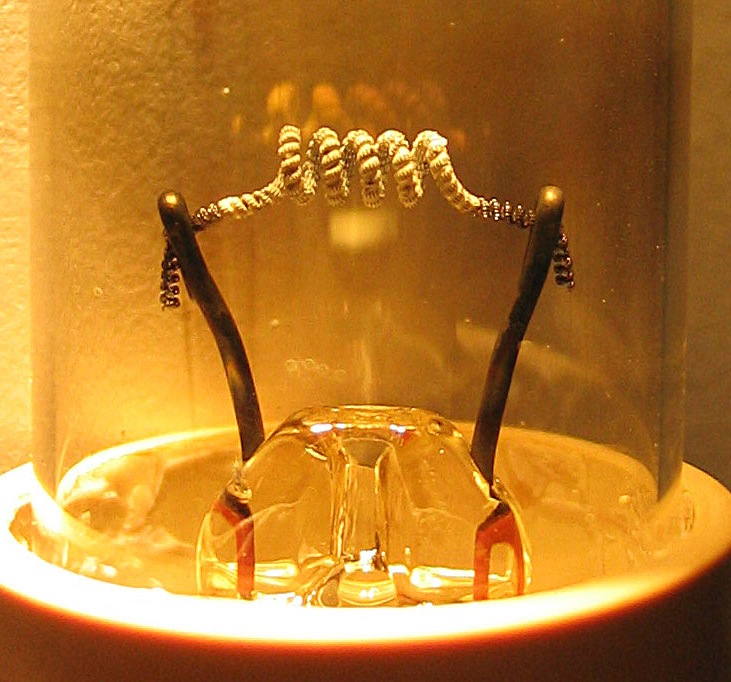
Thermionic emission is crucial to the operation of a variety of electronic devices and can be used for electricity generation (such as thermionic converters and electrodynamic tethers) or cooling. Thermionic vacuum tubes emit electrons from a hot cathode into an enclosed vacuum and may steer those emitted electrons with applied voltage. The hot cathode can be a metal filament, a coated metal filament, or a separate structure of metal or carbides or borides of transition metals. Vacuum emission from metals tends to become significant only for temperatures over 1,000 K (730 °C; 1,340 °F). Charge flow increases dramatically with temperature.
The term thermionic emission is now also used to refer to any thermally-excited charge emission process, even when the charge is emitted from one solid-state region into another.
Because the electron was not identified as a separate physical particle until the work of J. J. Thomson in 1897, the word "electron" was not used when discussing experiments that took place before this date.
The phenomenon was initially reported in 1853 by Edmond Becquerel. It was observed again in 1873 by Frederick Guthrie in Britain. While doing work on charged objects, Guthrie discovered that a red-hot iron sphere with a negative charge would lose its charge (by somehow discharging it into air). He also found that this did not happen if the sphere had a positive charge. Other early contributors included Johann Wilhelm Hittorf (1869–1883), Eugen Goldstein (1885), and Julius Elster and Hans Friedrich Geitel (1882–1889).
Thermionic emission was observed again by Thomas Edison in 1880 while his team was trying to discover the reason for breakage of carbonized bamboo filaments and undesired blackening of the interior surface of the bulbs in his incandescent lamps. This blackening was carbon deposited from the filament and was darkest near the positive end of the filament loop, which apparently cast a light shadow on the glass, as if negatively-charged carbon emanated from the negative end and was attracted towards and sometimes absorbed by the positive end of the filament loop. This projected carbon was deemed "electrical carrying" and initially ascribed to an effect in Crookes tubes where negatively-charged cathode rays from ionized gas move from a negative to a positive electrode. To try to redirect the charged carbon particles to a separate electrode instead of the glass, Edison did a series of experiments (a first inconclusive one is in his notebook on 13 February 1880) such as the following successful one:
This effect had many applications. Edison found that the current emitted by the hot filament increased rapidly with voltage, and filed a patent for a voltage-regulating device using the effect on 15 November 1883, notably the first US patent for an electronic device. He found that sufficient current would pass through the device to operate a telegraph sounder, which was exhibited at the International Electrical Exhibition of 1884 in Philadelphia. Visiting British scientist William Preece received several bulbs from Edison to investigate. Preece's 1885 paper on them referred to the one-way current through the partial vacuum as the Edison effect, although that term is occasionally used to refer to thermionic emission itself. British physicist John Ambrose Fleming, working for the British Wireless Telegraphy Company, discovered that the Edison effect could be used to detect radio waves. Fleming went on to develop a two-element thermionic vacuum tube diode called the Fleming valve (patented 16 November 1904). Thermionic diodes can also be configured to convert a heat difference to electric power directly without moving parts as a device called a thermionic converter, a type of heat engine.
Hub AI
Thermionic emission AI simulator
(@Thermionic emission_simulator)
Thermionic emission
Thermionic emission is the liberation of charged particles from a hot electrode whose thermal energy gives some particles enough kinetic energy to escape the material's surface. The particles, sometimes called thermions in early literature, are now known to be ions or electrons. Thermal electron emission specifically refers to emission of electrons and occurs when thermal energy overcomes the material's work function.
After emission, an opposite charge of equal magnitude to the emitted charge is initially left behind in the emitting region. But if the emitter is connected to a battery, that remaining charge is neutralized by charge supplied by the battery as particles are emitted, so the emitter will have the same charge it had before emission. This facilitates additional emission to sustain an electric current. Thomas Edison in 1880 while inventing his light bulb noticed this current, so subsequent scientists referred to the current as the Edison effect, though it wasn't until after the 1897 discovery of the electron that scientists understood that electrons were emitted and why.
Thermionic emission is crucial to the operation of a variety of electronic devices and can be used for electricity generation (such as thermionic converters and electrodynamic tethers) or cooling. Thermionic vacuum tubes emit electrons from a hot cathode into an enclosed vacuum and may steer those emitted electrons with applied voltage. The hot cathode can be a metal filament, a coated metal filament, or a separate structure of metal or carbides or borides of transition metals. Vacuum emission from metals tends to become significant only for temperatures over 1,000 K (730 °C; 1,340 °F). Charge flow increases dramatically with temperature.
The term thermionic emission is now also used to refer to any thermally-excited charge emission process, even when the charge is emitted from one solid-state region into another.
Because the electron was not identified as a separate physical particle until the work of J. J. Thomson in 1897, the word "electron" was not used when discussing experiments that took place before this date.
The phenomenon was initially reported in 1853 by Edmond Becquerel. It was observed again in 1873 by Frederick Guthrie in Britain. While doing work on charged objects, Guthrie discovered that a red-hot iron sphere with a negative charge would lose its charge (by somehow discharging it into air). He also found that this did not happen if the sphere had a positive charge. Other early contributors included Johann Wilhelm Hittorf (1869–1883), Eugen Goldstein (1885), and Julius Elster and Hans Friedrich Geitel (1882–1889).
Thermionic emission was observed again by Thomas Edison in 1880 while his team was trying to discover the reason for breakage of carbonized bamboo filaments and undesired blackening of the interior surface of the bulbs in his incandescent lamps. This blackening was carbon deposited from the filament and was darkest near the positive end of the filament loop, which apparently cast a light shadow on the glass, as if negatively-charged carbon emanated from the negative end and was attracted towards and sometimes absorbed by the positive end of the filament loop. This projected carbon was deemed "electrical carrying" and initially ascribed to an effect in Crookes tubes where negatively-charged cathode rays from ionized gas move from a negative to a positive electrode. To try to redirect the charged carbon particles to a separate electrode instead of the glass, Edison did a series of experiments (a first inconclusive one is in his notebook on 13 February 1880) such as the following successful one:
This effect had many applications. Edison found that the current emitted by the hot filament increased rapidly with voltage, and filed a patent for a voltage-regulating device using the effect on 15 November 1883, notably the first US patent for an electronic device. He found that sufficient current would pass through the device to operate a telegraph sounder, which was exhibited at the International Electrical Exhibition of 1884 in Philadelphia. Visiting British scientist William Preece received several bulbs from Edison to investigate. Preece's 1885 paper on them referred to the one-way current through the partial vacuum as the Edison effect, although that term is occasionally used to refer to thermionic emission itself. British physicist John Ambrose Fleming, working for the British Wireless Telegraphy Company, discovered that the Edison effect could be used to detect radio waves. Fleming went on to develop a two-element thermionic vacuum tube diode called the Fleming valve (patented 16 November 1904). Thermionic diodes can also be configured to convert a heat difference to electric power directly without moving parts as a device called a thermionic converter, a type of heat engine.
Recent media