Hubbry Logo
logo
Spanish solution
Community hub

Spanish solution

logo
0 subscribers
Read side by side
from Wikipedia
Spanish solution
Spanish solution diagram: Passengers board from the left platform and alight onto the island in the center.

In railway and rapid transit parlance, the Spanish solution is a station layout with two railway platforms, one on each side of a track,[1] which allows for separate platforms for boarding and alighting.

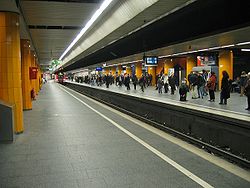
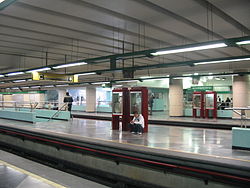
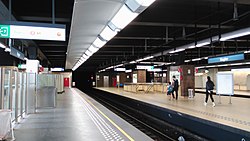
The Spanish solution is used in several stations of the Madrid Metro (e.g. Avenida de América) and Barcelona Metro (e.g. Sant Andreu).

Description

[edit]

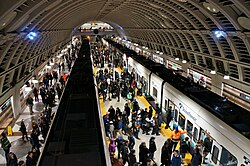
This platform arrangement allows the separation of passenger streams by using one platform only for boarding and the other only for alighting.[1] The separate designation of platforms for boarding and alighting has been proven effective at reducing dwell time at stations with high passenger numbers.[2]

The Spanish solution is most commonly applied at high-frequency underground metro stations. Stations are sometimes retrofitted to include a Spanish solution layout to expand the capacity of existing stations when there is no space to widen the existing platform, an issue that can occur in island platform configurations.

To encourage passengers to exit to the correct platform, arriving trains typically first open their doors facing the platform for alighting passengers, and then open the doors for boarding passengers after a slight delay.

Examples

[edit]

An example of the Spanish Solution is the Karlsplatz (Stachus) station on the Munich S-Bahn, which has island platforms for boarding and side platforms for alighting.

Additionally this solution can be found on several Metro de Madrid stations: Sainz de Baranda, Avenida de America and many others.[citation needed]

[edit]

See also

[edit]

References

[edit]
[edit]
Revisions and contributorsEdit on WikipediaRead on Wikipedia
from Grokipedia
The Spanish solution, also known as the Barcelona solution, is a railway and rapid transit station design featuring platforms on both sides of one or more tracks, enabling passengers to alight onto one platform while boarding from the opposite side to streamline operations.[1] This configuration typically involves two tracks with three platforms—an island platform in the center for one function and side platforms on the outer edges for the other—allowing simultaneous entry and exit without cross-platform congestion.[2] Originating in the Barcelona Metro during the 1930s, 1940s, and 1950s, the design was pioneered to manage growing passenger volumes in Spain's expanding urban rail networks.[2] While similar configurations appeared earlier, such as at Boston's Park Street station in 1915, it gained the "Spanish" moniker due to its widespread adoption in Spanish metros, such as Madrid's Avenida de América station on Line 7, where it facilitates efficient flow on busy routes.[1] The solution's core advantage lies in separating alighting and boarding movements, which can reduce dwell times in high-traffic settings, enhances safety by minimizing crowding on a single platform, and supports faster cross-platform transfers.[3][4] Despite its benefits, the Spanish solution remains uncommon globally, implemented primarily at major interchanges or event venues due to the high costs of retrofitting existing infrastructure.[1] Notable international examples include Sydney's Olympic Park station, built for the 2000 Olympics to handle peak crowds; and Hong Kong's Lo Wu station for border crossings.[1] Some systems, such as New York's subway, have decommissioned certain Spanish solution platforms due to changing ridership patterns.[1]

Definition and History

Definition

The Spanish solution is a station layout in railway and rapid transit systems featuring two tracks served by three platforms: two outer side platforms and a central island platform, with the side platforms designated for alighting passengers and the island platform for boarding (or vice versa), thereby segregating passenger flows to reduce congestion and improve efficiency.[5] The term originates from its prominent adoption in Spanish metro systems, allowing cross-platform transfers in some configurations but primarily aimed at flow separation.[5] In basic mechanics, trains stop aligned to the track such that the alighting-side platform is adjacent to the relevant doors first, enabling simultaneous but separated passenger movements—alighting to the side platform and boarding from the island platform—to minimize congestion in high-frequency urban rail contexts.[3]

Origins and Development

The Spanish solution traces its roots to the early 20th-century development of urban rapid transit systems, though similar layouts appeared earlier in cities like New York, São Paulo, and Boston (as early as 1914). In Spain, it built on the nation's rail infrastructure established in the 19th century, with the first railway line connecting Barcelona and Mataró opening in 1848.[6] This foundational rail history influenced the design of underground metros, where space constraints necessitated innovative platform arrangements to support growing urban populations. The configuration first gained prominence in Spanish metros during the interwar period and post-World War II era, with notable early adoption in the Barcelona Metro, which opened in 1924, and the Madrid Metro, inaugurated in 1919.[7][8] These systems initially featured basic island platforms, but as passenger volumes increased, the three-platform setup—characterized by separate alighting and boarding areas—emerged in the 1930s, 1940s, and 1950s to streamline operations amid urban expansion. The Barcelona Metro popularized the approach, originally termed the "Barcelona solution," to manage overcrowding on high-capacity lines in confined subterranean spaces.[5][2] Driven by the need to optimize dwell times and passenger flows during Spain's metro expansions, the design was widely implemented as networks grew to accommodate urbanization. Stations with this layout were constructed or retrofitted in major lines, such as those in Madrid and Barcelona, to address platform congestion without expanding infrastructure footprints. Key milestones included its integration with advanced signaling systems by the 1990s, enhancing safety and throughput in dense operations. The term "Spanish solution" entered international transit literature by the late 1990s, recognizing its proven efficiency in supporting rapid transit in compact urban settings.[9] This evolution underscores its role in reducing dwell times by segregating passenger movements.[5]

Layout and Operation

Platform Configuration

The Spanish solution employs a mixed platform configuration consisting of a central island platform flanked by two side platforms, typically serving two parallel tracks to separate alighting and boarding passenger flows. This layout ensures that passengers disembark onto the central platform while boarding occurs from the outer side platforms, promoting unidirectional movement and level boarding where platforms are constructed at the same height as train floors for accessibility. Barriers, signage, and sometimes platform screen doors are installed to enforce directionality and prevent cross-flow, with the overall width often reaching approximately 18 meters (6 meters per platform) in modern implementations.[10][11] Track infrastructure requires precise alignment between train doors and platform edges to facilitate simultaneous door operations on both sides of the train, utilizing up to 100% of available doors for efficiency. Most implementations operate on standard gauge tracks of 1435 mm, compatible with common metro rolling stock, and incorporate safety features such as tactile paving along platform edges for visually impaired users, adequate lighting for visibility, and CCTV surveillance systems to monitor high-traffic areas. In Barcelona Metro stations employing this configuration, such as those on lines 3 and 4, these elements support safe operations in dense urban environments.[12][13][14] For retrofitting existing stations, the Spanish solution is adapted by repurposing space through the addition of side platforms or the installation of temporary barriers and signage on island platforms, particularly in underground metros where expanding to full three-platform setups is constrained by structural limitations. This modular approach allows initial implementation with a central platform for alighting, later expandable by adding side platforms to double capacity without major overhauls. Integration with automatic train control (ATC) systems ensures precise train positioning within centimeters, critical for door alignment and operational reliability in high-frequency services.[10][15]

Boarding and Alighting Procedures

In the Spanish solution, operational protocols for passenger movement emphasize the segregation of alighting and boarding flows to enhance efficiency and safety at the station. Upon the train's arrival, doors facing the central island platform open, enabling disembarking passengers to exit directly onto the dedicated alighting area without interfering with incoming crowds. After a brief interval to clear the platform, doors on the opposite side of the train open to the lateral entry platforms, allowing boarding passengers to enter in a controlled manner; all doors then close simultaneously once loading is complete. This sequence prevents cross-flows and supports unidirectional movement per platform.[10][16] Safety is prioritized through a combination of technological and human elements, including audio announcements guiding passengers to the correct platform, visual indicators such as green and red lights signaling door status and flow directions, and on-site staff to monitor and enforce compliance. Emergency overrides permit the immediate opening of all doors for rapid evacuation in critical situations. These measures collectively reduce the risk of accidents by eliminating counterflows at doors and platforms.[10] The procedures optimize passenger management by staggering movements, which distributes crowds across dedicated spaces and alleviates peak congestion. This approach maximizes platform utilization, with simulations demonstrating up to double the transfer capacity of conventional island platforms through full door usage and the absence of conflicting streams. Such configurations can handle significantly higher passenger volumes under asymmetric demand patterns.[10] While the core protocol maintains unidirectional flows, variations in paired-track systems may permit bidirectional cross-platform interchanges under controlled conditions, provided the primary separation of alighting and boarding is preserved. This procedure also contributes to overall dwell time reductions by minimizing onboard conflicts, though detailed efficiency metrics are addressed elsewhere.[16]

Benefits and Challenges

Advantages

The Spanish solution, by segregating boarding and alighting passenger flows through dedicated platforms on either side of the track, significantly reduces dwell times at stations. This separation prevents conflicts between incoming and outgoing passengers, allowing doors to open and close more efficiently without delays from overcrowding or hesitation. Studies indicate that such configurations can shorten average station stops, enabling higher frequencies during peak periods.[10] In terms of capacity, the layout enhances overall throughput by utilizing all train doors simultaneously, effectively doubling the passenger handling efficiency compared to traditional central island platforms. This is particularly beneficial in high-demand urban environments, where it can increase system capacity by up to 100% in constrained station designs, supporting higher frequencies without expanding infrastructure footprint.[10] The design also improves safety and passenger comfort by eliminating counterflows on platforms and at doorways, which reduces crowding, collision risks, and congestion around access points. Dedicated spaces for boarding and alighting enhance accessibility, especially for elderly, disabled, or mobility-impaired users, as they can navigate less chaotic environments. This flow separation contributes to a more orderly experience, aligning with level-of-service standards that prioritize pedestrian safety in dense transit settings.[10] From a cost perspective, the Spanish solution is retrofit-friendly for existing stations, as it allows modular additions of side platforms to legacy island setups without requiring complete rebuilds. This phased approach enables operators to scale capacity incrementally based on demand growth, offering long-term economic benefits through optimized operations and reduced need for extensive capital investments.[10]

Disadvantages and Criticisms

One significant drawback of the Spanish solution is its substantial space requirements, as the configuration typically involves three platforms for two tracks—a central island platform flanked by side platforms—resulting in a total platform width of approximately 18 meters to accommodate efficient passenger flows without counterflow at doors.[10] This design demands wider tunnels or station footprints compared to standard island or side platform layouts, limiting its applicability in constrained urban environments or existing infrastructure.[10] Implementation costs represent another major limitation, with initial construction and retrofitting expenses significantly higher due to the need for structural reinforcements, track separations, and wall modifications in dense or seismically active areas.[10] For instance, proposals to retrofit the Spanish solution at Toronto's Bloor-Yonge station, one of North America's busiest transit hubs, were estimated at nearly $1 billion, a figure approaching the cost of constructing an entirely new subway line, leading to the plan's indefinite postponement.[17] Such financial burdens make it less viable for budget-constrained projects or upgrades to legacy systems. The Spanish solution may also prove overly complex or inefficient for lower-frequency services, where simpler platform designs can achieve comparable performance at reduced scale. In a comparative analysis of light rail systems, Portland's MAX Orange Line terminus employs three Spanish solution platforms for 10-minute headways, yet Manchester's Metrolink achieves superior on-time performance with just two tracks and a single platform for 6-minute headways, suggesting potential overdesign and unnecessary infrastructure investment in non-peak scenarios.[18] Operational challenges during adoption further complicate its use, including potential disruptions from phased expansions—such as adding side platforms to an existing central one—and the need for staff training to manage separated boarding and alighting streams effectively.[19] While effective for high-volume corridors, these factors have led transit authorities to view the Spanish solution as impractical in contexts requiring flexibility or minimal intervention.[17]

Implementations

In Spain

The Spanish solution originated and remains most prevalent in Spain's major metro systems, where it facilitates efficient passenger flow at high-demand interchanges. In the Madrid Metro, this layout was introduced during expansions in the 1980s to accommodate growing ridership on busy lines. Notable examples include the station at Avenida de América, serving Lines 4, 6, 7, and 9, which features a central platform for alighting passengers flanked by side platforms for boarding, allowing simultaneous train operations in opposite directions. Similarly, Sainz de Baranda station on Lines 6 and 9 employs the same configuration to manage peak-hour crowds. The Madrid Metro, one of Europe's largest networks, transports approximately 1.8 million passengers daily as of 2024, across its 302 stations.[20][21] In the Barcelona Metro, the Spanish solution—sometimes referred to locally as the "solución Barcelona"—was integrated during infrastructure upgrades, including those ahead of the 1992 Summer Olympics, which spurred significant enhancements to public transport capacity. Stations like Sant Andreu on Lines 1 and 2 exemplify this, with a central island platform enabling segregated entry and exit to reduce congestion at key northern hubs. These modifications supported the city's transformation into a major transit-oriented metropolis, handling approximately 1 million daily metro users by the early 2000s. Beyond Madrid and Barcelona, partial implementations of the Spanish solution appear in other regional systems, such as the Valencia Metro and Bilbao Metro, often at intermodal points connecting to RENFE national rail services for seamless transfers. For instance, select Valencia stations incorporate central platforms to optimize flow in the city's network, while Bilbao's modernized lines use similar designs at high-traffic nodes. The approach is used in numerous stations nationwide, bolstering Spain's efficient urban rail transit.

International Examples

The Spanish solution has been adapted in several international rail systems to improve passenger flow in high-density urban environments. In Germany, the Munich S-Bahn employs this configuration at key underground stations along its trunk line (Stammstrecke), Europe's busiest rail corridor, including Karlsplatz (Stachus), where it has been in use since the network's opening in 1971.[22] At Karlsplatz, passengers alight onto side platforms flanking the central island boarding platform, separating flows to minimize dwell times amid high frequencies of up to 5-minute headways during peak hours; this setup supports the overall S-Bahn's daily ridership of approximately 450,000 passengers as of 2024 across its network.[23] The design allows simultaneous door openings on both sides of trains, enhancing efficiency in a station integrated with U-Bahn lines and serving as a major transfer hub.[24] Similar platform arrangements for ingress-egress separation have been implemented in other metros to manage high densities, though not always explicitly termed the "Spanish solution". For instance, some stations in Asian systems like Guangzhou and Shenzhen use dedicated alighting areas to support short headways. In hubs like New York and Paris, select rapid transit stations feature comparable configurations with local adaptations for accessibility and signage.
User Avatar
No comments yet.