



Community hub
Recent from talks
Contribute something
Nothing was collected or created yet.
Specific detectivity
View on Wikipedia | This article may rely excessively on sources too closely associated with the subject, potentially preventing the article from being verifiable and neutral. (October 2018) |
Specific detectivity, or D*, for a photodetector is a figure of merit used to characterize performance, equal to the reciprocal of noise-equivalent power (NEP), normalized per square root of the sensor's area and frequency bandwidth (reciprocal of twice the integration time).
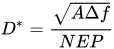
Specific detectivity is given by , where is the area of the photosensitive region of the detector, is the bandwidth, and NEP the noise equivalent power [unit: ]. It is commonly expressed in Jones units () in honor of Robert Clark Jones who originally defined it.[1][2]


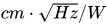
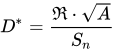
Given that noise-equivalent power can be expressed as a function of the responsivity (in units of or ) and the noise spectral density (in units of or ) as , it is common to see the specific detectivity expressed as .


It is often useful to express the specific detectivity in terms of relative noise levels present in the device. A common expression is given below.
![{\displaystyle D^{*}={\frac {q\lambda \eta }{hc}}\left[{\frac {4kT}{R_{0}A}}+2q^{2}\eta \Phi _{b}\right]^{-1/2}}](https://wikimedia.org/api/rest_v1/media/math/render/svg/f457d102712ed5f96da3127e95b23631500c8601)
With q as the electronic charge, is the wavelength of interest, h is the Planck constant, c is the speed of light, k is the Boltzmann constant, T is the temperature of the detector, is the zero-bias dynamic resistance area product (often measured experimentally, but also expressible in noise level assumptions), is the quantum efficiency of the device, and is the total flux of the source (often a blackbody) in photons/sec/cm2.


Detectivity measurement
[edit]Detectivity can be measured from a suitable optical setup using known parameters. You will need a known light source with known irradiance at a given standoff distance. The incoming light source will be chopped at a certain frequency, and then each wavelength will be integrated over a given time constant over a given number of frames.
In detail, we compute the bandwidth directly from the integration time constant .


Next, an average signal and rms noise needs to be measured from a set of frames. This is done either directly by the instrument, or done as post-processing.

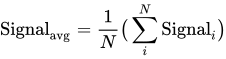

Now, the computation of the radiance in W/sr/cm2 must be computed where cm2 is the emitting area. Next, emitting area must be converted into a projected area and the solid angle; this product is often called the etendue. This step can be obviated by the use of a calibrated source, where the exact number of photons/s/cm2 is known at the detector. If this is unknown, it can be estimated using the black-body radiation equation, detector active area and the etendue. This ultimately converts the outgoing radiance of the black body in W/sr/cm2 of emitting area into one of W observed on the detector.


The broad-band responsivity, is then just the signal weighted by this wattage.

where
- is the responsivity in units of Signal / W, (or sometimes V/W or A/W)
- is the outgoing radiance from the black body (or light source) in W/sr/cm2 of emitting area
- is the total integrated etendue between the emitting source and detector surface
- is the detector area
- is the solid angle of the source projected along the line connecting it to the detector surface.


From this metric noise-equivalent power can be computed by taking the noise level over the responsivity.

Similarly, noise-equivalent irradiance can be computed using the responsivity in units of photons/s/W instead of in units of the signal. Now, the detectivity is simply the noise-equivalent power normalized to the bandwidth and detector area.

See also
[edit]References
[edit]- ^ R. C. Jones, "Quantum efficiency of photoconductors," Proc. IRIS 2, 9 (1957)
- ^ R. C. Jones, "Proposal of the detectivity D** for detectors limited by radiation noise," J. Opt. Soc. Am. 50, 1058 (1960), doi:10.1364/JOSA.50.001058)
 This article incorporates public domain material from Federal Standard 1037C. General Services Administration. Archived from the original on 2022-01-22.
Specific detectivity
View on GrokipediaFundamentals
Definition
Photodetectors are devices that convert incident optical radiation into measurable electrical signals through the absorption of photons, which generate charge carriers or alter material properties such as conductivity or temperature.[5] These instruments are essential in applications ranging from imaging to spectroscopy, where sensitivity to low light levels is critical. Specific detectivity, denoted as , is a key figure of merit that quantifies a photodetector's ability to discern weak optical signals against its intrinsic noise. It normalizes the detector's sensitivity by accounting for the active area and electrical bandwidth, allowing for equitable performance comparisons across devices of varying sizes and configurations.[6] This normalization addresses the fact that larger detectors may inherently collect more signal but also more noise, making raw detectivity metrics insufficient for standardization.[7] The concept of specific detectivity was introduced in the early 1960s as an advancement over basic detectivity, particularly to accommodate the diverse geometries of emerging infrared sensors. It was first formalized by S. Nudelman in a seminal 1962 analysis of infrared photodetector performance.[8] Specific detectivity is typically expressed in units of cm /W, which reflect its dimensional normalization by area (cm²) and bandwidth (√Hz), underscoring its role as a device-independent sensitivity metric.[5] Fundamentally, derives from the noise equivalent power (NEP)—the minimum detectable signal power for unity signal-to-noise ratio—as a normalized reciprocal, enabling broader applicability in detector design and evaluation.[6]Importance in photodetector performance
Specific detectivity, denoted as , serves as a critical figure of merit for benchmarking photodetector performance by enabling direct comparisons across devices irrespective of their active area or bandwidth, which is essential for selecting optimal detectors in noise-limited, low-light scenarios such as astronomical observations.[1] Unlike raw metrics, normalizes the noise-equivalent power to a standard 1 cm² area and 1 Hz bandwidth, providing a measure of intrinsic sensitivity that accounts for fundamental noise limitations.[9] This normalization is particularly valuable in fields requiring high signal-to-noise ratios (SNR), where even faint signals must be distinguished from background noise, as seen in infrared astronomy for detecting distant celestial objects.[1] Higher values of directly correlate with improved SNR, motivating advancements in photodetector materials and designs to push performance boundaries, particularly in infrared detection where thermal noise poses significant challenges. For instance, mercury cadmium telluride (HgCdTe) photodiodes have been extensively researched for their ability to achieve high in mid- to long-wave infrared regimes, enabling background-limited performance in cryogenic environments and driving innovations in photodiode architectures for enhanced quantum efficiency and reduced dark current.[10] Similarly, graphene-based detectors have emerged as promising candidates due to their broadband response and potential for room-temperature operation, with engineered heterostructures yielding values competitive with traditional materials while offering advantages in speed and flexibility for integrated infrared systems; as of 2025, self-powered graphene heterojunctions have achieved detectivities up to Jones in the mid-infrared.[11][12] These developments underscore how guides material selection and optimization, fostering progress toward more efficient, compact detectors for next-generation technologies. Raw responsivity or unnormalized detectivity can mislead evaluations, as they do not account for device geometry; for example, larger-area detectors may exhibit apparently higher sensitivity due to increased signal collection, but this overlooks noise scaling with the square root of the area, potentially overestimating performance without revealing true material or design efficacy.[9] In contrast, mitigates these issues by providing a geometry-independent metric, ensuring reliable assessments that prioritize fundamental detectivity over superficial gains. A practical illustration is in space-based telescopes, where cryogenic infrared detectors target cm Hz W to suppress background noise from cosmic sources and achieve the sensitivity needed for deep-space imaging.[13]Mathematical Formulation
Noise equivalent power
The noise equivalent power (NEP) is a key metric quantifying the sensitivity of a photodetector, defined as the incident optical power that generates a signal equal in magnitude to the detector's noise, yielding a signal-to-noise ratio (SNR) of 1 within a 1 Hz bandwidth.[14] This represents the minimum detectable signal power under standard conditions, with NEP typically expressed in units of watts per square root hertz (W/√Hz) to account for its dependence on measurement bandwidth.[15] The NEP concept emerged in the 1950s amid advancements in infrared detection for radar and early optical systems, providing an initial unnormalized measure of detector performance before the introduction of area- and bandwidth-normalized figures like specific detectivity.[5] Fundamentally, NEP is derived from the detector's electrical characteristics, calculated as the root-mean-square (RMS) noise current divided by the responsivity : Here, responsivity is the ratio of the generated photocurrent to the incident optical power, measured in amperes per watt (A/W), reflecting the efficiency of photon-to-electron conversion in the photodetector.[14] The noise current aggregates contributions from multiple sources, determining the overall limit of detection. Note that here is the noise current spectral density (in A/√Hz), so NEP is in W/√Hz. The dominant noise types influencing in photodetectors are shot noise, thermal (Johnson) noise, and 1/f (flicker) noise, each with distinct physical origins. Shot noise stems from the granular, probabilistic nature of charge carrier flow, including statistical variations in both the signal photocurrent from absorbed photons and the dark current from thermal generation, following Poisson statistics.[14] Thermal noise arises from the random thermal agitation of electrons in conductive elements like the load resistor or shunt resistance, producing a white noise spectrum that is temperature-dependent and signal-independent.[14] In contrast, 1/f noise originates from material imperfections such as surface traps, bulk defects, or interface states in the semiconductor, causing correlated fluctuations that increase at lower frequencies and often dominate in the sub-kilohertz regime.[14]Specific detectivity formula
The specific detectivity, denoted as , is a normalized figure of merit for photodetectors, given by the formula where is the active area of the detector in cm² and NEP is the noise equivalent power in W/√Hz (normalized to 1 Hz bandwidth).[5] This expression links directly to the noise equivalent power, with NEP representing the incident power required to produce a signal-to-noise ratio of unity in a 1 Hz bandwidth. The derivation begins with the unnormalized detectivity , defined for a given bandwidth as the reciprocal of the minimum detectable power : since for bandwidth in Hz. This quantifies the detector's sensitivity but depends on device geometry and measurement conditions. To enable fair comparisons across detectors, specific detectivity normalizes by the square root of the product of area and bandwidth: The normalization renders independent of bandwidth , assuming ideal or background-limited conditions where performance is not dominated by extraneous factors.[5] This form was proposed by R. Clark Jones to standardize evaluations of infrared and visible detectors.[5] The units of are cm √Hz / W, often termed "Jones" in honor of its originator. These arise from the square root of the area () and division by NEP (), ensuring the metric reflects intrinsic material and design performance independent of scale.[5] A key variation distinguishes specific detectivity (normalized) from the non-specific detectivity (unnormalized). In terms of signal processing, relates to the signal-to-noise ratio (SNR) for an incident power as providing a direct measure of how effectively the detector converts input radiation into a usable signal relative to noise.[15]Measurement and Evaluation
Experimental methods
The measurement of specific detectivity in photodetectors typically employs a controlled laboratory setup to deliver a calibrated optical input while isolating the device's response from external noise sources. Standard configurations include a modulated light source, such as a laser for monochromatic illumination or a blackbody radiator for broadband infrared signals, paired with an optical chopper operating at frequencies like 1 kHz to enable phase-sensitive detection.[14] A lock-in amplifier synchronizes with the chopper to extract the signal, effectively suppressing ambient interference, while cryogenic cooling—often using liquid nitrogen at 77 K—reduces thermal noise in the detector and surrounding environment.[9] Cold shields around the detector further minimize background radiation, ensuring measurements approach background-limited infrared performance (BLIP) conditions.[5] These setups originated in the 1960s during military infrared testing for applications like missile seekers, where early photoconductive devices required precise characterization amid wartime demands for reliable detection.[8] The experimental procedure begins by calibrating the incident optical power using a reference photodetector, such as a silicon trap or InGaAs device, to establish accurate irradiance levels on the test photodetector. The device is then illuminated with the modulated beam, and the resulting photocurrent or photovoltage is recorded via the lock-in amplifier to determine the signal amplitude. Next, the noise spectral density is measured in the absence of illumination, capturing contributions from sources like shot noise, generation-recombination noise, and 1/f noise, often by scanning frequencies with a spectrum analyzer. The noise equivalent power (NEP) is identified as the incident power that produces a signal equal to the noise level (signal-to-noise ratio of 1), serving as the foundation for computing specific detectivity D*.[16] Throughout, the detector's active area is quantified using techniques like scanning photocurrent microscopy or calibrated aperture masks to ensure geometric accuracy.[14] Common instruments in these measurements include spectrum analyzers (e.g., Keysight models) for resolving noise across bandwidths up to several kHz, and preamplifiers with low noise floors (e.g., 0.6 nV/√Hz) to amplify weak signals without introducing artifacts.[16] Optical components such as monochromators or Fourier transform infrared (FTIR) spectrometers allow spectral selectivity, while temperature controllers maintain stable operating conditions from 10 K to room temperature.[9] Key challenges involve subtracting background radiation, achieved through shielded enclosures and instrument noise purging via cross-correlation techniques, to isolate intrinsic detector performance. Frequency-dependent noise, particularly 1/f components at low frequencies, complicates broadband assessments and requires validation of noise independence from area and bandwidth, often using fixed 1 Hz references for consistency.[9] Misestimation of effective area or overlooked noise types can lead to inflated results, underscoring the need for standardized protocols in high-impact evaluations.[14]Normalization and comparison
The normalization of measured data to compute specific detectivity involves adjusting the noise equivalent power (NEP) by the square root of the product of the detector's active area (in cm²) and the noise bandwidth (in Hz), using the [formula .[6] This process standardizes to a reference area of 1 cm² and bandwidth of 1 Hz, enabling geometry- and bandwidth-independent benchmarking across devices, provided the root-mean-square noise scales proportionally with , as is typical for shot-noise-dominated operation in vertical photodiodes.[15][9] Post-measurement, raw NEP values obtained from experimental setups—such as lock-in amplifier noise spectral density recordings—are scaled accordingly to yield in units of cm Hz W (Jones).[9] Specific detectivity facilitates direct comparisons of photodetector performance across materials and designs by isolating intrinsic sensitivity from size and speed variations. For instance, silicon photodetectors typically achieve values around to cm Hz W in the visible to near-infrared range, while InGaAs devices reach cm Hz W or higher at near-infrared wavelengths under cooled conditions.[17] HgCdTe photodetectors, optimized for mid- to long-wave infrared, exhibit on the order of to cm Hz W, depending on cutoff wavelength and temperature.[18]| Material | Typical (cm Hz W) | Wavelength Range | Notes on Discrepancies |
|---|---|---|---|
| Silicon (Si) | – | Visible–NIR (0.4–1.1 µm) | Real-world values often lower than ideal due to thermal noise in uncooled operation; exceeds in low-noise PIN designs.[19] |
| InGaAs | NIR (0.9–1.7 µm) | Cooled devices approach background-limited performance; room-temperature values drop to – from excess 1/f noise.[20][17] | |
| HgCdTe | – | MWIR–LWIR (3–12 µm) | Ideal BLIP limits higher at cryogenic temperatures; real discrepancies arise from Auger recombination and surface leakage, reducing effective by factors of 2–10.[18] |