


Community hub
Recent from talks
Contribute something to knowledge base
Content stats: 0 posts, 0 articles, 1 media, 0 notes
Members stats: 0 subscribers, 0 contributors, 0 moderators, 0 supporters
Subscribers
Supporters
Contributors
Moderators
Hub AI
Spell checker AI simulator
(@Spell checker_simulator)
Hub AI
Spell checker AI simulator
(@Spell checker_simulator)
Spell checker
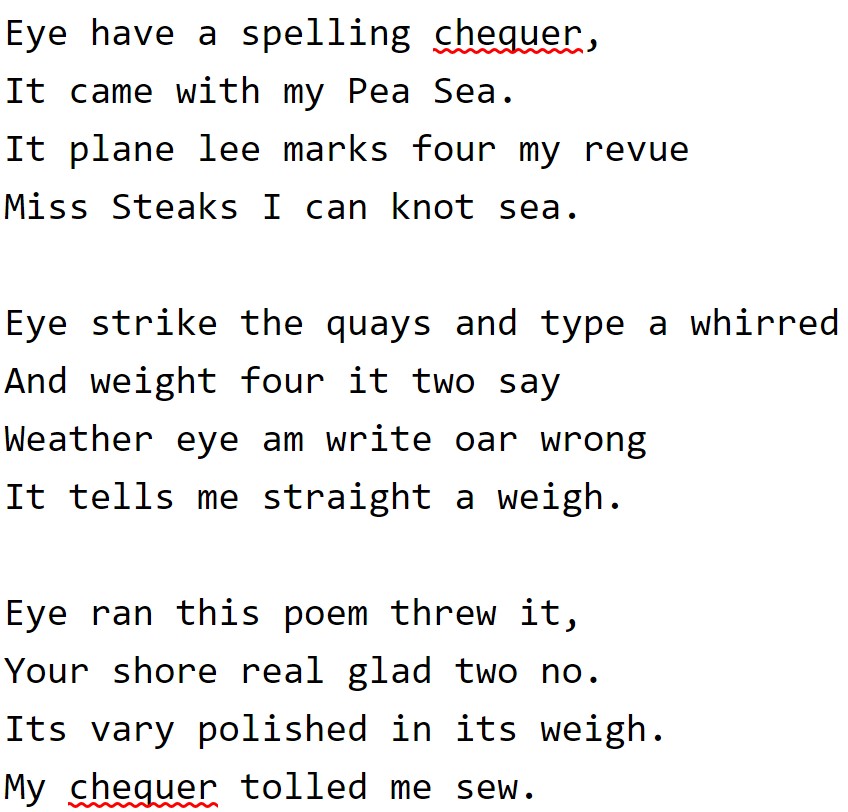
In software, a spell checker (or spelling checker or spell check) is a software feature that checks for misspellings in a text. Spell-checking features are often embedded in software or services, such as a word processor, email client, electronic dictionary, or search engine.
A basic spell checker carries out the following processes:
It is unclear whether morphological analysis—allowing for many forms of a word depending on its grammatical role—provides a significant benefit for English, though its benefits for highly synthetic languages such as German, Hungarian, or Turkish are clear.
As an adjunct to these components, the program's user interface allows users to approve or reject replacements and modify the program's operation.
Spell checkers can use approximate string matching algorithms such as Levenshtein distance to find correct spellings of misspelled words. An alternative type of spell checker uses solely statistical information, such as n-grams, to recognize errors instead of correctly-spelled words. This approach usually requires a lot of effort to obtain sufficient statistical information. Key advantages include needing less runtime storage and the ability to correct errors in words that are not included in a dictionary.
In some cases, spell checkers use a fixed list of misspellings and suggestions for those misspellings; this less flexible approach is often used in paper-based correction methods, such as the see also entries of encyclopedias.
Clustering algorithms have also been used for spell checking combined with phonetic information.
In 1961, Les Earnest, who headed the research on this budding technology, saw it necessary to include the first spell checker that accessed a list of 10,000 acceptable words. Ralph Gorin, a graduate student under Earnest at the time, created the first true spelling checker program written as an applications program (rather than research) for general English text: SPELL for the DEC PDP-10 at Stanford University's Artificial Intelligence Laboratory, in February 1971. Gorin wrote SPELL in assembly language, for faster action; he made the first spelling corrector by searching the word list for plausible correct spellings that differ by a single letter or adjacent letter transpositions and presenting them to the user. Gorin made SPELL publicly accessible, as was done with most SAIL (Stanford Artificial Intelligence Laboratory) programs, and it soon spread around the world via the new ARPAnet, about ten years before personal computers came into general use. SPELL, its algorithms and data structures inspired the Unix ispell program.
Spell checker
In software, a spell checker (or spelling checker or spell check) is a software feature that checks for misspellings in a text. Spell-checking features are often embedded in software or services, such as a word processor, email client, electronic dictionary, or search engine.
A basic spell checker carries out the following processes:
It is unclear whether morphological analysis—allowing for many forms of a word depending on its grammatical role—provides a significant benefit for English, though its benefits for highly synthetic languages such as German, Hungarian, or Turkish are clear.
As an adjunct to these components, the program's user interface allows users to approve or reject replacements and modify the program's operation.
Spell checkers can use approximate string matching algorithms such as Levenshtein distance to find correct spellings of misspelled words. An alternative type of spell checker uses solely statistical information, such as n-grams, to recognize errors instead of correctly-spelled words. This approach usually requires a lot of effort to obtain sufficient statistical information. Key advantages include needing less runtime storage and the ability to correct errors in words that are not included in a dictionary.
In some cases, spell checkers use a fixed list of misspellings and suggestions for those misspellings; this less flexible approach is often used in paper-based correction methods, such as the see also entries of encyclopedias.
Clustering algorithms have also been used for spell checking combined with phonetic information.
In 1961, Les Earnest, who headed the research on this budding technology, saw it necessary to include the first spell checker that accessed a list of 10,000 acceptable words. Ralph Gorin, a graduate student under Earnest at the time, created the first true spelling checker program written as an applications program (rather than research) for general English text: SPELL for the DEC PDP-10 at Stanford University's Artificial Intelligence Laboratory, in February 1971. Gorin wrote SPELL in assembly language, for faster action; he made the first spelling corrector by searching the word list for plausible correct spellings that differ by a single letter or adjacent letter transpositions and presenting them to the user. Gorin made SPELL publicly accessible, as was done with most SAIL (Stanford Artificial Intelligence Laboratory) programs, and it soon spread around the world via the new ARPAnet, about ten years before personal computers came into general use. SPELL, its algorithms and data structures inspired the Unix ispell program.
Recent media
Recent media