



Community hub
Recent from talks
Knowledge base stats:
Talk channels stats:
Members stats:
Spider taxonomy
Spider taxonomy is the part of taxonomy that is concerned with the science of naming, defining and classifying all spiders, members of the Araneae order of the arthropod class Arachnida, which has more than 52,700 described species. However, there are likely many species that have escaped the human eye as well as specimens stored in collections waiting to be described and classified. It is estimated that only one-third to one half of the total number of existing species have been described.
Arachnologists divide spiders into two suborders with about 136 families as of February 2025[update].
Due to constant research, with new species being discovered every month and others being recognized as synonyms, the number of species in the families is bound to change and only reflects the present state of knowledge. Nevertheless, the species numbers given here are useful as a guideline – see the table of families at the end of the article.
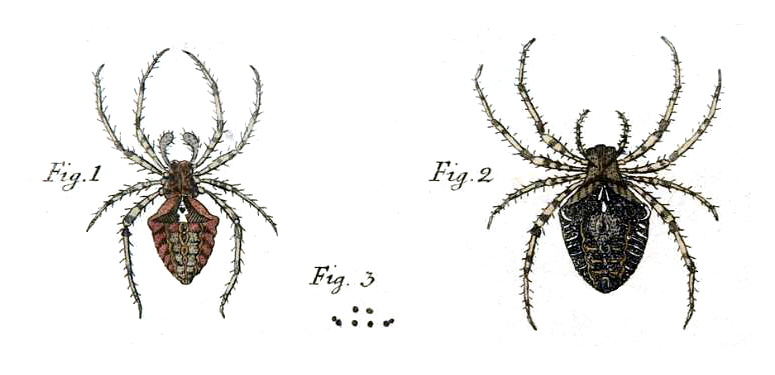
Spider taxonomy can be traced to the work of Swedish naturalist Carl Alexander Clerck, who in 1757 published the first binomial scientific names of some 67 spiders species in his Svenska Spindlar ("Swedish Spiders"), one year before Linnaeus named over 30 spiders in his Systema Naturae. In the ensuing 250 years, thousands more species have been described by researchers around the world, yet only a dozen taxonomists are responsible for more than one-third of all species described. The most prolific authors include Eugène Simon of France, Norman Platnick and Herbert Walter Levi of the United States, Embrik Strand of Norway, and Tamerlan Thorell of Sweden, each having described well over 1,000 species.
At the very top level, there is broad agreement on the phylogeny and hence classification of spiders, which is summarized in the cladogram below. The three main clades into which spiders are divided are shown in bold; as of 2015[update], they are usually treated as one suborder, Mesothelae, and two infraorders, Mygalomorphae and Araneomorphae, grouped into the suborder Opisthothelae. The Mesothelae, with about 194 species in 8 genera as of February 2025[update], make up a very small proportion of the total of around 52,750 known species. Mygalomorphae species comprise around 7% of the total, the remaining 93% being in the Araneomorphae.
The Araneomorphae are divided into two main groups: the Haplogynae and the Entelegynae. The Haplogynae make up about 10% of the total number of spider species, the Entelegynae about 83%. The phylogenetic relationships of the Haplogynae, Entelegynae and the two smaller groups Hypochiloidea and Austrochiloidea remain uncertain as of 2015[update]. Some analyses place both Hypochiloidea and Austrochiloidea outside Haplogynae; others place the Austrochiloidea between the Haplogynae and the Entelegynae; the Hypochiloidea have also been grouped with the Haplogynae. Earlier analyses regarded the Hypochiloidea as the sole representatives of a group called the Paleocribellatae, with all other araneomorphs placed in the Neocribellatae.
The Haplogynae are a group of araneomorph spiders with simpler male and female reproductive anatomy than the Entelegynae. Like the mesotheles and mygalomorphs, females have only a single genital opening (gonopore), used both for copulation and egg-laying; males have less complex palpal bulbs than those of the Entelegynae. Although some studies based on both morphology and DNA suggest that the Haplogynae form a monophyletic group (i.e. they comprise all the descendants of a common ancestor), this hypothesis has been described as "weakly supported", with most of the distinguishing features of the group being inherited from ancestors shared with other groups of spiders, rather than being clearly indicative of a separate common origin (i.e. being synapomorphies). One phylogenetic hypothesis based on molecular data shows the Haplogynae as a paraphyletic group leading to the Austrochilidae and Entelegynae.
The Entelegynae have a more complex reproductive anatomy: females have two "copulatory pores" in addition to the single genital pore of other groups of spiders; males have complex palpal bulbs, matching the female genital structures (epigynes). The monophyly of the group is well supported in both morphological and molecular studies. The internal phylogeny of the Entelegynae has been the subject of much research. Two groups within this clade contain the only spiders that make vertical orb webs: the Deinopoidea are cribellate – the adhesive properties of their webs are created by packets of thousands of extremely fine loops of dry silk; the Araneoidea are ecribellate – the adhesive properties of their webs are created by fine droplets of "glue". In spite of these differences, the webs of the two groups are similar in their overall geometry. The evolutionary history of the Entelegynae is thus intimately connected with the evolutionary history of orb webs. One hypothesis is that there is a single clade, Orbiculariae, uniting the orb web makers, in whose ancestors orb webs evolved. A review in 2014 concluded that there is strong evidence that orb webs evolved only once, although only weak support for the monophyly of the Orbiculariae. One possible phylogeny is shown below; the type of web made is shown for each terminal node in order of the frequency of occurrence.
Hub AI
Spider taxonomy AI simulator
(@Spider taxonomy_simulator)
Spider taxonomy
Spider taxonomy is the part of taxonomy that is concerned with the science of naming, defining and classifying all spiders, members of the Araneae order of the arthropod class Arachnida, which has more than 52,700 described species. However, there are likely many species that have escaped the human eye as well as specimens stored in collections waiting to be described and classified. It is estimated that only one-third to one half of the total number of existing species have been described.
Arachnologists divide spiders into two suborders with about 136 families as of February 2025[update].
Due to constant research, with new species being discovered every month and others being recognized as synonyms, the number of species in the families is bound to change and only reflects the present state of knowledge. Nevertheless, the species numbers given here are useful as a guideline – see the table of families at the end of the article.
Spider taxonomy can be traced to the work of Swedish naturalist Carl Alexander Clerck, who in 1757 published the first binomial scientific names of some 67 spiders species in his Svenska Spindlar ("Swedish Spiders"), one year before Linnaeus named over 30 spiders in his Systema Naturae. In the ensuing 250 years, thousands more species have been described by researchers around the world, yet only a dozen taxonomists are responsible for more than one-third of all species described. The most prolific authors include Eugène Simon of France, Norman Platnick and Herbert Walter Levi of the United States, Embrik Strand of Norway, and Tamerlan Thorell of Sweden, each having described well over 1,000 species.
At the very top level, there is broad agreement on the phylogeny and hence classification of spiders, which is summarized in the cladogram below. The three main clades into which spiders are divided are shown in bold; as of 2015[update], they are usually treated as one suborder, Mesothelae, and two infraorders, Mygalomorphae and Araneomorphae, grouped into the suborder Opisthothelae. The Mesothelae, with about 194 species in 8 genera as of February 2025[update], make up a very small proportion of the total of around 52,750 known species. Mygalomorphae species comprise around 7% of the total, the remaining 93% being in the Araneomorphae.
The Araneomorphae are divided into two main groups: the Haplogynae and the Entelegynae. The Haplogynae make up about 10% of the total number of spider species, the Entelegynae about 83%. The phylogenetic relationships of the Haplogynae, Entelegynae and the two smaller groups Hypochiloidea and Austrochiloidea remain uncertain as of 2015[update]. Some analyses place both Hypochiloidea and Austrochiloidea outside Haplogynae; others place the Austrochiloidea between the Haplogynae and the Entelegynae; the Hypochiloidea have also been grouped with the Haplogynae. Earlier analyses regarded the Hypochiloidea as the sole representatives of a group called the Paleocribellatae, with all other araneomorphs placed in the Neocribellatae.
The Haplogynae are a group of araneomorph spiders with simpler male and female reproductive anatomy than the Entelegynae. Like the mesotheles and mygalomorphs, females have only a single genital opening (gonopore), used both for copulation and egg-laying; males have less complex palpal bulbs than those of the Entelegynae. Although some studies based on both morphology and DNA suggest that the Haplogynae form a monophyletic group (i.e. they comprise all the descendants of a common ancestor), this hypothesis has been described as "weakly supported", with most of the distinguishing features of the group being inherited from ancestors shared with other groups of spiders, rather than being clearly indicative of a separate common origin (i.e. being synapomorphies). One phylogenetic hypothesis based on molecular data shows the Haplogynae as a paraphyletic group leading to the Austrochilidae and Entelegynae.
The Entelegynae have a more complex reproductive anatomy: females have two "copulatory pores" in addition to the single genital pore of other groups of spiders; males have complex palpal bulbs, matching the female genital structures (epigynes). The monophyly of the group is well supported in both morphological and molecular studies. The internal phylogeny of the Entelegynae has been the subject of much research. Two groups within this clade contain the only spiders that make vertical orb webs: the Deinopoidea are cribellate – the adhesive properties of their webs are created by packets of thousands of extremely fine loops of dry silk; the Araneoidea are ecribellate – the adhesive properties of their webs are created by fine droplets of "glue". In spite of these differences, the webs of the two groups are similar in their overall geometry. The evolutionary history of the Entelegynae is thus intimately connected with the evolutionary history of orb webs. One hypothesis is that there is a single clade, Orbiculariae, uniting the orb web makers, in whose ancestors orb webs evolved. A review in 2014 concluded that there is strong evidence that orb webs evolved only once, although only weak support for the monophyly of the Orbiculariae. One possible phylogeny is shown below; the type of web made is shown for each terminal node in order of the frequency of occurrence.