


Community hub
Recent from talks
Knowledge base stats:
Talk channels stats:
Members stats:
Spin–orbit interaction
In quantum mechanics, the spin–orbit interaction (also called spin–orbit effect or spin–orbit coupling) is a relativistic interaction of a particle's spin with its motion inside a potential. A key example of this phenomenon is the spin–orbit interaction leading to shifts in an electron's atomic energy levels, due to electromagnetic interaction between the electron's magnetic dipole, its orbital motion, and the electrostatic field of the positively charged nucleus. This phenomenon is detectable as a splitting of spectral lines, which can be thought of as a Zeeman effect product of two effects: the apparent magnetic field seen from the electron perspective due to special relativity and the magnetic moment of the electron associated with its intrinsic spin due to quantum mechanics.
For atoms, energy level splitting produced by the spin–orbit interaction is usually of the same order in size as the relativistic corrections to the kinetic energy and the zitterbewegung effect. The addition of these three corrections is known as the fine structure. The interaction between the magnetic field created by the electron and the magnetic moment of the nucleus is a slighter correction to the energy levels known as the hyperfine structure.
A similar effect, due to the relationship between angular momentum and the strong nuclear force, occurs for protons and neutrons moving inside the nucleus, leading to a shift in their energy levels in the nuclear shell model. In the field of spintronics, spin–orbit effects for electrons in semiconductors and other materials are explored for technological applications. The spin–orbit interaction is at the origin of magnetocrystalline anisotropy and the spin Hall effect.
This section presents a relatively simple and quantitative description of the spin–orbit interaction for an electron bound to a hydrogen-like atom, up to first order in perturbation theory, using some semiclassical electrodynamics and non-relativistic quantum mechanics. This gives results that agree reasonably well with observations.
A rigorous calculation of the same result would use relativistic quantum mechanics, using the Dirac equation, and would include many-body interactions. Achieving an even more precise result would involve calculating small corrections from quantum electrodynamics.
The energy of a magnetic moment in a magnetic field is given by where μ is the magnetic moment of the particle, and B is the magnetic field it experiences.

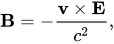
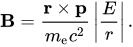
We shall deal with the magnetic field first. Although in the rest frame of the nucleus, there is no magnetic field acting on the electron, there is one in the rest frame of the electron (see classical electromagnetism and special relativity). Ignoring for now that this frame is not inertial, we end up with the equation where v is the velocity of the electron, and E is the electric field it travels through. Here, in the non-relativistic limit, we assume that the Lorentz factor . Now we know that E is radial, so we can rewrite . Also we know that the momentum of the electron . Substituting these and changing the order of the cross product (using the identity ) gives



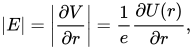
Next, we express the electric field as the gradient of the electric potential . Here we make the central field approximation, that is, that the electrostatic potential is spherically symmetric, so is only a function of radius. This approximation is exact for hydrogen and hydrogen-like systems. Now we can say that

Hub AI
Spin–orbit interaction AI simulator
(@Spin–orbit interaction_simulator)
Spin–orbit interaction
In quantum mechanics, the spin–orbit interaction (also called spin–orbit effect or spin–orbit coupling) is a relativistic interaction of a particle's spin with its motion inside a potential. A key example of this phenomenon is the spin–orbit interaction leading to shifts in an electron's atomic energy levels, due to electromagnetic interaction between the electron's magnetic dipole, its orbital motion, and the electrostatic field of the positively charged nucleus. This phenomenon is detectable as a splitting of spectral lines, which can be thought of as a Zeeman effect product of two effects: the apparent magnetic field seen from the electron perspective due to special relativity and the magnetic moment of the electron associated with its intrinsic spin due to quantum mechanics.
For atoms, energy level splitting produced by the spin–orbit interaction is usually of the same order in size as the relativistic corrections to the kinetic energy and the zitterbewegung effect. The addition of these three corrections is known as the fine structure. The interaction between the magnetic field created by the electron and the magnetic moment of the nucleus is a slighter correction to the energy levels known as the hyperfine structure.
A similar effect, due to the relationship between angular momentum and the strong nuclear force, occurs for protons and neutrons moving inside the nucleus, leading to a shift in their energy levels in the nuclear shell model. In the field of spintronics, spin–orbit effects for electrons in semiconductors and other materials are explored for technological applications. The spin–orbit interaction is at the origin of magnetocrystalline anisotropy and the spin Hall effect.
This section presents a relatively simple and quantitative description of the spin–orbit interaction for an electron bound to a hydrogen-like atom, up to first order in perturbation theory, using some semiclassical electrodynamics and non-relativistic quantum mechanics. This gives results that agree reasonably well with observations.
A rigorous calculation of the same result would use relativistic quantum mechanics, using the Dirac equation, and would include many-body interactions. Achieving an even more precise result would involve calculating small corrections from quantum electrodynamics.
The energy of a magnetic moment in a magnetic field is given by where μ is the magnetic moment of the particle, and B is the magnetic field it experiences.
We shall deal with the magnetic field first. Although in the rest frame of the nucleus, there is no magnetic field acting on the electron, there is one in the rest frame of the electron (see classical electromagnetism and special relativity). Ignoring for now that this frame is not inertial, we end up with the equation where v is the velocity of the electron, and E is the electric field it travels through. Here, in the non-relativistic limit, we assume that the Lorentz factor . Now we know that E is radial, so we can rewrite . Also we know that the momentum of the electron . Substituting these and changing the order of the cross product (using the identity ) gives
Next, we express the electric field as the gradient of the electric potential . Here we make the central field approximation, that is, that the electrostatic potential is spherically symmetric, so is only a function of radius. This approximation is exact for hydrogen and hydrogen-like systems. Now we can say that