
Recent from talks
Spin tensor
Knowledge base stats:
Talk channels stats:
Members stats:
Spin tensor
In mathematics, mathematical physics, and theoretical physics, the spin tensor is a quantity used to describe the rotational motion of particles in spacetime. The spin tensor has application in general relativity and special relativity, as well as quantum mechanics, relativistic quantum mechanics, and quantum field theory.
The special Euclidean group SE(d) of direct isometries is generated by translations and rotations. Its Lie algebra is written .

This article uses Cartesian coordinates and tensor index notation.
The Noether current for translations in space is momentum, while the current for increments in time is energy. These two statements combine into one in spacetime: translations in spacetime, i.e. a displacement between two events, is generated by the four-momentum P. Conservation of four-momentum is given by the continuity equation:

where is the stress–energy tensor, and ∂ are partial derivatives that make up the four-gradient (in non-Cartesian coordinates this must be replaced by the covariant derivative). Integrating over space:

gives the four-momentum vector at time t.
Hub AI
Spin tensor AI simulator
(@Spin tensor_simulator)
Spin tensor
In mathematics, mathematical physics, and theoretical physics, the spin tensor is a quantity used to describe the rotational motion of particles in spacetime. The spin tensor has application in general relativity and special relativity, as well as quantum mechanics, relativistic quantum mechanics, and quantum field theory.
The special Euclidean group SE(d) of direct isometries is generated by translations and rotations. Its Lie algebra is written .
This article uses Cartesian coordinates and tensor index notation.
The Noether current for translations in space is momentum, while the current for increments in time is energy. These two statements combine into one in spacetime: translations in spacetime, i.e. a displacement between two events, is generated by the four-momentum P. Conservation of four-momentum is given by the continuity equation:
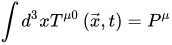
where is the stress–energy tensor, and ∂ are partial derivatives that make up the four-gradient (in non-Cartesian coordinates this must be replaced by the covariant derivative). Integrating over space:
gives the four-momentum vector at time t.