Hubbry Logo
Splinter hemorrhageSplinter hemorrhageMain
Open search
Splinter hemorrhage
Community hub
Splinter hemorrhage
logo
8 pages, 0 posts
0 subscribers
Be the first to start a discussion here.
Splinter hemorrhage
Splinter hemorrhage
from Wikipedia
Splinter hemorrhage
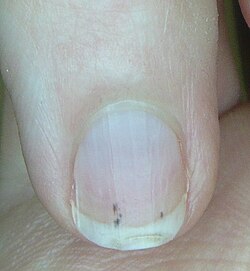
Splinter hemorrhage on a fingernail of the little finger
Differential diagnosissubacute infective endocarditis, scleroderma, trichinosis, systemic lupus erythematosus (SLE), rheumatoid arthritis, psoriatic nails, antiphospholipid syndrome

Splinter hemorrhages (or haemorrhages) are tiny blood clots that tend to run vertically under the nails. Splinter hemorrhages are not specific to any particular condition, and can be associated with subacute infective endocarditis, scleroderma, trichinosis, systemic lupus erythematosus (SLE), rheumatoid arthritis, psoriatic nails,[1] antiphospholipid syndrome,[2]: 659  haematological malignancy, and trauma.[3] At first they are usually plum-colored, but then darken to brown or black in a couple of days. In certain conditions (in particular, infective endocarditis), clots can migrate from the affected heart valve and find their way into various parts of the body. If this happens in the finger, it can cause damage to the capillaries resulting in a splinter hemorrhage.[citation needed]

There are a number of other causes for splinter hemorrhages. They could be due to hitting the nail (trauma), a sign of inflammation in blood vessels all around the body (systemic vasculitis), or they could be where a fragment of cholesterol has become lodged in the capillaries of the finger. Even if a patient does have infective endocarditis, roughly 1 in 10 patients have splinter hemorrhages.[4]

Additional image

[edit]
Splinter hemorrhage under the microscope

See also

[edit]

References

[edit]
Revisions and contributorsEdit on WikipediaRead on Wikipedia
from Grokipedia
A splinter hemorrhage is a small, longitudinal streak of blood appearing under the fingernail or toenail, resembling a splinter of wood, and resulting from minor bleeding due to damage or rupture of capillaries in the nail bed. These lesions typically measure 1–3 mm in length, run parallel to the direction of nail growth, and present as thin red, brown, or black lines that may initially appear bright red before darkening over time. They are usually painless unless associated with recent trauma and can affect one or multiple nails. The most common cause of splinter hemorrhages is local trauma to the nail, such as from stubbing a toe, aggressive manicuring, nail biting, or sports-related injuries, which damages the small blood vessels beneath the nail plate. Other etiologies include systemic conditions like subacute bacterial endocarditis (often due to septic emboli occluding nail bed vessels), psoriasis, rheumatoid arthritis, systemic lupus erythematosus, vasculitis, and occasionally malignancies or fungal infections. In cases linked to endocarditis, the hemorrhages may arise from microemboli originating from infected heart valves, highlighting their potential as a historical hallmark of this infection. While splinter hemorrhages are often benign and resolve spontaneously as the nail grows out (typically within weeks to months), their clinical significance depends on distribution, number, and location: distal lesions are more likely trauma-related, whereas proximal or multiple hemorrhages across several nails warrant investigation for underlying systemic disease. Diagnosis is primarily clinical, based on physical examination and patient history, but may involve blood tests (e.g., cultures, inflammatory markers), echocardiography for suspected endocarditis, or biopsy to rule out other nail pathologies like melanoma. Treatment focuses on addressing any underlying cause, such as antibiotics for infection or managing autoimmune conditions, with no specific intervention needed for trauma-induced cases.

Overview

Definition

A splinter hemorrhage is defined as a longitudinal, linear streak of extravasated blood confined to the capillaries of the nail bed, appearing as thin lines typically 1–3 mm in length that run parallel to the direction of nail growth, often becoming visible through the translucent nail plate. These nonblanching lesions are typically vertical and follow the orientation of the nail growth, often becoming visible through the translucent nail plate. The term "splinter hemorrhage" originates from its visual resemblance to thin wooden splinters embedded beneath the nail surface, a description first coined by George Blumer in 1923 in the context of subacute bacterial endocarditis. This naming highlights the focal, elongated nature of the hemorrhage, which is confined to the distal or proximal nail bed depending on the underlying mechanism. Pathophysiologically, splinter hemorrhages arise from minor bleeding due to rupture or damage of the longitudinally oriented capillaries in the nail bed, often involving extravasation of blood from vessel injury or occlusion by microemboli. In distinction from other nail abnormalities, splinter hemorrhages are focal and linear, unlike the diffuse, often larger areas of bleeding seen in subungual hematomas, which typically result from acute trauma. They differ from Beau's lines, which present as transverse ridges or grooves in the nail plate caused by temporary interruptions in nail growth, without vascular involvement.

Epidemiology

Splinter hemorrhages are a common nail finding, with an estimated prevalence of approximately 19% in the general adult population, often attributable to minor trauma. In clinical settings, the incidence is higher among hospitalized patients with systemic conditions; for instance, they occur in 15–33% of cases of infective endocarditis in older studies, with recent data indicating lower rates around 5–10%. Demographically, splinter hemorrhages are more frequently observed in adults, with studies reporting mean patient ages around 32-42 years and no consistent strong gender bias, though some investigations note a slight male predominance. Higher prevalence is noted in individuals with darker skin tones compared to those with lighter skin. They are uncommon in children, typically occurring only in the context of trauma, and their frequency may decrease in the elderly compared to younger adults. Occupational exposure to repetitive hand trauma, such as in manual laborers or athletes, can elevate incidence. Key risk factors include mechanical trauma to the nails, nail manipulation practices like the application of acrylic nails, and underlying conditions such as valvular heart disease predisposing to infectious complications. Comorbidities like psoriasis, onychomycosis, and chronic renal failure also increase susceptibility. No significant geographic variations in prevalence have been identified, but temporal trends show increased reporting in association with post-COVID-19 vasculitis and nail changes, with splinter hemorrhages noted in up to 9.3% of acute COVID-19 patients in some cohorts.

Clinical Features

Appearance and Location

Splinter hemorrhages appear as thin, linear, non-blanchable streaks beneath the nail plate, resembling wooden s. They typically measure 1 mm in , and are often multiple per affected nail. Initially, they present as bright red or plum-colored due to fresh , darkening to reddish-brown and eventually black or brown over a few days as the hemorrhage ages. These lesions are predominantly located in the distal portion of the nail bed, particularly under the free edge of the nail, aligning longitudinally with the direction of nail growth. They more commonly affect fingernails than toenails. In severe or systemic cases, splinter hemorrhages may appear in the proximal nail bed or middle third. Microscopically, they result from extravasation of blood from ruptured, longitudinally oriented capillaries in the nail bed. Over time, splinter hemorrhages migrate distally with normal nail growth, typically resolving as they advance toward the nail tip and are shed, a process that typically takes 3-4 months for fingernails. Proximal locations are more indicative of underlying systemic conditions, while distal ones often relate to local trauma. Patterns can be unilateral, affecting a single nail or hand, or bilateral and multifocal across multiple nails.

Associated Symptoms

Splinter hemorrhages are typically , presenting without pain, itching, or associated nail in cases related to minor trauma or mechanical stress. In such instances, individuals often notice the linear streaks incidentally during nail inspection, with no accompanying discomfort unless the underlying injury involves acute swelling or . When linked to systemic conditions, splinter hemorrhages may coincide with broader symptoms indicative of the underlying disease, such as fever, fatigue, or joint pain in cases of infective endocarditis or vasculitis. Nail bed tenderness or localized swelling is rare but can occur in inflammatory vasculitic processes. Concurrent signs frequently include other dermatologic or systemic manifestations depending on the etiology; for example, in infective endocarditis, splinter hemorrhages may appear alongside Janeway lesions (painless erythematous macules on the palms or soles) or Osler's nodes (tender nodules on the finger or toe pads). In psoriatic nail disease, they often accompany onycholysis, where the nail plate separates from the bed, or pitting of the nail surface. The associated symptoms generally resolve as the hemorrhage migrates distally with nail growth over weeks to months, unless perpetuated by a chronic underlying condition like psoriasis or ongoing vasculitis.

Causes and Pathophysiology

Traumatic Causes

Traumatic causes represent the most common etiology of splinter hemorrhages, resulting from direct mechanical injury to the capillaries in the nail bed, which leads to localized bleeding and the formation of linear streaks under the nail plate. This injury often involves repetitive microtrauma, where repeated pressure or friction disrupts the fragile longitudinal vessels, causing blood to extravasate without affecting deeper structures or systemic circulation. The mechanism typically entails rupture of small blood vessels due to physical force, with the hemorrhage becoming trapped in the subungual keratin as the nail grows, appearing as thin red or brown lines. Common scenarios include acute injuries such as stubbing toes or fingers, slamming nails in doors, or sports-related impacts that compress the nail unit. Repetitive activities like manual labor, typing, gardening, playing percussion instruments, or household chores can induce chronic microtrauma, while cosmetic procedures such as applying acrylic nails may exert prolonged pressure leading to capillary damage. In older adults, use of walking aids or daily activities involving hand pressure may contribute, and occupational hazards in professions requiring frequent nail manipulation, such as construction or music performance, are also implicated. Pathophysiologically, the trauma induces vessel rupture or thrombosis in the spiral arteries at the stratum granulosum level of the nail bed, resulting in linear bleeding that follows the direction of nail growth without systemic involvement. The hemorrhage remains confined to the nail bed, encased by the overlying nail plate, and typically resolves spontaneously as the nail advances, with the streaks migrating distally over weeks to months. These cases carry a benign prognosis, often requiring no intervention beyond avoidance of further trauma. Trauma is the most common cause of splinter hemorrhages, accounting for approximately 20% of cases, particularly in primary care where systemic etiologies are less prevalent.

Infectious Causes

Splinter hemorrhages are primarily associated with subacute bacterial endocarditis, particularly cases caused by Streptococcus viridans, where they occur in 15-33% of patients due to septic emboli originating from vegetations on heart valves. These microemboli travel through the bloodstream and lodge in the small capillaries of the nail bed, leading to focal rupture and linear hemorrhage beneath the nail plate. The same embolic process can affect other sites, such as the retina, resulting in Roth spots—white-centered retinal hemorrhages that occur in less than 5% of infective endocarditis cases, though historically reported in up to 80%. In addition to bacterial endocarditis, splinter hemorrhages may arise from other infections, including fungal onychomycosis, where fungal invasion of the nail bed causes secondary vascular fragility and bleeding. Rarely, they are linked to trichinosis, a parasitic infection from Trichinella spiralis, or systemic mycoses, which can produce similar embolic or vasculitic effects in the nail vasculature. Key risk factors for infection-related splinter hemorrhages include pre-existing valvular heart disease, which predisposes to endocarditis vegetations, and intravenous drug use, which facilitates bacterial entry into the bloodstream and increases embolic events. In endocarditis, these emboli often produce proximal splinter hemorrhages on multiple nails, distinguishing them from distal lesions in other contexts.

Systemic and Other Causes

Splinter hemorrhages can arise from various systemic conditions that involve inflammation, thrombosis, or vascular fragility affecting the nail bed capillaries. In autoimmune disorders, such as systemic lupus erythematosus (SLE), these hemorrhages occur due to lupus vasculitis, which damages small vessels and leads to capillary leakage in the nail bed. Similarly, rheumatoid arthritis may cause splinter hemorrhages through associated rheumatoid vasculitis, resulting in endothelial injury and microhemorrhages in multiple nails. Antiphospholipid syndrome is another key autoimmune contributor, where thrombotic microangiopathy promotes emboli and subungual bleeding, often presenting with multiple splinter hemorrhages on fingernails in both primary and secondary forms, including those linked to SLE. Dermatologic conditions like psoriasis can also produce splinter hemorrhages via chronic inflammation of the nail bed, where psoriatic changes disrupt capillary integrity and cause longitudinal bleeding streaks, frequently alongside other nail dystrophy features. In cases of inflammatory overlap with conditions such as onychomycosis, heightened nail bed inflammation may exacerbate vascular damage, though this is less common without concurrent infection. Vascular and other systemic etiologies include various forms of vasculitis, such as polyarteritis nodosa, where necrotizing inflammation of medium-sized vessels leads to distal microemboli and splinter hemorrhages, often bilaterally across multiple nails. Scleroderma contributes through capillary fragility and microangiopathy, with splinter hemorrhages appearing as part of broader nail fold changes in systemic sclerosis, correlating with disease severity. Cholesterol emboli syndrome, typically following atherosclerotic plaque disruption, causes showering of cholesterol crystals into small vessels, manifesting as splinter hemorrhages alongside livedo reticularis and purpura. Hematologic malignancies, such as leukemia associated with thrombocytopenia, result in splinter hemorrhages due to reduced platelet counts impairing hemostasis in nail bed capillaries, leading to spontaneous bleeding. Drug-induced splinter hemorrhages are also notable, particularly with antineoplastic agents such as multi-kinase inhibitors (e.g., sunitinib, sorafenib), occurring in 60-70% of treated patients due to vascular toxicity and capillary disruption. The underlying mechanism in these systemic causes generally involves inflammatory or thrombotic injury to the longitudinally oriented capillaries of the nail bed, causing extravasation of red blood cells and formation of linear streaks; this often affects multiple nails bilaterally, distinguishing it from localized trauma. In rare instances, high-dose nonsteroidal anti-inflammatory drugs (NSAIDs) can induce splinter hemorrhages by promoting vasculitis-like vascular damage or platelet dysfunction. Additionally, some cases remain idiopathic, occurring without identifiable systemic or local factors in otherwise healthy individuals.

Diagnosis

History and Physical Examination

During the history taking for suspected splinter hemorrhages, clinicians inquire about recent trauma to the nails or fingers, such as injuries from manual labor, sports, or manicure procedures, as this is the most common cause. Patients are asked about the onset and duration of the findings, involvement of multiple nails, and any pattern of recurrence, along with systemic symptoms like fever, unexplained weight loss, joint pain, or fatigue that may indicate underlying conditions such as endocarditis or vasculitis. Additional questions cover current medications (e.g., anticoagulants or chemotherapy agents), occupational exposures, and personal history of skin or nail disorders like psoriasis. In the physical examination, all fingernails and toenails are inspected under adequate lighting and magnification, often with dermoscopy to better visualize the lesions, to identify thin, linear red to reddish-brown streaks under the nail plate, typically 1 to 3 mm in length and oriented longitudinally. The location is noted, with distal hemorrhages more suggestive of trauma and proximal ones raising concern for systemic disease; multiplicity across several nails is also assessed. A cardiac auscultation is performed to detect murmurs indicative of endocarditis, and joints are examined for swelling or tenderness in cases of suspected rheumatoid arthritis or other rheumatologic conditions. Red flags include involvement of multiple nails without trauma history, proximal location of the hemorrhages, or accompanying petechiae, which warrant further evaluation for systemic causes like infective endocarditis. Differential clues help distinguish splinter hemorrhages from mimics: pigmented, irregular lesions suggest subungual melanoma, while associated nail pitting points to psoriasis.

Laboratory and Imaging Investigations

Laboratory investigations for splinter hemorrhages are typically reserved for cases suggesting an underlying systemic condition, such as multiple lesions, proximal nail involvement, or accompanying symptoms like fever or joint pain. A complete blood count (CBC) is often performed to evaluate for anemia or thrombocytopenia, which may indicate hematologic disorders associated with splinter hemorrhages. Inflammatory markers, including erythrocyte sedimentation rate (ESR) and C-reactive protein (CRP), help assess for systemic inflammation potentially linked to vasculitis or infection. Blood cultures are essential when infective endocarditis is suspected, as splinter hemorrhages can represent embolic phenomena from valvular vegetations. If autoimmune disease such as systemic lupus erythematosus (SLE) or rheumatoid arthritis (RA) is suspected, standard serologic tests including antinuclear antibody (ANA) or anti-double-stranded DNA (anti-dsDNA) for SLE and rheumatoid factor (RF) for RA may be indicated to support the diagnosis of the underlying condition. Imaging studies primarily target cardiac evaluation in suspected endocarditis. Transthoracic or transesophageal echocardiography is recommended to detect valvular vegetations or abscesses. A chest X-ray may be obtained if pulmonary involvement is suspected, such as in systemic vasculitides or embolic disease. In rare instances of suspected vascular occlusion, Doppler ultrasound can assess for peripheral arterial abnormalities contributing to nail bed hemorrhage. Additional tests include nail clipping microscopy with potassium hydroxide (KOH) preparation to exclude onychomycosis, which may mimic or coexist with splinter hemorrhages. Nail bed biopsy is infrequently required but may be pursued for persistent or atypical lesions to investigate vasculitis, infection, or malignancy. These investigations are not routine for isolated, distal splinter hemorrhages likely due to trauma, where observation suffices.

Management

General Approach

The general approach to managing splinter hemorrhages prioritizes identifying and addressing the underlying cause, as these findings are often benign but can signal serious systemic conditions. For cases attributed to trauma, initial management involves patient reassurance and observation, as the hemorrhage typically resolves spontaneously as the nail grows out. Fingernails advance distally at approximately 0.8 to 1 mm per week, allowing the lesion to migrate beyond the nail bed within several months without intervention. Risk stratification guides further evaluation: isolated, distal splinter hemorrhages following documented trauma are generally considered benign and require no additional workup. In contrast, multiple hemorrhages, those located proximally on the nail (closer to the cuticle), or those accompanied by systemic symptoms such as fever, joint pain, or fatigue warrant prompt investigation to rule out infectious, inflammatory, or vasculitic etiologies. A thorough history and physical examination are essential at this stage to assess for recent trauma, medication use, or signs of underlying disease. Management often requires a multidisciplinary team depending on suspected causes. Referral to cardiology is indicated if infective endocarditis is suspected, particularly in patients with risk factors like valvular heart disease or recent dental procedures. Rheumatology consultation is appropriate for potential autoimmune conditions, while dermatology referral aids in evaluating psoriatic or other nail-specific disorders. Coordination among specialists ensures comprehensive assessment and targeted care. Prevention focuses on minimizing trauma and optimizing overall . Patients should be advised to practice gentle nail care, such as avoiding aggressive manicures, , or excessive hand use in high-risk , to reduce mechanical . For those with comorbidities like , which can predispose to vascular fragility, emphasizing glycemic control and regular monitoring helps mitigate recurrence risks.

Treatment of Underlying Conditions

Treatment of splinter hemorrhages primarily involves addressing the underlying etiology to prevent recurrence and resolve associated complications. For infectious causes, such as infective endocarditis, initial therapy consists of intravenous broad-spectrum antibiotics, often including vancomycin for staphylococcal infections, administered for 4 to 6 weeks depending on the pathogen and clinical response. In cases of fungal nail infections like onychomycosis, oral terbinafine at 250 mg daily is the preferred antifungal agent, typically continued for 6 weeks for fingernail involvement or 12 weeks for toenails, achieving clinical cure rates up to 76%. Systemic conditions contributing to splinter hemorrhages, including vasculitis or systemic lupus erythematosus (SLE), are managed with corticosteroids such as prednisone at an initial dose of 1 mg/kg daily, often combined with immunosuppressants like methotrexate or azathioprine for mild-to-moderate manifestations to reduce inflammation and immune-mediated vascular damage. For antiphospholipid syndrome, anticoagulation with warfarin or low-dose aspirin serves as the cornerstone of therapy to mitigate thrombotic risks, with dosing adjusted to maintain an international normalized ratio (INR) of 2.0 to 3.0 in most cases. Traumatic splinter hemorrhages require no specific pharmacological intervention, as they typically resolve spontaneously with nail growth over several weeks to months; management focuses on protecting the nail bed by avoiding further pressure or trauma, and applying topical emollients if the surrounding skin is irritated. In other etiologies, such as drug-induced cases, discontinuing the offending agent like nonsteroidal anti-inflammatory drugs (NSAIDs) is essential to halt ongoing vascular effects, with symptoms often improving thereafter. For severe infective endocarditis unresponsive to antibiotics, surgical intervention including valve repair or replacement may be necessary to excise vegetations and restore cardiac function.

Prognosis

Outcomes for Benign Cases

In benign cases of splinter hemorrhage, typically resulting from localized trauma, the condition resolves spontaneously as the nail grows out, without leaving scars or causing long-term damage to the nail bed. The resolution time generally spans 4 to 8 weeks for fingernails, which grow at an average rate of 3.47 mm per month, allowing the hemorrhage to migrate distally and disappear from view. Toenails, growing more slowly at about 1.62 mm per month, may take longer, often up to several months for complete clearance. Recurrence is uncommon provided further trauma to the nail is avoided, as the underlying mechanism is mechanical rather than systemic. Complications in these isolated, trauma-related instances are rare, with no inherent risks from the hemorrhage itself. If the initial injury creates an open wound around the nail, a secondary bacterial or fungal infection could potentially develop, though this occurs infrequently in uncomplicated cases. No routine follow-up is required for benign splinter hemorrhages, as they pose no ongoing health threat. Patient education focuses on basic nail hygiene practices, such as keeping nails clean, trimmed, and protected during manual activities to prevent reinjury. The impact on quality of life is minimal, primarily limited to temporary cosmetic concerns due to the visible linear streaks under the nail. Individuals typically experience no functional impairment, pain, or disruption to daily activities once any acute trauma has subsided.

Risks in Systemic Disease

When splinter hemorrhages occur in the context of infective endocarditis, they represent minor embolic phenomena from septic vegetations on heart valves, signaling a high risk of systemic complications if the underlying infection remains untreated. Untreated infective endocarditis carries a nearly 100% mortality rate due to progressive valvular destruction, sepsis, and multi-organ failure. With prompt antibiotic therapy, often combined with surgical intervention for complicated cases, cure rates exceed 80%, though in-hospital mortality remains 15-20% owing to factors like heart failure or persistent infection. Embolic events, which splinter hemorrhages may herald, pose additional risks of stroke, myocardial infarction, or renal infarction in up to 20-50% of patients, particularly with large vegetations exceeding 10 mm. In autoimmune conditions and vasculitides, such as ANCA-associated vasculitis or systemic lupus erythematosus, splinter hemorrhages arise from microvascular inflammation and vessel wall damage, indicating active disease that can lead to variable but potentially severe outcomes. Response to immunosuppressive therapies, including glucocorticoids and cyclophosphamide or rituximab, achieves complete remission in approximately 70-80% of cases initially, though chronic flares occur in 30-50% within five years. Renal involvement, common in these disorders, significantly worsens prognosis, with glomerular filtration rates below 50 mL/min associated with a 50% risk of death or end-stage kidney disease at five years; cardiac manifestations, such as myocarditis or coronary vasculitis, further elevate cardiovascular event risk by 65%. While splinter hemorrhages themselves are benign and resolve without sequelae, in conditions like infective endocarditis, their presence underscores a 20-50% risk of major embolic events, with thrombotic risks varying in other systemic pathologies such as vasculitis, necessitating urgent evaluation to mitigate organ damage. Long-term prognosis hinges on treating the root cause; untreated systemic conditions lead to recurrent hemorrhages and progressive morbidity, whereas regular monitoring through serial echocardiography, blood tests, and clinical exams can detect flares early and improve survival rates to 70-80% at five years with modern treatments in responsive cases.

References

Add your contribution
Related Hubs
User Avatar
No comments yet.