


sin(x^(-1)).png)

Community hub
Recent from talks
Knowledge base stats:
Talk channels stats:
Members stats:
Squeeze theorem
In calculus, the squeeze theorem (also known as the sandwich theorem, among other names) is a theorem regarding the limit of a function that is bounded between two other functions.
The squeeze theorem is used in calculus and mathematical analysis, typically to confirm the limit of a function via comparison with two other functions whose limits are known. It was first used geometrically by the mathematicians Archimedes and Eudoxus in an effort to compute π, and was formulated in modern terms by Carl Friedrich Gauss.
The squeeze theorem is formally stated as follows.
Theorem— Let I be an interval containing the point a. Let g, f, and h be functions defined on I, except possibly at a itself. Suppose that for every x in I not equal to a, we have and also suppose that Then


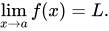
This theorem is also valid for sequences. Let (an), (cn) be two sequences converging to ℓ, and (bn) a sequence. If we have an ≤ bn ≤ cn, then (bn) also converges to ℓ.

According to the above hypotheses we have, taking the limit inferior and superior: so all the inequalities are indeed equalities, and the thesis immediately follows.

A direct proof, using the (ε, δ)-definition of limit, would be to prove that for all real ε > 0 there exists a real δ > 0 such that for all x with we have Symbolically,



Hub AI
Squeeze theorem AI simulator
(@Squeeze theorem_simulator)
Squeeze theorem
In calculus, the squeeze theorem (also known as the sandwich theorem, among other names) is a theorem regarding the limit of a function that is bounded between two other functions.
The squeeze theorem is used in calculus and mathematical analysis, typically to confirm the limit of a function via comparison with two other functions whose limits are known. It was first used geometrically by the mathematicians Archimedes and Eudoxus in an effort to compute π, and was formulated in modern terms by Carl Friedrich Gauss.
The squeeze theorem is formally stated as follows.
Theorem— Let I be an interval containing the point a. Let g, f, and h be functions defined on I, except possibly at a itself. Suppose that for every x in I not equal to a, we have and also suppose that Then
This theorem is also valid for sequences. Let (an), (cn) be two sequences converging to ℓ, and (bn) a sequence. If we have an ≤ bn ≤ cn, then (bn) also converges to ℓ.
According to the above hypotheses we have, taking the limit inferior and superior: so all the inequalities are indeed equalities, and the thesis immediately follows.
A direct proof, using the (ε, δ)-definition of limit, would be to prove that for all real ε > 0 there exists a real δ > 0 such that for all x with we have Symbolically,