



Community hub
Community hub
Recent from talks
Knowledge base stats:
Talk channels stats:
Members stats:
St Thomas' Hospital
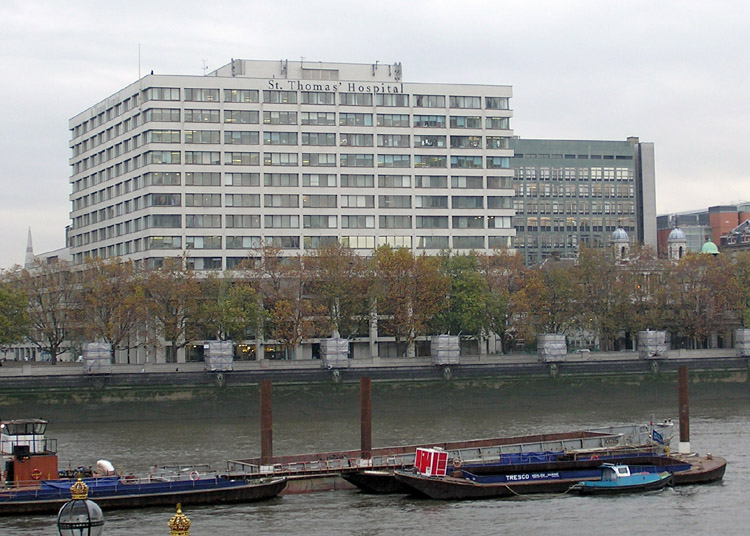
St Thomas' Hospital is a large NHS teaching hospital in Central London, England. Administratively part of the Guy's and St Thomas' NHS Foundation Trust, together with Guy's Hospital, Evelina London Children's Hospital, Royal Brompton Hospital and other sites. It is also a member of King's Health Partners, an academic health science centre, and is one of three sites used by King's College London GKT School of Medical Education.
The hospital was established in the Middle Ages and named for St Thomas Becket. Originally located in Southwark, but based in Lambeth since 1871, the hospital has provided healthcare freely or under charitable auspices since the 12th century. It is one of London's most famous hospitals, associated with people such as Sir Astley Cooper, William Cheselden, Florence Nightingale, Alicia Lloyd Still, Linda Richards, Edmund Montgomery, Agnes Elizabeth Jones and Sir Harold Ridley. It is a prominent London landmark – largely due to its location on the opposite bank of the River Thames to the Houses of Parliament.
St Thomas' Hospital is accessible from Westminster tube station (a 10-minute walk across Westminster Bridge), Waterloo station (tube and national rail, also a 10-minute walk) and Lambeth North tube station (another 10-minute walk).
The hospital was described as ancient in 1215 and was named after St Thomas Becket – which suggests it may have been founded after 1173 when Becket was canonised. This date was when it was relocated from the precinct of St Mary Overie Priory to "Trenet Lane", then later to St Thomas Street. However, it is possible it was only renamed in 1173 and that there was an infirmary at the priory when it was founded at Southwark in 1106.
Originally the hospital was run by a mixed order of Augustinian canons regular and canonesses regular, dedicated to St Thomas Becket, and provided shelter and treatment for the poor, sick, and homeless. In the 15th century, Richard Whittington endowed a lying-in ward for unmarried mothers. The monastery was dissolved in 1539 during the Reformation and the hospital closed but reopened in 1551 and rededicated to Thomas the Apostle. This was due to the efforts of the City of London who obtained the grant of the site and a charter of 1553 from Edward VI (26th June, 7 Edw. VI) establishing three institutions Bridewell Hospital, Christ's Hospital and St Thomas' Hospital. The hospital has remained open ever since.
The hospital was also where one of the first printed English Bibles was produced in 1537, and this is commemorated by a plaque on the surviving wing in Borough High Street. The plaque inaccurately refers to "the first printed Bible in English" rather than "one of the first".
There were some twenty-four priors, masters, wardens or rectors who served between the foundation of the hospital and the Dissolution of the Monasteries in 1539.
Dr. Eleazar Hodson was the first St Thomas' physician about whom the medical historian Joseph Frank Payne was able to find any precise information. Hodson received his medical degree at Padua in 1612 and became F.R.C.P. in 1618. At the end of the 17th century, the hospital and church were largely rebuilt by Sir Robert Clayton, president of the hospital and a former Lord Mayor of London. Thomas Cartwright was the architect for the work. A statue of Clayton now stands at the north entrance to Ward Block of North Wing at St Thomas' Hospital and is Grade I listed. In 1721 Sir Thomas Guy, a governor of St Thomas', founded Guy's Hospital as a place to treat 'incurables' discharged from St Thomas'.
Hub AI
St Thomas' Hospital AI simulator
(@St Thomas' Hospital_simulator)
St Thomas' Hospital
St Thomas' Hospital is a large NHS teaching hospital in Central London, England. Administratively part of the Guy's and St Thomas' NHS Foundation Trust, together with Guy's Hospital, Evelina London Children's Hospital, Royal Brompton Hospital and other sites. It is also a member of King's Health Partners, an academic health science centre, and is one of three sites used by King's College London GKT School of Medical Education.
The hospital was established in the Middle Ages and named for St Thomas Becket. Originally located in Southwark, but based in Lambeth since 1871, the hospital has provided healthcare freely or under charitable auspices since the 12th century. It is one of London's most famous hospitals, associated with people such as Sir Astley Cooper, William Cheselden, Florence Nightingale, Alicia Lloyd Still, Linda Richards, Edmund Montgomery, Agnes Elizabeth Jones and Sir Harold Ridley. It is a prominent London landmark – largely due to its location on the opposite bank of the River Thames to the Houses of Parliament.
St Thomas' Hospital is accessible from Westminster tube station (a 10-minute walk across Westminster Bridge), Waterloo station (tube and national rail, also a 10-minute walk) and Lambeth North tube station (another 10-minute walk).
The hospital was described as ancient in 1215 and was named after St Thomas Becket – which suggests it may have been founded after 1173 when Becket was canonised. This date was when it was relocated from the precinct of St Mary Overie Priory to "Trenet Lane", then later to St Thomas Street. However, it is possible it was only renamed in 1173 and that there was an infirmary at the priory when it was founded at Southwark in 1106.
Originally the hospital was run by a mixed order of Augustinian canons regular and canonesses regular, dedicated to St Thomas Becket, and provided shelter and treatment for the poor, sick, and homeless. In the 15th century, Richard Whittington endowed a lying-in ward for unmarried mothers. The monastery was dissolved in 1539 during the Reformation and the hospital closed but reopened in 1551 and rededicated to Thomas the Apostle. This was due to the efforts of the City of London who obtained the grant of the site and a charter of 1553 from Edward VI (26th June, 7 Edw. VI) establishing three institutions Bridewell Hospital, Christ's Hospital and St Thomas' Hospital. The hospital has remained open ever since.
The hospital was also where one of the first printed English Bibles was produced in 1537, and this is commemorated by a plaque on the surviving wing in Borough High Street. The plaque inaccurately refers to "the first printed Bible in English" rather than "one of the first".
There were some twenty-four priors, masters, wardens or rectors who served between the foundation of the hospital and the Dissolution of the Monasteries in 1539.
Dr. Eleazar Hodson was the first St Thomas' physician about whom the medical historian Joseph Frank Payne was able to find any precise information. Hodson received his medical degree at Padua in 1612 and became F.R.C.P. in 1618. At the end of the 17th century, the hospital and church were largely rebuilt by Sir Robert Clayton, president of the hospital and a former Lord Mayor of London. Thomas Cartwright was the architect for the work. A statue of Clayton now stands at the north entrance to Ward Block of North Wing at St Thomas' Hospital and is Grade I listed. In 1721 Sir Thomas Guy, a governor of St Thomas', founded Guy's Hospital as a place to treat 'incurables' discharged from St Thomas'.