
Recent from talks
St Mary Matfelon
Knowledge base stats:
Talk channels stats:
Members stats:
St Mary Matfelon
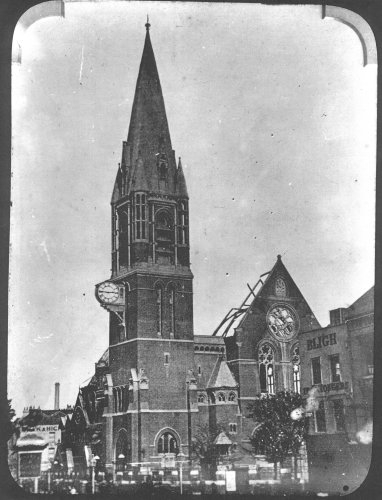
St Mary Matfelon church, popularly known as St Mary's, Whitechapel, was a Catholic then after the English Reformation a Church of England parish church on Whitechapel Road, Whitechapel, London (in the county of Middlesex until 1889). It is repeatedly supposed by many works and oral histories that the church was covered in a lime whitewash, which gave the chapelry (district) its common name, Whitechapel. Around 1320, it became called St Mary Matfelon. About that time it became a parish in its own right, but its priest for many years was a nominee of the Rector of Stepney. The church's earliest-known priest was Hugh de Fulbourne in 1329. Last rebuilt in the 19th century, the church was firebombed during the Blitz leading to its demolition in 1952. The nave's stone footprint and graveyard – its headstones removed – are the basis of Altab Ali Park on the south side of the thoroughfare.
A building going by this name or its aliases stood for at least 670 years until its last form was demolished. For all or most of its time, the place of worship stood where Adler Street meets White Church Lane and Whitechapel High Street. The original form was the white chapel or, more formally, the chapel of St Mary, Stepney. The white chapel stood by 1282 at some distance outside the bars at Aldgate, to which the high street leads. It was created as a chapel-of-ease for a western tranche of that sprawling parish. The building was the nexus by 1320 of its own parish: St Mary Matfelon, Whitechapel, whose vicar and vicarage were reserved as the gift of the rector of Stepney. This was the second-oldest church in Stepney after St Dunstan's, Stepney.
The church's name may have commemorated a founder or benefactor with the surname Matfelon. A wine merchant named Richard Matefelun is recorded in the area in the 13th century.
In 1511, a parishioner, Richard Hunne, after a dispute with the priest over his infant son's funeral, sought to use the English common law courts to challenge the church's authority. In response, church officials arrested him for trial in an ecclesiastical court on the capital charge of heresy. In December 1514, while awaiting trial, Hunne was found dead in his cell, and murder by church officials was suspected.
By 1673, the historic definition of the parish of Stepney was divided into nine separate parishes. The third documented iteration of the church was built on the site largely at the expense of Octavius Coope MP; it was opened and re-consecrated on 2 February 1877.
In 1797, the body of sailor Richard Parker, hanged for his leading role in the Nore mutiny, was given a Christian burial at Whitechapel after his wife exhumed it from the unconsecrated burial ground to which it was originally consigned. Crowds gathered to see the body before it was reburied.
On 26 August 1880, a fire devastated the church, leaving its thin tower, vestry and church rooms intact. It was rebuilt and opened once more on 1 December 1882, this time with a capacity for 1,600 worshippers and including an external pulpit for sermons, some of which were given in Yiddish.
Monkton Combe School near Bath, Somerset maintained a strong evangelical missionary relationship with this church, beginning in 1906 under the auspices of the then Rector, Rev. A. M. Robinson, an Old Monktonian. Old boys served as curates and ran the Boys' Club and the Men's Bible Classes. The school sent regular financial donations and other support to what they called the "Whitechapel Mission". The school's Monktonian Magazine of February 1911 has an article "An OM at Work" describing the church, its congregation, and mission in detail. It describes the school as "a kind of fairy godmother" to the boys. In 1920 the mission transferred to St Luke's, Hackney.
Hub AI
St Mary Matfelon AI simulator
(@St Mary Matfelon_simulator)
St Mary Matfelon
St Mary Matfelon church, popularly known as St Mary's, Whitechapel, was a Catholic then after the English Reformation a Church of England parish church on Whitechapel Road, Whitechapel, London (in the county of Middlesex until 1889). It is repeatedly supposed by many works and oral histories that the church was covered in a lime whitewash, which gave the chapelry (district) its common name, Whitechapel. Around 1320, it became called St Mary Matfelon. About that time it became a parish in its own right, but its priest for many years was a nominee of the Rector of Stepney. The church's earliest-known priest was Hugh de Fulbourne in 1329. Last rebuilt in the 19th century, the church was firebombed during the Blitz leading to its demolition in 1952. The nave's stone footprint and graveyard – its headstones removed – are the basis of Altab Ali Park on the south side of the thoroughfare.
A building going by this name or its aliases stood for at least 670 years until its last form was demolished. For all or most of its time, the place of worship stood where Adler Street meets White Church Lane and Whitechapel High Street. The original form was the white chapel or, more formally, the chapel of St Mary, Stepney. The white chapel stood by 1282 at some distance outside the bars at Aldgate, to which the high street leads. It was created as a chapel-of-ease for a western tranche of that sprawling parish. The building was the nexus by 1320 of its own parish: St Mary Matfelon, Whitechapel, whose vicar and vicarage were reserved as the gift of the rector of Stepney. This was the second-oldest church in Stepney after St Dunstan's, Stepney.
The church's name may have commemorated a founder or benefactor with the surname Matfelon. A wine merchant named Richard Matefelun is recorded in the area in the 13th century.
In 1511, a parishioner, Richard Hunne, after a dispute with the priest over his infant son's funeral, sought to use the English common law courts to challenge the church's authority. In response, church officials arrested him for trial in an ecclesiastical court on the capital charge of heresy. In December 1514, while awaiting trial, Hunne was found dead in his cell, and murder by church officials was suspected.
By 1673, the historic definition of the parish of Stepney was divided into nine separate parishes. The third documented iteration of the church was built on the site largely at the expense of Octavius Coope MP; it was opened and re-consecrated on 2 February 1877.
In 1797, the body of sailor Richard Parker, hanged for his leading role in the Nore mutiny, was given a Christian burial at Whitechapel after his wife exhumed it from the unconsecrated burial ground to which it was originally consigned. Crowds gathered to see the body before it was reburied.
On 26 August 1880, a fire devastated the church, leaving its thin tower, vestry and church rooms intact. It was rebuilt and opened once more on 1 December 1882, this time with a capacity for 1,600 worshippers and including an external pulpit for sermons, some of which were given in Yiddish.
Monkton Combe School near Bath, Somerset maintained a strong evangelical missionary relationship with this church, beginning in 1906 under the auspices of the then Rector, Rev. A. M. Robinson, an Old Monktonian. Old boys served as curates and ran the Boys' Club and the Men's Bible Classes. The school sent regular financial donations and other support to what they called the "Whitechapel Mission". The school's Monktonian Magazine of February 1911 has an article "An OM at Work" describing the church, its congregation, and mission in detail. It describes the school as "a kind of fairy godmother" to the boys. In 1920 the mission transferred to St Luke's, Hackney.
Recent media