Hubbry Logo
Standard TenStandard TenMain
Open search
Standard Ten
Community hub
Standard Ten
logo
8 pages, 0 posts
0 subscribers
Be the first to start a discussion here.
Standard Ten
Standard Ten
from Wikipedia

A 1934 Standard 10/12 Speedline

The Standard Ten was a model name given to several small cars produced by the British Standard Motor Company between 1906 and 1961. The name was a reference to the car's fiscal horsepower or tax horsepower, a function of the surface area of the pistons. This system quickly became obsolete as an estimate of the power produced by the engine, but it continued to be relevant as a way to classify cars for tax purposes. Like other manufacturers, Standard continued to use the name to define the approximate size of their 'Ten' model long after the origins of the name had, in Britain, become inapplicable.

An experimental two-cylinder "10" was made in 1906, after which Standard's next car in that category was a four-cylinder 9.5 tax horsepower built between 1914 and 1919. They returned to the 10 tax horsepower market in 1934; this model was replaced in 1937 by a "Flying Ten" that lasted until the outbreak of World War II.

Standard again returned to the 10 tax horsepower market in 1954 with another Ten, which was supplemented in 1957 by an up-market version called the Pennant. The Ten and the Pennant were replaced by the Triumph Herald in 1961.

Edwardian 10 hp cars

[edit]
Standard 9.5 hp[1]
Overview
ManufacturerStandard Motor Company
Production1914–1915, 1919
Body and chassis
LayoutFR
Powertrain
Engineinline four side-valve engine
1914–1915: 1087 cc
1919: 1328 cc
Dimensions
Wheelbase1914–1915: 2,286 mm (90 in)
1919: 2,336.8 mm (92 in)
Length1914–1915: 3,200 mm (126 in)
1919: 3,277 mm (129 in)
Chronology
Successor1934 Standard 10 hp

The name was first used in 1906 on an experimental two-cylinder 10 tax horsepower car.[2] The side-valve[citation needed] engine had a 70 mm bore and an 82 mm stroke, giving a capacity of 631 cc.[1]

A 9.5 tax horsepower four-cylinder car was introduced in 1914 and built until 1915. A version of this car, with increases in wheelbase and engine stroke, was offered in 1919.[1]

10 hp (1934–1936)

[edit]
Standard 10 hp[3]
Overview
ManufacturerStandard Motor Company
Production1934–1936
Body and chassis
LayoutFR
Powertrain
Engine1343 cc inline four side-valve engine
Dimensions
Wheelbasebase: 2,311 mm (91 in)
optional: 2,388 mm (94 in)
Chronology
Predecessor1919 Standard 9.5 hp
Successor1934 Standard 10 hp

Flying Ten

[edit]
Standard Flying Ten
1938 Standard Flying 10 (10BL)
Overview
Production1937–1939[3]
Body and chassis
Body stylesaloon
2 door coupe utility[4]
Powertrain
Engine1267 cc Inline-four engine[3]
TransmissionThree speed manual
Dimensions
Wheelbase90 in (2,286 mm)[3]
Length152 in (3,861 mm)[3]
Width56.5 in (1,435 mm)[3]

The Flying Ten was a replacement for the earlier Ten with the semi-streamlined look of the Standard Flying range. The side-valve 1267 cc long stroke (100 mm) engine had a single Zenith carburettor and could produce 33 bhp (25 kW) at 4000 rpm.[3] Drive was to the rear wheels through a 3-speed synchromesh gearbox. The suspension was conventional at first with a solid front axle but this was upgraded to an independent set-up at the front with a transverse leaf spring in 1939. A top speed of around 65 mph (105 km/h) was attainable. Brakes were cable operated using the Bendix system. In early 1941, 150 four-doors were built for the military after civilian production had ceased.

A sportier version, the Light Flying Ten was also made.

Post-war models

[edit]
Standard Ten
1954 Standard Ten Saloon
Overview
Also called
  • Standard Companion (estate)
  • Standard 6 cwt (van & pickup)[5]
  • Standard Cadet (Australia)[6]
  • Standard Vanguard Junior (Sweden)
  • Triumph 10/TR-10 (North America)[7]
ProductionMay 1954[8]–1960
172,500 made [9]
AssemblyUnited Kingdom
Australia[10]
India
Body and chassis
Body style4-door saloon
4-door estate car
2-door coupe utility[5]
2-door panel van[5]
Powertrain
Engine948 cc OHV I4[11]
TransmissionFour speed manual
optional overdrive
Dimensions
Wheelbase84 in (2,134 mm)[11]
Length144 in (3,658 mm)[11]
Width60 in (1,524 mm)[11]
Height60 in (1,524 mm)[12]

In 1954 the Ten was introduced as a more powerful, better-appointed version of the Standard Eight, with the Eight's Standard SC engine increased in size to 948 cc and sharing a similar frame and transmission. Overdrive (from March 1957) or a temperamental semi-automatic were available as options.

An estate (station wagon) version, the Companion, was launched in June 1955.[8] It was among the first small British estate cars to have rear-passenger doors (like the saloon, and unlike its rivals such as the Ford Squire and Hillman Husky which used the two-door "van" arrangement).

A small number of left-hand-drive Tens were exported to the US and sold as the Triumph TR-10. On these, the two-tone colour arrangement normally reserved for the Pennant was available (though this export model was not tailfinned).

A Ten saloon tested by the British magazine The Motor in 1954 had a top speed of 69.0 mph (111.0 km/h) and could accelerate from 0-60 mph (97 km/h) in 38.3 seconds. A fuel consumption of 34.4 miles per imperial gallon (8.2 L/100 km; 28.6 mpg‑US) was recorded. The test car cost £580 including taxes.[13]

In 1955, supported by an inscrutable handicapping régime favouring small cars, a factory-prepared Standard Ten, driven by Jimmy Ray and Brian Horrocks, won the UK's RAC Rally.[14]

For the United States export market the car was badged as the Triumph 10[7] and in Scandinavia it was sold as the Standard Vanguard Junior. In Australia the Ten was known as the Cadet.[15]

Standard Pennant

[edit]
Standard Pennant
Overview
Also calledStandard 10 (India)
Production1957–1960
42,910 made [9]
Body and chassis
Body style4-door saloon[16]
RelatedStandard Atlas
Powertrain
Engine948 cc OHV I4[11]
TransmissionFour-speed manual
optional overdrive
Dimensions
Wheelbase84 in (2,134 mm)[11]
Length142 in (3,607 mm)[11]
Width59 in (1,499 mm)[11]
Height60 in (1,524 mm)[17]

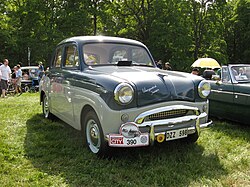
A tail-finned (with optional two-tone paint schemes) version of the Ten, the Standard Pennant was launched in October 1957. Engine power was increased to 37 bhp (28 kW)[9] and an overdrive gearbox was offered as an option. other options included a radio, heater, leather upholstery and clutchless two-pedal control. Indian-produced Pennants were branded as "Standard 10", and lacked any bootlid trim other than the branding.

A Pennant tested by British magazine The Motor in 1958 had a top speed of 70.2 mph (113 km/h) and could accelerate from 0–60 mph (97 km/h) in 35.3 seconds. A fuel consumption of 40.2 miles per imperial gallon (7.03 L/100 km; 33.5 mpg‑US) was recorded. The test car cost £728, including taxes of £243.[17]

A 1957 Pennant

References

[edit]
Revisions and contributorsEdit on WikipediaRead on Wikipedia
from Grokipedia
The Standard Ten was a model name used by the Standard Motor Company of Coventry, England, for several small cars produced discontinuously from 1906 to 1961. Early versions appeared in 1906 and 1914, followed by pre-war saloons from 1934 to 1939. The final post-war series, launched in 1954, was a small economy car serving as an affordable option for the British family market, with UK production running until November 1959 and licensed assembly in India continuing until 1961. Positioned as a step up from the entry-level Standard Eight, the post-war Ten featured a 948 cc overhead-valve inline-four engine initially delivering 33 bhp, enabling a top speed of around 70 mph and fuel efficiency of approximately 35-45 mpg (imperial). It was built on a unitary chassisless construction with independent front suspension using coil springs and wishbones, a live rear axle, and hydraulic drum brakes, making it reliable for everyday use while competing with rivals like the Morris Minor and Austin A30. The post-war model was introduced in March 1954 as a four-door saloon priced at approximately £580 (including taxes), quickly gaining popularity for its simple, no-frills design featuring sliding quarter windows, Vynide upholstery, and basic instrumentation, with over 172,000 units produced across its run. An estate variant, initially called the Ten Good Companion and later simply the Companion, debuted in October 1954 with a five-door body for added practicality. Updates included the 1956 Super Ten with an opening bootlid, the introduction of the semi-automatic Standrive transmission in late 1956, and the 1957 Phase II revision featuring a revised "Gold Star" engine with 37 , a new chrome grille, higher , and optional Laycock overdrive for improved highway cruising. A sportier two-door Pennant joined the lineup in 1957, boasting enhanced trim, wind-up windows, and a column-mounted gearchange to attract younger buyers, though it retained the same mechanicals. The post-war Standard Ten played a key role in the company's strategy to revive sales amid post-war economic constraints and from BMC, helping Standard-Triumph maintain a foothold in the small-car segment before discontinuation in 1959 () and replacement by the more innovative . Its enduring appeal today lies in its straightforward engineering, ease of maintenance, and availability of parts through enthusiast clubs, with surviving examples often praised for their originality and value in the market, where well-preserved saloons typically fetch £3,000-£6,000 as of 2025.

Early Models (1906–1919)

Two-Cylinder Prototype (1906)

The Standard Motor Company's two-cylinder prototype of 1906 marked an early experimental effort to develop a compact automobile within the 10 hp category, reflecting the company's initial exploration into affordable urban vehicles following its founding in 1903. This model utilized a 631 cc side-valve two-cylinder , designed with a bore of 70 mm and stroke of 82 mm, emphasizing simplicity and reliability for short-distance town driving. The prototype's chassis was rudimentary, constructed on a conventional ladder frame with chain or shaft drive options typical of the period, paired with a basic three-speed transmission lacking synchromesh to keep costs low and maintenance straightforward. Intended primarily for city use, it featured minimal bodywork options, such as a light or open two-seater configuration, prioritizing ease of access and maneuverability over long-distance comfort. Production remained confined to a handful of prototypes, with no transition to series manufacturing due to the company's focus on larger, more profitable four- and six-cylinder models during the ; this decision was shaped by Britain's system, which levied duties based on RAC horsepower ratings derived from cylinder bore size, making small engines like the 10 hp appealing for budget-conscious buyers but challenging for volume production. The engine delivered approximately 10 hp under the RAC rating system, underscoring its modest performance suited to early 20th-century urban constraints. This brief foray into two-cylinder design influenced subsequent developments, leading to the adoption of four-cylinder configurations in Standard's lineup by .

Four-Cylinder Model (–1919)

The Standard Ten's four-cylinder model, launched in as the company's entry into the light car market, was powered by a 1087 cc side-valve inline-four with a 62 mm bore and 90 mm stroke, producing 9.5 hp under the RAC rating. This monobloc-cast featured a carburettor, high-tension magneto ignition, thermo-siphon cooling, and automatic pump-driven lubrication, emphasizing reliability for everyday motoring in the . Drawing from earlier two-cylinder experiments, the design prioritized simplicity and affordability, with a base price starting at £185 for the . Key features included a single-plate disc clutch, three-speed gearbox with gate selector, and rear-wheel drive via a propeller shaft, mounted on a sturdy with 700 x 80 detachable steel wheels and artillery-type spokes. The wheelbase measured 7 ft 6 in (2,286 ), providing a compact footprint with 4 ft track width and 9.5 in ground clearance, suitable for urban and light touring use. Available body styles encompassed open tourers like the two-seater and four-seater Hurlingham Victoria, as well as enclosed options such as the Ranalagh or Richmond coupe saloons, with light van variants also offered for commercial buyers. Production totaled 2,134 units between late 1913 and 1919, though wartime demands severely disrupted output after 1,936 examples were completed from late 1913 to May 1915. During , Standard Motor Company's factories shifted to manufacturing over 1,000 aircraft, including models like the and F.2B, halting civilian car assembly until a brief resumption in 1918 that yielded 198 additional chassis to address pent-up demand. The model remained geared toward civilian markets despite these interruptions, with engine capacity upgraded to 1328 cc in the SLS variant by 1919 while retaining the 9.5 hp rating.

Pre-War Models (1934–1939)

10 hp Saloon (1934–1936)

The was reintroduced by the in 1934 as an affordable family saloon, marking a revival of the name originally used for early 20th-century models and reflecting the company's strategic shift under managing director John Black, who had joined in 1929 to revitalize the firm through market-aligned production and cost efficiencies. Black's leadership emphasized accessible vehicles for middle-class buyers, positioning the Ten as a reliable, value-driven option in the competitive 10 hp tax class, with production spanning 1934 to 1936. Powered by a 1,343 cc side-valve four-cylinder delivering 32 at 3,600 rpm, the model offered straightforward performance suited to everyday use, achieving a top speed of around 60 mph while prioritizing and ease of . It featured a four-speed gearbox with synchromesh on the top three ratios—a notable advancement for British cars at the time—and four-wheel drum brakes, contributing to improved drivability over earlier designs. Body styles included four-door saloons (standard, special, and de luxe variants) and a two-door coupé, with the saloon emphasizing practical comfort through well-finished interiors and full equipment like electric lighting. The design drew subtle influences from emerging American streamline aesthetics, evident in its cleaner lines and enclosed wheels, though it retained a conventional on a ladder frame. Priced at £192 for the base saloon (with the synchromesh gearbox adding £25), the Standard Ten targeted budget-conscious families, offering strong value through its and low running costs in an era of economic recovery. This model helped boost Standard's output significantly under , from modest weekly figures in to thousands annually by the mid-1930s, underscoring its role in the company's pre-war resurgence before evolving into the lighter Flying Ten successor.

Flying Ten (1937–1939)

The Flying Ten, launched in 1937 as part of Standard's "Flying" range, marked a sportier development of the pre-war Ten series, emphasizing lightweight construction and enhanced agility for family use. It utilized a downsized 1267 cc four-cylinder side-valve with a single carburettor, producing 33 at 4000 rpm to deliver economical yet responsive performance. This powerplant represented a reduction from the prior 1343 cc unit, prioritizing efficiency while maintaining adequate output for the era's roads. Building on the naming tradition of the 1934 10 hp saloon, the Flying Ten adopted a more streamlined aesthetic with a four-door saloon body mounted on a separate chassis, eliminating running boards for a sleeker profile and improved ride quality. The design incorporated practical features such as a folding rear seat for expanded luggage space and an externally mounted spare wheel, contributing to its appeal as an affordable, versatile vehicle. A four-speed synchromesh transferred power to the rear wheels, enabling a top speed of 65 mph and reasonable acceleration for daily commuting. Available primarily as a saloon in basic (10AL) and de luxe trims—with the latter adding refinements like improved and chrome accents—a two-door utility variant was offered for commercial purposes, adapting the saloon's for light cargo duties. The measured 2286 mm, striking a balance between maneuverability and interior space compared to the shorter Flying Nine and longer Flying Twelve. Over its run, the model evolved slightly, with the 1938 10BL gaining a distinctive "" grille and the 1939 10C introducing an optional body and independent front suspension on some examples. Production of the Flying Ten spanned 1937 to 1939, ceasing as the Second loomed and resources shifted to military needs, with units also destined for export markets including .

Post-War Models (1954–1961)

Standard Ten Saloon and Estates (1954–1961)

The Standard Ten Saloon was introduced in March 1954 as an affordable , reviving the pre-war "Ten" name for the era. It featured a 948 cc overhead-valve four-cylinder engine producing 33 bhp, paired with a four-speed manual gearbox. The saloon body adopted unitary for improved rigidity and lighter weight compared to earlier separate-chassis designs, with independent front suspension using coil springs and double wishbones, while the rear used a live with leaf springs. This setup contributed to responsive handling for its class, though the car was noted for its rust-prone bodywork due to poor drainage in the sills and wheel arches. In October 1954, the estate variant, initially called the Standard Ten Good Companion, joined the lineup as a five-door wagon suitable for family use or light commercial duties, with the "Good" prefix dropped by 1955 to become simply the Companion. A panel van version was also offered for small business needs. Production of the saloon reached approximately 172,500 units, while estates and vans totaled around 15,000, with assembly occurring in the UK at Coventry's Tile Hill plant, as well as in Australia and India where the model continued until 1961 under local licensing. The cars achieved a top speed of 69 mph and 0-60 mph acceleration in 38 seconds, with fuel economy around 40 mpg, making them economical for everyday motoring. In 1956, the Super Ten variant was introduced, featuring an opening bootlid for easier access. Late that year, the optional Standrive became available. Updates continued in 1957 with the Phase II revision, featuring a revised "Gold Star" engine boosted to 37 through higher compression, along with optional Laycock overdrive for the top two gears to enhance cruising comfort. Phase 2 models also included a restyled grille, standard opening bootlid on higher trims, and minor interior improvements like better seating . These changes addressed early criticisms of basic , such as fixed rear windows in base models, while maintaining the car's reputation for reliability and low running costs in a competitive small-car market. Production ceased in 1961 as Standard shifted focus to Triumph-badged models following the Leyland merger.

Standard Pennant (1957–1961)

The Standard Pennant was launched in October 1957 as an upscale, sportier variant of the Standard Ten, featuring a four-door saloon body with distinctive styling elements including tail fins on the rear quarters, a full-width grille, peaked headlight surrounds, and an enlarged rear window. It was powered by a 948 cc overhead-valve inline-four producing 37 at 5,000 rpm and 46 lb-ft of at 2,500 rpm, offering improved performance over the base Ten model. The design aimed to appeal to buyers seeking more style and equipment in a , positioning it against rivals like the and with added luxury touches such as optional two-tone paint schemes and hooded headlamps. Equipped with a four-speed manual gearbox featuring synchromesh on second, third, and fourth gears, the Pennant also offered the optional Standrive for easier driving. Its interior included a full-width with a two-instrument panel, duo-tone Vynair , and optional leather seats, providing higher trim levels than the standard saloon. Priced at £729 including purchase tax, it achieved a top speed of 70 mph and accelerated from 0-60 mph in 35 seconds, with fuel economy around 39 mpg, making it suitable for while emphasizing comfort through variable-rate rear leaf springs. Production of the Pennant totaled 42,910 units, running until 1961 when it was phased out in favor of the Triumph Herald. Targeted at younger or style-conscious drivers wanting an elevated small car experience, it saw significant exports, including sales in the United States badged as the Triumph TR10 from 1957 to 1960 and continued assembly in India as the Standard Ten until 1961. Light commercial SC derivatives, based on the Pennant chassis, persisted in limited production until 1964, later adopting the Herald's 1,147 cc engine for enhanced capability. The model's discontinuation aligned with the Standard-Triumph company's strategic shift toward the Triumph brand under evolving corporate priorities. The Pennant shared its basic platform and mechanical underpinnings with the contemporary Standard Ten saloon variants, allowing for efficient shared production.
Add your contribution
Related Hubs
User Avatar
No comments yet.