



Community hub
Recent from talks
Knowledge base stats:
Talk channels stats:
Members stats:
Stanford torus
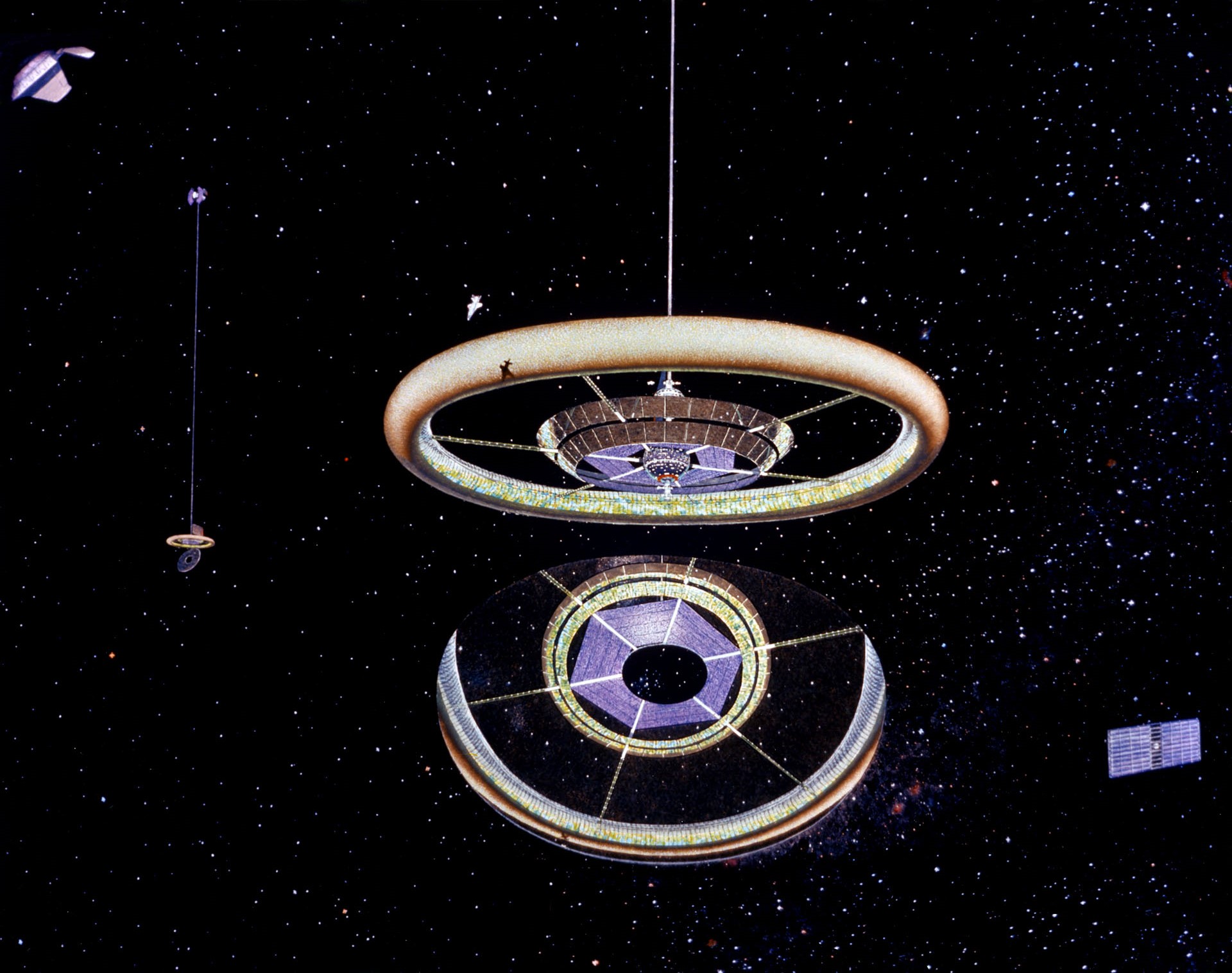
The Stanford torus is a proposed NASA design for a space settlement capable of housing 10,000 permanent residents. It is a type of rotating wheel space station, consisting of a ring with a diameter of about 1.8 km (1.1 mi), its rotation providing about 1.0 g of artificial gravity.
The Stanford torus was proposed during the 1975 NASA Summer Study, conducted at Stanford University, with the purpose of exploring and speculating on designs for future space colonies, with the conclusions and the detailed proposal being published in 1977 in Space Settlements: A Design Study book, by Richard D. Johnson and Charles H. Holbrow (Gerard O'Neill later proposed his Island One or Bernal sphere as an alternative to the torus). "Stanford torus" refers only to this particular version of the design, as the concept of a ring-shaped rotating space station was previously proposed by Konstantin Tsiolkovsky ("Bublik-City", 1903), Herman Potočnik (1923) and Wernher von Braun (1952), among others.
The Stanford torus (the proposed 10,000 people habitat described in the 1975 Summer Study, to be distinguished from other rotating wheel space station designs) consists of a torus, or doughnut-shaped ring, that is 1.8 km (1.1 mi) in diameter and rotates once per minute to provide between 0.9 g and 1.0 g of artificial gravity on the inside of the outer ring via centrifugal force.
Sunlight is provided to the interior of the torus by a system of mirrors, including a large non-rotating primary solar mirror.
The ring is connected to a hub via a number of "spokes", which serve as conduits for people and materials travelling to and from the hub. Since the hub is at the rotational axis of the station, it experiences the least artificial gravity and is the easiest location for spacecraft to dock. Zero-gravity industry is performed in a non-rotating module attached to the hub's axis.
The interior space of the torus itself is used as living space, and is large enough that a "natural" environment can be simulated; the torus appears similar to a long, narrow, straight glacial valley whose ends curve upward and eventually meet overhead to form a complete circle. The population density is similar to a dense suburb, with part of the ring dedicated to agriculture and part to housing.
The Stanford Torus design was not conceived for a single, isolated space settlement, but as part of a system for the colonization of space. Part of the people living in the colony would work in the construction of satellite solar power stations and new colonies, so that the habitat would be capable of self-replication, with a full system of multiple Stanford toruses being eventually built.
The 1975 NASA Summer Study evaluated several options for the space habitat design, including spherical and cylindrical shapes, in addition to the toroidal one. The torus was chosen as the best option, among other reasons, because it minimized the amount of mass required to have the same area and radius of rotation.
Hub AI
Stanford torus AI simulator
(@Stanford torus_simulator)
Stanford torus
The Stanford torus is a proposed NASA design for a space settlement capable of housing 10,000 permanent residents. It is a type of rotating wheel space station, consisting of a ring with a diameter of about 1.8 km (1.1 mi), its rotation providing about 1.0 g of artificial gravity.
The Stanford torus was proposed during the 1975 NASA Summer Study, conducted at Stanford University, with the purpose of exploring and speculating on designs for future space colonies, with the conclusions and the detailed proposal being published in 1977 in Space Settlements: A Design Study book, by Richard D. Johnson and Charles H. Holbrow (Gerard O'Neill later proposed his Island One or Bernal sphere as an alternative to the torus). "Stanford torus" refers only to this particular version of the design, as the concept of a ring-shaped rotating space station was previously proposed by Konstantin Tsiolkovsky ("Bublik-City", 1903), Herman Potočnik (1923) and Wernher von Braun (1952), among others.
The Stanford torus (the proposed 10,000 people habitat described in the 1975 Summer Study, to be distinguished from other rotating wheel space station designs) consists of a torus, or doughnut-shaped ring, that is 1.8 km (1.1 mi) in diameter and rotates once per minute to provide between 0.9 g and 1.0 g of artificial gravity on the inside of the outer ring via centrifugal force.
Sunlight is provided to the interior of the torus by a system of mirrors, including a large non-rotating primary solar mirror.
The ring is connected to a hub via a number of "spokes", which serve as conduits for people and materials travelling to and from the hub. Since the hub is at the rotational axis of the station, it experiences the least artificial gravity and is the easiest location for spacecraft to dock. Zero-gravity industry is performed in a non-rotating module attached to the hub's axis.
The interior space of the torus itself is used as living space, and is large enough that a "natural" environment can be simulated; the torus appears similar to a long, narrow, straight glacial valley whose ends curve upward and eventually meet overhead to form a complete circle. The population density is similar to a dense suburb, with part of the ring dedicated to agriculture and part to housing.
The Stanford Torus design was not conceived for a single, isolated space settlement, but as part of a system for the colonization of space. Part of the people living in the colony would work in the construction of satellite solar power stations and new colonies, so that the habitat would be capable of self-replication, with a full system of multiple Stanford toruses being eventually built.
The 1975 NASA Summer Study evaluated several options for the space habitat design, including spherical and cylindrical shapes, in addition to the toroidal one. The torus was chosen as the best option, among other reasons, because it minimized the amount of mass required to have the same area and radius of rotation.