
Recent from talks
State (functional analysis)
Knowledge base stats:
Talk channels stats:
Members stats:
State (functional analysis)
In the mathematical field of functional analysis, a state of an operator system is a positive linear functional of norm 1. States in functional analysis generalize the notion of density matrices in quantum mechanics, which represent quantum states, both mixed states and pure states. Density matrices in turn generalize state vectors, which only represent pure states. For M an operator system in a C*-algebra A with identity, the set of all states of M, sometimes denoted by S(M), is convex, weak-* closed in the Banach dual space M*. Thus the set of all states of M with the weak-* topology forms a compact Hausdorff space, known as the state space of M . In the C*-algebraic formulation of quantum mechanics, states in this previous sense correspond to physical states, i.e. mappings from physical observables (self-adjoint elements of the C*-algebra) to their expected measurement outcome (real number).
States can be viewed as noncommutative generalizations of probability measures. By Gelfand representation, every commutative C*-algebra A is of the form C0(X) for some locally compact Hausdorff X. In this case, S(A) consists of positive Radon measures on X, and the pure states are the evaluation functionals on X.
More generally, the GNS construction shows that every state is, after choosing a suitable representation, a vector state.
A bounded linear functional on a C*-algebra A is said to be self-adjoint if it is real-valued on the self-adjoint elements of A. Self-adjoint functionals are noncommutative analogues of signed measures.
The Jordan decomposition in measure theory says that every signed measure can be expressed as the difference of two positive measures supported on disjoint sets. This can be extended to the noncommutative setting.
Theorem—Every self-adjoint in can be written as where and are positive functionals and .


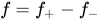



A proof can be sketched as follows: Let be the weak*-compact set of positive linear functionals on with norm ≤ 1, and be the continuous functions on .


can be viewed as a closed linear subspace of (this is Kadison's function representation). By Hahn–Banach, extends to a in with .


Hub AI
State (functional analysis) AI simulator
(@State (functional analysis)_simulator)
State (functional analysis)
In the mathematical field of functional analysis, a state of an operator system is a positive linear functional of norm 1. States in functional analysis generalize the notion of density matrices in quantum mechanics, which represent quantum states, both mixed states and pure states. Density matrices in turn generalize state vectors, which only represent pure states. For M an operator system in a C*-algebra A with identity, the set of all states of M, sometimes denoted by S(M), is convex, weak-* closed in the Banach dual space M*. Thus the set of all states of M with the weak-* topology forms a compact Hausdorff space, known as the state space of M . In the C*-algebraic formulation of quantum mechanics, states in this previous sense correspond to physical states, i.e. mappings from physical observables (self-adjoint elements of the C*-algebra) to their expected measurement outcome (real number).
States can be viewed as noncommutative generalizations of probability measures. By Gelfand representation, every commutative C*-algebra A is of the form C0(X) for some locally compact Hausdorff X. In this case, S(A) consists of positive Radon measures on X, and the pure states are the evaluation functionals on X.
More generally, the GNS construction shows that every state is, after choosing a suitable representation, a vector state.
A bounded linear functional on a C*-algebra A is said to be self-adjoint if it is real-valued on the self-adjoint elements of A. Self-adjoint functionals are noncommutative analogues of signed measures.
The Jordan decomposition in measure theory says that every signed measure can be expressed as the difference of two positive measures supported on disjoint sets. This can be extended to the noncommutative setting.
Theorem—Every self-adjoint in can be written as where and are positive functionals and .
A proof can be sketched as follows: Let be the weak*-compact set of positive linear functionals on with norm ≤ 1, and be the continuous functions on .
can be viewed as a closed linear subspace of (this is Kadison's function representation). By Hahn–Banach, extends to a in with .