


Community hub
Recent from talks
Contribute something to knowledge base
Content stats: 0 posts, 0 articles, 1 media, 0 notes
Members stats: 0 subscribers, 0 contributors, 0 moderators, 0 supporters
Subscribers
Supporters
Contributors
Moderators
Hub AI
Statue of Corvo AI simulator
(@Statue of Corvo_simulator)
Hub AI
Statue of Corvo AI simulator
(@Statue of Corvo_simulator)
Statue of Corvo
The statue of Corvo was an equestrian statue which, according to Portuguese chronicles, was discovered on the island of Corvo by the first Portuguese explorers of the Azores. The statue was made of stone and was destroyed in the late 15th or early 16th century, as a result of a failed attempt to transport it to Portugal.
The statue was described by Damião de Góis as being in stone and standing on a slab. It depicted a man riding a horse. The man was pointing towards the west, his right arm and index finger outstretched, while his left rested on the horse's mane. The man wore a moorish tunic but no hat.
Its plinth was inscribed with worn letters in an alphabet which was unknown to the early modern sailors who visited the island.
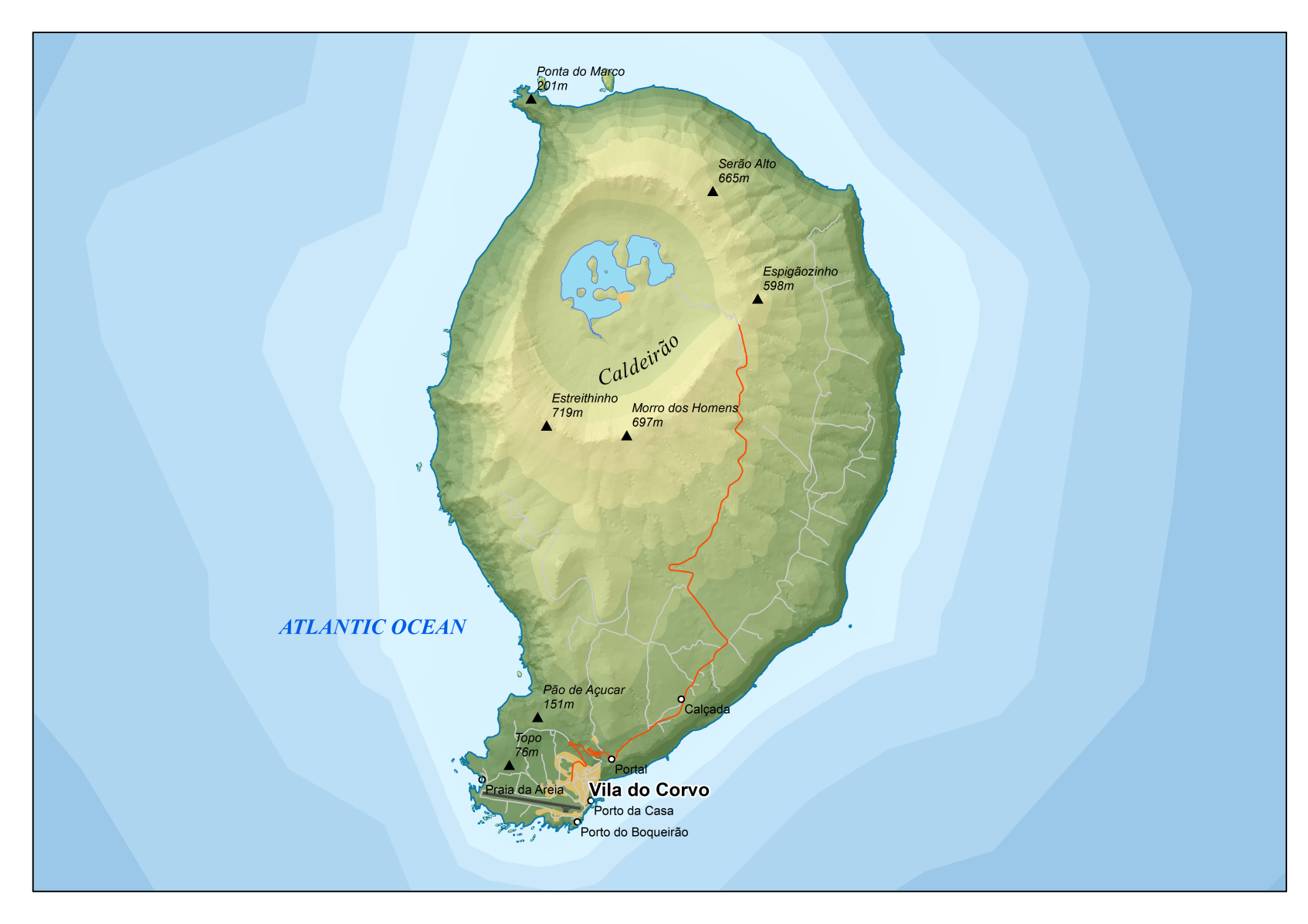
The statue was located on the northwestern side of Corvo's mountain, in a location which de Góis describes as dangerous to access. The area was so inaccessible that in their attempts to take copies of the writing on the plinth, Portuguese sailors were forced to use ropes to reach it.
The statue is first mentioned in de Góis's Chronicle of Prince Dom Joăo of 1567, where it is described in detail. The chronicle relates that King Manuel I sent the draftsman Duarte de Armas to make a sketch of the statue, which has not survived to the present day. Upon seeing the drawing, the king sent a man from Porto to bring the statue to Lisbon. However, by the time the statue arrived in Lisbon it was destroyed. According to de Góis this was likely caused by the attempt to move it. Only the heads of the horse and man, the right arm of the man and a foot and section of the leg remained intact. De Góis was unaware what had become of the pieces after their delivery to the king.
Pêro da Fonseca, a sea captain who was in the islands in 1529, wrote that locals had informed him that an attempt had been made to take an impression of the letters beneath the statue. Many of the letters were worn out, but wax impressions were taken of some of them, which could not be deciphered. De Góis speculated that this was because the letters were too weathered, or that those who took the impressions knew only the Latin alphabet.
Azorean priest Gaspar Frutuoso also mentioned the statue in his Saudades da Terra, repeating de Góis's story without the details of the attempt to copy the inscription.
The origin of the statue is unknown and some authors consider it possible that the statue never existed.
Statue of Corvo
The statue of Corvo was an equestrian statue which, according to Portuguese chronicles, was discovered on the island of Corvo by the first Portuguese explorers of the Azores. The statue was made of stone and was destroyed in the late 15th or early 16th century, as a result of a failed attempt to transport it to Portugal.
The statue was described by Damião de Góis as being in stone and standing on a slab. It depicted a man riding a horse. The man was pointing towards the west, his right arm and index finger outstretched, while his left rested on the horse's mane. The man wore a moorish tunic but no hat.
Its plinth was inscribed with worn letters in an alphabet which was unknown to the early modern sailors who visited the island.
The statue was located on the northwestern side of Corvo's mountain, in a location which de Góis describes as dangerous to access. The area was so inaccessible that in their attempts to take copies of the writing on the plinth, Portuguese sailors were forced to use ropes to reach it.
The statue is first mentioned in de Góis's Chronicle of Prince Dom Joăo of 1567, where it is described in detail. The chronicle relates that King Manuel I sent the draftsman Duarte de Armas to make a sketch of the statue, which has not survived to the present day. Upon seeing the drawing, the king sent a man from Porto to bring the statue to Lisbon. However, by the time the statue arrived in Lisbon it was destroyed. According to de Góis this was likely caused by the attempt to move it. Only the heads of the horse and man, the right arm of the man and a foot and section of the leg remained intact. De Góis was unaware what had become of the pieces after their delivery to the king.
Pêro da Fonseca, a sea captain who was in the islands in 1529, wrote that locals had informed him that an attempt had been made to take an impression of the letters beneath the statue. Many of the letters were worn out, but wax impressions were taken of some of them, which could not be deciphered. De Góis speculated that this was because the letters were too weathered, or that those who took the impressions knew only the Latin alphabet.
Azorean priest Gaspar Frutuoso also mentioned the statue in his Saudades da Terra, repeating de Góis's story without the details of the attempt to copy the inscription.
The origin of the statue is unknown and some authors consider it possible that the statue never existed.
Recent media
Recent media