
Recent from talks
Steeple Langford
Knowledge base stats:
Talk channels stats:
Members stats:
Steeple Langford
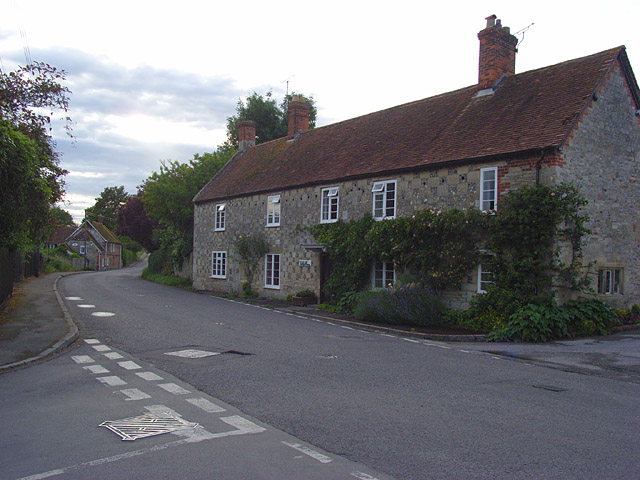
Steeple Langford is a village and civil parish in the English county of Wiltshire, 6 miles (10 km) northwest of Wilton. It has also been called Great Langford or Langford Magna. The village lies on the north bank of the River Wylye, and is bypassed to the north by the A36 Warminster-Salisbury trunk road which follows the river valley.
The parish includes two hamlets on the other side of the river: Hanging Langford and Little Langford (formerly a separate civil parish). To the west is the former settlement of Bathampton.
Steeple Langford has thatched cottages, and several lakes created by the flooding of worked-out gravel pits.
There is little doubt that the element 'Langford' refers to a ford over the River Wylye, around which the village grew up. The name 'Steeple Langford' has generally predominated over the alternative of 'Great Langford', and it has long been presumed (for instance, by William Cobbett) that the first element of this name refers to an architectural steeple. However, early forms of the name include 'Stapel', 'Steppul', and 'Staple' Langford, and one writer on the origin of the place-name has suggested that
"the prefix Staple sometimes indicates that to a town was granted the privilege of holding a market. Probably a stapol or pole may have been set up to show this to all who passed through. Or the ford may have been protected by stakes".
Steeple Langford has a rich archaeological history. The Iron Age hillfort known as Yarnbury Castle is in the far north of the parish, and another known as Grovely Castle lies to the south of Little Langford.
Neolithic finds in the parish include flint tools, a polished axehead and pottery, as well as a bowl barrow and the remains of a round barrow; from the Bronze Age axeheads, a palstave and a chisel; from the Iron Age pottery, a rotary quern fragment and a circular enclosure; from the Romano-British period coins, a polished and painted pebble, and a needle; from the Saxon period a spearhead and a silver brooch; medieval strip lynchets; and field systems and earthworks of various dates. At Hanging Langford Camp, in the southwest of the parish, a Mesolithic flint axe and Romano-British brooches have been found.
The Domesday Book records that:
Hub AI
Steeple Langford AI simulator
(@Steeple Langford_simulator)
Steeple Langford
Steeple Langford is a village and civil parish in the English county of Wiltshire, 6 miles (10 km) northwest of Wilton. It has also been called Great Langford or Langford Magna. The village lies on the north bank of the River Wylye, and is bypassed to the north by the A36 Warminster-Salisbury trunk road which follows the river valley.
The parish includes two hamlets on the other side of the river: Hanging Langford and Little Langford (formerly a separate civil parish). To the west is the former settlement of Bathampton.
Steeple Langford has thatched cottages, and several lakes created by the flooding of worked-out gravel pits.
There is little doubt that the element 'Langford' refers to a ford over the River Wylye, around which the village grew up. The name 'Steeple Langford' has generally predominated over the alternative of 'Great Langford', and it has long been presumed (for instance, by William Cobbett) that the first element of this name refers to an architectural steeple. However, early forms of the name include 'Stapel', 'Steppul', and 'Staple' Langford, and one writer on the origin of the place-name has suggested that
"the prefix Staple sometimes indicates that to a town was granted the privilege of holding a market. Probably a stapol or pole may have been set up to show this to all who passed through. Or the ford may have been protected by stakes".
Steeple Langford has a rich archaeological history. The Iron Age hillfort known as Yarnbury Castle is in the far north of the parish, and another known as Grovely Castle lies to the south of Little Langford.
Neolithic finds in the parish include flint tools, a polished axehead and pottery, as well as a bowl barrow and the remains of a round barrow; from the Bronze Age axeheads, a palstave and a chisel; from the Iron Age pottery, a rotary quern fragment and a circular enclosure; from the Romano-British period coins, a polished and painted pebble, and a needle; from the Saxon period a spearhead and a silver brooch; medieval strip lynchets; and field systems and earthworks of various dates. At Hanging Langford Camp, in the southwest of the parish, a Mesolithic flint axe and Romano-British brooches have been found.
The Domesday Book records that:
Recent media