Hubbry Logo
Steven CreaSteven CreaMain
Open search
Steven Crea
Community hub
Steven Crea
logo
8 pages, 0 posts
0 subscribers
Be the first to start a discussion here.
Steven Crea
Steven Crea
from Wikipedia

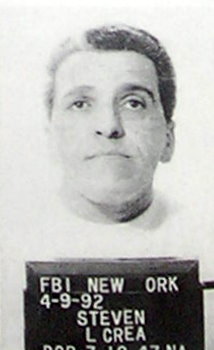
Steven Lorenzo "Stevie" Crea (born July 18, 1947)[1] is an American mobster and former underboss of the Lucchese crime family of New York. In August 2020, Crea was sentenced to life imprisonment for murder and racketeering.

Key Information

Lucchese crime family

[edit]

Rise to power

[edit]
Lucchese crime family - Chart 1991

Steven Crea grew up on Arthur Avenue in the Bronx, a neighborhood that had a strong Mafia presence.[2] In the late 1970s, Crea worked closely with his mentor and close friend Vincent DiNapoli, a "made" member of Genovese crime family, who was in the construction "rehab" industry.[2] By 1979, Crea and Vincent DiNapoli began working with SEBCO (South East Bronx Community Organization), an organization created by Catholic priest Louis Gigante, who was the brother of Genovese family boss Vincent Gigante.[2] SEBCO was an organization of low-income housing in the South East Bronx that was funded by the federal Department of Housing and Urban Development.[2] Crea and DiNapoli's drywall companies were able to secure millions of dollars in construction projects award by SEBCO.[2]

Sometime in the early 1980s, Crea was inducted into the Lucchese crime family, under the reign of boss Anthony Corallo.

In 1983, DiNapoli was imprisoned, and Crea took control of the construction business with SEBCO.[2] The Federal Bureau of Investigation (FBI) reported that Crea visited Vincent DiNapoli in prison a number of times.[2] Crea lived in a home just across the street from DiNapoli and he became DiNapoli's daughter godfather, helping her arrange her wedding while DiNapoli was in prison.[2] In 1985, Crea was convicted of conspiracy to plot to murder a Bronx man who Crea believed had assaulted his wife, but in 1987, his conviction was overturned.[2]

In 1990, family boss Victor Amuso promoted Crea to caporegime (captain), taking over Samuel "Sammy Bones" Castaldi's crew in the Bronx.[3] Crea specialized in labor racketeering, and gained control over Carpenter's Local 608, using it to extort New York City contractors. He also held a no-show job at Inner City Drywall, one of the city's largest drywall contractors and was involved with Local 282 of the Cement and Concrete Workers Union.

In 1993, imprisoned family boss Vic Amuso promoted Crea to underboss of the Lucchese family. Crea along with his Bronx allies, shifted the family's power center away from the Brooklyn faction and back to the Bronx and Upper Manhattan crews, which had historically controlled the family for decades. This angered former underboss Anthony Casso and his Brooklyn loyalists George Zappola and Frank "Spaghetti Man" Gioia, Jr. who during the early 1990s, plotted to murder Crea and retake control of the family.[4] The Brooklyn loyalists planned to lure Crea to a sit-down (a mafia meeting) and then murder him. However, the plot fell through after Zappola, Gioia, and the rest of Casso's faction were indicted and imprisoned.[5]

Construction boss

[edit]

From 1997 through 1999, Crea served as the head of the "Lucchese Construction Group", which also included Lucchese caporegimes (capos) Dominic Truscello, head of the Prince Street crew, and Joseph Tangorra, head of a Brooklyn crew. The Construction Group brokered the bribes and "mob tax" payments to be received from contractors, and settled disputes over who would dominate a particular construction site. The group also, placed mobsters on company payrolls so they could report legitimate taxable income to the U.S. Internal Revenue Service (IRS). During its existence, the Construction Group controlled over $40 million in construction contracts, increasing overall construction costs by 5%.[6]

In 1998, after acting Lucchese boss Joseph DeFede was indicted on labor racketeering and extortion charges, Crea became the family's new acting boss.

In December 1999, Crea and Joseph Datello talked about bribery and extortion with Sean Richard, the son-in-law of John Riggi, the boss of the DeCavalcante crime family.[7] It was later revealed that Richard was wearing a hidden recording device.[7]

In 1999, it was revealed that Crea had formed an alliance with members of the Gambino crime family in extorting local officials of New York City's carpenters, laborers and bricklayers unions.[8]

Guilty plea on corruption charges

[edit]

On September 6, 2000, Crea and other members of the Lucchese Construction Group were indicted in New York on state enterprise corruption, labor racketeering, extortion, and bid-rigging charges.[9][10] The District Attorney charged that these schemes had systematically siphoned off millions of dollars from both public and private construction projects. Specifically, Crea used mob associates to extort building contractors who wished to receive rights to no-bid jobs or who wanted to reduce the number of union members on their payrolls.[11] Crea's attorney was able to negotiate a favorable plea agreement which called for Crea to plead guilty to enterprise corruption and restraint of trade charges, and in January 2004, he received a 34-month prison sentence.[12][13][14][15] Crea also pleaded guilty to similar federal charges and served both sentences concurrently.

Back to power

[edit]

On August 24, 2006, Crea was released from prison with parole restrictions that prohibited him from associating with other mobsters or union officials.[16][17] On November 17, 2009, Crea's parole restrictions expired.[18] Since his release it was speculated that he would take over the Lucchese crime family when his parole was up. In March 2010, the FBI observed at a Bronx social club Crea meeting with capo John Castellucci.[19]

In July 2014, Jerry Capeci reported that Vic Amuso remains the official boss while Crea serves as acting boss.[20] When the US attorneys office in Manhattan arrested him in 2017, they alleged he was the underboss of the family.

Racketeering indictment and life sentence

[edit]
DOJ mugshot of Steven Crea in 2017

On May 31, 2017, Crea was indicted and held without bail for racketeering, fraud and murder conspiracy.[21][22] The indictment built on charges previously filed against a reputed Lucchese soldier and associate in February 2017 with the murder of Michael Meldish in the Bronx on November 15, 2013; Matthew Madonna, Crea and his son Steven D. Crea, were charged and suspected of serving as co-conspirators in the Meldish gangland execution.[21][22][23]

Crea is also accused of ordering the attempted murder of a Bonanno crime family associate. The FBI also accuses Crea of giving his approval for one of his underlings driving to New Hampshire in an attempt to find and murder an informant. Crea was personally charged with mail and wire fraud in connection of his skimming involvement with the construction of a New York City hospital.[24][25][26]

On November 15, 2019, Crea, Madonna, Christopher Londonio and Terrence Caldwell were convicted in White Plains federal court of executing the murder of East Harlem Purple Gang leader Michael Meldish.[27]

On August 27, 2020, Crea was sentenced to life in prison, along with a $400,000 fine and the forfeit of $1 million.[28][29]

After Crea's 2020, imprisonment for the murder of Michael Meldish, he was demoted from his underboss position. Crea was initially incarcerated at the United States Penitentiary, Canaan in Pennsylvania.[30] In April 2024, it was reported by Jerry Capeci that Crea was seeking compassionate release from prison after being diagnosed with stage IV lung cancer.[31] He is undergoing treatment at Federal Medical Center, Butner, North Carolina.[30]

References

[edit]

Further reading

[edit]
[edit]
Revisions and contributorsEdit on WikipediaRead on Wikipedia
from Grokipedia
Steven L. Crea, a.k.a. "Wonder Boy," is an American organized crime figure who served as underboss of the Lucchese crime family, a key component of New York City's traditional Mafia syndicates. Crea rose to prominence within the family during the 1990s, overseeing operations including extortion, illegal gambling, and labor racketeering, while navigating internal power struggles and external law enforcement pressures. In 2019, following a federal trial, he was convicted of racketeering conspiracy, murder in aid of racketeering for authorizing the 2013 execution of rival gangster Michael Meldish, and related offenses, resulting in a life sentence imposed in August 2020. His incarceration marked a significant blow to the Lucchese leadership structure, highlighting ongoing federal efforts to dismantle persistent Mafia hierarchies through RICO prosecutions grounded in intercepted communications and cooperating witness testimony.

Early Life

Background and Entry into Organized Crime

Steven Lorenzo Crea was born on July 18, 1947, in the Bronx, New York, an area with a dense Italian-American enclave around Arthur Avenue that attracted post-World War II immigrants and fostered tight-knit communities often intertwined with emerging organized crime networks. This environment, marked by economic pressures and cultural insularity in urban neighborhoods recovering from wartime disruptions, provided fertile ground for young men like Crea to encounter local racketeers through familial and street-level associations. During the 1960s and 1970s, Crea initiated his criminal activities as a low-level associate in Bronx rackets, operating in the shadow of the Lucchese crime family's influence in the borough's labor and construction sectors. Influenced by neighborhood connections to established mob figures, he engaged in street-level operations that capitalized on the family's control over unionized trades and informal gambling outfits, marking his transition from petty offenses to structured underworld affiliations. Crea's early brushes with law enforcement involved minor infractions tied to these rackets, though specific convictions from this period remain undocumented in federal records, underscoring his initial role as an unindicted associate evading major scrutiny. By the late 1970s, these foundations positioned him for mentorship under Anthony Corallo, the Lucchese boss, enabling a shift toward more organized extortion and labor manipulation schemes without yet ascending to formal family membership.

Lucchese Crime Family Involvement

Rise Within the Hierarchy

Steven Crea joined the Lucchese crime family as an associate during the leadership of boss Anthony Corallo, who controlled the organization from 1973 until his conviction in the 1986 Commission case. Crea's induction as a made member occurred sometime in the 1980s under Corallo's regime, marking his formal entry into the family's inner ranks. Following Corallo's imprisonment and the subsequent ascension of Vittorio Amuso as boss in 1987, Crea advanced amid the disruptions caused by federal RICO prosecutions targeting the family's upper echelons. In 1990, Amuso elevated Crea to the position of caporegime, placing him in command of a Bronx-based crew that had previously been led by Samuel "Sammy Bones" Castaldi. This promotion positioned Crea as a mid-level leader overseeing operations in the Bronx faction, a strategic area for the family's activities. Crea consolidated his authority by drawing on longstanding personal ties within the Bronx underworld, fostering loyalty among associates and soldiers through targeted alliances rather than overt violence during this period of internal reorganization. His ascent reflected Amuso's preference for reliable operators capable of navigating the power vacuum left by incarcerated predecessors, including underboss Salvatore Santoro and consigliere Christopher Furnari, both convicted alongside Corallo.

Dominance in Construction and Labor Rackets

During the mid-1990s, under acting boss Joseph DeFede, Steven Crea assumed oversight of the Lucchese crime family's labor and construction operations, revitalizing these rackets after earlier federal disruptions had diminished their profitability. Crea's management focused on the New York City metropolitan area, where the family infiltrated unions such as carpenters' and painters' locals, extracting up to 10% taxes on contracts through coerced agreements with contractors. These schemes generated substantial revenue—estimated in the millions annually—by enforcing no-show jobs for family associates, manipulating labor costs to undercut legitimate bids, and deterring non-compliant firms via implicit threats of work stoppages or sabotage. Crea's group maintained influence over the "Concrete Club," a longstanding mob cartel regulating large-scale pours in NYC infrastructure projects, by brokering "mob taxes" of approximately 5% on qualifying contracts and resolving territorial disputes among families. This control extended to bid-rigging on public and private developments, where favored contractors paid kickbacks in exchange for union harmony and exclusive pours exceeding $2 million in value, sustaining family income amid RICO prosecutions targeting gambling and loansharking. Empirical evidence from infiltrated projects, such as benefit fund frauds defrauding union locals by around $5 million, underscores the scale, with Crea's strategies prioritizing economic leverage over overt violence to minimize law enforcement scrutiny. Ties to the Teamsters facilitated additional infiltration, particularly in air freight and building trades, where Lucchese operatives under Crea's direction secured payoffs from contractors seeking labor peace, contributing to the family's resilience during the 1990s federal crackdowns. By embedding associates in union leadership and exploiting regulatory gaps, Crea ensured a steady flow of illicit funds from NYC's booming construction sector, which saw billions in projects vulnerable to organized extortion without direct confrontation. This approach, rooted in established networks rather than expansion, preserved operational continuity while yielding higher returns than riskier ventures.

Ascension to Underboss and Acting Boss

In 1993, imprisoned Lucchese boss Vittorio Amuso, with support from underboss Anthony Casso, elevated Steven Crea to the position of underboss, recognizing his influence in Bronx operations and labor rackets. Crea's promotion stabilized the family's Bronx faction amid federal prosecutions that had decimated leadership following the 1980s Commission trials. Following the September 1998 indictment of acting boss Joseph DeFede on labor racketeering and extortion charges, Crea was appointed acting boss, overseeing family affairs until his own arrest in 2000 on state enterprise corruption charges. This transition occurred without internal violence, contrasting with bloody power struggles in rival families like the Gambinos during the same period. After completing his sentence and returning in 2009 upon expiration of parole restrictions, Crea resumed as underboss under street boss Matthew Madonna, who managed day-to-day operations for the officially imprisoned Amuso. In this role through the 2010s, Crea facilitated non-violent leadership handovers and mediated inter-family disputes, maintaining Lucchese control over Bronx and Westchester territories—key areas for the family's revenue—while avoiding open conflicts with Genovese or Bonanno groups. Federal records indicate the family generated millions annually from activities in these regions under such stabilized governance.

2000 Indictment for Construction Corruption

On September 6, 2000, a 57-count indictment was unsealed in Manhattan, charging Steven Crea and 37 other individuals—including union officials, contractors, and alleged organized crime figures—with bribery, bid-rigging, and extortion in New York City's construction sector. The case, led by Manhattan District Attorney Robert M. Morgenthau, targeted schemes where defendants allegedly imposed a "mob tax" on projects by controlling labor unions and manipulating competitive bids to favor compliant firms. Crea, then 53 and identified as the acting boss of the Lucchese crime family, faced accusations of directing these operations to extract payoffs from contractors seeking union labor or project awards. Prosecutors alleged the rackets generated substantial illicit revenue through systematic extortion, with Crea serving as a key overseer in coordinating Lucchese family involvement in the "Lucchese Construction Group." Evidence included testimony from cooperating witnesses, notably FBI informant Sean J. Richards—a former associate tied to New Jersey mob figures—who described bid-rigging tactics, union no-show jobs, and direct payoffs to ensure mob-approved subcontractors dominated public and private works. Richards' accounts highlighted Crea's enforcer role in intimidating non-compliant parties and enforcing family dominance over lucrative trades like concrete pouring and demolition. The indictment encompassed 11 companies alongside the individuals, reflecting the breadth of infiltrated entities from labor locals to building firms. Pre-trial proceedings involved immediate arrests of several defendants, including Crea, prompting defensive maneuvers such as asset freezes and motions to suppress informant-derived evidence on grounds of reliability. While the probe temporarily halted certain Lucchese-supervised projects and strained family logistics, operational resilience persisted through decentralized lieutenants maintaining low-profile collections.

Guilty Plea and Imprisonment

Crea resolved the charges from the September 6, 2000, New York state indictment for enterprise corruption involving bid-rigging and extortion in the construction sector by entering a plea agreement. He pleaded guilty to enterprise corruption and restraint of trade, avoiding trial on the broader racketeering allegations that could have resulted in lengthier incarceration. In January 2004, Crea was sentenced to an indeterminate state prison term of 2 to 6 years. Crea served approximately five years of the sentence at a state facility, during which he maintained operational oversight of Lucchese family matters through communications with relatives and trusted associates, including his son Steven D. Crea Jr. No significant asset forfeitures were imposed as part of this plea, unlike in subsequent federal cases. The indeterminate sentencing structure allowed for parole eligibility after the minimum term, contingent on good behavior and institutional conduct. Released in 2006, Crea faced standard parole conditions for a convicted felon, including restrictions on associating with known organized crime figures, requirements for regular reporting to parole authorities, and prohibitions on engaging in unauthorized employment or travel. These terms effectively curtailed his public-facing activities while permitting indirect influence within the family hierarchy.

Return to Influence Post-Release

Following his release from federal prison on August 24, 2006, Steven Crea faced strict parole conditions barring association with known criminals or labor union officials, yet he gradually reasserted authority within the Lucchese crime family. These restrictions lapsed in late 2009, enabling Crea to formally resume his underboss role under street boss Matthew Madonna, focusing on Bronx and Westchester operations. From his base in Westchester County, Crea directed rackets remotely through capos, including his son Steven D. Crea Jr., who managed Bronx crews involved in enforcement and crew coordination. In the post-RICO era, Crea adapted family activities to evade heightened scrutiny, maintaining subtler control over remnants of construction and labor extortion while expanding into fronts for gambling and loansharking, such as Yonkers-based establishments like McKiernan’s Lawton Street Tavern. These operations generated millions annually across New York City, Westchester, Long Island, and New Jersey, leveraging recruits from groups like the Tanglewood Boys for low-profile enforcement. Crea's key decisions in the early 2010s bolstered Lucchese stability amid internal factional strains between Bronx loyalists and Brooklyn elements, as well as external pressures from rival families like the Genovese. By aligning with Madonna's Bronx-centric administration, Crea helped consolidate power without resorting to overt violence, preserving operational continuity through delegated authority and coded communications. This approach sustained the family's influence in traditional rackets while minimizing exposure to federal probes.

2017 Racketeering Charges and Meldish Murder Allegations

On May 31, 2017, a superseding indictment unsealed in the U.S. District Court for the Southern District of New York charged Steven Crea Sr., identified as the Lucchese crime family's underboss, alongside street boss Matthew Madonna and at least nine other associates, with racketeering conspiracy under the Racketeer Influenced and Corrupt Organizations (RICO) Act, murder in aid of racketeering, extortion, and related offenses spanning from approximately 2000 to May 2017. The charges alleged a pattern of criminal activity including violent enforcement of debts, control over legitimate businesses through threats, and inter-gang conflicts, with Crea portrayed as a key decision-maker in the family's hierarchy. Central to the indictment was the alleged orchestration of the November 15, 2013, murder of Michael Meldish, a leader of the Bronx-based Purple Gang, which had previously conducted armed robberies on behalf of Lucchese associates. Prosecutors claimed Meldish owed the Lucchese family around $100,000 from proceeds of a 2010 robbery of a family associate, and that Madonna and Crea ordered his execution to settle the debt, with Crea providing approval for the hit carried out by associates including his son Steven D. Crea Jr., Christopher Londonio, and Terrance Caldwell. The Meldish killing was tied to broader violence in the indictment, including an alleged attempted murder of a Bonanno crime family associate, positioning Crea as integral to maintaining the family's dominance through lethal force. The government's case relied on evidence from cooperating witnesses—former Lucchese members turned informants—and electronic surveillance, which purportedly captured discussions and orders linking Crea to the Meldish murder and extortion schemes targeting construction firms and labor unions. These sources documented Crea's role in approving violent resolutions to disputes, such as the Meldish hit, as part of the family's ongoing racketeering enterprise.

2019 Trial, Life Sentence, and Appeals

A federal in the U.S. for the Southern of New York convicted Steven L. Crea on , , at the conclusion of a six-week , of , in of for the 2013 slaying of Michael Meldish, and related firearms offenses, alongside co-defendants Matthew Madonna, Christopher Londonio, and Terrence Caldwell. The prosecution's case centered on cooperating witness testimony from former Lucchese associates detailing Crea's orchestration of the Meldish murder over an unpaid debt and Mafia protocol violations, corroborated by ballistics evidence matching weapons recovered from the crime scene to those linked to the convicted shooters. Crea was acquitted on charges of attempted murder and assault in of racketeering stemming from a 2016 attack on a former witness. On August 27, 2020, United States District Judge Cathy Seibel sentenced Crea, then 73, to life imprisonment, a $400,000 fine, and $1 million in forfeiture, marking the final sentencing in the 2017 Lucchese racketeering takedown. During his allocution, Crea expressed no remorse for the crimes, stating he maintained his innocence while acknowledging the jury's verdict, a factor prosecutors highlighted in advocating for the maximum penalty given the premeditated nature of the Meldish execution and Crea's leadership role in the family's violent enterprises. Crea filed appeals challenging the conviction, including arguments that the district court erred in denying his motion to dismiss a prior indictment and to inspect grand jury minutes, with a Second Circuit mandate issued on December 18, 2024, upholding the proceedings. Crea is currently incarcerated at the United States Penitentiary Canaan in Waymart, Pennsylvania. In April 2024, reports indicated Crea sought compassionate release amid a stage IV lung cancer diagnosis, though no cooperation with authorities was confirmed.

Family and Associates

Immediate Family and Son's Involvement

Steven Crea has maintained a low public profile regarding his immediate family, with limited verifiable details emerging primarily through federal court proceedings related to organized crime indictments. He is known to have at least one son, Steven D. Crea Jr., who followed familial patterns by ascending within the Lucchese crime family's hierarchy. No confirmed public records detail Crea's marriage or spouse, reflecting the insularity typical of high-ranking organized crime figures who shield personal lives from scrutiny. Steven D. Crea Jr., born around 1973 and residing in New Rochelle, New York, emerged as a captain overseeing Bronx operations for the Lucchese family, exemplifying intergenerational succession in the organization's structure. In May 2017, he was indicted alongside his father and other family members on racketeering charges, including conspiracy in the 2012 murder of Michael Meldish, a Lucchese associate killed for unauthorized intrusions into family rackets. Crea Jr. pleaded guilty in August 2019 to lesser charges of murder conspiracy and assault in an unconsummated revenge plot, avoiding a potential life sentence by cooperating on a reduced role. The 2017 charges and subsequent 2020 life sentence for Steven Crea Sr. directly implicated and disrupted family operations, with Jr.'s plea highlighting the cascading legal pressures on direct relatives in such prosecutions. Crea Jr.'s involvement in Bronx rackets, inherited amid his father's dominance in construction and labor sectors, underscored patterns of filial continuity, though federal interventions curtailed full succession. Public information on other children or extended kin remains scarce, consistent with efforts to compartmentalize family from criminal exposure.

Key Alliances and Rivalries

Crea forged alliances with Gambino crime family members in the late 1990s to conduct joint extortion of New York City officials, enhancing Lucchese influence in construction-related political corruption. These collaborations leveraged shared interests in labor and building trades rackets, allowing coordinated bid-rigging and bribery without immediate inter-family conflict. Relations with Bonanno associates initially involved cooperative ventures but soured into rivalry, exemplified by the 2013 murder of Michael Meldish, a Bonanno crime family associate, which Crea approved due to an unpaid $100,000 loan and related enforcement disputes. This incident underscored tensions over financial obligations crossing family lines, yet Crea's approach emphasized de-escalation to preserve operational stability. Competition with the Genovese family over New York construction turf persisted, but Crea pursued pragmatic accommodations, including joint participation in bribes for projects like a Bronx public hospital development alongside Genovese captain Vincent DiNapoli. Such arrangements, mediated through traditional Mafia protocols, averted full-scale wars and facilitated sustained revenue from shared rackets, with federal probes documenting multimillion-dollar gains from these controlled rivalries.

Controversies and Alternative Perspectives

Government Overreach Claims in Convictions

In appeals following his 2020 life sentence for racketeering conspiracy and murder in aid of racketeering, Steven Crea Sr. and co-defendants contended that the evidence tying Crea to the 2013 Michael Meldish homicide was insufficient, relying predominantly on the testimony of cooperating witnesses who received substantial sentencing reductions in exchange for their accounts. These witnesses, including figures like Anthony Villani, had flipped after their own arrests on drug and racketeering charges, prompting arguments that their incentives to implicate higher-ranking figures like Crea compromised testimonial reliability absent corroborating physical or direct evidence. A 2021 self-published audiobook, Guilt for the Guiltless: The Story of Steven Crea, a Government Target Wrongfully Convicted, advances the narrative that federal prosecutors pursued Crea as part of a pattern of overzealous targeting of organized crime leaders, asserting no forensic links, surveillance intercepts, or non-cooperator eyewitnesses substantiated his orchestration of Meldish's killing over a disputed $100,000 loan. The work, produced by Justice Techpros, portrays Crea's prosecution under the Racketeer Influenced and Corrupt Organizations (RICO) Act as emblematic of guilt-by-association tactics, where leadership roles in enterprises historically centered on loansharking and illegal gambling—activities not inherently violent—were leveraged to attribute unproven murders without establishing specific causation or intent. Broader critiques of RICO's application, echoed in legal scholarship, underscore how the statute's enterprise clause facilitates convictions through inferred participation rather than discrete predicate acts, a mechanism ill-suited to figures like Crea whose prior 2004 guilty plea involved non-violent extortion and bid-rigging in construction rather than documented personal violence. Such expansions, critics argue, prioritize prosecutorial narratives of hierarchical command over empirical proof of individual agency, particularly when reliant on informants whose credibility is structurally undermined by plea bargains offering freedom for testimony. Perspectives from conservative legal analysts further highlight systemic incentives in federal organized crime units for securing marquee convictions, potentially eroding due process through uncritical acceptance of cooperator statements amid declining traditional evidentiary standards in Mafia cases.

Empirical Evidence on Racketeering Operations

Court documents from the 2000 indictment detail Steven Crea's direction of the Lucchese crime family's construction rackets, involving bid-rigging, bribery of union officials, and extortion to secure no-show jobs and inflated contracts on New York City projects, including hospitals. Crea, as acting boss, received proceeds from these schemes, with the family funneling millions through fraudulent skimming on public works like a Manhattan hospital expansion. In a 2003 guilty plea, Crea admitted to conspiring to extort at least $100,000 in protection payments from a subcontractor in exchange for labor peace, resulting in a 4.5-year sentence and confirming the economic core of these operations centered on monopolizing lucrative trades rather than isolated violence. Prosecution evidence in the 2017 racketeering case established Crea's oversight of loansharking and union infiltration, generating steady illicit revenue through high-interest usury and coerced pension contributions, with family earnings from labor rackets reportedly increasing under his Bronx faction's control. Regarding violence, Crea was convicted in 2019 of authorizing the 2013 murder of associate Michael Meldish in aid of racketeering, motivated by an unpaid $100,000 loansharking debt that threatened collection operations; trial testimony from cooperators and surveillance corroborated the hit as a targeted enforcement measure to maintain debtor compliance. However, acquittals on charges of attempted murder and related assaults highlight limits to proven violent extents, with defense arguments successfully challenging cooperating witness credibility and forensic linkages in those counts, suggesting operations prioritized economic coercion over indiscriminate aggression. These patterns align with incentives favoring sustained profit extraction via market distortions—such as rigging bids to claim 10-20% kickbacks on multimillion-dollar contracts—over high-risk violence that invites federal scrutiny and disrupts revenue streams. Post-2000 and 2017 indictments dismantling Crea's leadership, Lucchese operations contracted, with successive prosecutions eroding union footholds and construction influence, reducing the family's overall illicit income as evidenced by diminished high-profile schemes in subsequent years. While prosecutors portrayed Crea's role as emblematic of entrenched Mafia predation, alternative perspectives from trial defenses emphasized overreliance on incentivized informants whose testimonies occasionally faltered under cross-examination, underscoring the need to weigh conviction outcomes against evidentiary gaps in unproven allegations.

Current Status and Incarceration

Prison Term and Recent Developments

Steven Crea's life sentence, imposed on August 27, 2020, for racketeering conspiracy, murder in aid of racketeering, and related offenses, is being served at the United States Penitentiary in Canaan, Pennsylvania. The sentence includes a $400,000 fine and $1 million forfeiture, with no indication of early release mechanisms beyond standard federal procedures as of late 2025. In April 2024, Crea, then 76, was diagnosed with stage IV lung cancer and began pursuing compassionate release from federal custody, as reported by organized crime journalist Jerry Capeci in Gang Land News. This development prompted speculation about potential shifts in Lucchese family dynamics, though no verified changes in leadership succession tied directly to Crea's health have materialized by October 2025. Federal Bureau of Prisons records do not indicate any granted privileges or transfers altering his incarceration status beyond routine medical considerations. As of October 2025, Crea remains incarcerated without confirmed cooperation with authorities or successful appeals overturning his conviction, maintaining his non-cooperative stance consistent with prior patterns among high-ranking organized crime figures. No public BOP updates suggest alterations to his life term enforcement or family-influenced operational impacts within the Lucchese organization.

References

Add your contribution
Related Hubs
User Avatar
No comments yet.