Hubbry Logo
Henry HillHenry HillMain
Open search
Henry Hill
Community hub
Henry Hill
logo
8 pages, 0 posts
0 subscribers
Be the first to start a discussion here.
Henry Hill
Henry Hill
from Wikipedia

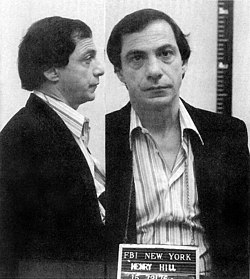
Henry Hill Jr. (June 11, 1943 – June 12, 2012) was an American mobster who was associated with the Lucchese crime family of New York City from 1955 until 1980, when he was arrested on narcotics charges and became an FBI informant. Hill testified against his former Mafia associates, resulting in fifty convictions, including those of caporegime (captain) Paul Vario and fellow associate James Burke on multiple charges. Hill subsequently entered the Witness Protection Program but was removed from the program in 1987.

Key Information

Hill's life story was documented in the true crime book Wiseguy: Life in a Mafia Family by Nicholas Pileggi, which was subsequently adapted by Martin Scorsese into the critically acclaimed 1990 film Goodfellas, in which Hill was portrayed by Ray Liotta. The crime comedy film My Blue Heaven is a heavily fictionalized version of Hill’s life story, its screenplay written by Pileggi’s wife Nora Ephron based on joint researched sessions with her husband.[1]

Early life

[edit]

Henry Hill Jr. was born on June 11, 1943, in the New York City borough of Manhattan to Henry Hill Sr., an Irish-American electrician, and Carmela Costa, an Italian immigrant of Sicilian descent.[2] Hill claimed in the book Wiseguy that his father had emigrated from Ireland at age 12 after the death of Hill's grandfather.[3] The working-class family, consisting of Henry and his seven siblings, grew up in Brownsville, a working-class neighborhood of Brooklyn.[4] Hill was dyslexic[5] and performed poorly at school.

From an early age, Hill admired the local mobsters who socialized at a dispatch cabstand across the street from his home, a group that included Paul Vario, a caporegime (captain) in the Lucchese crime family.[6] In 1955, when he was eleven years old, Hill wandered into the cabstand looking for a part-time after-school job.[7] In his early teens, Hill began running errands for patrons at the cabstand and Vario's other front businesses. It was in this capacity that 13-year-old Hill first met notorious hijacker and Lucchese family associate James "Jimmy the Gent" Burke in 1956. Hill served drinks and sandwiches at a card game and was dazzled by Burke's openhanded tipping: "He was sawbucking me to death. Twenty here. Twenty there. He wasn't like anyone else I had ever met."[8]

The following year, Vario's younger brother, Vito "Tuddy" Vario, and his son, Lenny Vario, presented Hill with a highly sought-after union card in the bricklayers' local. Hill would be a "no show" and put on a building contractor's construction payroll, guaranteeing him a weekly salary of $190 (equivalent to $2,130 in 2024).[9] This didn't mean Hill would get or keep all the money every week; he received a portion, while the rest was kept and divided among the Vario crew. The card also allowed Hill to facilitate the pickup of daily policy bets and loan payments to Vario from local construction sites. Once Hill had this "legitimate" job, he dropped out of high school and began working exclusively for the Varios.[10]

Hill's first encounter with arson occurred when a rival cabstand opened just around the corner from Paul Vario's. The competing company's owner was from Alabama, new to New York City. Sometime after midnight, Tuddy and Hill drove to the rival cabstand with a drum full of gasoline in the backseat of Tuddy's car. Hill smashed the cab windows and filled them with gasoline-soaked newspapers, then tossed in lit matchbooks.[11]

Hill was first arrested when he was aged 16; his arrest record is one of the few official documents which used his real name.[12] Hill and Lenny, who was of the same age, had attempted to use a stolen credit card to buy snow tires for Tuddy's wife. When Hill and Lenny returned to Tuddy's, two police detectives apprehended Hill. During a rough interrogation, Hill gave his name and nothing else; Vario's attorney later facilitated his release on bail. While a suspended sentence resulted, Hill's refusal to talk earned him the respect of both Vario and Burke. Burke, in particular, saw great potential in Hill. Like Hill, Burke was of Irish ancestry and therefore ineligible to become a "made man". The Vario crew, however, were happy to have associates of any ethnicity, so long as they made money and refused to cooperate with authorities.[13]

In June 1960, at age 17, Hill joined the United States Army, serving with the 82nd Airborne Division at Fort Bragg in North Carolina. He claimed the timing was deliberate; the FBI's investigation into the 1957 Apalachin meeting had prompted a United States Senate investigation into organized crime and its links with businesses and unions. This resulted in the publication of a list of nearly 5,000 names of members and associates of the five New York crime families. Hill searched through a partial list but could not find Vario listed among the Lucchese family.[14]

Throughout his three-year enlistment, Hill maintained his mob contacts. He also continued to hustle: in charge of kitchen detail, he sold surplus food, loan sharked pay advances to fellow soldiers and sold tax-free cigarettes. Before his discharge, Hill spent two months in the stockade for stealing a local sheriff's car and brawling in a bar with Marines and a civilian. In 1963 he returned to New York and began the most notorious phase of his criminal career: arson, intimidation,[15] running an organized stolen car ring,[16] and hijacking trucks.[17]

In 1965, Hill met his future wife, Karen Friedman, through Paul Vario, who insisted that Hill accompany his son on a double date at Frank "Frankie the Wop" Manzo's restaurant, Villa Capra. According to Friedman, the date was disastrous, and Hill stood her up at the next dinner date. Afterward, the two began going on dates at the Copacabana and other nightclubs, where Friedman was introduced to Hill's outwardly impressive lifestyle. The two later married in a large North Carolina wedding, attended by most of Hill's mob associates.[18]

Criminal career

[edit]

Air France robbery

[edit]

Shortly before midnight on April 6, 1967, Hill and Lucchese associate Tommy DeSimone drove to the Air France cargo terminal at John F. Kennedy International Airport with an empty suitcase, the largest Hill could find. Inside connection Robert McMahon instructed the two to just walk in, as people often came to the terminal to pick up lost baggage. DeSimone and Hill entered the unsecured area unchallenged and unlocked the door with a duplicate key. Using a small flashlight, they loaded seven bags into the suitcase and left with US$420,000 (equivalent to $4 million in 2024). No alarm was raised, no shots were fired and no one was injured.[8] The theft was not discovered until the following Monday, when a Wells Fargo truck arrived to pick up the cash to be delivered to the French American Banking Corporation.[19] Hill later believed that it was the Air France robbery that endeared him to the Mafia at large.[8]

Restaurant ownership and murder of William "Billy Batts" Bentvena

[edit]

Hill used his share of the robbery proceeds to purchase a restaurant on Queens Boulevard, called The Suite, initially aiming to run it as a legitimate business and provide distance between himself and his mob associates. However, within several months, members of Lucchese and Gambino crews, including high-ranking Gambino members who "were always there", moved into the club en masse and made it another mob hangout.[20]

According to the book Wiseguy, after William "Billy Batts" Bentvena was released from prison in 1970, a welcome-home party was thrown for him at Robert's Lounge, which was owned by Burke. Hill stated that Bentvena saw DeSimone and jokingly asked him if he still shined shoes, which DeSimone perceived as an insult. DeSimone leaned over to Hill and Burke and said, "I'm gonna kill that fuck."[8] Two weeks later, on June 11, 1970, Bentvena was at The Suite near closing time when he was ambushed and pistol-whipped by DeSimone. Hill said that before DeSimone started to beat Bentvena, DeSimone yelled, "Shine these fucking shoes!"[8]

After Bentvena was beaten and presumed killed, DeSimone, Burke and Hill placed his body in the trunk of Hill's car for transport. They stopped at DeSimone's mother's house to fetch a shovel and lime. They started to hear sounds from the trunk, and when they realized that Bentvena was still alive, DeSimone and Burke stopped the car and beat him to death with the shovel and a tire iron. Burke had a friend who owned a dog kennel in Upstate New York, and Bentvena was buried there.[8] About three months after the murder, Burke's friend sold the dog kennel to housing developers, and Burke ordered Hill and DeSimone to exhume Bentvena's corpse and dispose of it elsewhere.[8]

In Wiseguy, Hill said the body was eventually crushed in a car crusher at a New Jersey junkyard, which was owned by Clyde Brooks. However, on the commentary for the film Goodfellas, Hill states that Bentvena's body was buried in the basement of Robert's Lounge, a bar and restaurant owned by Burke, and only later was put into the car crusher.

Drug business

[edit]

In November 1972, Burke and Hill were arrested for beating Gaspar Ciaccio in Tampa, Florida. Ciaccio allegedly owed a large gambling debt to their friend, union boss Casey Rosado. They were convicted of extortion and sentenced to ten years at the United States Penitentiary, Lewisburg.[21][22] Hill was imprisoned with Vario, who was serving a sentence for tax evasion, and several members of John Gotti's Gambino crew. At Lewisburg, Hill met a man from Pittsburgh who, for a fee, taught Hill how to smuggle drugs into the prison.

While Hill was in jail, his wife Karen had an affair with Vario. DeSimone attempted to rape Karen,[23] and beat her when she resisted. It has been speculated that Vario subsequently took revenge by telling the Gambino family about DeSimone's role in Bentvena's murder; they in turn killed DeSimone.[24]

On July 12, 1978, Hill was paroled after four years and resumed his criminal career. He began trafficking in drugs, which Burke eventually became involved with, even though the Lucchese family did not authorize any of its members to engage in such activity.[25] Hill began wholesaling marijuana, cocaine, heroin and quaaludes based on connections he made in prison, making enormous amounts of money. However, a young child who acted as a mule of Hill's "ratted" him out to narcotics detectives Daniel Mann and William Broder. "The Youngster" (so named by the detectives) informed them that Hill was connected to the Lucchese family. Knowing of Hill's exploits, the detectives put surveillance on him. Mann and Broder had "thousands" of wiretaps of Hill, but Hill and his crew used coded language in the conversations. Hill's wiretap on March 29 is an example of the bizarre vocabulary:

Pittsburgh Connection: You know the golf club and the dogs you gave me in return?
Hill: Yeah.
Pittsburgh Connection: Can you still do that?
Hill: Same kind of golf clubs?
Pittsburgh Connection: No. No golf clubs. Can you still give me the dogs if I can pay for the golf clubs?
Hill: Yeah. Sure.
[portion of conversation omitted]
Pittsburgh Connection: You front me the shampoo and I'll front you the dog pills. ... what time tomorrow?
Hill: Anytime after twelve.
Pittsburgh Connection: You won't hold my lady friend up?
Hill: No.
Pittsburgh Connection: Somebody will just exchange dogs.[26]

Lufthansa heist

[edit]

On December 11, 1978, an estimated $5.875 million (equivalent to $28.3 million in 2024) was stolen from the Lufthansa cargo terminal at Kennedy airport, with $5 million in cash and $875,000 in jewelry, making it the largest cash robbery committed on American soil at the time.[27] The plot had begun when bookmaker Martin Krugman told Hill that Lufthansa flew in currency to its cargo terminal at the airport; Burke set the plan in motion. Hill did not directly take part in the heist.[8]

Basketball fixing

[edit]

Hill and two Pittsburgh gamblers set up the 1978–79 Boston College basketball point-shaving scheme by convincing Boston College center Rick Kuhn to participate. Kuhn, who was a high school friend of one of the gamblers, encouraged teammates to participate in the scheme.[28]

Hill also claimed to have an NBA referee in his pocket who worked games at Madison Square Garden during the 1970s. The referee had incurred gambling debts on horse races.[29]

As an informant

[edit]

1980 arrest

[edit]

In 1980, Hill was arrested on a narcotics-trafficking charge.[20] He became convinced that his former associates planned to have him killed: Vario, for dealing drugs; and Burke, to prevent Hill from implicating him in the Lufthansa heist. Hill heard on a wiretap that his associates Angelo Sepe and Anthony Stabile were anxious to have him killed, and that they were telling Burke that Hill "is no good" and "is a junkie". Burke told them "not to worry about it". Hill was more convinced by a surveillance tape played to him by federal investigators, in which Burke tells Vario of their need to have Hill "whacked".[29]

When Hill was finally released on bail, Burke told him they should meet at a bar, which Hill had never heard of or seen before, owned by "Charlie the Jap". However, Hill never met Burke there; instead they met at Burke's sweatshop with Karen and asked for the address in Florida where Hill was to kill Bobby Germaine's son with Anthony Stabile. Hill knew he would be murdered if he went to Florida.[20]

Edward A. McDonald, the head of the Brooklyn Organized Crime Strike Force, arrested Hill as a material witness in the Lufthansa robbery.[20] With a long sentence hanging over him, Hill agreed to become an informant and signed an agreement with the Strike Force on May 27, 1980.[30]

Informant and the witness protection program

[edit]

Hill testified against his former associates to avoid impending prosecution and being murdered by his crew. His testimony led to 50 convictions.[4] Hill, his wife Karen, and their two children (Gregg and Gina)[31] entered the U.S. Marshals' Witness Protection Program in 1980, changed their names, and moved around to several undisclosed locations.

Jimmy Burke was given 12 years in prison for the 1978–79 Boston College point-shaving scandal, involving fixing Boston College basketball games. Burke was also later sentenced to life in prison for the murder of scam artist Richard Eaton.[32] Burke died of cancer while serving his life sentence, on April 13, 1996, at the age of 64.[33][34]

Paul Vario received four years for helping Henry Hill obtain a no-show job to get him paroled from prison. Vario was also later sentenced to 10 years in prison for the extortion of air freight companies at JFK Airport. He died of respiratory failure on November 22, 1988, at age 73 while incarcerated in the FCI Federal Prison in Fort Worth.[35]

Hill's bigamy, subsequent arrests, and divorce

[edit]

In the fall of 1981, Hill (now Martin Lewis) met a woman named Sherry Anders. After a whirlwind romance, the two got married in Virginia City, Nevada, despite the fact that Hill was already married. This led to a breakdown in many areas of Hill's life.[36] In 1987, Hill was convicted of cocaine trafficking in a federal court in Seattle and expelled from the witness protection program.[37][38][39] In 1990, his wife Karen filed for divorce after 23 years of marriage. The divorce was finalized in 2002.[citation needed]

In August 2004, Hill was arrested in North Platte, Nebraska, at North Platte Regional Airport after he had left his luggage containing drug paraphernalia. On September 26, 2005, he was sentenced to 180 days imprisonment for attempted methamphetamine possession.[40]

Hill was sentenced to two years of probation on March 26, 2009, after he pleaded guilty to two misdemeanor counts of public intoxication.[41] On December 14, 2009, he was arrested in Fairview Heights, Illinois, for disorderly conduct and resisting arrest, which Hill attributed to his drinking problems.[42]

Later years

[edit]

In his later years, after his first divorce, he married Kelly Alor,[4] and then Lisa Caserta. They lived in Topanga Canyon, near Malibu, California. Both appeared in several documentaries and made public appearances on various media programs, including The Howard Stern Show, where he would often appear in drunken condition.[43] Hill fathered a third child during this time.[44]

Goodfellas film

[edit]

Goodfellas, the 1990 Martin Scorsese-directed crime film adaptation of the 1985 non-fiction book Wiseguy by Nicholas Pileggi, follows the 1955 to 1980 rise and fall of Hill and his Lucchese crime family associates. Hill was portrayed by Ray Liotta. Scorsese initially named the film Wise Guy but subsequently, with Pileggi's agreement, changed the name to Goodfellas to avoid confusion with the unrelated television crime drama Wiseguy.[45] Two weeks in advance of the filming, Hill was paid $480,000.[46] Robert De Niro, who portrayed Jimmy Conway (the film's version of Burke), often called Hill several times a day to ask how Burke walked, held his cigarette, and so on.[47][48] Driving to and from the set, Liotta listened to FBI audio cassette tapes of Hill, so he could practice speaking like his real-life counterpart.[48] The cast did not meet Hill until a few weeks before the film's premiere. Liotta met him in an undisclosed city; Hill had seen the film and told the actor that he loved it.[49]

Other media appearances and activity

[edit]

The 1990 film My Blue Heaven was based on Hill's life, with the screenplay written by Pileggi's wife Nora Ephron.[50] The 2001 TV film The Big Heist was based on the Lufthansa heist, and Hill was portrayed by Nick Sandow.[citation needed][51]

In 2004, Hill was interviewed by Charlie Rose for 60 Minutes.[52] Hill celebrated the film's 20th anniversary on July 24, 2010, by hosting a private screening at the Museum of the American Gangster.[53] On June 8, 2011, a show about Hill's life aired on the National Geographic Channel's Locked Up Abroad.

In 2006, Hill and Ray Liotta appeared in a photo shoot for Entertainment Weekly. At Liotta's urging, Hill entered alcohol rehabilitation two days after the session shoot.[54]

In reference to his many victims, Hill stated in an interview in March 2008 with the BBC's Heather Alexander: "I don't give a heck what those people think; I'm doing the right thing now," addressing the reporter's question about how his victims might think of his commercialization of his story through self-written books and advising on Goodfellas.[55]

In 2008, Hill was featured in episode three of the crime documentary series The Irish Mob. In the episode, Hill recounts his life of crime, as well as his close relationship with Jimmy Burke and the illegal activity the two engaged in together. A large portion of the segment focuses on Burke's and Hill's involvements in the famous Lufthansa heist.

In August 2011, Hill appeared in the special "Mob Week" on AMC; he and other former mob members talked about The Godfather, Goodfellas, and other such mob films.[56]

In 2014, the ESPN-produced 30 for 30 series debuted Playing for the Mob,[57] the story about how Hill and his Pittsburgh associates, and several Boston College basketball players, committed the point-shaving scandal during the 1978–79 season, an episode briefly mentioned in the movie. The documentary, narrated by Liotta, was set up so that the viewer needed to watch the film beforehand to understand many of the references in the story.

Books

[edit]

In October 2002, Hill published The Wiseguy Cookbook: My Favorite Recipes from My Life as a Goodfella to Cooking on the Run. In it, Hill shared some stories throughout his childhood, life in the mob, and running from the law. He also presents recipes he learned from his family, during his years in the mob, and some that he came up with himself. For example, Hill claimed his last meal the day he was busted for drugs consisted of rolled veal cutlets, sauce with pork butt, veal shanks, ziti, and green beans with olive oil and garlic.[58]

In 2012, Henry Hill collaborated with the author Daniel Simone in writing and developing a non-fiction book titled The Lufthansa Heist, a portrayal of the famous 1978 Lufthansa Airline robbery at Kennedy Airport. The book was published in August 2015.[citation needed]

Other books by Hill include:

  • Hill, Henry; Bryon Schreckengost (2003). A Goodfella's Guide to New York: Your Personal Tour Through the Mob's Notorious Haunts, Hair-Raising Crime Scenes, and Infamous Hot Spots. Three Rivers Press. ISBN 0-7615-1538-0.
  • Hill, Henry; Gus Russo (2004). Gangsters and Goodfellas: Wiseguys, Witness Protection, and Life on the Run. M. Evans and Company, Inc. ISBN 1-56731-757-X.

Restaurants

[edit]

Hill worked for a time as a chef at an Italian restaurant in North Platte, Nebraska, and his spaghetti sauce, Sunday Gravy, was marketed over the internet.[59] Hill opened another restaurant, Wiseguys, in West Haven, Connecticut, in October 2007, which closed the following month after a fire.[60]

Death

[edit]

Hill died of complications related to heart disease in a Los Angeles hospital, on June 12, 2012, after a long battle with his illness, a day after his 69th birthday. His girlfriend for the last six years of his life, Lisa Caserta,[61] said, "He had been sick for a long time. ... his heart gave out".

CBS News aired Caserta's report of Hill's death, during which she stated: "He went out pretty peacefully, for a goodfella." She said Hill had recently had a heart attack before his death and died of complications after a long history of heart problems associated with smoking. Hill's family was present when he died.[38] Hill was cremated the day after his death.

References

[edit]

Further reading

[edit]
Revisions and contributorsEdit on WikipediaRead on Wikipedia
from Grokipedia

Henry Hill Jr. (June 11, 1943 – June 12, 2012) was an American criminal of Irish and Sicilian descent who operated as an associate of New York City's Lucchese crime family from his teenage years through 1980. Beginning as an errand boy for mobsters in Brooklyn during the 1950s, Hill progressed to participating in extortion, hijackings, arson, and narcotics trafficking, including involvement in the 1978 Lufthansa heist at Kennedy Airport—one of the largest cash robberies in U.S. history at the time. Arrested in 1980 for drug-related offenses, he chose to cooperate with federal prosecutors rather than face imprisonment, providing testimony that contributed to over 50 convictions of organized crime figures, including members of the Lucchese family. His account formed the basis for Nicholas Pileggi's 1985 nonfiction book Wiseguy: Life in a Mafia Family, later adapted into the 1990 film Goodfellas directed by Martin Scorsese. Despite entering the Witness Security Program, Hill repeatedly violated its terms by committing further crimes, such as drug possession and assault, resulting in multiple convictions during the 1980s. He died in Los Angeles from complications of chronic heart disease linked to decades of heavy smoking.

Early Life

Family Background and Childhood

Henry Hill Jr. was born on June 11, 1943, in , New York, to Henry Hill Sr., an Irish immigrant who worked as an electrician in the construction industry, and Carmela Elisabetta Costa Hill, a Sicilian immigrant and homemaker. The Hills raised their family in a poor, working-class household in the Brownsville section of East New York, Brooklyn, a neighborhood characterized by economic hardship and high crime rates during the mid-20th century. Hill's upbringing reflected his parents' emphasis on amid limited means, with his father's providing the primary in an environment where immigrant families like theirs navigated urban poverty and challenges. His mixed Irish-Sicilian heritage shaped his outsider status in Italian-dominated circles, as full membership required unmixed Sicilian ancestry, though this did not immediately hinder his early fascination with local mob figures observed from childhood.

Initial Entry into Organized Crime

Henry Hill's initial foray into organized crime began in 1955 at age 11, when he wandered into Paul Vario's cabstand in , drawn by the allure of the mobsters' apparent wealth and influence in contrast to his family's working-class struggles. There, Hill started performing minor errands, such as delivering messages and packages for Vario—a in the —and other associates, gradually earning their notice through his eagerness and reliability. By age 14 around 1957, Hill dropped out of school to commit fully to these activities, taking on roles like shining shoes for patrons and assisting with collections at the cabstand, which served as a front for Vario's operations. This progression marked his transition from peripheral observer to active associate, ineligible for full membership due to his Irish-Sicilian heritage but protected under Vario's . Hill's loyalty was tested early; at age 16 in 1959, he was arrested for attempting to buy snow tires with a stolen on behalf of Vario's brother, an incident that introduced him to legal repercussions while affirming his place within the group's and mutual aid.

Association with the Lucchese Crime Family

Mentors: Paul Vario and Jimmy Burke

, a in the who controlled operations in and East New York, became Henry Hill's initial mentor by drawing him into mob activities as a child. In 1955, at age 11, Hill wandered into Vario's cabstand in , and began running errands such as shining shoes and delivering messages, which provided entry into the crew's daily rackets including and . Vario recognized Hill's utility and , offering protection from rivals and immersion in the organization's hierarchy, despite Hill's partial Irish ancestry barring him from full initiation as a . Under Vario's oversight, Hill progressed from peripheral tasks to active involvement in felonies by the early , learning the codes of and profit-sharing while contributing to hijackings and loan-sharking that sustained the crew's $1.5 million annual take from local unions and businesses. Vario's emphasized and territorial control, positioning Hill as a trusted associate who handled operations and against competitors, such as torching a rival cabstand to eliminate threats. Jimmy , Vario's key Irish associate renowned for truck hijackings, supplemented Vario's guidance by mentoring Hill in practical theft techniques starting in 1956, when 13-year-old Hill first encountered him during a card game at the cabstand. , impressed by Hill's initiative, involved him in stolen cargo and planning scores in the , imparting skills in , crew coordination, and evading detection that enabled multimillion-dollar operations. Their collaboration under Vario's umbrella extended to joint ventures like selling hijacked goods through Ozone Park storefronts, with 's violent enforcement style contrasting Vario's more measured authority but forging Hill's expertise in high-risk robberies.

Early Heists and Robberies

Hill's involvement in escalated in the mid-1960s following his discharge from the U.S. Army in 1963, where he began participating in truck hijackings at Idlewild Airport (later renamed ) as part of Paul Vario's Lucchese crew. These operations typically targeted cargo trucks carrying valuable goods such as , liquor, and textiles, with Hill acting as a lookout, driver, or for stolen merchandise, generating significant unreported income for the group through black-market sales. A pivotal early score came on April 7, 1967, when Hill, alongside associate , executed the at JFK's cargo terminal. Leveraging insider information from airport employee Louis Werner, who provided a duplicated key to the strong room, the crew accessed and stole approximately $420,000 in cash—equivalent to over $3 million in 2023 dollars—without firing a shot or encountering resistance, marking it as the largest cash theft at an American airport up to that point. Werner, the sole individual convicted in connection with the heist, received a reduced sentence for cooperating, while Hill and his accomplices evaded immediate prosecution by distributing proceeds discreetly within the Lucchese network. Throughout the late and early , Hill continued orchestrating similar cargo hijackings and smaller robberies, often collaborating with Jimmy Burke to exploit vulnerabilities in logistics and trucking routes, which honed the crew's tactics for larger operations. These activities included extorting shippers for protection and hijacked goods through Vario's social clubs, though they occasionally drew scrutiny without leading to major indictments against Hill until later decades.

Key Criminal Activities

Air France Robbery

The Air France robbery occurred on April 7, 1967, when Henry Hill and associate targeted the cargo terminal at in New York. Acting on a tip from employee Robert McMahon, who supplied a duplicate key to the strong room containing cash shipments for European flights, Hill and DeSimone arrived around 11:40 p.m. in a rented vehicle with falsified license plates. They accessed the secure area undetected, emptied the strong room of approximately $420,000 in U.S. currency—equivalent to about $3.7 million in 2023 dollars—and escaped without triggering alarms or encountering guards. This heist, planned under the oversight of Lucchese associate Jimmy Burke, marked one of the largest cash robberies in U.S. history at the time and demonstrated the crew's reliance on insider corruption at airport facilities. Hill later recounted in interviews that the operation's success stemmed from McMahon's detailed knowledge of protocols and shipment schedules, allowing the thieves to strike during a low-vigilance overnight shift. The stolen funds were divided among the participants, with Hill receiving a share that bolstered his standing within the Lucchese network. Law enforcement investigations recovered minimal linking the perpetrators directly to the , resulting in no convictions for Hill, DeSimone, or Burke. The sole individual prosecuted was airport mechanic Louis Werner, who admitted to providing peripheral assistance and served time. McMahon, the key informant, avoided immediate scrutiny but was murdered in 1973 alongside another associate, Joseph Manri, in an apparent mob hit unrelated to direct fallout but reflective of the era's internal purges. Hill's detailed accounts of the event, primarily from his cooperation with author , form the basis of most public knowledge, though their veracity relies on his self-reported involvement as an unindicted participant.

Restaurant Ownership and Billy Batts Murder

In the late , Henry Hill used a portion of the proceeds from the —estimated at around $420,000 for the Lucchese crew—to acquire The Suite, a and located on in Ozone Park, Queens. The establishment served as a front for illicit activities, including and loansharking operations tied to Paul Vario's crew, while Hill managed daily operations alongside associates like Tommy DeSimone. On June 11, 1970, William "Billy Batts" Bentvena, a associate recently released after serving six years for narcotics trafficking, visited The Suite during a gathering. Bentvena, known for his sharp tongue and connections to , taunted DeSimone about his early days as a shoeshine boy, prompting DeSimone to pistol-whip and repeatedly kick Bentvena until he appeared lifeless. Hill, present at the scene, assisted DeSimone and Jimmy Burke in wrapping Bentvena's body in a and placing it in a car trunk to avoid immediate detection. The group transported the body to , 's bar in South Ozone Park, where Bentvena unexpectedly regained consciousness and groaned; then stomped on his head with sufficient force to ensure death, as later described by Hill in his accounts to authorities. Hill and subsequently buried the remains in a wooded area in , later exhuming and relocating them to a landfill amid concerns over land development. The killing violated protocol by targeting a "made" member without sanction, though Hill's and 's peripheral roles—primarily cleanup and disposal—spared them immediate retaliation, attributed in Hill's testimony to protections under Vario's influence. Hill's firsthand narration, provided during his 1980 cooperation with the FBI, forms the core of documented details, though his status invites scrutiny for potential self-exculpatory elements.

Drug Trafficking Operations

Following his release from in late 1978 after serving approximately six years of a ten-year sentence, Hill launched a large-scale trafficking enterprise leveraging narcotics contacts established during his incarceration. This operation centered on procuring bulk from suppliers in , , including associate Paul Mazzei, and transporting it for distribution networks in New York, often via interstate routes to evade detection. Hill coordinated the importation and wholesaling of substantial quantities, cutting and repackaging the product for street-level sales, which generated enormous profits but directly contravened explicit prohibitions against drug involvement imposed by his Lucchese mentor . The connection proved pivotal, linking Hill to regional dealers who facilitated the flow of high-purity eastward, with Hill handling logistics such as dilution, packaging, and delivery to buyers in and beyond. Associates like Mazzei, who operated fronts including a dog-grooming salon, aided in concealment, while Hill's wife Karen occasionally assisted in storage and processing at their home, contributing to operational until intensified. This venture expanded rapidly in 1979, intertwining with Hill's other rackets and involving occasional overlaps with figures like gamblers tied to schemes, though the core focused on volume-driven movement rather than diversification into or marijuana at this stage. Vario's awareness remained limited initially, as Hill concealed dealings to avoid reprisal, but the enterprise's scale—handling kilos weekly—drew federal narcotics scrutiny by early 1980.

Lufthansa Heist

The took place on December 11, 1978, at the Airlines cargo terminal at in New York, resulting in the theft of approximately $5.8 million in cash and nearly $1 million in jewelry and valuables, marking the largest robbery of its kind in U.S. history at the time. The operation was masterminded by Jimmy Burke, a associate known for prior heists, who assembled a crew including drivers, gunmen, and insiders but ensured no direct fingerprints from the core mob hierarchy to minimize retaliation risks. At around 3:00 a.m., five armed men, dressed as airport personnel, entered the facility after a tip from a disgruntled employee; they subdued guards without firing shots, accessed the vault using a provided key, loaded the loot into a van, and fled, completing the job in under an hour. Henry Hill, Burke's longtime associate in the Lucchese crew's operations at , played a peripheral but informed role, providing logistical support and awareness of the planning through his connections in schemes but abstaining from direct participation due to his Irish-Italian heritage, which barred him from "made" status and exposed him to greater scrutiny. Hill later detailed in his accounts that recruited figures like bookmaker Marty Krugman for the initial tip-off about uncollected flight payments and involved hijackers such as Tommy DeSimone and Angelo "Nicky" Sepe, though Hill emphasized his distance from the execution to avoid compromising the crew's . These claims, drawn from Hill's post-arrest debriefings and co-authored works, have faced skepticism for potential self-aggrandizement, as no tied Hill directly, and subsequent informant testimonies, such as Gaspare Valenti's in 2015, contradicted specifics like Bonanno family involvement that Hill alleged. In the heist's aftermath, Burke's over loose ends triggered a series of murders among associates to prevent leaks, including the January 1979 killing of Krugman, whose body was never recovered, and the December 1978 shooting of driver Parnell "Stacks" Edwards for failing to dispose of the getaway van. By mid-1979, at least six heist-linked individuals had been slain, effectively silencing witnesses and complicating FBI investigations, which yielded no convictions for itself despite Burke's 1982 life sentence on unrelated murder and charges. The bulk of the proceeds vanished, with Burke reportedly distributing shares unevenly and hoarding much for himself, fueling internal distrust; Hill's later cooperation with authorities in 1980 provided key leads on the crew but did not recover the loot or secure heist-specific indictments.

Sports Fixing and Gambling Schemes

Henry Hill engaged in organized and operations as part of his activities with associates and Jimmy Burke, who oversaw bookmaking and wagering rings in New York. These schemes involved placing bets on professional and through underground networks, often leveraging loansharking to collect debts from losing gamblers. Hill's role included coordinating wagers and ensuring payouts, with operations centered in social clubs frequented by mob figures. A prominent example was Hill's orchestration of a point-shaving scandal targeting the men's team during the 1978–79 season. Following his release from on July 15, 1978, Hill partnered with Pittsburgh-area gamblers including brothers Tony and Perla, connected through mutual associate Paul Mazzei, a drug dealer and . Mazzei introduced Hill to the Perlas, who recruited Boston College center Rick Kuhn to participate by intentionally underperforming to manipulate game margins against betting spreads, ensuring bets on BC failing to cover or losing by specific point differentials. The scheme affected at least nine games, with Kuhn paid approximately $500 to $1,000 per game to shave 6 to 10 points. Bets totaling tens of thousands of dollars were placed via bookies in New York and Pittsburgh, with Hill facilitating the operation and distributing proceeds. One January 1979 game against Connecticut exemplified the flaws: despite Kuhn's efforts, BC won by only 2 points instead of covering the spread, resulting in losses for the fixers estimated at $10,000 to $20,000 due to miscalculations in the shave amount. The group attempted to recoup losses in subsequent games but dissolved the operation amid suspicions and poor returns. Burke, Hill's mentor, provided indirect backing by approving the venture and handling larger financial stakes, though primary execution fell to Hill and the Perlas. Kuhn's conviction in 1981, along with the Perlas, substantiated the plot through Hill's testimony and corroborating evidence, marking it as one of the more documented college basketball manipulations tied to organized crime. These activities underscored the Lucchese crew's exploitation of sports wagering vulnerabilities, blending legitimate game outcomes with controlled corruption for profit.

Arrest and Turn to Informing

1980 Arrest and Facing Charges

In early 1980, Henry Hill was ed by federal narcotics agents on charges of trafficking illegal s, including and , in violation of both federal law and prohibitions against narcotics involvement. The followed of Hill's extensive drug distribution network, which he had operated covertly despite explicit bans from mentor , amassing significant profits but risking severe internal retribution. Hill faced multiple counts that carried potential sentences of decades in , compounded by his prior and ongoing investigations into related mob activities such as the . The charges exposed Hill to immediate threats from within the Lucchese family, as drug dealing was grounds for execution under codes, and suspicions lingered over his peripheral role in the unresolved robbery, where accomplices were already being systematically eliminated. Incarcerated pending trial, Hill's legal exposure included not only the narcotics trafficking but also potential RICO violations tied to broader , amplifying the pressure as prosecutors built cases against higher-ranking associates like Vario and Jimmy Burke. This dire predicament, with a realistic outcome absent , marked the collapse of Hill's insulated criminal existence.

Decision to Become an FBI Informant

In early 1980, Henry Hill was arrested by federal narcotics agents on charges of trafficking and , stemming from his extensive drug dealing operations that violated explicit prohibitions from his associates. The charges exposed Hill to a potential lengthy sentence, compounded by his prior convictions and the scale of the operation, which involved distribution networks extending beyond New York. Hill later recounted in interviews that the left him facing imminent incarceration, stating, "I was in trouble... I knew I was going away," reflecting his assessment of the dire legal jeopardy. Hill's decision was driven by dual threats: severe punishment from the law and mortal danger from his criminal partners. He believed intended to eliminate him over unpaid tribute from drug profits, while Jimmy Burke sought to silence him regarding the unresolved proceeds and potential loose ends. This intensified amid Hill's own cocaine-fueled instability and reports of by mob figures, leading him to conclude that cooperation offered survival where loyalty did not; as he reflected, fear of betrayal by associates outweighed dread of prison. Federal investigators, leveraging the drug bust, presented Hill with an opportunity to mitigate his exposure through testimony against the Lucchese family, a path he weighed against the alternative of enduring mob retribution in custody. On May 27, 1980, Hill formalized his status by signing a cooperation agreement with the U.S. Attorney's Strike Force Against , securing a plea deal that reduced his sentence in exchange for detailed disclosures on murders, heists, and . This pact granted immunity for his testimony, entry into the Program, and relocation for his family, marking his irrevocable break from the . Hill's choice dismantled key Lucchese operations but stemmed fundamentally from amid converging perils, as corroborated by court records and his subsequent accounts.

Informant Role and Its Consequences

Testimony and Convictions Achieved

Hill's testimony as a government witness in federal trials against members of the resulted in approximately fifty convictions of former associates, significantly disrupting the organization's operations in New York. His cooperation provided prosecutors with detailed insider accounts of , , and schemes, enabling the FBI to build cases that previously lacked . A pivotal case involved Lucchese Paul , Hill's longtime mentor. In 1984, Vario was convicted on charges of conspiracy and fraud for arranging no-show jobs at to evade federal payroll taxes, with Hill's testimony detailing how Vario secured the positions for him and others in exchange for kickbacks. Vario received a four-year prison sentence for these offenses, followed by an additional conviction for in 1985, further eroding his authority within the family. Similarly, Hill's evidence contributed to the 1982 conviction of associate James on federal conspiracy and charges stemming from a scheme to coerce $250,000 from a businessman through threats and violence. , suspected mastermind of the 1978 , was sentenced to twenty years in prison, a term he served until his death from in 1996. These high-profile prosecutions, alongside convictions of numerous lower-level figures in gambling, loansharking, and hijacking rackets, marked a rare penetration of the Lucchese hierarchy through informant testimony.

Reliability of Hill's Accounts and Controversies

Hill's testimony as an FBI informant contributed to the convictions of key Lucchese crime family figures, including caporegime Paul Vario in 1984 for racketeering and extortion, and associate Jimmy Burke in 1982 for conspiracy to commit extortion related to college basketball point-shaving. However, his credibility was routinely challenged in court due to his extensive criminal history, including involvement in hijackings, extortion, and narcotics trafficking, as well as documented drug abuse and inconsistencies in prior statements. In Burke's 1981 trial, Hill underwent intensive cross-examination over four days, where defense attorneys highlighted his self-serving motives under a cooperation agreement granting immunity in exchange for truthful testimony. Burke later alleged in a 1989 motion that Hill perjured himself with improbable claims and discrepancies between the Burke trial and a subsequent Cobb trial, further asserting government encouragement of lies through lax enforcement of the truth-telling pact. The Eastern District of New York court rejected these arguments after an evidentiary hearing, finding the inconsistencies minor and crediting prosecutor Edward McDonald's affirmation that perjury would void the deal, thus upholding Burke's conviction without deeming Hill fundamentally unreliable. Beyond legal proceedings, Hill's autobiographical accounts in Nicholas Pileggi's Wiseguy (1985)—the basis for —faced skepticism for apparent exaggerations, particularly regarding his centrality to major crimes. Mafia associates, in FBI-recorded conversations from a 2015 Lufthansa heist trial, dismissed Hill's involvement in the 1978 , with Vincent Asaro's associate Gaspare Valenti stating Hill "made a big thing like he was there with us," implying inflation of a peripheral role to enhance his narrative or bargaining position. Such disputes, echoed in theories that Hill overstated exploits to deter mob retaliation or capitalize on fame, underscore causal incentives for distortion: as a low-level associate ineligible for full membership due to his Irish heritage, Hill had motive to amplify his stature post-turn. Critics, including former Colombo family member Michael Franzese, have questioned specifics like Hill's depicted intimacy with Vario—portrayed as paternal in Goodfellas—and logistical implausibilities, such as unaided entry into the Copacabana nightclub, arguing these reflect embellishment for dramatic effect rather than fidelity to events. Hill's expulsion from the Witness Protection Program in 1987 (or 1990 per varying reports) for repeated violations, including narcotics offenses and identity disclosures, further eroded perceptions of his dependability, as it demonstrated disregard for program stipulations designed to safeguard informants providing accurate intelligence. Despite these issues, federal prosecutors valued his operational knowledge, which yielded tangible law enforcement outcomes, though his accounts remain subject to scrutiny given the inherent biases of incentivized cooperators in organized crime cases.

Impact on the Mafia and Law Enforcement Successes

Hill's cooperation as an FBI from 1980 onward provided detailed internal accounts of operations, particularly the Vario crew's activities in , New York, enabling federal prosecutors to secure over 50 convictions against his former associates. These outcomes stemmed from his testimony in multiple RICO-influenced trials, where he detailed rackets, hijackings, and gambling schemes, corroborating wiretap evidence and other data. Among the most significant was the 1984 conviction of Paul Vario on charges including and , for which he received sentences totaling years that confined him until his death in 1988; Hill's firsthand descriptions of Vario's oversight of illegal enterprises, such as the social club as a hub for loan-sharking and union , proved pivotal in linking Vario to predicate acts under RICO statutes. Similarly, associate James Burke was convicted in 1982 of conspiracy in the 1978–1979 basketball point-shaving , drawing a 20-year sentence, based partly on Hill's revelations of Burke's role in coordinating the fixes through networks. These prosecutions removed key operational leaders, disrupting the crew's hierarchy and revenue streams from construction kickbacks and cargo thefts. The fallout extended to dozens of lower-level figures, including enforcers and associates implicated in the 1978 at JFK Airport, though direct convictions for the robbery itself remained elusive due to Burke's death in prison before related trials advanced. For the Lucchese family, Hill's disclosures accelerated the erosion of its New York rackets during the early , contributing to a broader FBI strategy of informant-driven indictments that targeted street crews rather than insulated bosses, thereby fragmenting loyalty and intelligence-sharing within the organization. benefited from validated techniques for peripheral mob figures—Hill, as a non-initiated associate of Irish descent ineligible for full membership—yielding actionable intelligence that supported subsequent Commission Trial prosecutions against multiple families in 1985–1986. This informant model, exemplified by Hill's case, underscored the efficacy of plea deals in exchanging personal immunity for systemic dismantlement, though it relied on cross-verification to mitigate risks of fabricated testimony.

Post-Informing Life

Witness Protection Program Entry and Relocations

Following his decision to cooperate with federal authorities in late 1980, Henry Hill, along with his wife Karen and their two children, entered the Federal Program, administered by the U.S. Marshals Service. The program provided the family with new identities, financial support, and relocation to protect them from retaliation by figures against whom Hill had testified, including associates of the . Hill adopted the alias Martin Lewis, under which he and his family were initially resettled in , where authorities arranged housing and employment to facilitate a civilian lifestyle. The Hills underwent multiple relocations within the program as part of standard protocol to maintain security and adapt to breaches in anonymity. Subsequent moves included , where Hill's continued involvement in illicit activities, such as drug trafficking, drew federal scrutiny by 1987. Another relocation placed the family in Cincinnati, Ohio, reflecting efforts to distance them from known criminal networks and prior incidents that compromised their cover. These frequent shifts, typical of the Witness Security Program's operations for high-profile informants, involved identity changes, vocational training, and psychological support, though Hill's adaptation proved challenging amid reports of rule violations. By mid-decade, the family's placements spanned the and Midwest, underscoring the program's emphasis on geographic isolation from East Coast mob influences.

Expulsion, Arrests, and Personal Failings

In 1987, Hill was arrested in the area for involvement in a trafficking deal involving approximately 8 ounces of the drug in suburban Kirkland on May 1 of that year. He was convicted in federal court in on September 10, 1987, for these narcotics charges, which violated the conditions of the Program prohibiting further criminal activity. This conviction resulted in his expulsion from the program, as authorities determined his continued engagement in drug-related crimes posed too great a risk to program integrity and his own safety. Following his removal from , Hill's criminal relapses persisted, culminating in further arrests for drug possession. In March 2005, he was charged with felony possession of and in . These incidents reflected his inability to abstain from narcotics, despite the program's prior emphasis on as a condition for participation. Hill's personal failings were marked by chronic addiction to alcohol and drugs, including and later substances like , which repeatedly undermined his attempts at rehabilitation and stability. Even prior to full expulsion, his addictions led to multiple program violations, such as unauthorized relocations necessitated by his self-sabotaging behavior, including public indiscretions that risked exposing his protected identity. These patterns of and poor impulse control perpetuated a cycle of legal troubles and personal instability throughout his later years.

Family Dynamics, Bigamy, and Divorce

Henry Hill married Karen Friedman in 1965 after eloping to , later holding a formal to satisfy her Jewish family. The couple had two children: daughter Gina, born circa 1969, and son Gregg, born in 1972. Their family life revolved around Hill's involvement in , which provided material comforts but fostered chronic instability; Karen tolerated his infidelities and absences during his mob years, drawn initially to the excitement and perks, though she later confronted the dangers, including threats from associates and his gambling debts. Following Hill's 1980 entry into the Witness Protection Program, the family—under new identities—underwent over a dozen relocations across states like , , and Washington, subjecting Gina and Gregg to frequent school changes, , and enforced that hindered normal development. Hill's addiction, , and continued criminal ventures, including drug dealing and assaults, intensified domestic conflicts; he verbally abused Karen and neglected the children, who witnessed his relapses and erratic behavior, contributing to a household rife with and financial despite program stipends. The children later recounted in their 2004 On the Run: A Mafia Childhood how these dynamics eroded trust, with Gregg describing Hill as an unreliable figure whose informant status failed to reform his self-destructive habits. In the fall of 1981, while still married to Karen, Hill engaged in by wedding Sherry after a brief in which he misrepresented his as divorced; this act, alongside his drug trafficking and other violations, prompted the U.S. Marshals Service to expel the family from the program by 1983. The episode underscored Hill's disregard for family stability, as briefly joined their witness-protected life before the arrangement collapsed amid revelations and legal scrutiny. Karen filed for in 1990 after approximately 25 years of marriage, driven primarily by Hill's unrelenting addictions, serial , and failure to provide emotional or financial security post-protection; the proceedings dragged due to jurisdictional issues from their nomadic history, finalizing in 2002. Despite the acrimony, Karen retained custody influences over the children, who distanced themselves from Hill's influence, highlighting the long-term familial fractures from his choices.

Media Portrayals and Public Ventures

Inspiration for Wiseguy Book and Goodfellas Film

Nicholas Pileggi, a veteran crime journalist, began interviewing Henry Hill in the early 1980s after Hill entered the Witness Protection Program in 1980, with Hill seeking a writer to document his experiences as a Lucchese crime family associate turned informant. The resulting 1985 nonfiction book, Wiseguy: Life in a Mafia Family, drew from hundreds of hours of taped conversations conducted in clandestine locations to evade FBI oversight, detailing Hill's criminal career from his teenage entry into organized crime through the 1978 Lufthansa heist at JFK Airport and his subsequent arrest and cooperation with authorities in 1980. Pileggi verified Hill's accounts against court records, law enforcement files, and interviews with associates where possible, though Hill's narrative dominated the structure, portraying the allure and mechanics of Mafia life alongside its violent undercurrents. The book gained rapid acclaim for its insider perspective, selling over a million copies and prompting Hollywood interest. , upon reading an advance galley in 1985, collaborated with Pileggi to adapt it into the 1990 film , with Pileggi co-writing the screenplay that condensed Hill's life into a spanning 1955 to 1980, emphasizing key events like the 1970 and the fallout from the . portrayed Hill (renamed Henry Hill in the film), capturing his ascent as a wiseguy and descent into paranoia-fueled informing, while the production incorporated Hill's on-set consultations for authenticity in and , though Scorsese prioritized cinematic pacing over strict . Released on September 19, 1990, received critical praise for its raw depiction of mob dynamics, earning six Academy Award nominations, including Best Picture, and solidifying Hill's story as a cultural touchstone for lore. Hill later expressed mixed satisfaction with the portrayal, noting its fidelity to his exploits but critiquing certain dramatizations as exaggerated for effect.

Other Media Appearances and Autobiographical Works

Hill co-authored The Wiseguy Cookbook: My Favorite Recipes from My Life as a Goodfella to Cooking on the Run with Priscilla Davis, published in 2002, which featured recipes drawn from his criminal associations and later life, including dishes like meatballs and associated with mob figures. In 2003, he released A Goodfella's Guide to New York: Your Personal Tour Through the Mob's Notorious Haunts, Hair-Raising Crime Scenes, and Infamous Hot Spots, co-written with David Fisher and Catterall, providing guided tours of locations tied to his activities, such as in Ozone Park. His 2004 Gangsters and Goodfellas: Wiseguys, , and Life on the Run, co-authored with Byron J. Schneider, detailed his experiences after entering witness protection, including relocations, relapses into crime, and family estrangements, claiming over 20 years of post-informant life marked by instability. Beyond books, Hill pursued public performances and media engagements. He starred in the one-man stage show Wiseguy: An Evening with Henry Hill, a autobiographical production recounting his mob life and informing decision, performed in theaters during the early and captured in uncensored video recordings released posthumously. In 2006, he featured in the documentary The Real Goodfella: Henry Hill, directed by Cayman Grant, which included interviews on his criminal exploits and role, marking one of his last filmed appearances before his death. Hill made frequent television cameos and interviews. He appeared multiple times on The Howard Stern Show, including in 1992 and 2002 episodes where he discussed mob operations, laughed off threats from former associates during live calls, and promoted his post-protection ventures, often emphasizing his straight-edge sobriety claims despite prior admissions of relapses. He guested on 60 Minutes in the 1980s and early 1990s, providing on-camera testimony about Lucchese family rackets, and joined Frank Cullotta on The Ed Bernstein Show in 2011 to recount heists like Lufthansa. Additionally, he contributed to ESPN's 2016 documentary Playing for the Mob, narrated by Ray Liotta, detailing his orchestration of the 1978–1979 Boston College point-shaving scandal involving BC basketball players. These outlets often highlighted Hill's charisma but noted inconsistencies in his timelines, as cross-referenced with court records and co-conspirator accounts.

Restaurant Businesses and Later Enterprises

In the years following his expulsion from the Witness Protection Program, Henry Hill ventured into the restaurant industry, leveraging his notoriety from . In October 2007, he opened , a mob-themed eatery in , featuring memorabilia tied to his criminal past and the film. The restaurant operated for approximately one month before closing after an attic fire on November 5, 2007, which Connecticut fire officials investigated but could not definitively attribute to a specific cause. Beyond restaurants, Hill pursued other commercial enterprises capitalizing on his public image. He developed and marketed a line of Italian pasta sauces under the brand Sunday Gravy, drawing from traditional family recipes he promoted in interviews as authentic to his upbringing. These products were sold online and through select outlets, positioning Hill as an entrepreneur transitioning from crime to legitimate food-related branding. Such endeavors reflected his ongoing efforts to monetize his life story amid personal and financial instability.

Death and Legacy Assessment

Final Years and Health Issues

In the decade preceding his death, Henry Hill grappled with chronic health deterioration exacerbated by decades of heavy and persistent struggles with . Despite achieving sobriety at various points, including a notable rehabilitation stint in the early 2000s prompted by encouragement from actor —who portrayed him in —Hill relapsed into alcohol dependency, which compounded his cardiovascular strain. His lifelong tobacco use, estimated at multiple packs per day during his mobster years, directly contributed to the development of severe heart disease. By 2011, Hill's condition necessitated major open-heart surgery to address advancing cardiac complications. Recovery proved challenging amid his ongoing lifestyle factors, including residual effects from prior drug use and inadequate management of risk factors like and noted in medical reports from associates. In early 2012, he experienced a acute heart attack, signaling the critical phase of his decline, though he initially stabilized under medical care in . These episodes underscored the cumulative toll of his earlier excesses, with no evidence of aggressive lifestyle interventions post-surgery to mitigate further risks.

Death in 2012

Henry Hill died on June 12, 2012, at a hospital, one day after his 69th birthday. The cause was complications from chronic heart disease, linked to decades of heavy smoking; Hill had undergone open-heart surgery the prior year. His fiancée and manager, Lisa —son of Hill's friend and fellow ex-mobster Nate —confirmed the details to the , noting that Hill had faced a series of escalating health problems leading to his death. Hill left behind and two sons from his first marriage to Karen Hill, though he had been estranged from much of his family in later years. No public funeral or memorial service was widely reported, consistent with his low-profile life post-Witness Protection.

Balanced Evaluation: Criminal Record, Informant Value, and Cultural Influence

Henry Hill's criminal record encompassed a range of organized crime activities from the mid-1950s to the early 1980s, primarily as an associate of the Lucchese crime family in New York, including truck hijackings at JFK Airport, extortion, narcotics distribution, and gun trafficking. He played a key role in the 1967 Air France robbery, netting over $420,000 in valuables, and facilitated the 1978 Lufthansa heist—valued at approximately $5.8 million in cash and jewels—by leveraging airport contacts for insider information, though he did not participate in the execution itself. His involvement extended to loan-sharking operations and drug deals that generated substantial illicit revenue, often tied to mentor Paul Vario's crew, with indirect links to retaliatory murders following major scores like Lufthansa, which resulted in at least six associates' deaths. Even after entering the Witness Protection Program in 1980, Hill faced convictions for cocaine trafficking in 1987, burglary, assault, and multiple driving while intoxicated offenses, leading to his expulsion from the program. As an FBI informant starting in 1980, Hill's testimony proved instrumental in dismantling elements of the Lucchese family, contributing to approximately 50 convictions of mob figures, including key figures from his own network. His evidence directly implicated in government fraud and , resulting in Vario's 1984 and four-year sentence, and aided in Jimmy Burke's 1985 for the 1979 murder of informant Eaton, adding to Burke's prior 12-year term for . This cooperation, motivated by self-preservation amid threats of murder and lengthy imprisonment for his own pending charges, provided with detailed operational insights into hijacking schemes, internal hierarchies, and code violations, significantly disrupting Lucchese activities in and beyond. Hill's cultural influence stems largely from Nicholas Pileggi's 1985 book Wiseguy, based on his life, and its adaptation into Martin Scorsese's 1990 film Goodfellas, where he was portrayed by Ray Liotta, offering an unvarnished depiction of mob allure, violence, and inevitable downfall that shaped public perceptions of organized crime. The narrative, drawn from Hill's accounts, highlighted the seductive yet destructive nature of gangster life—seduction through status and excitement, undercut by paranoia, betrayal, and legal consequences—though critics note it reflects Hill's self-serving unreliability as a narrator, potentially romanticizing self-interest over moral accountability. In legacy terms, while his informant role delivered empirical damage to the Mafia's structure, his extensive criminal history—facilitating multimillion-dollar thefts and associated killings—outweighs personal redemption, and cultural portrayals, though informative, risk glamorizing the very pathologies they expose by centering an unrepentant opportunist.

References

Add your contribution
Related Hubs
User Avatar
No comments yet.