
Recent from talks
Stockton and Darlington Railway
Knowledge base stats:
Talk channels stats:
Members stats:
Stockton and Darlington Railway
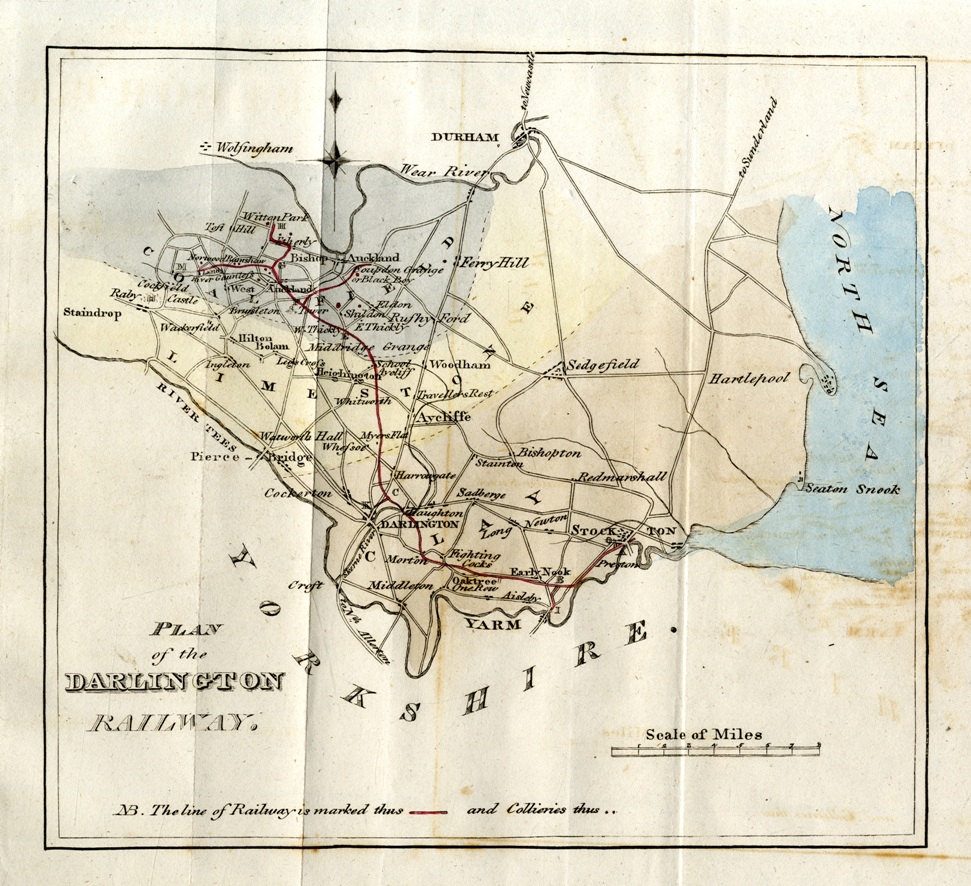
The Stockton and Darlington Railway (S&DR) was a railway company that operated in north-east England from 1825 to 1863. The world's first public railway to use steam locomotives, its first line connected collieries near Shildon with Darlington and Stockton in County Durham, and was officially opened on 27 September 1825. The movement of coal to ships rapidly became a lucrative business, and the line was soon extended to a new port at Middlesbrough. While coal waggons were hauled by steam locomotives from the start, passengers were carried in coaches drawn by horses until carriages hauled by steam locomotives were introduced in 1833.
The S&DR was involved in building the East Coast Main Line between York and Darlington, but its main expansion was at Middlesbrough Docks and west into Weardale and east to Redcar. It suffered severe financial difficulties at the end of the 1840s and was nearly taken over by the York, Newcastle and Berwick Railway, before the discovery of iron ore in Cleveland and the subsequent increase in revenue meant it could pay its debts. At the beginning of the 1860s it took over railways that had crossed the Pennines to join the West Coast Main Line at Tebay and Clifton, near Penrith.
The company was taken over by the North Eastern Railway in 1863, transferring 200 route miles (320 route kilometres) of line and about 160 locomotives, but continued to operate independently as the Darlington Section until 1876. The opening of the S&DR was seen as proof of steam railway effectiveness and its anniversary was celebrated in 1875, 1925 and 1975. Much of the original route is now served by the Tees Valley Line, operated by Northern.
Coal from the inland mines in southern County Durham used to be taken away on packhorses and later on horse-drawn carts as the roads were improved. A canal was proposed by George Dixon in 1767 and again by John Rennie in 1815, but both schemes failed. The harbour of Stockton-on-Tees invested considerably during the early 19th century in straightening the Tees in order to improve navigation on the river downstream of the town and was subsequently looking for ways to increase trade to recoup those costs.
A few years later, a canal was proposed on a route that bypassed Darlington and Yarm, and a meeting was held in Yarm to oppose the route. The Welsh engineer George Overton was consulted, and he advised building a tramroad. Overton carried out a survey and planned a route from the Etherley and Witton Collieries to Shildon, and then passing to the north of Darlington to reach Stockton. The Scottish engineer Robert Stevenson was said to favour the railway, and the Quaker Edward Pease supported it at a public meeting in Darlington on 13 November 1818, promising a five per cent return on investment. Approximately two-thirds of the shares were sold locally, and the rest were bought by Quakers nationally. A private bill was presented to Parliament in March 1819, but as the route passed through Earl of Eldon's estate and one of the Earl of Darlington's fox coverts, it was opposed and defeated by 13 votes.
Overton surveyed a new line that avoided Darlington's estate and agreement was reached with Eldon, but another application was deferred early in 1820, as the death of King George III had made it unlikely a bill would pass that parliamentary year. The promoters lodged a bill on 30 September 1820, the route having changed again as agreement had not been reached with Viscount Barrington about the line passing over his land. The railway was unopposed this time, but the bill nearly failed to enter the committee stage as the required four-fifths of shares had not been sold. Pease subscribed £7,000; from that time he had considerable influence over the railway and it became known as "the Quaker line". The Stockton and Darlington Railway Act 1821 (1 & 2 Geo. 4. c. xliv), which received royal assent on 19 April 1821, allowed for a railway that could be used by anyone with suitably built vehicles on payment of a toll, that was closed at night, and with which land owners within 5 miles (8 km) could build branches and make junctions; no mention was made of steam locomotives. This new railway initiated the construction of more railway lines, causing significant developments in railway mapping and cartography, iron and steel manufacturing, as well as in any industries requiring more efficient transportation.
Concerned about Overton's competence, Pease asked George Stephenson, an experienced enginewright of the collieries of Killingworth, to meet him in Darlington. On 12 May 1821 the shareholders appointed Thomas Meynell as chairman and Jonathan Backhouse as treasurer; a majority of the managing committee, which included Thomas Richardson, Edward Pease and his son Joseph Pease, were Quakers. The committee designed a seal, showing waggons being pulled by a horse, and adopted the Latin motto Periculum privatum utilitas publica ("At private risk for public service"). By 23 July 1821 it had decided that the line would be a railway with edge rails, rather than a plateway, and appointed Stephenson to make a fresh survey of the line. Stephenson recommended using malleable iron rails, even though he owned a share of the patent for the alternative cast iron rails, and both types were used. Stephenson was assisted by his 18-year-old son Robert during the survey, and by the end of 1821 had reported that a usable line could be built within the bounds of the act of Parliament, but another route would be shorter by 3 miles (5 km) and avoid deep cuttings and tunnels. Overton had kept himself available, but had no further involvement and the shareholders elected Stephenson Engineer on 22 January 1822, with a salary of £660 per year. On 23 May 1822 a ceremony in Stockton celebrated the laying of the first track at St John's Well, the rails 4 ft 8 in (1,422 mm) apart, the same gauge used by Stephenson on his Killingworth Railway.
Stephenson advocated the use of steam locomotives on the line. Pease visited Killingworth in mid-1822 and the directors visited Hetton colliery railway, on which Stephenson had introduced steam locomotives. A new bill was presented, requesting Stephenson's deviations from the original route and the use of "loco-motives or moveable engines", and this received royal assent on 23 May 1823 as the Stockton and Darlington Railway Act 1823 (4 Geo. 4. c. xxxiii). The line included embankments up to 48 feet (15 m) high, and Stephenson designed an iron truss bridge to cross the River Gaunless. The Skerne Bridge over the River Skerne was designed by the Durham architect Ignatius Bonomi.
Hub AI
Stockton and Darlington Railway AI simulator
(@Stockton and Darlington Railway_simulator)
Stockton and Darlington Railway
The Stockton and Darlington Railway (S&DR) was a railway company that operated in north-east England from 1825 to 1863. The world's first public railway to use steam locomotives, its first line connected collieries near Shildon with Darlington and Stockton in County Durham, and was officially opened on 27 September 1825. The movement of coal to ships rapidly became a lucrative business, and the line was soon extended to a new port at Middlesbrough. While coal waggons were hauled by steam locomotives from the start, passengers were carried in coaches drawn by horses until carriages hauled by steam locomotives were introduced in 1833.
The S&DR was involved in building the East Coast Main Line between York and Darlington, but its main expansion was at Middlesbrough Docks and west into Weardale and east to Redcar. It suffered severe financial difficulties at the end of the 1840s and was nearly taken over by the York, Newcastle and Berwick Railway, before the discovery of iron ore in Cleveland and the subsequent increase in revenue meant it could pay its debts. At the beginning of the 1860s it took over railways that had crossed the Pennines to join the West Coast Main Line at Tebay and Clifton, near Penrith.
The company was taken over by the North Eastern Railway in 1863, transferring 200 route miles (320 route kilometres) of line and about 160 locomotives, but continued to operate independently as the Darlington Section until 1876. The opening of the S&DR was seen as proof of steam railway effectiveness and its anniversary was celebrated in 1875, 1925 and 1975. Much of the original route is now served by the Tees Valley Line, operated by Northern.
Coal from the inland mines in southern County Durham used to be taken away on packhorses and later on horse-drawn carts as the roads were improved. A canal was proposed by George Dixon in 1767 and again by John Rennie in 1815, but both schemes failed. The harbour of Stockton-on-Tees invested considerably during the early 19th century in straightening the Tees in order to improve navigation on the river downstream of the town and was subsequently looking for ways to increase trade to recoup those costs.
A few years later, a canal was proposed on a route that bypassed Darlington and Yarm, and a meeting was held in Yarm to oppose the route. The Welsh engineer George Overton was consulted, and he advised building a tramroad. Overton carried out a survey and planned a route from the Etherley and Witton Collieries to Shildon, and then passing to the north of Darlington to reach Stockton. The Scottish engineer Robert Stevenson was said to favour the railway, and the Quaker Edward Pease supported it at a public meeting in Darlington on 13 November 1818, promising a five per cent return on investment. Approximately two-thirds of the shares were sold locally, and the rest were bought by Quakers nationally. A private bill was presented to Parliament in March 1819, but as the route passed through Earl of Eldon's estate and one of the Earl of Darlington's fox coverts, it was opposed and defeated by 13 votes.
Overton surveyed a new line that avoided Darlington's estate and agreement was reached with Eldon, but another application was deferred early in 1820, as the death of King George III had made it unlikely a bill would pass that parliamentary year. The promoters lodged a bill on 30 September 1820, the route having changed again as agreement had not been reached with Viscount Barrington about the line passing over his land. The railway was unopposed this time, but the bill nearly failed to enter the committee stage as the required four-fifths of shares had not been sold. Pease subscribed £7,000; from that time he had considerable influence over the railway and it became known as "the Quaker line". The Stockton and Darlington Railway Act 1821 (1 & 2 Geo. 4. c. xliv), which received royal assent on 19 April 1821, allowed for a railway that could be used by anyone with suitably built vehicles on payment of a toll, that was closed at night, and with which land owners within 5 miles (8 km) could build branches and make junctions; no mention was made of steam locomotives. This new railway initiated the construction of more railway lines, causing significant developments in railway mapping and cartography, iron and steel manufacturing, as well as in any industries requiring more efficient transportation.
Concerned about Overton's competence, Pease asked George Stephenson, an experienced enginewright of the collieries of Killingworth, to meet him in Darlington. On 12 May 1821 the shareholders appointed Thomas Meynell as chairman and Jonathan Backhouse as treasurer; a majority of the managing committee, which included Thomas Richardson, Edward Pease and his son Joseph Pease, were Quakers. The committee designed a seal, showing waggons being pulled by a horse, and adopted the Latin motto Periculum privatum utilitas publica ("At private risk for public service"). By 23 July 1821 it had decided that the line would be a railway with edge rails, rather than a plateway, and appointed Stephenson to make a fresh survey of the line. Stephenson recommended using malleable iron rails, even though he owned a share of the patent for the alternative cast iron rails, and both types were used. Stephenson was assisted by his 18-year-old son Robert during the survey, and by the end of 1821 had reported that a usable line could be built within the bounds of the act of Parliament, but another route would be shorter by 3 miles (5 km) and avoid deep cuttings and tunnels. Overton had kept himself available, but had no further involvement and the shareholders elected Stephenson Engineer on 22 January 1822, with a salary of £660 per year. On 23 May 1822 a ceremony in Stockton celebrated the laying of the first track at St John's Well, the rails 4 ft 8 in (1,422 mm) apart, the same gauge used by Stephenson on his Killingworth Railway.
Stephenson advocated the use of steam locomotives on the line. Pease visited Killingworth in mid-1822 and the directors visited Hetton colliery railway, on which Stephenson had introduced steam locomotives. A new bill was presented, requesting Stephenson's deviations from the original route and the use of "loco-motives or moveable engines", and this received royal assent on 23 May 1823 as the Stockton and Darlington Railway Act 1823 (4 Geo. 4. c. xxxiii). The line included embankments up to 48 feet (15 m) high, and Stephenson designed an iron truss bridge to cross the River Gaunless. The Skerne Bridge over the River Skerne was designed by the Durham architect Ignatius Bonomi.
Recent media