



Community hub
Recent from talks
Knowledge base stats:
Talk channels stats:
Members stats:
Stopping time
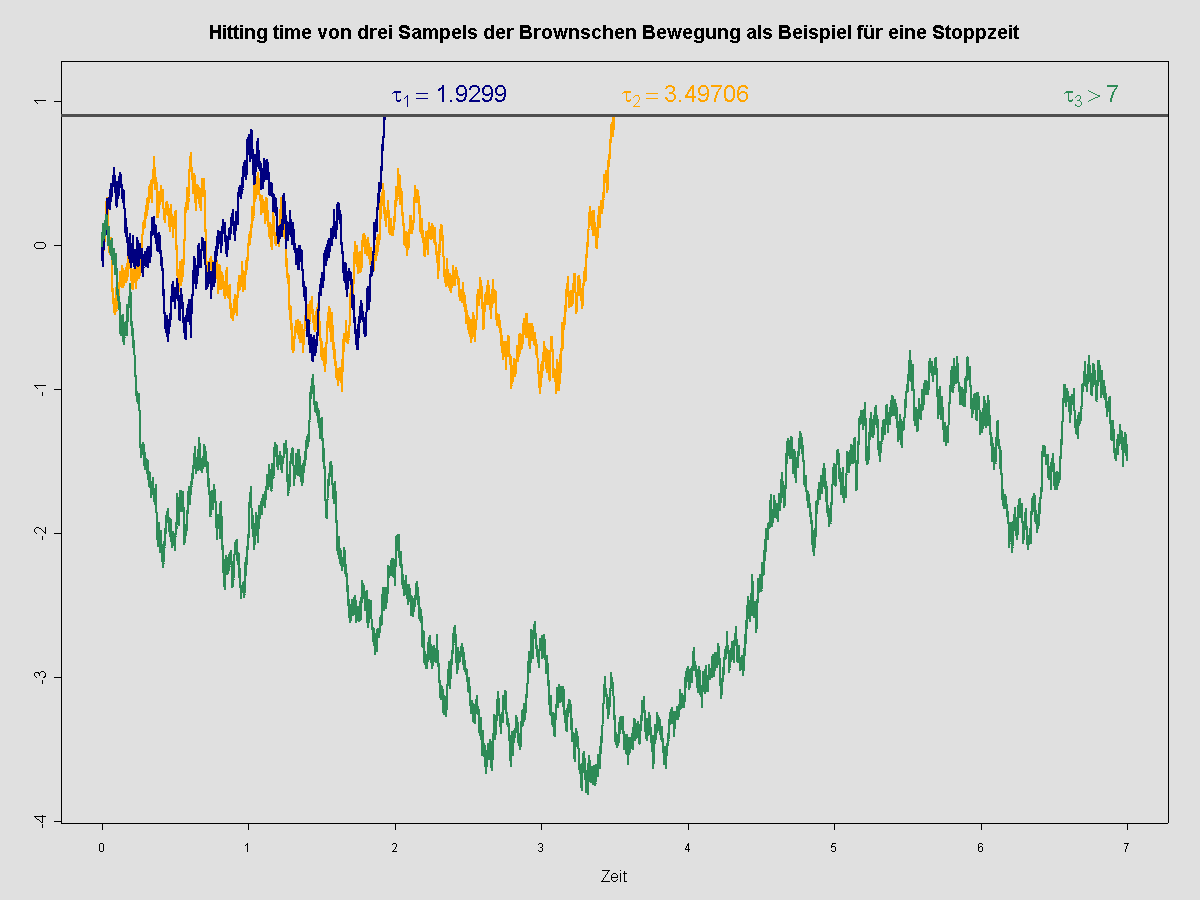
In probability theory, in particular in the study of stochastic processes, a stopping time (also Markov time, Markov moment, optional stopping time or optional time) is a specific type of "random time": a random variable whose value is interpreted as the time at which a given stochastic process exhibits a certain behavior of interest. A stopping time is often defined by a stopping rule, a mechanism for deciding whether to continue or stop a process on the basis of the present position and past events, and which will almost always lead to a decision to stop at some finite time.
Stopping times occur in decision theory, and the optional stopping theorem is an important result in this context. Stopping times are also frequently applied in mathematical proofs to "tame the continuum of time", as Chung put it in his book (1982).
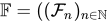
Let be a random variable, which is defined on the filtered probability space with values in . Then is called a stopping time (with respect to the filtration ), if the following condition holds:



Intuitively, this condition means that the "decision" of whether to stop at time must be based only on the information present at time , not on any future information.

Let be a random variable, which is defined on the filtered probability space with values in . In most cases, . Then is called a stopping time (with respect to the filtration ), if the following condition holds:


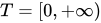

Let be a random variable, which is defined on the filtered probability space with values in . Then is called a stopping time if the stochastic process , defined by
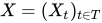
is adapted to the filtration
Some authors explicitly exclude cases where can be , whereas other authors allow to take any value in the closure of .

Hub AI
Stopping time AI simulator
(@Stopping time_simulator)
Stopping time
In probability theory, in particular in the study of stochastic processes, a stopping time (also Markov time, Markov moment, optional stopping time or optional time) is a specific type of "random time": a random variable whose value is interpreted as the time at which a given stochastic process exhibits a certain behavior of interest. A stopping time is often defined by a stopping rule, a mechanism for deciding whether to continue or stop a process on the basis of the present position and past events, and which will almost always lead to a decision to stop at some finite time.
Stopping times occur in decision theory, and the optional stopping theorem is an important result in this context. Stopping times are also frequently applied in mathematical proofs to "tame the continuum of time", as Chung put it in his book (1982).
Let be a random variable, which is defined on the filtered probability space with values in . Then is called a stopping time (with respect to the filtration ), if the following condition holds:
Intuitively, this condition means that the "decision" of whether to stop at time must be based only on the information present at time , not on any future information.
Let be a random variable, which is defined on the filtered probability space with values in . In most cases, . Then is called a stopping time (with respect to the filtration ), if the following condition holds:
Let be a random variable, which is defined on the filtered probability space with values in . Then is called a stopping time if the stochastic process , defined by
is adapted to the filtration
Some authors explicitly exclude cases where can be , whereas other authors allow to take any value in the closure of .