Hubbry Logo
search
logo
2097362

Stopping time

logo
Community Hub0 Subscribers
Read side by side
from Wikipedia
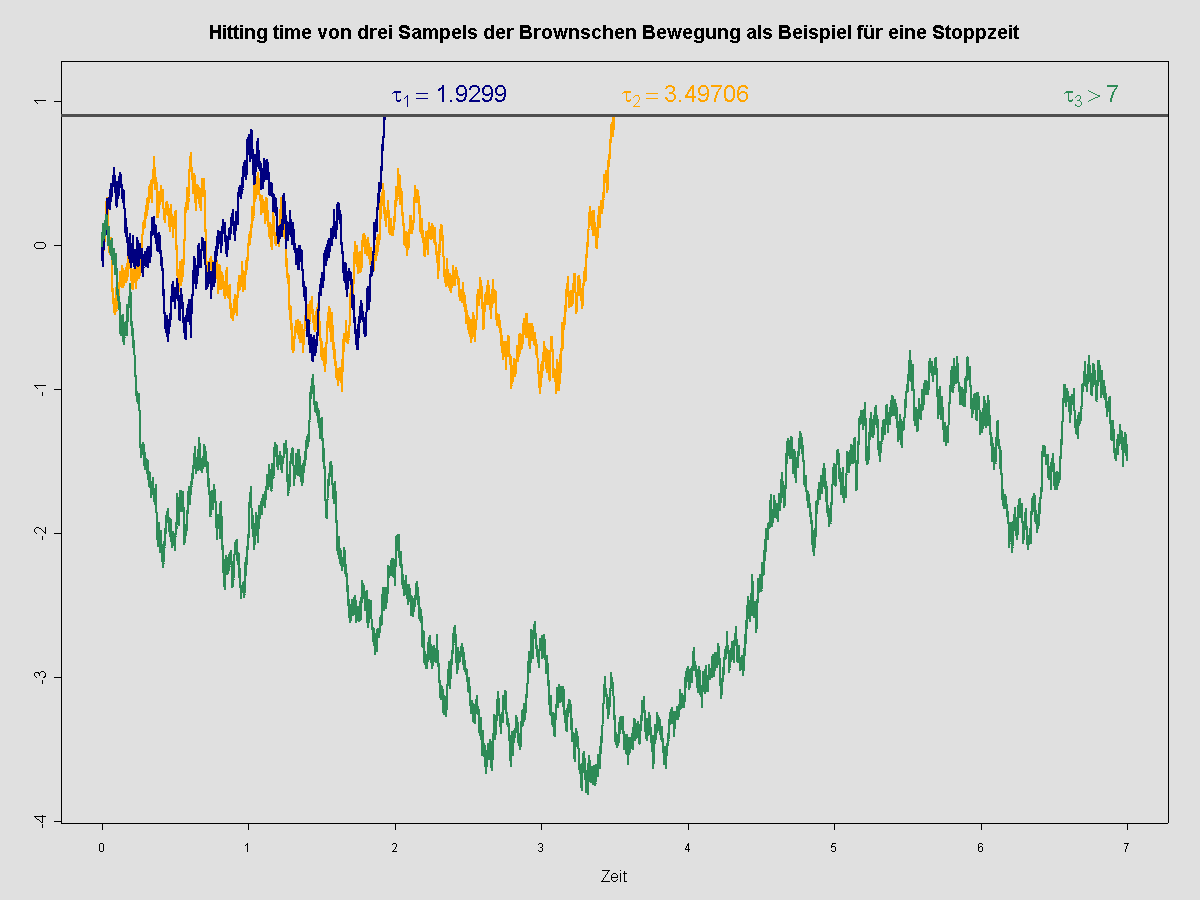
Example of a stopping time: a hitting time of Brownian motion. The process starts at 0 and is stopped as soon as it hits 1.

In probability theory, in particular in the study of stochastic processes, a stopping time (also Markov time, Markov moment, optional stopping time or optional time[1]) is a specific type of "random time": a random variable whose value is interpreted as the time at which a given stochastic process exhibits a certain behavior of interest. A stopping time is often defined by a stopping rule, a mechanism for deciding whether to continue or stop a process on the basis of the present position and past events, and which will almost always lead to a decision to stop at some finite time.

Stopping times occur in decision theory, and the optional stopping theorem is an important result in this context. Stopping times are also frequently applied in mathematical proofs to "tame the continuum of time", as Chung put it in his book (1982).

Definition

[edit]

Discrete time

[edit]

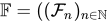
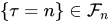
Let be a random variable, which is defined on the filtered probability space with values in . Then is called a stopping time (with respect to the filtration ), if the following condition holds:


for all

Intuitively, this condition means that the "decision" of whether to stop at time must be based only on the information present at time , not on any future information.

General case

[edit]

Let be a random variable, which is defined on the filtered probability space with values in . In most cases, . Then is called a stopping time (with respect to the filtration ), if the following condition holds:

for all

As adapted process

[edit]

Let be a random variable, which is defined on the filtered probability space with values in . Then is called a stopping time if the stochastic process , defined by
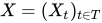
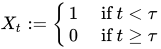
is adapted to the filtration

Comments

[edit]

Some authors explicitly exclude cases where can be , whereas other authors allow to take any value in the closure of .

Examples

[edit]

To illustrate some examples of random times that are stopping rules and some that are not, consider a gambler playing roulette with a typical house edge, starting with $100 and betting $1 on red in each game:

  • Playing exactly five games corresponds to the stopping time τ = 5, and is a stopping rule.
  • Playing until they either run out of money or have played 500 games is a stopping rule.
  • Playing until they obtain the maximum amount ahead they will ever be is not a stopping rule and does not provide a stopping time, as it requires information about the future as well as the present and past.
  • Playing until they either double their money or run out of money is a stopping rule, even though there is potentially no limit to the number of games they play, but the probability that they stop in a finite time is 1.

To illustrate the more general definition of stopping time, consider Brownian motion, which is a stochastic process , where each is a random variable defined on the probability space . We define a filtration on this probability space by letting be the σ-algebra generated by all the sets of the form where and is a Borel set. Intuitively, an event E is in if and only if we can determine whether E is true or false just by observing the Brownian motion from time 0 to time t.

  • Every constant is (trivially) a stopping time; it corresponds to the stopping rule "stop at time ".
  • Let Then is a stopping time for Brownian motion, corresponding to the stopping rule: "stop as soon as the Brownian motion hits the value a."
  • Another stopping time is given by . It corresponds to the stopping rule "stop as soon as the Brownian motion has been positive over a contiguous stretch of length 1 time unit."
  • In general, if τ1 and τ2 are stopping times on then their minimum , their maximum , and their sum τ1 + τ2 are also stopping times. (This is not true for differences and products, because these may require "looking into the future" to determine when to stop.)

Hitting times like the second example above can be important examples of stopping times. While it is relatively straightforward to show that essentially all stopping times are hitting times,[2] it can be much more difficult to show that a certain hitting time is a stopping time. The latter types of results are known as the Début theorem.

Localization

[edit]

Stopping times are frequently used to generalize certain properties of stochastic processes to situations in which the required property is satisfied in only a local sense. First, if X is a process and τ is a stopping time, then Xτ is used to denote the process X stopped at time τ.
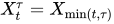
Then, X is said to locally satisfy some property P if there exists a sequence of stopping times τn, which increases to infinity and for which the processes

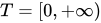
satisfy property P. Common examples, with time index set I = [0, ∞), are as follows:

Local martingale process. A process X is a local martingale if it is càdlàg[clarification needed] and there exists a sequence of stopping times τn increasing to infinity, such that

is a martingale for each n.

Locally integrable process. A non-negative and increasing process X is locally integrable if there exists a sequence of stopping times τn increasing to infinity, such that

for each n.

Types of stopping times

[edit]

Stopping times, with time index set I = [0,∞), are often divided into one of several types depending on whether it is possible to predict when they are about to occur.

A stopping time τ is predictable if it is equal to the limit of an increasing sequence of stopping times τn satisfying τn < τ whenever τ > 0. The sequence τn is said to announce τ, and predictable stopping times are sometimes known as announceable. Examples of predictable stopping times are hitting times of continuous and adapted processes. If τ is the first time at which a continuous and real valued process X is equal to some value a, then it is announced by the sequence τn, where τn is the first time at which X is within a distance of 1/n of a.

Accessible stopping times are those that can be covered by a sequence of predictable times. That is, stopping time τ is accessible if, P(τ = τn for some n) = 1, where τn are predictable times.

A stopping time τ is totally inaccessible if it can never be announced by an increasing sequence of stopping times. Equivalently, P(τ = σ < ∞) = 0 for every predictable time σ. Examples of totally inaccessible stopping times include the jump times of Poisson processes.

Every stopping time τ can be uniquely decomposed into an accessible and totally inaccessible time. That is, there exists a unique accessible stopping time σ and totally inaccessible time υ such that τ = σ whenever σ < ∞, τ = υ whenever υ < ∞, and τ = ∞ whenever σ = υ = ∞. Note that in the statement of this decomposition result, stopping times do not have to be almost surely finite, and can equal ∞.

Stopping rules in clinical trials

[edit]

Clinical trials in medicine often perform interim analysis, in order to determine whether the trial has already met its endpoints. However, interim analysis create the risk of false-positive results, and therefore stopping boundaries are used to determine the number and timing of interim analysis (also known as alpha-spending, to denote the rate of false positives). At each of R interim tests, the trial is stopped if the likelihood is below a threshold p, which depends on the method used. See Sequential analysis.

See also

[edit]

References

[edit]

Further reading

[edit]
Revisions and contributorsEdit on WikipediaRead on Wikipedia
from Grokipedia
In probability theory and stochastic processes, a stopping time (also known as an optional time or Markov time) is a type of random time associated with a filtered probability space (Ω,F,(Ft)t0,P)(\Omega, \mathcal{F}, (\mathcal{F}_t)_{t \geq 0}, P), where the occurrence of the time is adapted to the filtration, meaning it depends only on information available up to that point without anticipating the future. In the discrete-time case, it is a non-negative integer-valued random variable τ\tau such that {τ=n}Fn\{\tau = n\} \in \mathcal{F}_n for each n0n \geq 0; in continuous time, {τt}Ft\{\tau \leq t\} \in \mathcal{F}_t for each t0t \geq 0.[1][2] This ensures stopping times model realistic decision processes in random environments, such as first passage times τ=min{n0:XnA}\tau = \min\{n \geq 0 : X_n \in A\} (discrete) or analogous infima in continuous settings, and hitting times in Markov chains.[2] Filtrations (Ft)t0(\mathcal{F}_t)_{t \geq 0} form an increasing family of σ\sigma-algebras representing accumulating information, with F0FsFtF\mathcal{F}_0 \subseteq \mathcal{F}_s \subseteq \mathcal{F}_t \subseteq \cdots \subseteq \mathcal{F} for s<ts < t. Key properties include: if τ\tau is a stopping time, then so are {τt}\{\tau \leq t\} and the supremum or infimum of a sequence of stopping times; for stopping times STS \leq T, FSFT\mathcal{F}_S \subseteq \mathcal{F}_T. These enable composition in stochastic models.[1][2] Stopping times are central to martingale theory, where the optional stopping theorem preserves expectations under conditions like bounded increments or E[τ]<E[\tau] < \infty, aiding convergence proofs and gambling fairness. Wald's equation for i.i.d. {Xn}\{X_n\} with finite mean E(X)E(X) and finite E(τ)E(\tau) gives E(n=1τXn)=E(τ)E(X)E\left(\sum_{n=1}^\tau X_n\right) = E(\tau) E(X), with uses in renewal theory and risk assessment.[2][1] Applications include optimal stopping in finance (e.g., asset selling decisions), sequential testing in statistics, queueing theory for buffer exit times, and Markov chain analysis via the strong Markov property, where the process restarts independently post-τ\tau. These tools address uncertainty in operations research, economics, and physics.[3][1][4]

Definitions

Discrete Time

In discrete time, a filtration is defined as an increasing sequence of σ-algebras {Fn}n0\{\mathcal{F}_n\}_{n \geq 0} on a probability space (Ω,F,P)(\Omega, \mathcal{F}, P), where FnFn+1\mathcal{F}_n \subseteq \mathcal{F}_{n+1} for all nn, representing the progressively available information up to time nn.[5] A stopping time τ\tau with respect to this filtration is a random variable taking values in the extended non-negative integers {0,1,2,}{}\{0, 1, 2, \dots\} \cup \{\infty\} such that, for every n0n \geq 0, the event {τn}\{\tau \leq n\} belongs to Fn\mathcal{F}_n. This formulation, originating in the foundational work of Doob, captures the idea that the decision to stop by time nn depends only on the information revealed up to that time, without anticipating future outcomes.[6][1] An equivalent characterization is that {τ=n}Fn\{\tau = n\} \in \mathcal{F}_n for all n0n \geq 0. This follows directly from the increasing property of the filtration, as {τ=n}={τn}{τn1}\{\tau = n\} = \{\tau \leq n\} \setminus \{\tau \leq n-1\} (with the convention that {τ1}=\{\tau \leq -1\} = \emptyset), so each exact stopping event at nn is Fn\mathcal{F}_n-measurable.[5][1] Stopping times may attain the value \infty with positive probability, allowing for the possibility that stopping never occurs. However, in many theoretical contexts, such as the analysis of martingales or optional sampling theorems, it is standard to assume P(τ<)=1P(\tau < \infty) = 1, ensuring that stopping happens almost surely in finite time.[5][1] The defining condition guarantees that τ\tau is "decided" using only information up to time nn: on the event {τ=n}\{\tau = n\}, which is Fn\mathcal{F}_n-measurable, the realization of τ\tau requires no knowledge beyond Fn\mathcal{F}_n, as the complement {τ>n}=Ω{τn}\{\tau > n\} = \Omega \setminus \{\tau \leq n\} is also Fn\mathcal{F}_n-measurable. This adaptivity is evident in the construction of stopped processes, where indicators like 1{τn}1_{\{\tau \leq n\}} remain Fn\mathcal{F}_n-measurable.[1]

Continuous Time

In continuous-time stochastic processes, the underlying probability space is equipped with a filtration (Ft)t0(\mathcal{F}_t)_{t \geq 0}, which is an increasing family of sub-σ-algebras of the overall σ-algebra F\mathcal{F} on Ω\Omega, representing the evolution of available information over time. This filtration is typically assumed to be right-continuous, satisfying Ft=s>tFs\mathcal{F}_t = \bigcap_{s > t} \mathcal{F}_s for each t0t \geq 0, along with completeness (augmented by null sets). Right-continuity ensures that the filtration includes all limits of events from times approaching tt from the right, which is crucial for measurability properties in uncountable time indices.[7] A stopping time τ:Ω[0,]\tau: \Omega \to [0, \infty] with respect to the filtration (Ft)t0(\mathcal{F}_t)_{t \geq 0} is formally defined as a measurable random variable such that, for every t0t \geq 0, the event {τt}\{\tau \leq t\} belongs to Ft\mathcal{F}_t. This condition implies that the decision to stop by time tt can be determined using only the information available up to tt. Unlike in the discrete-time setting, where the events {τt}\{\tau \leq t\} and {τ<t+1}\{\tau < t+1\} coincide, in continuous time the event {τ<t}\{\tau < t\} generally does not belong to Ft\mathcal{F}_t, although {τt}\{\tau \leq t\} does; this distinction arises due to the density of the time index and requires careful handling in proofs of measurability.[7] Stopping times in continuous time are intimately related to the debut (or first entrance time) of progressive sets. A process A=(At)t0A = (A_t)_{t \geq 0} with values in {0,1} is progressive with respect to (Ft)(\mathcal{F}_t) if, for each t0t \geq 0, the map (s,ω)1As(ω)(s, \omega) \mapsto 1_{A_s}(\omega) from [0,t]×Ω[0,t] \times \Omega to R\mathbb{R} is measurable with respect to the product σ-algebra B([0,t])Ft\mathcal{B}([0,t]) \otimes \mathcal{F}_t. The debut of such a set is defined as D(A)(ω)=inf{t0:ωAt}D(A)(\omega) = \inf\{t \geq 0 : \omega \in A_t\} (with the convention inf=\inf \emptyset = \infty), and the debut theorem states that D(A)D(A) is a stopping time whenever AA is progressive. Conversely, every stopping time τ\tau is the debut of the progressive set {(τt)}t0\{ (\tau \leq t) \}_{t \geq 0}. This characterization highlights why progressive measurability is essential for defining hitting times or first passage times as stopping times in continuous time.[7] Many fundamental results on stopping times, such as those involving optional projections or martingale properties, assume that τ\tau is almost surely finite, meaning P(τ<)=1P(\tau < \infty) = 1. Without this, τ\tau may take the value \infty on a set of positive probability, complicating compositions with processes. Moreover, right-continuity of the filtration is necessary to guarantee that debuts of progressive sets are indeed stopping times; without it, measurability can fail for certain pathological sets. For instance, in non-right-continuous filtrations, the event {τt}\{\tau \leq t\} might not capture all relevant information at tt, leading to inconsistencies in stochastic calculus applications.[7]

Adapted Process Formulation

In the framework of stochastic processes, a process X=(Xt)t0X = (X_t)_{t \geq 0} is adapted to a filtration (Ft)t0(\mathcal{F}_t)_{t \geq 0} if, for each t0t \geq 0, the random variable XtX_t is Ft\mathcal{F}_t-measurable.[8] This adaptation ensures that the information revealed by the process up to time tt is contained within the sigma-algebra Ft\mathcal{F}_t, reflecting the progressive revelation of uncertainty in the underlying probability space. Stopping times can be reformulated in terms of adapted processes as the first instant at which the process satisfies a specified condition relative to the filtration. For an adapted process XX and a Borel set CC in the state space, a prototypical example is the first exit time τ=inf{t0:XtC}\tau = \inf\{t \geq 0 : X_t \notin C\}, where τ\tau inherits the stopping time property from the adaptedness of XX and the measurability of CC.[9] This formulation underscores the decision-making aspect of stopping times, as the exit event {XtC}\{X_t \notin C\} is Ft\mathcal{F}_t-measurable for each tt, allowing decisions to be based solely on information available up to that time. Associated with a stopping time τ\tau, the stopped process Xτ=(Xtτ)t0X^\tau = (X^\tau_t)_{t \geq 0} is defined by Xtτ=XtτX^\tau_t = X_{t \wedge \tau}, where ab=min(a,b)a \wedge b = \min(a, b). This construction preserves adaptedness to the filtration (Ft)(\mathcal{F}_t), as the minimum tτt \wedge \tau ensures that XtτX^\tau_t depends only on information up to time tt.[9] The stopped process effectively freezes the evolution of XX at τ\tau, facilitating analysis of behavior before and after the random stopping event without introducing extraneous information. A key structure induced by τ\tau is the sigma-algebra Fτ={AF:A{τt}Ft t0}\mathcal{F}_\tau = \{A \in \mathcal{F}_\infty : A \cap \{\tau \leq t\} \in \mathcal{F}_t \ \forall t \geq 0\}, where F=t0Ft\mathcal{F}_\infty = \bigvee_{t \geq 0} \mathcal{F}_t. This sigma-algebra captures the events observable precisely at the random time τ\tau, serving as the appropriate refinement of the terminal sigma-algebra F\mathcal{F}_\infty for conditioning at irregular times.[8][9] It enables the well-defined conditional expectation E[ZFτ]\mathbb{E}[Z \mid \mathcal{F}_\tau] for any integrable random variable ZZ that is F\mathcal{F}_\infty-measurable, which is crucial for theorems involving expectations halted at stopping times.[9] The family of sigma-algebras {Fτ}\{\mathcal{F}_\tau\} exhibits monotonicity: if τ1τ2\tau_1 \leq \tau_2 almost surely, then Fτ1Fτ2\mathcal{F}_{\tau_1} \subseteq \mathcal{F}_{\tau_2}. This increasing property allows for the construction of "stopped" filtrations, where the information structure respects the ordering of stopping times and supports sequential decision frameworks in stochastic models.[9][10]

Properties

Basic Closure Properties

The set of stopping times is closed under various operations, ensuring flexibility in constructing new stopping times from existing ones. Constant times c0c \geq 0 (deterministic) are stopping times, as {c=t}Ft\{c = t\} \in \mathcal{F}_t for tct \geq c and empty otherwise. If τ\tau and σ\sigma are stopping times, then their minimum τσ=min(τ,σ)\tau \wedge \sigma = \min(\tau, \sigma) and maximum τσ=max(τ,σ)\tau \vee \sigma = \max(\tau, \sigma) are also stopping times. Similarly, τn\tau \wedge n for fixed nn is a stopping time. For a sequence of stopping times (τk)k1(\tau_k)_{k \geq 1}, the pointwise infimum infkτk\inf_k \tau_k and supremum supkτk\sup_k \tau_k are stopping times, provided the filtration is right-continuous in continuous time. Additionally, if STS \leq T almost surely are stopping times, then the generated σ\sigma-algebra FSFT\mathcal{F}_S \subseteq \mathcal{F}_T, maintaining the adapted, non-anticipating structure.[11][1] These closure properties allow composition and limits of stopping times, foundational for modeling complex decision processes in stochastic settings.

Localization

In stochastic processes, localization extends theorems or properties that hold for bounded stopping times to unbounded ones. For an unbounded stopping time τ\tau, a localizing sequence of stopping times (τn)n1(\tau_n)_{n \geq 1} is constructed such that τnτ\tau_n \uparrow \tau (or \infty) almost surely, typically defined as τn=τn\tau_n = \tau \wedge n. This sequence bounds τ\tau progressively, controlling potential issues like infinite expectations or divergence.[12][13] A property holds locally for τ\tau if it holds for each bounded ττn\tau \wedge \tau_n almost surely. If a theorem (e.g., optional sampling) applies to bounded stopping times with respect to a right-continuous filtration, it extends to unbounded τ\tau via localization, under conditions like the filtration's completeness or uniform integrability of the underlying process. This propagates results such as martingale expectations at τ\tau without global boundedness.[12] The importance of localization for stopping times lies in handling unbounded cases rigorously, avoiding failures in convergence or integration. For example, in the optional stopping theorem for martingales, bounded approximations τn\tau \wedge n preserve E[Mτn]=E[M0]E[M_{\tau \wedge n}] = E[M_0], and under uniform integrability, the limit E[Mτ]=E[M0]E[M_\tau] = E[M_0] holds as nn \to \infty. This technique is crucial in stochastic calculus for unbounded domains.[12][14]

Boundedness and Unboundedness

A stopping time τ\tau is bounded if there exists a finite constant M<M < \infty such that τM\tau \leq M almost surely; otherwise, it is unbounded.[15] For a bounded stopping time τ\tau, the expectation E[τ]E[\tau] is automatically finite, since τ\tau takes values in a finite interval with probability 1. Additionally, the event {τt}\{\tau \leq t\} belongs to the filtration Ft\mathcal{F}_t for all tMt \geq M, which simplifies the measurability conditions inherent to the definition of stopping times. This boundedness ensures that optional sampling theorems apply directly without further restrictions; for instance, if XX is a martingale, then E[Xτ]=E[X0]E[X_\tau] = E[X_0].[15][16] Unbounded stopping times τ\tau may have E[τ]=E[\tau] = \infty, even if τ<\tau < \infty almost surely (e.g., due to heavy-tailed distributions). However, in many applications, it is assumed that P(τ<)=1P(\tau < \infty) = 1, meaning τ\tau is almost surely finite, which ensures the stopped process XτtX_{\tau \wedge t} is well-defined for all t>0t > 0. Almost sure finiteness is a key condition for extending results like optional sampling to unbounded cases, often requiring supplementary assumptions such as uniform integrability of the martingale or bounded increments.[17][16][15] A fundamental convergence property holds for sequences of bounded stopping times: if τn\tau_n is an increasing sequence of bounded stopping times converging to τ\tau, and the filtration is right-continuous, then the associated σ\sigma-algebras satisfy FτnFτ\mathcal{F}_{\tau_n} \uparrow \mathcal{F}_\tau. This monotonicity of filtrations facilitates the analysis of limits in stochastic processes.[18] Bounded stopping times play a central role in theorems where uniform integrability is readily satisfied, allowing straightforward application of martingale convergence results. For unbounded stopping times, more advanced tools are necessary, such as Doob's upcrossing inequality, which bounds the expected number of upcrossings of an interval by a supermartingale and enables almost sure convergence under L1L^1-boundedness, or localization techniques to reduce to bounded approximations.[18][19]

Examples

[Category header - no content]

Basic Stochastic Process Examples

Basic examples illustrate stopping times in simple stochastic processes, such as a symmetric random walk on integers where τ=min{n0:Sn=a}\tau = \min\{n \geq 0: S_n = a\} for a>0a > 0 stops upon reaching level aa. This τ\tau qualifies as a stopping time because {τ=n}\{\tau = n\} depends only on the path up to nn, verifiable from the filtration Fn=σ(S0,,Sn)\mathcal{F}_n = \sigma(S_0, \dots, S_n). Such examples highlight how stopping rules adapt to observed outcomes without foresight.[1][20] In Poisson processes, the first event time τ=inf{t>0:Nt1}\tau = \inf\{t > 0: N_t \geq 1\} serves as a stopping time, with {τt}={Nt1}Ft\{\tau \leq t\} = \{N_t \geq 1\} \in \mathcal{F}_t. This demonstrates exponential waiting times as fundamental cases, where the stopping decision aligns with the natural filtration of jumps. Discrete analogs include gambler's ruin, stopping at bankruptcy or target fortune.[11][21] These examples underscore accessibility: the event of stopping is Ft\mathcal{F}_t-measurable, enabling integration with martingale theory for expectation preservation. High-impact contributions, like Doob's foundational definitions, rely on such constructions to build broader theory.[22]

Hitting Times

Hitting times, defined as τA=inf{t0:XtA}\tau_A = \inf\{t \geq 0: X_t \in A\} for a set AA and process XX, are canonical stopping times when AA is closed, as {τAt}=st{XsA}Ft\{\tau_A \leq t\} = \bigcup_{s \leq t} \{X_s \in A\} \in \mathcal{F}_t. For Brownian motion, the first hitting time to a level b>0b > 0 follows a Lévy distribution, illustrating continuous-path properties.[23] In Markov chains, hitting times to absorbing states model absorption probabilities, solvable via first-step analysis: hi=P(τA<X0=i)h_i = \mathbb{P}(\tau_A < \infty | X_0 = i) satisfies linear equations from transitions. Exit times from intervals, like τ=inf{n:Sn(0,a)}\tau = \inf\{n: S_n \notin (0,a)\} in random walks, exemplify bounded cases if the process is recurrent.[24][25] Hitting times drive applications in diffusion processes, where Wald's identities compute expectations under optional stopping. Seminal papers by Lévy on Brownian hitting times establish scaling laws, such as E[τb]=\mathbb{E}[\tau_b] = \infty for one-dimensional Brownian motion hitting b0b \neq 0. These examples distinguish hitting from non-stopping times like last exits, which require future information.[26][27]

Applications

[Category header - no content]

Clinical Trials

In clinical trials, stopping times enable sequential monitoring, halting recruitment when efficacy or futility thresholds are crossed, as in group sequential designs by Pocock or O'Brien-Fleming boundaries. For example, the Lan-DeMets alpha-spending function approximates these, allowing early termination if interim p-values fall below adjusted limits, balancing type I error.[28][29] Futility stopping occurs when conditional power drops below 20%, computed from interim data, preventing resource waste on ineffective treatments. Safety stopping rules trigger if adverse events exceed predefined rates, often using exact binomial tests. The CHARM trial exemplifies stringent thresholds (p < 0.0001 early on) for benefit stopping, ensuring robust evidence.[30][31] These applications draw from martingale theory, where cumulative statistics form martingales stopped at boundaries, preserving overall significance levels. Influential guidelines from ICH harmonized principles mandate such rules in licensure trials, prioritizing patient safety and efficiency. Early stopping for benefit risks overestimation, mitigated by conservative boundaries in high-impact studies.[32][33]

Martingale Theory

Stopping times are central to martingale theory via the optional stopping theorem, stating that for a martingale MtM_t and bounded stopping time τ\tau, E[Mτ]=E[M0]\mathbb{E}[M_\tau] = \mathbb{E}[M_0], preserving the martingale property at random horizons. Extensions to unbounded times require uniform integrability, as in Doob's theorem for submartingales.[34][35] In discrete time, the theorem applies to fair games, showing no gain from stopping strategies, exemplified by gambler's ruin where fortune at ruin equals initial stake in expectation. Continuous-time versions handle diffusions, with stopped processes M~t=Mtτ\tilde{M}_t = M_{t \wedge \tau} remaining martingales.[15][36] Applications include Wald's sequential probability ratio test, stopping upon crossing log-likelihood boundaries, yielding optimal error rates. Seminal contributions by Doob (1953) formalize these, influencing stochastic control and finance via risk-neutral pricing. The theorem's conditions—bounded expectation or finite moments—ensure applicability without bias from premature stopping.[37][38]

Types

Stopping times are classified into accessible and totally inaccessible types, with predictable stopping times forming an important subclass of accessible ones. Accessible stopping times are those that can be announced by a sequence of predictable stopping times converging to them almost surely.

Predictable Stopping Times

Predictable stopping times are those announced by an increasing sequence of stopping times τnτ\tau_n \uparrow \tau almost surely, allowing prediction just before occurrence: {τ=t}Ft\{\tau = t\} \in \mathcal{F}_{t-} for discrete times, or via left-continuous adapted processes in continuous settings. Examples include deterministic times t0t_0 or first jumps in predictable compensators.[39][40] In filtration theory, predictability implies the stochastic interval ([τ,))([\tau, \infty)) is predictable, enabling decomposition of integrals over predictable sets. For predictable finite variation processes, jumps occur only at predictable times, contrasting with inaccessible ones. Doob-Meyer decomposition relies on this for compensators of submartingales.[41][42] These times facilitate optional sampling without accessibility issues, as in announced stopping rules like fixed horizons. High-impact work by Dellacherie and Meyer classifies them within progressive enlargements, essential for credit risk modeling where default is predictable via intensity processes.[43][2]

Totally Inaccessible Stopping Times

Totally inaccessible stopping times defy prediction, satisfying P(τ=σ<)=0\mathbb{P}(\tau = \sigma < \infty) = 0 for any predictable σ\sigma, with no announcing sequence converging without equality. The first jump of a Poisson process exemplifies this, as jumps arrive unexpectedly relative to the natural filtration.[39][44] In continuous-time, they decompose general stopping times via the accessible part (predictable) and totally inaccessible part, as in the Dellacherie-Meyer theorem, which decomposes the graph of any stopping time τ\tau into disjoint accessible and totally inaccessible parts, equivalently partitioning {τ<}\{\tau < \infty\} such that τ\tau coincides with an accessible stopping time on the accessible part and with a totally inaccessible one on the inaccessible part. Jumps at such times drive martingale discontinuities, with compensators zero on predictable parts.[45][9] Applications include honest times in enlargement of filtrations, where immersion holds if inaccessibility is total. Seminal results by Jeulin and Yor link them to last passage times, impacting volatility models in finance where sudden shocks are inaccessible. The dichotomy ensures exhaustive classification, with probability measures singular on accessible vs. inaccessible sets.[46][47]

References

User Avatar
No comments yet.