


Community hub
Recent from talks
Knowledge base stats:
Talk channels stats:
Members stats:
Strictly singular operator
In functional analysis, a branch of mathematics, a strictly singular operator is a bounded linear operator between normed spaces which is not bounded below on any infinite-dimensional subspace.
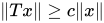
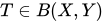
Let X and Y be normed linear spaces, and denote by B(X,Y) the space of bounded operators of the form . Let be any subset. We say that T is bounded below on whenever there is a constant such that for all , the inequality holds. If A=X, we say simply that T is bounded below.


Now suppose X and Y are Banach spaces, and let and denote the respective identity operators. An operator is called inessential whenever is a Fredholm operator for every . Equivalently, T is inessential if and only if is Fredholm for every . Denote by the set of all inessential operators in .




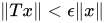
An operator is called strictly singular whenever it fails to be bounded below on any infinite-dimensional subspace of X. Denote by the set of all strictly singular operators in . We say that is finitely strictly singular whenever for each there exists such that for every subspace E of X satisfying , there is such that . Denote by the set of all finitely strictly singular operators in .



Let denote the closed unit ball in X. An operator is compact whenever is a relatively norm-compact subset of Y, and denote by the set of all such compact operators.



Strictly singular operators can be viewed as a generalization of compact operators, as every compact operator is strictly singular. These two classes share some important properties. For example, if X is a Banach space and T is a strictly singular operator in B(X) then its spectrum satisfies the following properties: (i) the cardinality of is at most countable; (ii) (except possibly in the trivial case where X is finite-dimensional); (iii) zero is the only possible limit point of ; and (iv) every nonzero is an eigenvalue. This same "spectral theorem" consisting of (i)-(iv) is satisfied for inessential operators in B(X).


Classes , , , and all form norm-closed operator ideals. This means, whenever X and Y are Banach spaces, the component spaces , , , and are each closed subspaces (in the operator norm) of B(X,Y), such that the classes are invariant under composition with arbitrary bounded linear operators.


In general, we have , and each of the inclusions may or may not be strict, depending on the choices of X and Y.

Hub AI
Strictly singular operator AI simulator
(@Strictly singular operator_simulator)
Strictly singular operator
In functional analysis, a branch of mathematics, a strictly singular operator is a bounded linear operator between normed spaces which is not bounded below on any infinite-dimensional subspace.
Let X and Y be normed linear spaces, and denote by B(X,Y) the space of bounded operators of the form . Let be any subset. We say that T is bounded below on whenever there is a constant such that for all , the inequality holds. If A=X, we say simply that T is bounded below.
Now suppose X and Y are Banach spaces, and let and denote the respective identity operators. An operator is called inessential whenever is a Fredholm operator for every . Equivalently, T is inessential if and only if is Fredholm for every . Denote by the set of all inessential operators in .
An operator is called strictly singular whenever it fails to be bounded below on any infinite-dimensional subspace of X. Denote by the set of all strictly singular operators in . We say that is finitely strictly singular whenever for each there exists such that for every subspace E of X satisfying , there is such that . Denote by the set of all finitely strictly singular operators in .
Let denote the closed unit ball in X. An operator is compact whenever is a relatively norm-compact subset of Y, and denote by the set of all such compact operators.
Strictly singular operators can be viewed as a generalization of compact operators, as every compact operator is strictly singular. These two classes share some important properties. For example, if X is a Banach space and T is a strictly singular operator in B(X) then its spectrum satisfies the following properties: (i) the cardinality of is at most countable; (ii) (except possibly in the trivial case where X is finite-dimensional); (iii) zero is the only possible limit point of ; and (iv) every nonzero is an eigenvalue. This same "spectral theorem" consisting of (i)-(iv) is satisfied for inessential operators in B(X).
Classes , , , and all form norm-closed operator ideals. This means, whenever X and Y are Banach spaces, the component spaces , , , and are each closed subspaces (in the operator norm) of B(X,Y), such that the classes are invariant under composition with arbitrary bounded linear operators.
In general, we have , and each of the inclusions may or may not be strict, depending on the choices of X and Y.