Hubbry Logo
Compact operatorCompact operatorMain
Open search
Compact operator
Community hub
Compact operator
logo
7 pages, 0 posts
0 subscribers
Be the first to start a discussion here.
Contribute something
Compact operator
Compact operator
from Wikipedia

In functional analysis, a branch of mathematics, a compact operator is a linear operator , where are normed vector spaces, with the property that maps bounded subsets of to relatively compact subsets of (subsets with compact closure in ). Such an operator is necessarily a bounded operator, and so continuous.[1] Some authors require that are Banach, but the definition can be extended to more general spaces.

Any bounded operator that has finite rank is a compact operator; indeed, the class of compact operators is a natural generalization of the class of finite-rank operators in an infinite-dimensional setting. When is a Hilbert space, it is true that any compact operator is a limit (in operator norm) of finite-rank operators,[1] so that the class of compact operators can be defined alternatively as the closure of the set of finite-rank operators in the norm topology. Whether this was true in general for Banach spaces (the approximation property) was an unsolved question for many years; in 1973 Per Enflo gave a counter-example, building on work by Alexander Grothendieck and Stefan Banach.[2]

The origin of the theory of compact operators is in the theory of integral equations, where integral operators supply concrete examples of such operators. A typical Fredholm integral equation gives rise to a compact operator K on function spaces; the compactness property is shown by equicontinuity. The method of approximation by finite-rank operators is basic in the numerical solution of such equations. The abstract idea of Fredholm operator is derived from this connection.

Definitions

[edit]

TVS case

[edit]

Let be topological vector spaces and a linear operator.

The following statements are equivalent, and different authors may pick any one of these as the principal definition for " is a compact operator":[3]

  • there exists a neighborhood of the origin in and is a relatively compact subset of ;
  • there exists a neighborhood of the origin in and a compact subset such that ;
  • there exists a nonempty open set in and is a relatively compact subset of .

Normed case

[edit]

If in addition are normed spaces, these statements are also equivalent to:[4]

  • the image of the unit ball of under is relatively compact in ;
  • the image of any bounded subset of under is relatively compact in ;
  • for any bounded sequence in , the sequence contains a converging subsequence.

Banach case

[edit]

If in addition is Banach, these statements are also equivalent to:

  • the image of any bounded subset of under is totally bounded in .

Properties

[edit]

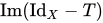
In the following, are Banach spaces, is the space of bounded operators under the operator norm, and denotes the space of compact operators . denotes the identity operator on , , and .

  • If a linear operator is compact, then it is continuous.
  • is a closed subspace of (in the norm topology). Equivalently,[5]
    • given a sequence of compact operators mapping (where are Banach) and given that converges to with respect to the operator norm, is then compact.
  • In particular, the limit of a sequence of finite rank operators is a compact operator.
  • Conversely, if are Hilbert spaces, then every compact operator from is the limit of finite rank operators. Notably, this "approximation property" is false for general Banach spaces and .[2][4]
  • where the composition of sets is taken element-wise. In particular, forms a two-sided ideal in .
  • Any compact operator is strictly singular, but not vice versa.[6]
  • A bounded linear operator between Banach spaces is compact if and only if its adjoint is compact (Schauder's theorem).[7]
    • If is bounded and compact, then:[5][7]
      • the closure of the range of is separable.
      • if the range of is closed in , then the range of is finite-dimensional.
  • If is a Banach space and there exists an invertible bounded compact operator then is necessarily finite-dimensional.[7]

Now suppose that is a Banach space and is a compact linear operator, and is the adjoint or transpose of T.


  • For any ,   is a Fredholm operator of index 0. In particular, is closed. This is essential in developing the spectral properties of compact operators. One can notice the similarity between this property and the fact that, if and are subspaces of where is closed and is finite-dimensional, then is also closed.
  • If is any bounded linear operator then both and are compact operators.[5]
  • If then the range of is closed and the kernel of is finite-dimensional.[5]
  • If then the following are finite and equal: [5]
  • The spectrum of is compact, countable, and has at most one limit point, which would necessarily be the origin.[5]
  • If is infinite-dimensional then .[5]
  • If and then is an eigenvalue of both and .[5]
  • For every the set is finite, and for every non-zero the range of is a proper subset of .[5]

Origins in integral equation theory

[edit]

A crucial property of compact operators is the Fredholm alternative in the solution of linear equations. Let be a compact operator, a given function, and the unknown function to be solved for. Then the Fredholm alternative states that the equationbehaves much like as in finite dimensions.

The spectral theory of compact operators then follows, and it is due to Frigyes Riesz (1918). It shows that a compact operator on an infinite-dimensional Banach space has spectrum that is either a finite subset of which includes 0, or the spectrum is a countably infinite subset of which has as its only limit point. Moreover, in either case the non-zero elements of the spectrum are eigenvalues of with finite multiplicities (so that has a finite-dimensional kernel for all complex ).

An important example of a compact operator is compact embedding of Sobolev spaces, which, along with the Gårding inequality and the Lax–Milgram theorem, can be used to convert an elliptic boundary value problem into a Fredholm integral equation.[8] Existence of the solution and spectral properties then follow from the theory of compact operators; in particular, an elliptic boundary value problem on a bounded domain has infinitely many isolated eigenvalues. One consequence is that a solid body can vibrate only at isolated frequencies, given by the eigenvalues, and arbitrarily high vibration frequencies always exist.

The compact operators from a Banach space to itself form a two-sided ideal in the algebra of all bounded operators on the space. Indeed, the compact operators on an infinite-dimensional separable Hilbert space form a maximal ideal, so the quotient algebra, known as the Calkin algebra, is simple. More generally, the compact operators form an operator ideal.

Compact operator on Hilbert spaces

[edit]

For Hilbert spaces, another equivalent definition of compact operators is given as follows.

An operator on an infinite-dimensional Hilbert space ,

,

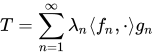
is said to be compact if it can be written in the form

,

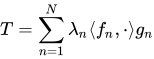
where and are orthonormal sets (not necessarily complete), and is a sequence of positive numbers with limit zero, called the singular values of the operator, and the series on the right hand side converges in the operator norm. The singular values can accumulate only at zero. If the sequence becomes stationary at zero, that is for some and every , then the operator has finite rank, i.e., a finite-dimensional range, and can be written as

.

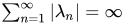
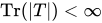
An important subclass of compact operators is the trace-class or nuclear operators, i.e., such that . While all trace-class operators are compact operators, the converse is not necessarily true. For example tends to zero for while .
Completely continuous operators

[edit]

Let be Banach spaces. A bounded linear operator is called completely continuous if, for every weakly convergent sequence from , the sequence is norm-convergent in (Conway 1985, §VI.3).

Compact operators on a Banach space are always completely continuous, but the converse is false, because there exists a completely continuous operator that is not compact. However, the converse is true if is a reflexive Banach space, then every completely continuous operator is compact.

Somewhat confusingly, compact operators are sometimes referred to as "completely continuous" in older literature, even though they are not necessarily completely continuous by the definition of that phrase in modern terminology.

Examples

[edit]
  • Every finite rank operator is compact.
  • The scaling operator for any nonzero is compact if and only if the space is finite-dimensional. This can be proven directly, or as a corollary of Riesz's lemma.[9]
  • The multiplication operator on sequence space with fixed , defined as and sequence converging to zero, is compact.
  • Every Hilbert–Schmidt operator is compact.
    • In particular, every Hilbert–Schmidt integral operator is compact. That is, if is any domain in and the integral kernel satisfies , then the integral operator on defined by is a compact operator.
  • The integral transform on (i.e. the continuous function space on a closed bounded real interval), defined by for any fixed , is a compact operator by the Arzelà–Ascoli theorem.
  • The inclusion map compactly embedding the Sobolev space in the Lebesgue space for every and , is a compact operator by the Rellich–Kondrachov theorem.

See also

[edit]

Notes

[edit]

References

[edit]
Revisions and contributorsEdit on WikipediaRead on Wikipedia
from Grokipedia
In , a compact operator is a bounded linear operator T:XYT: X \to Y between normed linear spaces XX and YY such that the image T(B)T(B) of every bounded subset BXB \subseteq X is relatively compact in YY. This means that the closure of T(B)T(B) is compact, providing a notion of "approximate finite-dimensionality" for infinite-dimensional spaces. Compact operators generalize finite-rank operators, as every finite-rank operator is compact, and conversely, every compact operator on a can be approximated in the by a sequence of finite-rank operators. A fundamental property of compact operators is their behavior under s and compositions: if TT is compact, then so is its TT^* (when defined on s), and the composition of two compact operators is compact. In , the spectrum of a compact operator on an infinite-dimensional consists solely of zero and a of eigenvalues that can accumulate only at zero, with corresponding eigenspaces of finite dimension except possibly for the zero eigenvalue. This spectral structure underpins the , which characterizes solvability of equations involving compact perturbations of the identity operator. Compact operators arise naturally in applications such as operators on function spaces and differential operators with compact resolvents, playing a central role in the study of partial differential equations and . They form a closed two-sided ideal in the of bounded operators on a , facilitating their analysis within operator algebras.

Definitions

In topological vector spaces

A is a over the real or complex numbers endowed with a such that the vector addition and operations are continuous. This framework generalizes normed spaces by not requiring a metric or completeness, allowing for a broad class of spaces where convergence and compactness are defined topologically rather than metrically. In a XX, a BXB \subseteq X is bounded if for every neighborhood VV of the origin 0X0 \in X, there exists a t>0t > 0 such that BtVB \subseteq tV. Bounded sets capture the intuitive notion of "smallness" in the topological sense, absorbed by scalar multiples of neighborhoods of zero, without reliance on a norm. A AA of a YY is relatively compact if its closure A\overline{A} is compact in the topology of YY. Compactness here means every open cover of A\overline{A} admits a finite subcover, providing a generalization of finite-dimensional behavior to infinite-dimensional settings. A linear operator T:XYT: X \to Y between topological vector spaces is compact if the image T(B)T(B) of every bounded subset BXB \subseteq X is relatively compact in YY. This definition extends the notion of compactness from metric-induced topologies (where relative compactness equates to total boundedness) to arbitrary topological vector spaces, accommodating non-metrizable and non-complete structures while preserving the essential property that compact operators "tame" infinite-dimensional spaces by mapping large sets to nearly finite ones.

In normed spaces

In normed linear spaces, a linear operator T:XYT: X \to Y between normed spaces XX and YY is defined to be compact if the image under TT of every bounded subset of XX is relatively compact in YY, meaning its closure is compact in the norm topology of YY. Equivalently, TT is compact if the image of the closed unit ball {xX:x1}\{ x \in X : \|x\| \leq 1 \} is precompact in YY, i.e., for every ϵ>0\epsilon > 0, there exists a finite ϵ\epsilon-net covering the image. This definition leverages the norm to quantify boundedness, where a set SXS \subseteq X is bounded if supxSx<\sup_{x \in S} \|x\| < \infty, enabling precise metric-based arguments for compactness that rely on the completeness or lack thereof in YY. An alternative characterization emphasizes sequential compactness: TT is compact if and only if, for every bounded sequence {xn}\{x_n\} in XX, there exists a subsequence {xnk}\{x_{n_k}\} such that {Txnk}\{T x_{n_k}\} converges in the norm of YY. This equivalence holds because the norm-induced metric allows relatively compact sets to be sequentially compact in normed spaces, bridging set-theoretic compactness with sequence behavior essential for operator analysis. The norm plays a central role here by defining convergence (TxnkTxn0\|T x_{n_k} - T x_{n_\ell}\| \to 0 as k,k, \ell \to \infty) and boundedness uniformly across sequences, without requiring completeness of XX or YY. Compact operators are necessarily continuous (bounded), as the image of the unit ball being precompact implies it is bounded in YY, but the converse does not hold: for instance, the identity operator on an infinite-dimensional normed space is continuous yet not compact, since the unit ball is not relatively compact. This distinction underscores that compactness imposes a stronger "finite-dimensional-like" constraint via the norm topology, distinguishing it from mere continuity which only requires TxMx\|T x\| \leq M \|x\| for some M>0M > 0.

In Banach spaces

In Banach spaces, which are complete normed spaces, the notion of a compact operator refines the definition from general normed spaces by leveraging completeness to ensure that the image of s has compact closure. Specifically, a bounded linear operator T:XYT: X \to Y between Banach spaces XX and YY is compact if the image T(B)T(B) of any BXB \subset X is precompact in YY, meaning its closure T(B)\overline{T(B)} is compact in the norm topology. This precompactness implies total boundedness of T(B)T(B), and the completeness of YY guarantees that the closure is a complete totally bounded set, hence compact. A key consequence of this definition in the Banach setting is that compact operators map the closed unit ball BX={xX:x1}B_X = \{ x \in X : \|x\| \leq 1 \} to a set whose closure has empty interior in YY whenever YY is infinite-dimensional. This follows from Riesz's lemma, which states that in any infinite-dimensional normed space, a closed can be approximated by a nearly orthogonal to it; iteratively applying this lemma to a supposed open ball in T(BX)\overline{T(B_X)} yields a sequence of points with pairwise distances bounded below by a positive constant, contradicting the total boundedness of T(BX)T(B_X). Thus, unless TT has finite-dimensional range, T(BX)\overline{T(B_X)} cannot contain any open ball, highlighting how completeness enables precise control over the geometry of operator images. The Arzelà–Ascoli theorem provides an important analogy for understanding in specific Banach spaces, such as continuous functions on compact sets. In C(K)C(K) for compact KK, a subset is relatively compact if it is bounded and , mirroring how compact operators produce images that are "uniformly approximable" in the norm; this equicontinuity condition parallels the total boundedness ensured by in general Banach spaces. Compact operators between Banach spaces are completely continuous, meaning they map weakly convergent sequences in XX to norm convergent sequences in YY. This property arises because weak convergence in XX implies boundedness, and the compactness of TT ensures the image sequence has a norm-convergent subsequence, with the full sequence converging due to the operator's linearity and continuity.

Characterizations and Properties

Equivalent formulations

A compact operator T:XYT: X \to Y between Banach spaces XX and YY can be equivalently characterized as the norm limit of a sequence of finite-rank operators. This property highlights the "finite-dimensional" nature of compact operators in infinite-dimensional settings, where the closure of the finite-rank operators in the topology coincides with the compact operators. To see the equivalence to the standard definition that TT maps the closed unit ball of XX into a precompact subset of YY, consider the forward direction: finite-rank operators map bounded sets to relatively compact sets, and the set of compact operators is closed under norm limits. For the reverse, if T(BX)T(B_X) is precompact, cover it with finitely many balls of radius ϵ/2\epsilon/2; project onto the span of corresponding centers to obtain a finite-rank approximation within ϵ\epsilon in operator norm. Another equivalent formulation is the sequential criterion: TT is compact if and only if, for every bounded sequence {xn}\{x_n\} in XX, the sequence {Txn}\{T x_n\} in YY admits a convergent . This follows from the fact that precompact sets in Banach spaces are sequentially precompact, so any sequence in T(BX)T(B_X) has a Cauchy (hence convergent, by completeness) subsequence; conversely, if T(BX)T(B_X) is not precompact, it contains a sequence without convergent subsequences by the failure of total boundedness. In the specific context of operators into spaces of continuous functions, such as T:XC(K)T: X \to C(K) where KK is compact and XX is a , compactness of TT is equivalent to the image T(BX)T(B_X) being pointwise bounded and on KK, by the Arzelà–Ascoli theorem. The proof leverages the theorem's characterization of relatively compact subsets of C(K)C(K): ensures uniform control, and pointwise boundedness with the unit ball's boundedness yields relative compactness. These formulations unify across normed and Banach spaces, extending to topological vector spaces where total boundedness is replaced by appropriate precompactness notions, though completeness is key for sequential convergence.

Algebraic and topological properties

Compact operators on normed linear spaces are inherently linear maps that preserve the structure. Moreover, every compact operator is bounded, meaning it maps bounded sets to bounded sets and is continuous with respect to the norm topology. This boundedness follows directly from the definition, as the image of the closed unit under a compact operator is relatively compact and hence bounded. The collection of compact operators from a XX to another YY, denoted K(X,Y)K(X, Y), forms a of the space of s B(X,Y)B(X, Y). Consequently, the sum of finitely many compact operators is compact, and scalar multiples of a compact operator remain compact. Additionally, K(X,Y)K(X, Y) is a two-sided ideal in B(X,Y)B(X, Y): if TK(X,Y)T \in K(X, Y) and SB(Z,X)S \in B(Z, X), UB(Y,W)U \in B(Y, W) for s Z,WZ, W, then UTSK(Z,W)U T S \in K(Z, W). This ideal property arises because the composition of a with a compact operator yields a compact operator, as the relatively compact image under the compact part remains relatively compact after bounded pre- and post-composition. In the context of dual spaces, the adjoint of a compact operator is also compact. Specifically, if T:XYT: X \to Y is compact between Banach spaces, then its T:YXT^*: Y^* \to X^* is compact; this is known as Schauder's theorem. The proof relies on the fact that the adjoint maps the unit ball of YY^* to a set whose weak* closure is compact in XX^*, leveraging the Alaoglu theorem. For compact operators with separable ranges, a key topological factorization property holds: such an operator T:XYT: X \to Y factors through the space of continuous functions on a . That is, there exists a KK, a A:XC(K)A: X \to C(K), and a B:C(K)YB: C(K) \to Y such that T=BAT = B A, where the range of AA is dense in a separable subspace of C(K)C(K). This factorization underscores the "finite-dimensional-like" topological behavior of compact operators, embedding their action into the structure of functions on compact sets.

Spectral properties

The spectral properties of compact operators are fundamentally discrete, distinguishing them from more general bounded operators on infinite-dimensional s. For a compact operator TT on a XX, the σ(T)\sigma(T) consists of 0 together with a discrete set of eigenvalues, where each non-zero eigenvalue λ0\lambda \neq 0 has finite geometric multiplicity, meaning dimker(TλI)<\dim \ker(T - \lambda I) < \infty. Moreover, the non-zero part of the σ(T){0}\sigma(T) \setminus \{0\} can only accumulate at 0, ensuring that for any ε>0\varepsilon > 0, there are only finitely many eigenvalues with λε|\lambda| \geq \varepsilon. This discreteness arises from the Riesz–Schauder theorem, which characterizes the of compact operators as σ(T)={0}σp(T)\sigma(T) = \{0\} \cup \sigma_p(T), where σp(T)\sigma_p(T) denotes the point (eigenvalues). A key consequence is the for compact operators: for any λ0\lambda \neq 0, the operator TλIT - \lambda I is either invertible or possesses a finite-dimensional kernel, with the range being closed and of finite if the kernel is non-trivial. In the latter case, the index \ind(TλI)=dimker(TλI)\codim\ran(TλI)\ind(T - \lambda I) = \dim \ker(T - \lambda I) - \codim \ran(T - \lambda I) is finite, reflecting the finite-dimensional nature of the eigenspaces. If the underlying space XX is infinite-dimensional, then 0 belongs to the σ(T)\sigma(T), serving as the sole possible of eigenvalues. Furthermore, if the range of TT is infinite-dimensional, the operator admits infinitely many distinct non-zero eigenvalues, which must accumulate solely at 0 due to compactness. The r(T)=sup{λ:λσ(T)}r(T) = \sup \{ |\lambda| : \lambda \in \sigma(T) \} of a compact operator TT equals the limit limnTn1/n\lim_{n \to \infty} \|T^n\|^{1/n}, a general formula for bounded operators that simplifies here to the supremum of the absolute values of its eigenvalues, since the beyond 0 is purely point spectral. This radius is finite and attained as the largest eigenvalue modulus if the is non-trivial, or zero if TT is quasinilpotent (i.e., all eigenvalues vanish except possibly at 0). These properties underpin the utility of compact operators in spectral decomposition and approximation theory, where the eigenvalues provide a countable basis for understanding the operator's action.

Historical Development

Origins in integral equation theory

The origins of compact operators trace back to the early 20th-century study of integral equations, particularly those motivated by physical problems in potential theory and heat conduction. In 1903, Ivar Fredholm published a seminal paper introducing a determinant method to solve integral equations of the second kind, expressed as ϕ(s)=f(s)+λabK(s,t)ϕ(t)dt\phi(s) = f(s) + \lambda \int_a^b K(s,t) \phi(t) \, dt, where the kernel K(s,t)K(s,t) was approximated by finite-rank expansions to ensure solvability. This approach highlighted the role of finite-rank kernels, akin to those in Volterra equations, in establishing existence and uniqueness results, laying the groundwork for operators whose images could be approximated by finite-dimensional subspaces. David Hilbert significantly advanced this framework between 1904 and 1910 through a series of six papers, culminating in his 1912 treatise Grundzüge einer allgemeinen Theorie der linearen Integralgleichungen, where he focused on equations with symmetric continuous kernels. Hilbert demonstrated that solutions could be expanded in series of eigenfunctions, with eigenvalues forming a sequence converging to zero, for what he termed "completely continuous" transformations—now recognized as compact operators—enabling the resolution of Fredholm's alternative in infinite dimensions. These operators mapped bounded sets to precompact ones, mirroring finite-dimensional behavior while addressing the challenges of infinite-dimensional function spaces. Around 1906, Hilbert introduced the concept of compact operators in the functional analysis context, emphasizing their spectral properties for symmetric operators. This marked a pivotal shift from concrete formulations to abstract in L2L^2 spaces, where Hilbert employed orthogonal expansions to represent solutions, bridging equations with emerging structures. Such operators, like those with square-integrable kernels, exemplify early compact examples, though their detailed forms are explored elsewhere.

Evolution in functional analysis

The abstraction of compact operators from concrete integral formulations to general topological settings emerged in the early 20th century, building briefly on David Hilbert's foundational work with integral equations around 1904–1910. This shift emphasized properties like approximation by finite-rank operators and spectral behavior in infinite-dimensional spaces. In the 1910s and 1920s, Maurice Fréchet and Hugo Steinhaus laid early topological groundwork for these concepts. Fréchet developed notions of compactness in metric spaces through sequential criteria and finite ε-net coverings, providing characterizations essential for defining operator compactness in emerging functional-analytic frameworks. Steinhaus advanced related ideas via studies on dual spaces, such as identifying the dual of L1[a,b]L^1[a,b] as L[a,b]L^\infty[a,b], which supported boundedness and continuity properties of linear operators in normed settings. A pivotal advancement came in 1918 with Frigyes Riesz's theorem on compact operators in Hilbert spaces, proving that such operators—termed "vollständig stetig" or completely continuous—can be uniformly approximated by finite-rank operators. Riesz's spectral theory further established that the non-zero part of the spectrum consists solely of eigenvalues with finite multiplicity, accumulating only at zero, thus generalizing Fredholm's earlier results on integral equations to abstract operator settings. Stefan Banach's 1932 monograph Théorie des opérations linéaires crystallized these developments by formally defining compact operators on Banach spaces as bounded linear maps sending the unit ball to a relatively compact set. Banach explicitly connected this definition to Riesz's results and Juliusz Schauder's (1930), which implied non-empty spectra for compact operators, thereby embedding compactness into the axiomatic structure of complete normed spaces. Developments in the 1930s, led by Marshall Stone, integrated compact operators more deeply into , extending Riesz's results to unbounded operators and axiomatic formulations that unified Hilbert and analyses. Stone's frameworks addressed resolvent properties and spectral measures, paving the way for modern generalizations like nuclear operators and applications in partial differential equations.

Compact Operators on Hilbert Spaces

Specific definitions and features

In Hilbert spaces, a bounded linear operator T:HHT: H \to H is compact if it maps the closed unit ball of HH to a precompact subset of HH. This property leverages the inner product structure, ensuring that the image has compact closure. Equivalently, in Hilbert spaces, compact operators are completely continuous, meaning they map weakly convergent sequences in HH to strongly convergent sequences in HH. For compact operators, the provides a diagonalization with respect to an . Specifically, if T:HHT: H \to H is compact and , then HH admits an {ei}i=1\{e_i\}_{i=1}^\infty of eigenvectors such that Tei=λieiT e_i = \lambda_i e_i for real eigenvalues λi\lambda_i satisfying λ1λ2|\lambda_1| \geq |\lambda_2| \geq \cdots and λi0\lambda_i \to 0 as ii \to \infty. Eigenspaces corresponding to distinct nonzero eigenvalues are orthogonal, and those for nonzero eigenvalues are finite-dimensional. Thus, TT can be expressed as Tu=i=1λiu,eieiT u = \sum_{i=1}^\infty \lambda_i \langle u, e_i \rangle e_i for all uHu \in H. More generally, every compact operator T:HHT: H \to H on a admits a singular value decomposition T=UΣVT = U \Sigma V^*, where UU and VV are unitary operators (or partial isometries extending to unitaries on the orthogonal complements of their kernels), and Σ\Sigma is a diagonal operator with nonnegative singular values σ1σ20\sigma_1 \geq \sigma_2 \geq \cdots \geq 0 satisfying σn0\sigma_n \to 0 as nn \to \infty. The singular values are the square roots of the eigenvalues of TTT^* T, and there exist orthonormal bases {vn}\{v_n\} in HH and {un}\{u_n\} in HH such that Tvn=σnunT v_n = \sigma_n u_n and Tun=σnvnT^* u_n = \sigma_n v_n. This decomposition allows representation as Tx=n=1σnx,vnunT x = \sum_{n=1}^\infty \sigma_n \langle x, v_n \rangle u_n for xHx \in H. The orthonormal bases in the singular value decomposition facilitate approximations by finite-rank operators that preserve orthogonality, as truncating the series to the first NN terms yields a rank-NN operator acting on the span of {v1,,vN}\{v_1, \dots, v_N\} and mapping to the orthogonal span of {u1,,uN}\{u_1, \dots, u_N\}. Such approximations converge in the to TT, maintaining the inner product structure inherent to the .

Approximation theorems

In Hilbert spaces, a bounded linear operator T:HHT: H \to H is compact if and only if it is the uniform limit of a sequence of finite-rank operators. This characterization highlights the "finite-dimensional" nature of compact operators, allowing them to be approximated arbitrarily closely in the by operators of finite rank. For compact operators, this approximation can be achieved using finite-rank projections derived from the spectral decomposition. Specifically, if TT is compact and , the provides an {en}\{e_n\} of eigenvectors with corresponding eigenvalues λn0\lambda_n \to 0, and the partial sums Tn=k=1nλkekekT_n = \sum_{k=1}^n \lambda_k |e_k\rangle\langle e_k| are finite-rank orthogonal projections scaled by the eigenvalues, satisfying TTn0\|T - T_n\| \to 0 as nn \to \infty. A key consequence of compactness in Hilbert spaces is the existence of an adapted to the operator. For any compact operator T:HHT: H \to H, there exists an {en}\{e_n\} of HH such that Ten0\|T e_n\| \to 0 as nn \to \infty. This property follows from the fact that compactness implies Txn0\|T x_n\| \to 0 for every orthonormal {xn}\{x_n\} in HH, and one can construct such a basis by selecting subsequences where the images converge appropriately. Conversely, if Ten0\|T e_n\| \to 0 for some {en}\{e_n\}, then TT maps the unit ball to a precompact set, confirming compactness. Picard's iteration provides a practical method for solving equations of the form (IT)x=y(I - T)x = y where TT is a compact operator on a HH and yHy \in H. Assuming T<1\|T\| < 1, the iterates defined by x0=yx_0 = y and xn+1=Txn+yx_{n+1} = T x_n + y converge to the unique solution x=(IT)1yx = (I - T)^{-1} y in the norm topology. This successive approximation scheme is particularly useful for integral equations with compact kernels, as the contraction property ensures linear convergence near the solution, and the method extends to cases where T1\|T\| \geq 1 via analytic continuation or perturbation when the spectral radius of TT is less than 1. Error estimates for finite-rank approximations of compact operators rely on the singular value decomposition (SVD), which, as discussed previously, expresses TT as T=n=1σnunvnT = \sum_{n=1}^\infty \sigma_n |u_n\rangle \langle v_n| with singular values σn0\sigma_n \downarrow 0. The optimal rank-nn approximation is the partial sum Tn=k=1nσkukvkT_n = \sum_{k=1}^n \sigma_k |u_k\rangle \langle v_k|, and the approximation error satisfies TTn=σn+1\|T - T_n\| = \sigma_{n+1}. This bound quantifies how rapidly finite-rank operators can approximate TT, with the decay rate of σn\sigma_n determining the efficiency; for example, if σn=O(np)\sigma_n = O(n^{-p}) for p>0p > 0, the error decreases polynomially.

Completely continuous operators

A completely continuous operator is a bounded linear operator between normed spaces that maps every weakly convergent sequence to a norm convergent sequence. This property emphasizes the operator's ability to "strengthen" convergence from the weak topology to the norm topology. In Banach spaces, every compact operator is completely continuous, as the image of the unit ball under a compact operator is relatively compact, implying the desired convergence property for sequences. The converse holds in reflexive Banach spaces, including Hilbert spaces, where completely continuous operators coincide with compact operators; the concept of completely continuous operators was introduced by in 1918, building on Hilbert's work on integral equations, and extended to general Banach spaces by in 1932, though the full equivalence requires reflexivity. For example, in the non-reflexive Banach space 1\ell_1, the identity operator is completely continuous due to the Schur property (weak convergence implies norm convergence) but is not compact, as its image of the unit ball is not relatively compact. Historically, the term "completely continuous" (translating from the German vollständig stetig) was used in early 20th-century literature on integral operators, following Hilbert's foundational work on . later generalized the concept to operators between arbitrary Banach spaces in his 1932 monograph Théorie des opérations linéaires. In modern , "compact operator" has become the standard terminology, as it more directly captures the precompactness of images of bounded sets and avoids the historical association with specific sequence convergence properties. In non-Banach settings, such as incomplete normed spaces, the notions of completely continuous and compact operators do not necessarily coincide, with counterexamples arising from the lack of completeness affecting relative compactness in the range space. For instance, certain inclusion operators into incomplete subspaces can satisfy the sequence convergence condition but fail to map bounded sets to relatively compact ones due to missing limit points in the space.

Connections to Fredholm operators

Fredholm operators are bounded linear operators between Banach spaces that possess finite-dimensional kernels and closed ranges with finite-dimensional cokernels. The index of a Fredholm operator TT, denoted ind(T)\operatorname{ind}(T), is defined as the difference between the dimensions of its kernel and cokernel, ind(T)=dimker(T)dim\coker(T)\operatorname{ind}(T) = \dim \ker(T) - \dim \coker(T). Compact operators form a significant subclass within this framework: on infinite-dimensional Banach spaces, every compact operator is Fredholm with index zero, meaning dimker(K)=dim\coker(K)<\dim \ker(K) = \dim \coker(K) < \infty for any compact KK. This property arises because the image of the unit ball under a compact operator is precompact, ensuring the finite dimensionality of the relevant subspaces. A key consequence is the , which characterizes the solvability of equations involving the identity plus a compact operator. Specifically, for a compact operator KK on a , the operator I+KI + K is invertible if and only if 1-1 is not an eigenvalue of KK, or equivalently, if ker(I+K)={0}\ker(I + K) = \{0\}; in this case, I+KI + K is bijective with a bounded inverse. This extends the classical alternative from finite-dimensional linear algebra to infinite dimensions and underscores the invertibility stability near the identity for compact perturbations. More broadly, the Fredholm property is stable under compact perturbations: if TT is Fredholm, then T+KT + K is also Fredholm for any compact KK, and ind(T+K)=ind(T)\operatorname{ind}(T + K) = \operatorname{ind}(T). This index invariance is crucial for perturbation analyses in operator theory. In applications to partial differential equations, compact operators play a pivotal role through the resolvents of . For a second-order LL on a bounded domain with suitable boundary conditions, the resolvent (LλI)1(L - \lambda I)^{-1} is compact on L2(Ω)L^2(\Omega) for λ\lambda in the , making LλIL - \lambda I a compact perturbation of the identity and thus Fredholm of index zero. This compactness ensures a discrete for , with eigenvalues accumulating only at infinity, and enables the to determine solvability: solutions to Lu=fLu = f exist uniquely if ff is orthogonal to the kernel of the , or more generally, under conditions for nonhomogeneous terms. Such structures are foundational in proving existence and regularity results for elliptic boundary value problems.

Examples

Finite-dimensional and finite-rank operators

All bounded linear operators between finite-dimensional normed spaces are compact, since the closed unit ball in a finite-dimensional space is compact, and the image of a bounded set under such an operator remains bounded and thus compact. This follows directly from the fact that in finite dimensions, boundedness implies compactness for subsets. A finite-rank operator T:XYT: X \to Y between normed spaces is a bounded linear operator whose range is finite-dimensional. Such operators are compact because the image of the closed unit ball under TT is bounded in a finite-dimensional space, hence relatively compact. Equivalently, for any bounded sequence in the domain, the image sequence has a convergent subsequence in the finite-dimensional range. Representative examples include orthogonal projections onto finite-dimensional subspaces of a , which are finite-rank and thus compact. Another example is any matrix operator acting on Rn\mathbb{R}^n or Cn\mathbb{C}^n, as these map between finite-dimensional spaces and are therefore compact. On separable , finite-rank operators are dense in the space of compact operators with respect to the ; that is, every compact operator is the norm limit of a sequence of finite-rank operators. This density result characterizes compact operators on such spaces and underpins their approximation properties.

Integral and differential operators

Integral operators provide fundamental examples of compact operators in infinite-dimensional spaces. A prominent class is the Hilbert-Schmidt operators, which act on the L2(Ω)L^2(\Omega) for a Ω\Omega via the formula (Tf)(x)=Ωk(x,y)f(y)dμ(y),(Tf)(x) = \int_{\Omega} k(x,y) f(y) \, d\mu(y), where the kernel kL2(Ω×Ω)k \in L^2(\Omega \times \Omega). Such operators are compact because their allows approximation by finite-rank operators, with the singular values forming a square-summable sequence that decays to zero. The Volterra operator offers another concrete example of compactness, defined on the space of continuous functions C[0,1]C[0,1] by (Vf)(x)=0xk(x,t)f(t)dt,(Vf)(x) = \int_0^x k(x,t) f(t) \, dt, where kk is continuous on the 0tx10 \leq t \leq x \leq 1. Despite the kernel being continuous (hence bounded), VV is compact on C[0,1]C[0,1] equipped with the supremum norm, as the image of the unit ball is equicontinuous and uniformly bounded, hence precompact by the Arzelà-Ascoli theorem. Multiplication operators provide examples in discrete settings. In the sequence space 2\ell^2, the diagonal operator (Mf)n=mnfn(Mf)_n = m_n f_n is compact if and only if mn0m_n \to 0 as nn \to \infty. A classic non-compact operator is the identity on 2\ell^2, whose image of the unit ball consists of all sequences with 2\ell^2-norm at most 1, which is not precompact since it contains the orthonormal basis vectors with no convergent subsequence. Differential operators, such as the d/dxd/dx realized as a from the H1(R)H^1(\mathbb{R}) to L2(R)L^2(\mathbb{R}), are typically non-compact on unbounded domains because they map bounded sets to sets lacking or uniform boundedness in higher norms, failing to produce precompact images.

References

Add your contribution
Related Hubs
Contribute something
User Avatar
No comments yet.