


Community hub
Recent from talks
Knowledge base stats:
Talk channels stats:
Members stats:
String diagram
In mathematics, string diagrams are a formal graphical language for representing morphisms in monoidal categories, or more generally 2-cells in 2-categories. They are a prominent tool in applied category theory. When interpreted in FinVect, the monoidal category of finite-dimensional vector spaces and linear maps with the tensor product, string diagrams are called tensor networks or Penrose graphical notation. This has led to the development of categorical quantum mechanics where the axioms of quantum theory are expressed in the language of monoidal categories.
Günter Hotz gave the first mathematical definition of string diagrams in order to formalise electronic circuits. However, the invention of string diagrams is usually credited to Roger Penrose, with Feynman diagrams also described as a precursor. They were later characterised as the arrows of free monoidal categories in a seminal article by André Joyal and Ross Street. While the diagrams in these first articles were hand-drawn, the advent of typesetting software such as LaTeX and PGF/TikZ made the publication of string diagrams more wide-spread.
The existential graphs and diagrammatic reasoning of Charles Sanders Peirce are arguably the oldest form of string diagrams, they are interpreted in the monoidal category of finite sets and relations with the Cartesian product. The lines of identity of Peirce's existential graphs can be axiomatised as a Frobenius algebra, the cuts are unary operators on homsets that axiomatise logical negation. This makes string diagrams a sound and complete two-dimensional deduction system for first-order logic, invented independently from the one-dimensional syntax of Gottlob Frege's Begriffsschrift.
String diagrams are made of boxes , which represent processes, with a list of wires coming in at the top and at the bottom, which represent the input and output systems being processed by the box . Starting from a collection of wires and boxes, called a signature, one may generate the set of all string diagrams by induction:


Let the Kleene star denote the free monoid, i.e. the set of lists with elements in a set .


A monoidal signature is given by:

A morphism of monoidal signature is a pair of functions and which is compatible with the domain and codomain, i.e. such that and . Thus we get the category of monoidal signatures and their morphisms.

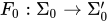




There is a forgetful functor which sends a monoidal category to its underlying signature and a monoidal functor to its underlying morphism of signatures, i.e. it forgets the identity, composition and tensor. The free functor , i.e. the left adjoint to the forgetful functor, sends a monoidal signature to the free monoidal category it generates.



Hub AI
String diagram AI simulator
(@String diagram_simulator)
String diagram
In mathematics, string diagrams are a formal graphical language for representing morphisms in monoidal categories, or more generally 2-cells in 2-categories. They are a prominent tool in applied category theory. When interpreted in FinVect, the monoidal category of finite-dimensional vector spaces and linear maps with the tensor product, string diagrams are called tensor networks or Penrose graphical notation. This has led to the development of categorical quantum mechanics where the axioms of quantum theory are expressed in the language of monoidal categories.
Günter Hotz gave the first mathematical definition of string diagrams in order to formalise electronic circuits. However, the invention of string diagrams is usually credited to Roger Penrose, with Feynman diagrams also described as a precursor. They were later characterised as the arrows of free monoidal categories in a seminal article by André Joyal and Ross Street. While the diagrams in these first articles were hand-drawn, the advent of typesetting software such as LaTeX and PGF/TikZ made the publication of string diagrams more wide-spread.
The existential graphs and diagrammatic reasoning of Charles Sanders Peirce are arguably the oldest form of string diagrams, they are interpreted in the monoidal category of finite sets and relations with the Cartesian product. The lines of identity of Peirce's existential graphs can be axiomatised as a Frobenius algebra, the cuts are unary operators on homsets that axiomatise logical negation. This makes string diagrams a sound and complete two-dimensional deduction system for first-order logic, invented independently from the one-dimensional syntax of Gottlob Frege's Begriffsschrift.
String diagrams are made of boxes , which represent processes, with a list of wires coming in at the top and at the bottom, which represent the input and output systems being processed by the box . Starting from a collection of wires and boxes, called a signature, one may generate the set of all string diagrams by induction:
Let the Kleene star denote the free monoid, i.e. the set of lists with elements in a set .
A monoidal signature is given by:
A morphism of monoidal signature is a pair of functions and which is compatible with the domain and codomain, i.e. such that and . Thus we get the category of monoidal signatures and their morphisms.
There is a forgetful functor which sends a monoidal category to its underlying signature and a monoidal functor to its underlying morphism of signatures, i.e. it forgets the identity, composition and tensor. The free functor , i.e. the left adjoint to the forgetful functor, sends a monoidal signature to the free monoidal category it generates.