


Community hub
Recent from talks
Contribute something
Nothing was collected or created yet.
Carex chordorrhiza
View on Wikipedia
| Carex chordorrhiza | |
|---|---|

| |
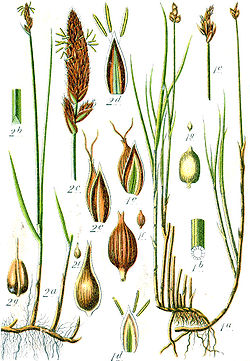
| Carex chordorrhiza on the right (1a-1g) | |
Scientific classification 
| |
| Kingdom: | Plantae |
| Clade: | Tracheophytes |
| Clade: | Angiosperms |
| Clade: | Monocots |
| Clade: | Commelinids |
| Order: | Poales |
| Family: | Cyperaceae |
| Genus: | Carex |
| Subgenus: | Carex subg. Vignea |
| Section: | Carex sect. Chordorrhizae (Heuffel) Meinshausen |
| Species: | C. chordorrhiza
|
| Binomial name | |
| Carex chordorrhiza | |
Carex chordorrhiza, commonly called creeping sedge or string sedge, is a species of perennial plant in the family Cyperaceae with Holarctic distribution growing in acidic bogs.
Growth form and classification
[edit]Carex chordorrhiza has an unusual growth habit, where prostrate stems produce new shoots the following year.[1] Using this means of growth, C. chordorrhiza can grow vegetatively by up to 70 centimetres (28 in) per year. This habit is considered so distinct from all other Carex species that C. chordorrhiza is placed in its own section, Carex sect. Chordorrhizae,[1] although similar habits are seen in other species such as Carex limosa.[2]
Description
[edit]The culms of C. chordorrhiza are 5–32 cm (2–13 in) long, and are initially erect. As they mature, the stems become prostrate and can reach a length of 120 cm (47 in).[3] The inflorescences are 5–16 mm (0.20–0.63 in) long and 4–12 mm (0.16–0.47 in) wide.[3]
Distribution
[edit]The distribution of Carex chordorrhiza is circumpolar in boreal and subarctic areas.[4] It is found in Iceland, Scandinavia, northern Germany, Poland, northern Russia, and in North America from Alaska to Greenland,[5][6] and occurs more patchily as far south as Indiana and the Pyrenees.[4]
Within the British Isles, it is restricted to two sites in the Scottish Highlands, at the head of Loch Naver (near Altnaharra, West Sutherland) and in the Insh Marshes (Easterness & Nairns).[4]
References
[edit]- ^ a b "Creeping Sedge, Carex chordorrhiza" (PDF). Natural Heritage & Endangered Species Program. Massachusetts Division of Fisheries and Wildlife. Retrieved August 8, 2011.
- ^ A. A. Reznicek & P. M. Catling (1986). "Vegetative shoots in the taxonomy of sedges (Carex, Cyperaceae)". Taxon. 35 (3): 495–501. Bibcode:1986Taxon..35..495R. doi:10.2307/1221903. hdl:2027.42/149768. JSTOR 1221903.
- ^ a b Peter W. Ball, A. A. Reznicek & David F. Murray (2002). "Carex chordorrhiza Ehrhart ex Linnaeus f., Suppl. Pl. 414. 1782". Magnoliophyta: Commelinidae (in part): Cyperaceae. Flora of North America North of Mexico. Vol. 23. Oxford University Press. p. 299. ISBN 978-0-19-515207-4.
- ^ a b c Colin J. Legg, Neil R. Cowie & Alistair Hamilton (1995). A sample survey of the distribution of the String Sedge Carex chordorrhiza on the Insh Marshes, Badenoch & Strathspey (PDF). Research, Survey & Monitoring Report. Vol. 7. Scottish Natural Heritage. Archived from the original (PDF) on 2012-03-24. Retrieved 2011-08-20.
- ^ Grønlands flora. Tyge Wittrock Böcher (3. reviderede udgave ed.). København: P. Haase & Sons. 1978. ISBN 87-559-0385-1. OCLC 183098604.
{{cite book}}: CS1 maint: others (link) - ^ Nordens flora. Bo Mossberg, Lennart Stenberg, Jon Feilberg, Anna Torsteinsrud, Victoria Widmark (Nye, udvidede og omarbejdede udgave ed.). Kbh.: Gyldendal. 2020. ISBN 978-87-02-28916-9. OCLC 1158895781.
{{cite book}}: CS1 maint: others (link)
External links
[edit]- Carex chordorrhiza, Flora of the Canadian Arctic
- Carex chordorrhiza, Cyperaceae of the Canadian Arctic Archipelago
- Carex chordorrhiza, Flora of Michigan