



Community hub
Recent from talks
Knowledge base stats:
Talk channels stats:
Members stats:
Strobilanthes callosa
Strobilanthes callosa (Synonym: Carvia callosa (Nees) Bremek) is a shrub found mainly in the low lying hills of the Western Ghats, all along the west coast of India. Its standardized Hindi name is maruadona (मरुआदोना) which it is called in the state of Madhya Pradesh where it is also found. In the state of Maharashtra, in the Marathi language, and other local dialects and in the neighboring state of Karnataka, the shrub is locally known as karvi (कारवी), sometimes spelled in English as karvy.
This shrub belongs to the genus Strobilanthes which was first scientifically described by Nees in the 19th century. The genus has around 350 species, of which at least 46 are found in India. Because most of these species show an unusual flowering behaviour, varying from annual to 16-year blooming cycles, there is often confusion on the national scale about which plant is flowering.
It is a large shrub, sometimes attaining 6–20 ft in height and 21⁄2 inches in diameter and flowers between July and September. This plant is recognized for the fact that it takes nearly a decade for the bloom cycle to occur. Its leaves are home to several insects including caterpillars and snails which feed on it. The shrub has an interesting life cycle; It comes alive and green every year with the advent of monsoon, but once the rainy season is over, all that is left is dry and dead-looking stems. This pattern repeats itself for seven years, but in the eighth year the plant bursts into mass flowering.
Plants that bloom at long intervals like Strobilanthes callosa are known as plietesials, the term plietesial has been used in reference to perennial monocarpic plants “of the kind most often met with in the Strobilanthinae” (a subtribe of Acanthaceae containing Strobilanthes and allied genera) that usually grow gregariously, flower simultaneously following a long interval, set seed, and die. Other commonly used expressions or terms which apply to part or all of the plietesial life history include gregarious flowering, mast seeding, and supra-annual synchronized semelparity (semelparity = monocarpy).
In 1953 Sharfuddin Khan describing the plant in the former Hyderabad State wrote:
Botanical Name - Strobilanthes callosus
Strobilanthes, Blume.; F.B.I. IV-429. S. callosus, Nees.; F.B.I. IV-451. Brandi's Ind. Trees, 500. Gamble's Ind. Timbers, 518. Vern. Karvi, Mar.
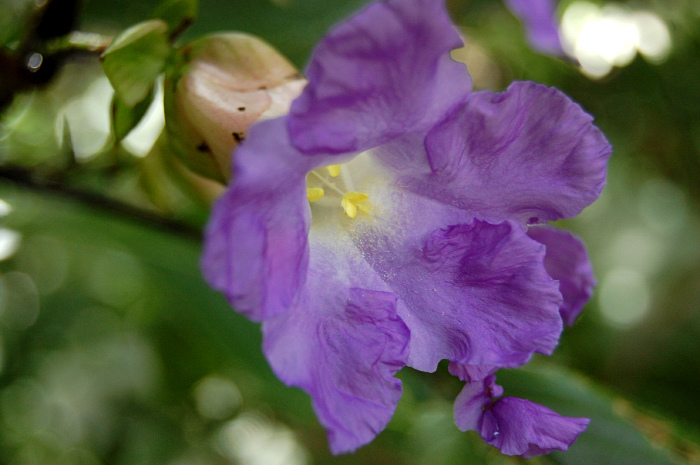
A large shrub, sometimes attaining 6-20 ft. in height and 21⁄2 inches in diameter; branches often warted or scabrous-tubercled. Leaves opposite, 7 by 3 in., sometimes much larger, crenate, rough, conspicuously marked with five lines above, nerves 8-16 pair; petiole 2-3 in. Flowers in strobiliform spikes 1-4 in. long, often densely or laxly cymose; bracts 1/2 - 1 in. long, orbicular or elliptic. Calyx 1/2 in., in fruit often exceeding 3/4 in., sub-equally 5-lobed to the base; segments oblong, obtuse, softly hairy. Corolla tubular-ventricose, 11⁄2 in., glabrous without, very hairy within, deep blue; lobes 5, nearly equal, contorted in bud. Stamens 4; filaments hairy downwards; anthers blunt; not spurred at the base. Ovary 4-ovuled; style linear; stigma of one long linear-lanceolate branch the other minute. Capsule 3/4 by 1/3 in., seeds more than 1/3 in. long, thin, obovate, acute, densely shaggy with white inelastic adpressed hair, except on the large oblong areoles.
Hub AI
Strobilanthes callosa AI simulator
(@Strobilanthes callosa_simulator)
Strobilanthes callosa
Strobilanthes callosa (Synonym: Carvia callosa (Nees) Bremek) is a shrub found mainly in the low lying hills of the Western Ghats, all along the west coast of India. Its standardized Hindi name is maruadona (मरुआदोना) which it is called in the state of Madhya Pradesh where it is also found. In the state of Maharashtra, in the Marathi language, and other local dialects and in the neighboring state of Karnataka, the shrub is locally known as karvi (कारवी), sometimes spelled in English as karvy.
This shrub belongs to the genus Strobilanthes which was first scientifically described by Nees in the 19th century. The genus has around 350 species, of which at least 46 are found in India. Because most of these species show an unusual flowering behaviour, varying from annual to 16-year blooming cycles, there is often confusion on the national scale about which plant is flowering.
It is a large shrub, sometimes attaining 6–20 ft in height and 21⁄2 inches in diameter and flowers between July and September. This plant is recognized for the fact that it takes nearly a decade for the bloom cycle to occur. Its leaves are home to several insects including caterpillars and snails which feed on it. The shrub has an interesting life cycle; It comes alive and green every year with the advent of monsoon, but once the rainy season is over, all that is left is dry and dead-looking stems. This pattern repeats itself for seven years, but in the eighth year the plant bursts into mass flowering.
Plants that bloom at long intervals like Strobilanthes callosa are known as plietesials, the term plietesial has been used in reference to perennial monocarpic plants “of the kind most often met with in the Strobilanthinae” (a subtribe of Acanthaceae containing Strobilanthes and allied genera) that usually grow gregariously, flower simultaneously following a long interval, set seed, and die. Other commonly used expressions or terms which apply to part or all of the plietesial life history include gregarious flowering, mast seeding, and supra-annual synchronized semelparity (semelparity = monocarpy).
In 1953 Sharfuddin Khan describing the plant in the former Hyderabad State wrote:
Botanical Name - Strobilanthes callosus
Strobilanthes, Blume.; F.B.I. IV-429. S. callosus, Nees.; F.B.I. IV-451. Brandi's Ind. Trees, 500. Gamble's Ind. Timbers, 518. Vern. Karvi, Mar.
A large shrub, sometimes attaining 6-20 ft. in height and 21⁄2 inches in diameter; branches often warted or scabrous-tubercled. Leaves opposite, 7 by 3 in., sometimes much larger, crenate, rough, conspicuously marked with five lines above, nerves 8-16 pair; petiole 2-3 in. Flowers in strobiliform spikes 1-4 in. long, often densely or laxly cymose; bracts 1/2 - 1 in. long, orbicular or elliptic. Calyx 1/2 in., in fruit often exceeding 3/4 in., sub-equally 5-lobed to the base; segments oblong, obtuse, softly hairy. Corolla tubular-ventricose, 11⁄2 in., glabrous without, very hairy within, deep blue; lobes 5, nearly equal, contorted in bud. Stamens 4; filaments hairy downwards; anthers blunt; not spurred at the base. Ovary 4-ovuled; style linear; stigma of one long linear-lanceolate branch the other minute. Capsule 3/4 by 1/3 in., seeds more than 1/3 in. long, thin, obovate, acute, densely shaggy with white inelastic adpressed hair, except on the large oblong areoles.