
Recent from talks
Structure factor
Knowledge base stats:
Talk channels stats:
Members stats:
Structure factor
In condensed matter physics and crystallography, the static structure factor (or structure factor for short) is a mathematical description of how a material scatters incident radiation. The structure factor is a critical tool in the interpretation of scattering patterns (interference patterns) obtained in X-ray, electron and neutron diffraction experiments.
Confusingly, there are two different mathematical expressions in use, both called 'structure factor'. One is usually written ; it is more generally valid, and relates the observed diffracted intensity per atom to that produced by a single scattering unit. The other is usually written or and is only valid for systems with long-range positional order — crystals. This expression relates the amplitude and phase of the beam diffracted by the planes of the crystal ( are the Miller indices of the planes) to that produced by a single scattering unit at the vertices of the primitive unit cell. is not a special case of ; gives the scattering intensity, but gives the amplitude. It is the modulus squared that gives the scattering intensity. is defined for a perfect crystal, and is used in crystallography, while is most useful for disordered systems. For partially ordered systems such as crystalline polymers there is obviously overlap, and experts will switch from one expression to the other as needed.


The static structure factor is measured without resolving the energy of scattered photons/electrons/neutrons. Energy-resolved measurements yield the dynamic structure factor.
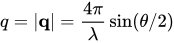
Consider the scattering of a beam of wavelength by an assembly of particles or atoms stationary at positions . Assume that the scattering is weak, so that the amplitude of the incident beam is constant throughout the sample volume (Born approximation), and absorption, refraction and multiple scattering can be neglected (kinematic diffraction). The direction of any scattered wave is defined by its scattering vector . This vector is , where and ( ) are the scattered and incident beam wavevectors, and is the angle between them. For elastic scattering, and , limiting the possible range of (see Ewald sphere). The amplitude and phase of this scattered wave will be the vector sum of the scattered waves from all the atoms









For an assembly of atoms, is the atomic form factor of the -th atom. The scattered intensity is obtained by multiplying this function by its complex conjugate


The structure factor is defined as this intensity normalized by

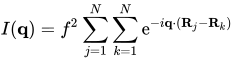
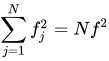
If all the atoms are identical, then Equation (1) becomes and so
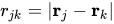
Another useful simplification is if the material is isotropic, like a powder or a simple liquid. In that case, the intensity depends on and . In three dimensions, Equation (2) then simplifies to the Debye scattering equation:

Hub AI
Structure factor AI simulator
(@Structure factor_simulator)
Structure factor
In condensed matter physics and crystallography, the static structure factor (or structure factor for short) is a mathematical description of how a material scatters incident radiation. The structure factor is a critical tool in the interpretation of scattering patterns (interference patterns) obtained in X-ray, electron and neutron diffraction experiments.
Confusingly, there are two different mathematical expressions in use, both called 'structure factor'. One is usually written ; it is more generally valid, and relates the observed diffracted intensity per atom to that produced by a single scattering unit. The other is usually written or and is only valid for systems with long-range positional order — crystals. This expression relates the amplitude and phase of the beam diffracted by the planes of the crystal ( are the Miller indices of the planes) to that produced by a single scattering unit at the vertices of the primitive unit cell. is not a special case of ; gives the scattering intensity, but gives the amplitude. It is the modulus squared that gives the scattering intensity. is defined for a perfect crystal, and is used in crystallography, while is most useful for disordered systems. For partially ordered systems such as crystalline polymers there is obviously overlap, and experts will switch from one expression to the other as needed.
The static structure factor is measured without resolving the energy of scattered photons/electrons/neutrons. Energy-resolved measurements yield the dynamic structure factor.
Consider the scattering of a beam of wavelength by an assembly of particles or atoms stationary at positions . Assume that the scattering is weak, so that the amplitude of the incident beam is constant throughout the sample volume (Born approximation), and absorption, refraction and multiple scattering can be neglected (kinematic diffraction). The direction of any scattered wave is defined by its scattering vector . This vector is , where and ( ) are the scattered and incident beam wavevectors, and is the angle between them. For elastic scattering, and , limiting the possible range of (see Ewald sphere). The amplitude and phase of this scattered wave will be the vector sum of the scattered waves from all the atoms
For an assembly of atoms, is the atomic form factor of the -th atom. The scattered intensity is obtained by multiplying this function by its complex conjugate
The structure factor is defined as this intensity normalized by
If all the atoms are identical, then Equation (1) becomes and so
Another useful simplification is if the material is isotropic, like a powder or a simple liquid. In that case, the intensity depends on and . In three dimensions, Equation (2) then simplifies to the Debye scattering equation: