Hubbry Logo
Atomic form factorAtomic form factorMain
Open search
Atomic form factor
Community hub
Atomic form factor
logo
8 pages, 0 posts
0 subscribers
Be the first to start a discussion here.
Atomic form factor
Atomic form factor
from Wikipedia
X-ray atomic form factors of oxygen (blue), chlorine (green), Cl (magenta), and K+ (red); smaller charge distributions have a wider form factor.

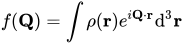
In physics, the atomic form factor, or atomic scattering factor, is a measure of the scattering amplitude of a wave by an isolated atom. The atomic form factor depends on the type of scattering, which in turn depends on the nature of the incident radiation, typically X-ray, electron or neutron. The common feature of all form factors is that they involve a Fourier transform of a spatial density distribution of the scattering object from real space to momentum space (also known as reciprocal space). For an object with spatial density distribution, , the form factor, , is defined as

,

where is the spatial density of the scatterer about its center of mass (), and is the momentum transfer. As a result of the nature of the Fourier transform, the broader the distribution of the scatterer in real space , the narrower the distribution of in ; i.e., the faster the decay of the form factor.

For crystals, atomic form factors are used to calculate the structure factor for a given Bragg peak of a crystal.

X-ray form factors

[edit]
The energy dependence of the real part of the atomic scattering factor of chlorine.

X-rays are scattered by the electron cloud of the atom and hence the scattering amplitude of X-rays increases with the atomic number, , of the atoms in a sample. As a result, X-rays are not very sensitive to light atoms, such as hydrogen and helium, and there is very little contrast between elements adjacent to each other in the periodic table. For X-ray scattering, in the above equation is the electron charge density about the nucleus, and the form factor the Fourier transform of this quantity. The assumption of a spherical distribution is usually good enough for X-ray crystallography.[1]

In general the X-ray form factor is complex but the imaginary components only become large near an absorption edge. Anomalous X-ray scattering makes use of the variation of the form factor close to an absorption edge to vary the scattering power of specific atoms in the sample by changing the energy of the incident x-rays hence enabling the extraction of more detailed structural information.

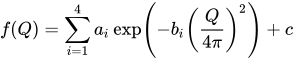
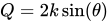
Atomic form factor patterns are often represented as a function of the magnitude of the scattering vector . Herein is the wavenumber and is the scattering angle between the incident x-ray beam and the detector measuring the scattered intensity, while is the wavelength of the X-rays. One interpretation of the scattering vector is that it is the resolution or yardstick with which the sample is observed. In the range of scattering vectors between Å−1, the atomic form factor is well approximated by a sum of Gaussians of the form
where the values of ai, bi, and c are tabulated here.[2]

Electron form factor

[edit]

The relevant distribution, is the potential distribution of the atom, and the electron form factor is the Fourier transform of this.[3] The electron form factors are normally calculated from X-ray form factors using the Mott–Bethe formula.[4] This formula takes into account both elastic electron-cloud scattering and elastic nuclear scattering.

Neutron form factor

[edit]

There are two distinct scattering interactions of neutrons by nuclei. Both are used in the investigation structure and dynamics of condensed matter: they are termed nuclear (sometimes also termed chemical) and magnetic scattering.

Nuclear scattering

[edit]

Nuclear scattering of the free neutron by the nucleus is mediated by the strong nuclear force. The wavelength of thermal (several ångströms) and cold neutrons (up to tens of Angstroms) typically used for such investigations is 4-5 orders of magnitude larger than the dimension of the nucleus (femtometres). The free neutrons in a beam travel in a plane wave; for those that undergo nuclear scattering from a nucleus, the nucleus acts as a secondary point source, and radiates scattered neutrons as a spherical wave. (Although a quantum phenomenon, this can be visualized in simple classical terms by the Huygens–Fresnel principle.) In this case is the spatial density distribution of the nucleus, which is an infinitesimal point (delta function), with respect to the neutron wavelength. The delta function forms part of the Fermi pseudopotential, by which the free neutron and the nuclei interact. The Fourier transform of a delta function is unity; therefore, it is commonly said that neutrons "do not have a form factor;" i.e., the scattered amplitude, , is independent of .

Since the interaction is nuclear, each isotope has a different scattering amplitude. This Fourier transform is scaled by the amplitude of the spherical wave, which has dimensions of length. Hence, the amplitude of scattering that characterizes the interaction of a neutron with a given isotope is termed the scattering length, b. Neutron scattering lengths vary erratically between neighbouring elements in the periodic table and between isotopes of the same element. They may only be determined experimentally, since the theory of nuclear forces is not adequate to calculate or predict b from other properties of the nucleus.[5]

Magnetic scattering

[edit]

Although neutral, neutrons also have a nuclear spin. They are a composite fermion and hence have an associated magnetic moment. In neutron scattering from condensed matter, magnetic scattering refers to the interaction of this moment with the magnetic moments arising from unpaired electrons in the outer orbitals of certain atoms. It is the spatial distribution of these unpaired electrons about the nucleus that is for magnetic scattering.

Since these orbitals are typically of a comparable size to the wavelength of the free neutrons, the resulting form factor resembles that of the X-ray form factor. However, this neutron-magnetic scattering is only from the outer electrons, rather than being heavily weighted by the core electrons, which is the case for X-ray scattering. Hence, in strong contrast to the case for nuclear scattering, the scattering object for magnetic scattering is far from a point source; it is still more diffuse than the effective size of the source for X-ray scattering, and the resulting Fourier transform (the magnetic form factor) decays more rapidly than the X-ray form factor.[6] Also, in contrast to nuclear scattering, the magnetic form factor is not isotope dependent, but is dependent on the oxidation state of the atom.

References

[edit]
Revisions and contributorsEdit on WikipediaRead on Wikipedia
from Grokipedia
The atomic form factor, also known as the atomic factor, is a fundamental quantity in physics that quantifies the of X-rays (or other electromagnetic waves) by the of an isolated atom, typically modeled as the of the atom's spherically symmetric distribution. It depends on the transfer q=4πsin(θ/2)λq = \frac{4\pi \sin(\theta/2)}{\lambda}, where θ\theta is the and λ\lambda is the , with the form factor f(0)f(0) equaling the ZZ (the total number of electrons) at zero and approaching zero for large angles due to destructive interference among scattered waves from distributed electrons. In X-ray crystallography and diffraction analysis, the atomic form factor plays a central role in calculating the structure factor F(G)F(\mathbf{G}), which determines the intensity of diffracted beams from a crystal lattice by summing contributions from all atoms in the unit cell: F(G)=jfj(G)eiGrjF(\mathbf{G}) = \sum_j f_j(\mathbf{G}) e^{i \mathbf{G} \cdot \mathbf{r}_j}, where jj indexes the atoms, fjf_j is the form factor for the jj-th atom, and rj\mathbf{r}_j is its position. This enables the determination of atomic positions, crystal structures, and material properties, with intensities proportional to F(G)2|F(\mathbf{G})|^2. The form factor is often approximated numerically using sums of Gaussian functions, f(G)=iaiebiG2+cf(G) = \sum_i a_i e^{-b_i G^2} + c, with coefficients tabulated for elements up to high atomic numbers. Near absorption edges, the atomic form factor includes anomalous dispersion corrections, comprising real (ff') and imaginary (ff'') components that account for energy-dependent and absorption, enhancing phase contrast in techniques like multiple-wavelength anomalous (MAD) for solving. Comprehensive tables of form factors, coefficients, and cross-sections are available for elements from (Z=1Z=1) to (Z=92Z=92) across energies from 1 eV to 433 keV, supporting applications in , , and . Analogous form factors exist for and , though the atomic form factor primarily refers to the case due to its electron-density sensitivity.

General Principles

Definition and Significance

The atomic form factor, also known as the atomic scattering factor, quantifies the amplitude of a scattered wave produced by an isolated atom when interacting with incident radiation such as X-rays, electrons, or neutrons. It serves as a measure of the atom's power and depends on the scattering angle as well as the type of probe used, reflecting the of scattering centers within the atom. This form factor plays a crucial role in experiments for determining atomic and molecular structures in , where it modulates the intensity of diffracted beams by accounting for the collective from all electrons (or other scatterers) in the atom. For example, as the scattering angle increases, the form factor diminishes due to destructive interference among the waves scattered by electrons at different positions within the atom, thereby influencing the observed diffraction pattern's contrast and resolution. The concept emerged in the early 20th century amid the foundational work on by and William Lawrence Bragg in the 1910s, who demonstrated how atomic arrangements produce diffraction patterns, laying the groundwork for understanding atomic-level . For X-rays, the atomic form factor is typically dimensionless and given in units of electrons, with its value at zero scattering angle, denoted f(0), equal to the Z, representing the total number of electrons available for .

Mathematical Formulation

The atomic form factor originates from the classical Thomson scattering for a free electron, which has a scattering amplitude of −r_e (where r_e is the classical electron radius), independent of scattering angle for low energies. For bound electrons in an atom, the form factor f(\mathbf{q}) accounts for phase differences due to their spatial distribution, given by the coherent sum f(\mathbf{q}) = \sum_{j=1}^Z \exp(i \mathbf{q} \cdot \mathbf{r}_j), such that the total scattering amplitude is −r_e f(\mathbf{q}). Here, \mathbf{q} is the momentum transfer vector with magnitude q = (4\pi / \lambda) \sin \theta, \lambda is the wavelength of the incident radiation, and \theta is half the scattering angle; in the continuum limit, this becomes the Fourier transform of the electron density distribution \rho(\mathbf{r}): f(q)=ρ(r)exp(iqr)d3r,f(\mathbf{q}) = \int \rho(\mathbf{r}) \exp(i \mathbf{q} \cdot \mathbf{r}) \, d^3\mathbf{r}, where \rho(\mathbf{r}) represents the charge density for X-ray or electron scattering (or nuclear/magnetic density for neutrons). This formulation assumes an isolated atom, neglecting interatomic interference effects that are accounted for separately by the structure factor in crystalline materials, and treats the atom as a collection of independent scatterers under the first Born approximation. Spherical symmetry of the atomic density is often invoked, justified by the approximate isotropy of isolated atoms, allowing \rho(\mathbf{r}) = \rho(r). Under this assumption, the angular integral over the exponential phase factor simplifies, yielding: f(q)=4π0ρ(r)r2sin(qr)qrdr.f(q) = 4\pi \int_0^\infty \rho(r) r^2 \frac{\sin(qr)}{qr} \, dr. The density \rho(r) is normalized such that \int \rho(\mathbf{r}) , d^3\mathbf{r} = Z for electron scattering, ensuring |f(0)| = Z, the atomic number, which corresponds to forward scattering where all electrons contribute in phase. These expressions hold under the kinematical approximation, valid for small scattering angles where q is modest and multiple scattering is negligible; at high energies or large angles, the form factor breaks down due to relativistic effects or the need for dynamical diffraction theory. In applications to crystalline scattering, the atomic form factor contributes to the overall intensity via I \propto |F|^2, where F is the structure factor summing form factors over lattice sites.

X-ray Form Factors

Non-resonant Scattering

In non-resonant X-ray scattering, the atomic form factor fX(θ)f_X(\theta) describes the scattering amplitude from the electron cloud of an atom, approximated as the sum over its ZZ electrons: fX(θ)j=1Zexp(iqrj),f_X(\theta) \approx \sum_{j=1}^Z \exp(i \mathbf{q} \cdot \mathbf{r}_j), where q\mathbf{q} is the momentum transfer vector with magnitude q=4πsinθ/λq = 4\pi \sin\theta / \lambda, θ\theta is the scattering angle, and λ\lambda is the X-ray wavelength. This expression is equivalent to the Fourier transform of the spherically symmetric atomic electron density ρ(r)\rho(r): fX(q)=ρ(r)exp(iqr)dr.f_X(q) = \int \rho(\mathbf{r}) \exp(i \mathbf{q} \cdot \mathbf{r}) \, d\mathbf{r}. At zero momentum transfer (q=0q = 0), fX(0)=Zf_X(0) = Z, reflecting the total number of electrons, while it decreases at higher angles due to destructive interference from the distributed electron density. Tabulated values of fXf_X as a function of sinθ/λ\sin\theta / \lambda are available for elements across the periodic table, enabling direct use in . For instance, the International Tables for , Volume C, provide mean atomic scattering factors in electrons for free atoms, where for carbon (Z=6Z = 6), fX(0)=6f_X(0) = 6 and the value falls to approximately 1 at high scattering angles corresponding to sinθ/λ4\sin\theta / \lambda \approx 4 Å1^{-1}. These tables, derived from numerical relativistic Dirac-Fock computations, account for core and contributions and are widely used for evaluations in refinement. Detailed tabulations, such as those by Chantler, extend this to precise form factors up to high energies, resolving discrepancies in earlier datasets. The independent atom model (IAM) approximates the electron density in the crystal as the superposition of individual atomic densities without bonding effects, leading to the structure factor F(G)=jfj(G)eiGrjF(\mathbf{G}) = \sum_j f_j(\mathbf{G}) e^{i \mathbf{G} \cdot \mathbf{r}_j}, where each fjf_j is the form factor for the jj-th atom, often arising from core or valence electrons treated separately. Computational models for fjf_j often employ Gaussian expansions or Hartree-Fock wave functions to represent ρ(r)\rho(r); for example, Cromer and Mann's numerical Hartree-Fock calculations provide accurate fXf_X values by integrating radial electron densities from self-consistent field solutions. Gaussian fits, typically as a sum of 4–10 terms, facilitate rapid evaluation in refinement algorithms while maintaining fidelity to quantum mechanical densities. Thermal motion broadens the effective , introducing a Debye-Waller factor that modulates the form factor: fX(q,T)=fX(q)exp(Bsin2θλ2),f_X(q, T) = f_X(q) \exp\left( -\frac{B \sin^2\theta}{\lambda^2} \right), where BB (in Ų) is the atomic factor, typically 1–5 for room-temperature , quantifying mean-square atomic displacements. This isotropic approximation assumes harmonic vibrations and is essential for correcting observed intensities in patterns. In practice, fXf_X values are computed using crystallographic software for refinement, such as the CCP4 suite's SFALL program, which generates factors from atomic coordinates and tabulated form factors. Python libraries, including those in the Gemmi package, offer modular access to atomic computations via interpolated tables or direct density integrations, supporting workflows in high-throughput .

Anomalous Dispersion

The anomalous form factor modifies the atomic scattering factor for X-rays near absorption edges, expressed as f=f0+f+iff = f_0 + f' + i f'', where f0f_0 is the non-resonant () atomic scattering factor, ff' is the real dispersive correction that is typically negative and reduces the effective , and ff'' is the positive imaginary absorptive component related to photoelectric absorption. This modification arises physically when the photon energy approaches atomic absorption edges, such as K- or L-edges, where it matches electronic transitions from inner shells, leading to resonant phase shifts in the scattered wave and increased absorption. The real and imaginary parts ff' and ff'' are interconnected through Kramers-Kronig relations, which derive them from the energy-dependent absorption cross-section μ(E)\mu(E), ensuring causality in the atomic response. Tabulated values of ff' and ff'' are available in databases computed using relativistic methods, such as the Cromer-Liberman approach or the NIST Form Factor Database, providing energy-specific corrections for elements across the periodic table. For example, at the K-edge (E8.98E \approx 8.98 keV), typical values are f5f' \approx -5 and f20f'' \approx 20, illustrating the significant dispersive reduction and absorptive enhancement near . In applications, anomalous dispersion enables solving the phase problem in through techniques like multiple-wavelength anomalous (MAD), where differences in scattering factors at distinct energies provide phase information via Δf=f(E2)f(E1)\Delta f = f'(E_2) - f'(E_1). This method has become a standard for de novo structure determination of macromolecules, leveraging sources for tunable wavelengths near edges. These corrections are valid primarily near absorption edges, within about ΔE/E<10%\Delta E / E < 10\%, where resonant effects dominate; far from edges, especially for hard X-rays, the anomalous terms become negligible compared to f0f_0.

Electron Form Factors

Elastic Scattering Amplitude

The elastic scattering amplitude for electrons interacting with atoms is described within the first Born approximation as the Fourier transform of the atomic electrostatic potential V(r)V(\mathbf{r}), given by fe(q)=me2π2V(r)eiqrd3r,f_e(\mathbf{q}) = -\frac{m_e}{2\pi \hbar^2} \int V(\mathbf{r}) e^{i \mathbf{q} \cdot \mathbf{r}} \, d^3\mathbf{r}, where mem_e is the electron mass, \hbar is the reduced Planck's constant, and q\mathbf{q} is the momentum transfer vector with magnitude q=4πλsin(θ/2)q = \frac{4\pi}{\lambda} \sin(\theta/2), λ\lambda being the de Broglie wavelength and θ\theta the scattering angle. For neutral atoms, the potential arises from the nuclear charge screened by the electron cloud, leading to an equivalent form fe(q)=2mee22q2[ZfX(q)]f_e(q) = \frac{2 m_e e^2}{\hbar^2 q^2} [Z - f_X(q)], where ZZ is the atomic number, ee is the elementary charge, and fX(q)f_X(q) is the X-ray atomic form factor representing the Fourier transform of the electron density. This expression, known as the non-relativistic Mott-Bethe formula, highlights how electrons probe the atomic potential directly, in contrast to X-rays which scatter from the charge density. In the Thomas-Fermi approximation, which models the electron density statistically for high-ZZ atoms, the screened Coulomb potential yields an analytic form for the scattering amplitude approximately as fe(q)Z(1+(qa0/2)2)2f_e(q) \approx \frac{Z}{(1 + (q a_0 / 2)^2)^2}, where a0a_0 is the Bohr radius adjusted by a screening parameter dependent on ZZ. This approximation captures the exponential screening of the nuclear potential at distances beyond the Thomas-Fermi screening length, roughly 0.885a0Z1/30.885 a_0 Z^{-1/3}, leading to a modified Rutherford scattering where the amplitude decreases more gradually with qq compared to point-charge scattering. The differential elastic cross-section is then dσdΩ=fe(q)2\frac{d\sigma}{d\Omega} = |f_e(q)|^2, which, due to the longer de Broglie wavelength of electrons relative to X-rays at typical energies, allows probing of atomic structure at larger scattering angles before the amplitude diminishes significantly. Relativistic corrections to the non-relativistic form become important at higher energies, introducing the formula to account for spin-orbit interactions and Dirac effects: fMott(q)=Zα2sin2(θ/2)[1+β2sin2(θ/2)+higher-order terms],f_\text{Mott}(q) = -\frac{Z \alpha}{2 \sin^2(\theta/2)} \left[ 1 + \beta^2 \sin^2(\theta/2) + \text{higher-order terms} \right], where α=e2/(c)1/137\alpha = e^2 / (\hbar c) \approx 1/137 is the and β=v/c\beta = v/c is the electron velocity in units of the ; detailed expansions address and screening. Unlike scattering, which is insensitive to light elements due to weak contrast in electron density, electron elastic scattering via the excels in imaging light atoms in (TEM), enabling atomic-resolution structural determination in materials like carbon-based nanostructures. Tabulated values of fe(q)f_e(q) for practical computations are available in standard references, such as the International Tables for Crystallography, where for (Z=79Z = 79) at 100 keV incident energy, the form factor remains significant (above 10% of the forward value) up to scattering angles of approximately 20–30 mrad, supporting high-angle in scanning TEM.

Relativistic and Inelastic Effects

At high energies, relativistic effects must be incorporated into the electron atomic form factor to account for the Dirac of the , particularly in scattering from the nuclear potential. The relativistic amplitude provides the point-nucleus limit, given by f=Ze216πϵ0E[1sin2(θ/2)iβcos(θ/2)sin2(θ/2)+spin terms],f = \frac{Z e^{2}}{16 \pi \epsilon_{0} E} \left[ \frac{1}{\sin^{2}(\theta/2)} - i \beta \frac{\cos(\theta/2)}{\sin^{2}(\theta/2)} + \text{spin terms} \right], where β=v/c\beta = v/c is the electron velocity in units of the speed of light, EE is the incident kinetic electron energy, and the imaginary term arises from spin-orbit coupling. This formulation, derived from the Dirac equation, enhances the scattering cross-section compared to non-relativistic Rutherford scattering, with the increase more pronounced for heavy elements due to stronger Coulomb fields. Inelastic effects introduce energy loss ω\omega during , modifying the form factor to include excitations such as plasmons and inner-shell transitions. The imaginary part of the inelastic form factor, Im[finel(q,ω)]\operatorname{Im}[f_{\text{inel}}(q, \omega)], is connected to the dynamic S(q,ω)S(q, \omega) through the fluctuation-dissipation theorem, which relates it to the imaginary part of the response function and ensures between absorption and emission processes. This allows quantification of energy dissipation, with S(q,ω)S(q, \omega) capturing the of fluctuations in the atomic electron cloud. Corrections to the elastic form factor fe(q)f_e(q) arise from exchange and , incorporated via the Hartree-Fock-Slater (HFS) model, which approximates the many-electron potential with a statistical exchange term. For greater precision, especially at high ZZ and relativistic speeds, the Dirac-Hartree-Fock (DHF) method solves the self-consistently, yielding improved fe(q)f_e(q) by including spin-orbit interactions and orbital contraction. These approaches refine the form factor beyond the independent approximation, reducing errors in momentum-space densities. In high-voltage (TEM) operating at 300 kV, relativistic effects significantly influence , boosting fe(q)f_e(q) by a factor of approximately 1.2 for light atoms at typical angles due to increased effective transfer and wave function contraction. Experimental and tabulated data, such as those from the EEDL97 library, support these corrections for validating simulations in materials analysis. However, the first underlying many form factor calculations fails at low energies below 10 keV, where exact partial-wave methods are required, and multiple in condensed matter deviates from the isolated atom model, necessitating dynamical theories.

Neutron Form Factors

Nuclear Coherent Scattering

The neutron atomic form factor arising from nuclear coherent scattering is approximated by the bound coherent scattering length bcohb_\text{coh}, which provides an isotropic and angle-independent description of the scattering amplitude fnbcohf_n \approx b_\text{coh} to first order for low momentum transfers qq. This parameter quantifies the coherent elastic interaction between thermal neutrons and the nucleus, enabling interference effects that reveal atomic structure in scattering experiments. The interaction stems from the short-range strong nuclear force, with the scattering length bcohb_\text{coh} determined experimentally from low-energy scattering measurements and tabulated for practical use per . Theoretical contributions from nuclear resonances can be approximated using dispersion relations derived from the optical , but experimental values are preferred due to complex nuclear structure effects. Accounting for the finite nuclear size, the momentum-dependent form factor is given by fn(q)=bcohρnuc(r)eiqrd3rf_n(\mathbf{q}) = b_\text{coh} \int \rho_\text{nuc}(\mathbf{r}) e^{i \mathbf{q} \cdot \mathbf{r}} \, d^3\mathbf{r}, where ρnuc(r)\rho_\text{nuc}(\mathbf{r}) is the nuclear density distribution. For typical qq values and nuclear radii Rnuc15R_\text{nuc} \sim 1{-}5 fm, this approximates to fn(q)bcohexp(q2Rnuc2/6)f_n(q) \approx b_\text{coh} \exp\left( -q^2 R_\text{nuc}^2 / 6 \right), yielding a nearly constant since qRnuc1q R_\text{nuc} \ll 1. Values of bcohb_\text{coh} vary irregularly with isotope due to differences in nuclear structure, enabling contrast variation techniques; for instance, protium (^1H) has bcoh=3.74b_\text{coh} = -3.74 fm, deuterium (^2H) has +6.67 fm, and heavier elements like natural have ~+10.3 fm, while many heavy nuclei range from ~+4 to +12 fm. Coherent scattering is separated from incoherent (spin-dependent) contributions by measuring total cross sections and spin statistics. Tabulated data, compiled in resources like the NIST Neutron Data compilation (based on ) and Koester tables, are expressed in femtometers (fm; 1 fm = 10^{-15} m), with typical magnitudes |b| ~ 10^{-12} cm. These properties make nuclear coherent scattering ideal for neutron diffraction studies of materials with light elements, such as locating positions in biological structures where the large negative bcohb_\text{coh} of protium provides strong contrast against heavier atoms.

Magnetic Scattering

Magnetic scattering of s by atoms occurs through the dipole interaction between the 's intrinsic , μn=1.91μN\mu_n = -1.91 \mu_N (with μN\mu_N the ), and the generated by the spins and orbital currents of atomic electrons. This contrasts with nuclear scattering by providing sensitivity to electronic magnetism, enabling probes of atomic-scale magnetic distributions. The interaction Hamiltonian is proportional to σnB\vec{\sigma}_n \cdot \vec{B}
Add your contribution
Related Hubs
User Avatar
No comments yet.