Structure factor
Structure factor
Main page

Structure factor

logo
Community Hub0 subscribers
Read side by side
from Wikipedia

In condensed matter physics and crystallography, the static structure factor (or structure factor for short) is a mathematical description of how a material scatters incident radiation. The structure factor is a critical tool in the interpretation of scattering patterns (interference patterns) obtained in X-ray, electron and neutron diffraction experiments.

Confusingly, there are two different mathematical expressions in use, both called 'structure factor'. One is usually written ; it is more generally valid, and relates the observed diffracted intensity per atom to that produced by a single scattering unit. The other is usually written or and is only valid for systems with long-range positional order — crystals. This expression relates the amplitude and phase of the beam diffracted by the planes of the crystal ( are the Miller indices of the planes) to that produced by a single scattering unit at the vertices of the primitive unit cell. is not a special case of ; gives the scattering intensity, but gives the amplitude. It is the modulus squared that gives the scattering intensity. is defined for a perfect crystal, and is used in crystallography, while is most useful for disordered systems. For partially ordered systems such as crystalline polymers there is obviously overlap, and experts will switch from one expression to the other as needed.

The static structure factor is measured without resolving the energy of scattered photons/electrons/neutrons. Energy-resolved measurements yield the dynamic structure factor.

Derivation of S(q)

[edit]

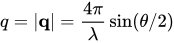
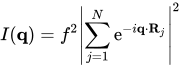
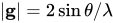
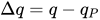
Consider the scattering of a beam of wavelength by an assembly of particles or atoms stationary at positions . Assume that the scattering is weak, so that the amplitude of the incident beam is constant throughout the sample volume (Born approximation), and absorption, refraction and multiple scattering can be neglected (kinematic diffraction). The direction of any scattered wave is defined by its scattering vector . This vector is , where and ( ) are the scattered and incident beam wavevectors, and is the angle between them. For elastic scattering, and , limiting the possible range of (see Ewald sphere). The amplitude and phase of this scattered wave will be the vector sum of the scattered waves from all the atoms [1][2]

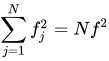
For an assembly of atoms, is the atomic form factor of the -th atom. The scattered intensity is obtained by multiplying this function by its complex conjugate

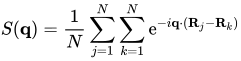
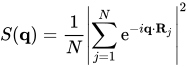
The structure factor is defined as this intensity normalized by [3]

If all the atoms are identical, then Equation (1) becomes and so
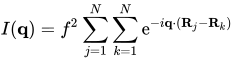
Another useful simplification is if the material is isotropic, like a powder or a simple liquid. In that case, the intensity depends on and . In three dimensions, Equation (2) then simplifies to the Debye scattering equation:[1]

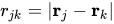
An alternative derivation gives good insight, but uses Fourier transforms and convolution. To be general, consider a scalar (real) quantity defined in a volume ; this may correspond, for instance, to a mass or charge distribution or to the refractive index of an inhomogeneous medium. If the scalar function is integrable, we can write its Fourier transform as . In the Born approximation the amplitude of the scattered wave corresponding to the scattering vector is proportional to the Fourier transform .[1] When the system under study is composed of a number of identical constituents (atoms, molecules, colloidal particles, etc.) each of which has a distribution of mass or charge then the total distribution can be considered the convolution of this function with a set of delta functions.

with the particle positions as before. Using the property that the Fourier transform of a convolution product is simply the product of the Fourier transforms of the two factors, we have , so that:

This is clearly the same as Equation (1) with all particles identical, except that here is shown explicitly as a function of .

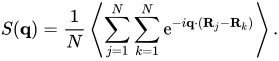
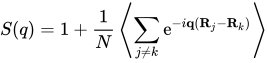
In general, the particle positions are not fixed and the measurement takes place over a finite exposure time and with a macroscopic sample (much larger than the interparticle distance). The experimentally accessible intensity is thus an averaged one ; we need not specify whether denotes a time or ensemble average. To take this into account we can rewrite Equation (3) as:

Perfect crystals

[edit]

In a crystal, the constitutive particles are arranged periodically, with translational symmetry forming a lattice. The crystal structure can be described as a Bravais lattice with a group of atoms, called the basis, placed at every lattice point; that is, [crystal structure] = [lattice] [basis]. If the lattice is infinite and completely regular, the system is a perfect crystal. For such a system, only a set of specific values for can give scattering, and the scattering amplitude for all other values is zero. This set of values forms a lattice, called the reciprocal lattice, which is the Fourier transform of the real-space crystal lattice.

In principle the scattering factor can be used to determine the scattering from a perfect crystal; in the simple case when the basis is a single atom at the origin (and again neglecting all thermal motion, so that there is no need for averaging) all the atoms have identical environments. Equation (1) can be written as

and .

The structure factor is then simply the squared modulus of the Fourier transform of the lattice, and shows the directions in which scattering can have non-zero intensity. At these values of the wave from every lattice point is in phase. The value of the structure factor is the same for all these reciprocal lattice points, and the intensity varies only due to changes in with .

Units

[edit]

The units of the structure-factor amplitude depend on the incident radiation. For X-ray crystallography they are multiples of the unit of scattering by a single electron (2.82 m); for neutron scattering by atomic nuclei the unit of scattering length of m is commonly used.

The above discussion uses the wave vectors and . However, crystallography often uses wave vectors and . Therefore, when comparing equations from different sources, the factor may appear and disappear, and care to maintain consistent quantities is required to get correct numerical results.


Definition of Fhkl

[edit]

In crystallography, the basis and lattice are treated separately. For a perfect crystal the lattice gives the reciprocal lattice, which determines the positions (angles) of diffracted beams, and the basis gives the structure factor which determines the amplitude and phase of the diffracted beams:

where the sum is over all atoms in the unit cell, are the positional coordinates of the -th atom, and is the scattering factor of the -th atom.[4] The coordinates have the directions and dimensions of the lattice vectors . That is, (0,0,0) is at the lattice point, the origin of position in the unit cell; (1,0,0) is at the next lattice point along and (1/2, 1/2, 1/2) is at the body center of the unit cell. defines a reciprocal lattice point at which corresponds to the real-space plane defined by the Miller indices (see Bragg's law).

is the vector sum of waves from all atoms within the unit cell. An atom at any lattice point has the reference phase angle zero for all since then is always an integer. A wave scattered from an atom at (1/2, 0, 0) will be in phase if is even, out of phase if is odd.


Again an alternative view using convolution can be helpful. Since [crystal structure] = [lattice] [basis], [crystal structure] = [lattice] [basis]; that is, scattering [reciprocal lattice] [structure factor].

Examples of Fhkl in 3-D

[edit]

Body-centered cubic (BCC)

[edit]

For the body-centered cubic Bravais lattice (cI), we use the points and which leads us to

and hence

Face-centered cubic (FCC)

[edit]

The FCC lattice is a Bravais lattice, and its Fourier transform is a body-centered cubic lattice. However to obtain without this shortcut, consider an FCC crystal with one atom at each lattice point as a primitive or simple cubic with a basis of 4 atoms, at the origin and at the three adjacent face centers, , and . Equation (8) becomes

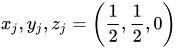
with the result

The most intense diffraction peak from a material that crystallizes in the FCC structure is typically the (111). Films of FCC materials like gold tend to grow in a (111) orientation with a triangular surface symmetry. A zero diffracted intensity for a group of diffracted beams (here, of mixed parity) is called a systematic absence.

Diamond crystal structure

[edit]

The diamond cubic crystal structure occurs for example diamond (carbon), tin, and most semiconductors. There are 8 atoms in the cubic unit cell. We can consider the structure as a simple cubic with a basis of 8 atoms, at positions

But comparing this to the FCC above, we see that it is simpler to describe the structure as FCC with a basis of two atoms at (0, 0, 0) and (1/4, 1/4, 1/4). For this basis, Equation (8) becomes:

And then the structure factor for the diamond cubic structure is the product of this and the structure factor for FCC above, (only including the atomic form factor once)

with the result

  • If h, k, ℓ are of mixed parity (odd and even values combined) the first (FCC) term is zero, so
  • If h, k, ℓ are all even or all odd then the first (FCC) term is 4
    • if h+k+ℓ is odd then
    • if h+k+ℓ is even and exactly divisible by 4 () then
    • if h+k+ℓ is even but not exactly divisible by 4 () the second term is zero and

These points are encapsulated by the following equations:
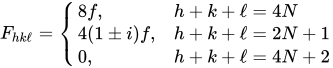
where is an integer.

Zincblende crystal structure

[edit]

The zincblende structure is similar to the diamond structure except that it is a compound of two distinct interpenetrating fcc lattices, rather than all the same element. Denoting the two elements in the compound by and , the resulting structure factor is

Cesium chloride

[edit]

Cesium chloride is a simple cubic crystal lattice with a basis of Cs at (0,0,0) and Cl at (1/2, 1/2, 1/2) (or the other way around, it makes no difference). Equation (8) becomes

We then arrive at the following result for the structure factor for scattering from a plane :

and for scattered intensity,

Hexagonal close-packed (HCP)

[edit]

In an HCP crystal such as graphite, the two coordinates include the origin and the next plane up the c axis located at c/2, and hence , which gives us

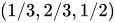
From this it is convenient to define dummy variable , and from there consider the modulus squared so hence

This leads us to the following conditions for the structure factor:
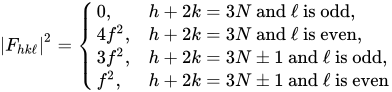
Perfect crystals in one and two dimensions

[edit]

The reciprocal lattice is easily constructed in one dimension: for particles on a line with a period , the reciprocal lattice is an infinite array of points with spacing . In two dimensions, there are only five Bravais lattices. The corresponding reciprocal lattices have the same symmetry as the direct lattice. 2-D lattices are excellent for demonstrating simple diffraction geometry on a flat screen, as below. Equations (1)–(7) for structure factor apply with a scattering vector of limited dimensionality and a crystallographic structure factor can be defined in 2-D as .

However, recall that real 2-D crystals such as graphene exist in 3-D. The reciprocal lattice of a 2-D hexagonal sheet that exists in 3-D space in the plane is a hexagonal array of lines parallel to the or axis that extend to and intersect any plane of constant in a hexagonal array of points.

Diagram of scattering by a square (planar) lattice. The incident and outgoing beam are shown, as well as the relation between their wave vectors , and the scattering vector .

The Figure shows the construction of one vector of a 2-D reciprocal lattice and its relation to a scattering experiment.

A parallel beam, with wave vector is incident on a square lattice of parameter . The scattered wave is detected at a certain angle, which defines the wave vector of the outgoing beam, (under the assumption of elastic scattering, ). One can equally define the scattering vector and construct the harmonic pattern . In the depicted example, the spacing of this pattern coincides to the distance between particle rows: , so that contributions to the scattering from all particles are in phase (constructive interference). Thus, the total signal in direction is strong, and belongs to the reciprocal lattice. It is easily shown that this configuration fulfills Bragg's law.

Structure factor of a periodic chain, for different particle numbers .

Imperfect crystals

[edit]

Technically a perfect crystal must be infinite, so a finite size is an imperfection. Real crystals always exhibit imperfections of their order besides their finite size, and these imperfections can have profound effects on the properties of the material. André Guinier[5] proposed a widely employed distinction between imperfections that preserve the long-range order of the crystal that he called disorder of the first kind and those that destroy it called disorder of the second kind. An example of the first is thermal vibration; an example of the second is some density of dislocations.

The generally applicable structure factor can be used to include the effect of any imperfection. In crystallography, these effects are treated as separate from the structure factor , so separate factors for size or thermal effects are introduced into the expressions for scattered intensity, leaving the perfect crystal structure factor unchanged. Therefore, a detailed description of these factors in crystallographic structure modeling and structure determination by diffraction is not appropriate in this article.

Finite-size effects

[edit]

For a finite crystal means that the sums in equations 1-7 are now over a finite . The effect is most easily demonstrated with a 1-D lattice of points. The sum of the phase factors is a geometric series and the structure factor becomes:

This function is shown in the Figure for different values of . When the scattering from every particle is in phase, which is when the scattering is at a reciprocal lattice point , the sum of the amplitudes must be and so the maxima in intensity are . Taking the above expression for and estimating the limit using, for instance, L'Hôpital's rule) shows that as seen in the Figure. At the midpoint (by direct evaluation) and the peak width decreases like . In the large limit, the peaks become infinitely sharp Dirac delta functions, the reciprocal lattice of the perfect 1-D lattice.

In crystallography when is used, is large, and the formal size effect on diffraction is taken as , which is the same as the expression for above near to the reciprocal lattice points, . Using convolution, we can describe the finite real crystal structure as [lattice] [basis] rectangular function, where the rectangular function has a value 1 inside the crystal and 0 outside it. Then [crystal structure] = [lattice] [basis] [rectangular function]; that is, scattering [reciprocal lattice] [structure factor] [ sinc function]. Thus the intensity, which is a delta function of position for the perfect crystal, becomes a function around every point with a maximum , a width , area .

Disorder of the first kind

[edit]

This model for disorder in a crystal starts with the structure factor of a perfect crystal. In one-dimension for simplicity and with N planes, we then start with the expression above for a perfect finite lattice, and then this disorder only changes by a multiplicative factor, to give[1]

where the disorder is measured by the mean-square displacement of the positions from their positions in a perfect one-dimensional lattice: , i.e., , where is a small (much less than ) random displacement. For disorder of the first kind, each random displacement is independent of the others, and with respect to a perfect lattice. Thus the displacements do not destroy the translational order of the crystal. This has the consequence that for infinite crystals () the structure factor still has delta-function Bragg peaks – the peak width still goes to zero as , with this kind of disorder. However, it does reduce the amplitude of the peaks, and due to the factor of in the exponential factor, it reduces peaks at large much more than peaks at small .


The structure is simply reduced by a and disorder dependent term because all disorder of the first-kind does is smear out the scattering planes, effectively reducing the form factor.

In three dimensions the effect is the same, the structure is again reduced by a multiplicative factor, and this factor is often called the Debye–Waller factor. Note that the Debye–Waller factor is often ascribed to thermal motion, i.e., the are due to thermal motion, but any random displacements about a perfect lattice, not just thermal ones, will contribute to the Debye–Waller factor.

Disorder of the second kind

[edit]

However, fluctuations that cause the correlations between pairs of atoms to decrease as their separation increases, causes the Bragg peaks in the structure factor of a crystal to broaden. To see how this works, we consider a one-dimensional toy model: a stack of plates with mean spacing . The derivation follows that in chapter 9 of Guinier's textbook.[6] This model has been pioneered by and applied to a number of materials by Hosemann and collaborators[7] over a number of years. Guinier and they termed this disorder of the second kind, and Hosemann in particular referred to this imperfect crystalline ordering as paracrystalline ordering. Disorder of the first kind is the source of the Debye–Waller factor.

To derive the model we start with the definition (in one dimension) of the
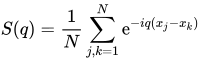
To start with we will consider, for simplicity an infinite crystal, i.e., . We will consider a finite crystal with disorder of the second-type below.

For our infinite crystal, we want to consider pairs of lattice sites. For large each plane of an infinite crystal, there are two neighbours planes away, so the above double sum becomes a single sum over pairs of neighbours either side of an atom, at positions and lattice spacings away, times . So, then

where is the probability density function for the separation of a pair of planes, lattice spacings apart. For the separation of neighbouring planes we assume for simplicity that the fluctuations around the mean neighbour spacing of a are Gaussian, i.e., that

and we also assume that the fluctuations between a plane and its neighbour, and between this neighbour and the next plane, are independent. Then is just the convolution of two s, etc. As the convolution of two Gaussians is just another Gaussian, we have that

The sum in is then just a sum of Fourier transforms of Gaussians, and so
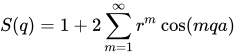
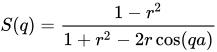
for . The sum is just the real part of the sum and so the structure factor of the infinite but disordered crystal is

This has peaks at maxima , where . These peaks have heights

i.e., the height of successive peaks drop off as the order of the peak (and so ) squared. Unlike finite-size effects that broaden peaks but do not decrease their height, disorder lowers peak heights. Note that here we assuming that the disorder is relatively weak, so that we still have relatively well defined peaks. This is the limit , where . In this limit, near a peak we can approximate , with and obtain

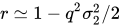
which is a Lorentzian or Cauchy function, of FWHM , i.e., the FWHM increases as the square of the order of peak, and so as the square of the wave vector at the peak.

Finally, the product of the peak height and the FWHM is constant and equals , in the limit. For the first few peaks where is not large, this is just the limit.

Finite crystals with disorder of the second kind

[edit]

For a one-dimensional crystal of size

where the factor in parentheses comes from the fact the sum is over nearest-neighbour pairs (), next nearest-neighbours (), ... and for a crystal of planes, there are pairs of nearest neighbours, pairs of next-nearest neighbours, etc.

Liquids

[edit]

In contrast with crystals, liquids have no long-range order (in particular, there is no regular lattice), so the structure factor does not exhibit sharp peaks. They do however show a certain degree of short-range order, depending on their density and on the strength of the interaction between particles. Liquids are isotropic, so that, after the averaging operation in Equation (4), the structure factor only depends on the absolute magnitude of the scattering vector . For further evaluation, it is convenient to separate the diagonal terms in the double sum, whose phase is identically zero, and therefore each contribute a unit constant:

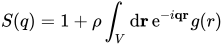
One can obtain an alternative expression for in terms of the radial distribution function :[8]

Ideal gas

[edit]

In the limiting case of no interaction, the system is an ideal gas and the structure factor is completely featureless: , because there is no correlation between the positions and of different particles (they are independent random variables), so the off-diagonal terms in Equation (9) average to zero: .

High-q limit

[edit]

Even for interacting particles, at high scattering vector the structure factor goes to 1. This result follows from Equation (10), since is the Fourier transform of the "regular" function and thus goes to zero for high values of the argument . This reasoning does not hold for a perfect crystal, where the distribution function exhibits infinitely sharp peaks.

Low-q limit

[edit]

In the low- limit, as the system is probed over large length scales, the structure factor contains thermodynamic information, being related to the isothermal compressibility of the liquid by the compressibility equation:

.

Hard-sphere liquids

[edit]
Structure factor of a hard-sphere fluid, calculated using the Percus-Yevick approximation, for volume fractions from 1% to 40%.

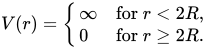
In the hard sphere model, the particles are described as impenetrable spheres with radius ; thus, their center-to-center distance and they experience no interaction beyond this distance. Their interaction potential can be written as:

This model has an analytical solution[9] in the Percus–Yevick approximation. Although highly simplified, it provides a good description for systems ranging from liquid metals[10] to colloidal suspensions.[11] In an illustration, the structure factor for a hard-sphere fluid is shown in the Figure, for volume fractions from 1% to 40%.

Polymers

[edit]

In polymer systems, the general definition (4) holds; the elementary constituents are now the monomers making up the chains. However, the structure factor being a measure of the correlation between particle positions, one can reasonably expect that this correlation will be different for monomers belonging to the same chain or to different chains.

Let us assume that the volume contains identical molecules, each composed of monomers, such that ( is also known as the degree of polymerization). We can rewrite (4) as:

where indices label the different molecules and the different monomers along each molecule. On the right-hand side we separated intramolecular () and intermolecular () terms. Using the equivalence of the chains, (11) can be simplified:[12]

where is the single-chain structure factor.

See also

[edit]

Notes

[edit]

References

[edit]
[edit]
Revisions and contributorsEdit on WikipediaRead on Wikipedia
from Grokipedia
The structure factor Fhkl\mathbf{F}_{hkl} is a mathematical function that describes the amplitude and phase of a wave diffracted from a crystalline material by lattice planes with Miller indices hh, kk, and ll.[1] It encapsulates the collective scattering contributions from all atoms in the unit cell, depending on their positions and scattering factors, and serves as the central quantity in diffraction-based structure analysis across X-ray, neutron, and electron methods.[2][3] Mathematically, the structure factor is expressed as Fhkl=jfjexp[2πi(hxj+kyj+lzj)]\mathbf{F}_{hkl} = \sum_j f_j \exp\left[2\pi i (h x_j + k y_j + l z_j)\right], where the sum is over all atoms jj in the unit cell, fjf_j is the atomic scattering factor (which approximates the number of electrons for X-rays or related to nuclear properties for neutrons), and (xj,yj,zj)(x_j, y_j, z_j) are the fractional coordinates of atom jj.[4] This complex-valued quantity can be decomposed into real and imaginary parts: Fhkl=Ahkl+iBhklF_{hkl} = A_{hkl} + i B_{hkl}, with Ahkl=jfjcos[2π(hxj+kyj+lzj)]A_{hkl} = \sum_j f_j \cos[2\pi (h x_j + k y_j + l z_j)] and Bhkl=jfjsin[2π(hxj+kyj+lzj)]B_{hkl} = \sum_j f_j \sin[2\pi (h x_j + k y_j + l z_j)].[4] The diffracted intensity for each reflection is proportional to Fhkl2|F_{hkl}|^2, but direct measurement yields only the amplitude Fhkl|F_{hkl}|, while phases must be inferred, posing the well-known phase problem in crystallography.[5][4] In practice, the structure factor determines the presence and intensity of diffraction peaks, revealing symmetries and systematic absences that aid in identifying crystal systems—for instance, in face-centered cubic lattices, reflections are allowed only when h,k,lh, k, l are all even or all odd, yielding Fhkl=4fF_{hkl} = 4f for permitted peaks and zero otherwise.[3] Beyond atomic resolution, it enables Fourier synthesis to reconstruct electron or nuclear density maps, facilitating the determination of molecular structures, bond lengths, and material properties in fields from materials science to biology.[6] Variations like partial structure factors extend its use to disordered or amorphous systems, where they describe average scattering from subsets of atoms or components.[7]

Fundamentals

Definition and Physical Significance

The structure factor, denoted as $ S(\mathbf{q}) $, represents the Fourier transform of the pair correlation function describing the distribution of atomic or electron densities within a material, thereby quantifying the collective amplitude and phase of waves scattered coherently from these density distributions.[8] This function captures the interference effects arising from the spatial arrangement of scatterers, distinguishing it from single-particle scattering contributions. In elastic scattering processes, where incident waves such as X-rays, neutrons, or electrons interact with matter without energy loss, the structure factor determines the modulation of scattered intensity based on the scattering vector $ \mathbf{q} $, providing a direct probe of microscopic structural features.[9] Physically, the structure factor encodes essential information about material organization, including lattice periodicity in crystals, density fluctuations in liquids, and short-range atomic ordering in amorphous solids, enabling the inference of interatomic distances, coordination numbers, and overall structural motifs from diffraction patterns.[10] For periodic structures, sharp peaks in $ S(\mathbf{q}) $ at reciprocal lattice vectors reveal long-range order, while broadening or diffuse scattering in disordered systems highlights local variations and correlations. This makes it indispensable for characterizing phase transitions, defects, and nanoscale heterogeneities across diverse condensed matter systems.[11] The origins of the structure factor concept trace back to early 20th-century X-ray crystallography, initiated by Max von Laue's 1912 demonstration that crystals diffract X-rays, confirming their wave nature and periodic atomic lattice.[12] William Henry Bragg and William Lawrence Bragg further advanced this in 1913 by formulating Bragg's law, which linked diffraction angles to interplanar spacings and laid the groundwork for interpreting scattering intensities through atomic arrangements. Post-1940s developments extended its application to neutron scattering, with pioneering experiments by Enrico Fermi and collaborators in 1944 at the CP-3 reactor enabling studies of light elements and magnetic structures inaccessible to X-rays.[13] Similarly, electron scattering techniques evolved in the mid-20th century to probe surface and thin-film structures, broadening the utility of structure factor analysis.[14]

Basic Mathematical Formulation

The scattering vector q\mathbf{q} is defined as q=kfki\mathbf{q} = \mathbf{k}_f - \mathbf{k}_i, where ki\mathbf{k}_i and kf\mathbf{k}_f are the wavevectors of the incident and scattered radiation, respectively, with ki=kf|\mathbf{k}_i| = |\mathbf{k}_f| for elastic scattering processes.[15] This vector q\mathbf{q} determines the momentum transfer to the sample and encodes the spatial scale probed by the scattering experiment, with q=4πλsin(θ)|\mathbf{q}| = \frac{4\pi}{\lambda} \sin(\theta) in terms of wavelength λ\lambda and scattering angle 2θ2\theta.[15] The basic mathematical formulation of the static structure factor S(q)S(\mathbf{q}) describes the coherent elastic scattering from a collection of NN scattering centers located at positions rj\mathbf{r}_j. It is expressed as
S(q)=1Nj=1Nk=1Nexp[iq(rjrk)], S(\mathbf{q}) = \frac{1}{N} \sum_{j=1}^N \sum_{k=1}^N \exp\left[i \mathbf{q} \cdot (\mathbf{r}_j - \mathbf{r}_k)\right],
which is mathematically equivalent to the squared modulus form
S(q)=1Nj=1Nexp(iqrj)2. S(\mathbf{q}) = \frac{1}{N} \left| \sum_{j=1}^N \exp\left(i \mathbf{q} \cdot \mathbf{r}_j\right) \right|^2.
This expression captures the interference effects arising from the relative phases of waves scattered by different centers, normalized by the number of scatterers to yield a dimensionless quantity that approaches 1 at high q\mathbf{q} (uncorrelated scattering).[15] To account for the intrinsic scattering properties of individual atoms or nuclei, the formulation is extended by incorporating scattering amplitudes specific to the probe. For X-ray scattering, each term in the sum is weighted by the atomic form factor fj(q)f_j(\mathbf{q}), which represents the scattering from the electron cloud of atom jj and depends on the scattering angle:
S(q)=1Nj=1Nfj(q)exp(iqrj)2, S(\mathbf{q}) = \frac{1}{N} \left| \sum_{j=1}^N f_j(\mathbf{q}) \exp\left(i \mathbf{q} \cdot \mathbf{r}_j\right) \right|^2,
where fj(0)=Zjf_j(0) = Z_j (the atomic number) at zero angle, decreasing with q|\mathbf{q}| due to the finite size of the electron distribution.[4] In neutron scattering, constant scattering lengths bjb_j (isotope- and spin-dependent) replace fjf_j, simplifying the expression since bjb_j is independent of q\mathbf{q}.[15] The structure factor S(q)S(\mathbf{q}) is typically computed as an ensemble average S(q)\langle S(\mathbf{q}) \rangle over configurations or time to incorporate statistical fluctuations and separate coherent (position-correlated) from incoherent (self-scattering) contributions, with the incoherent part adding a flat background of unity.[15] This averaging ensures S(q)S(\mathbf{q}) reflects equilibrium structural correlations in the sample, such as pair distribution functions via Fourier transform.[15]

Derivation

Derivation of the Structure Factor S(q)

The derivation of the structure factor $ S(\mathbf{q}) $ begins with the scattering amplitude in the first Born approximation, which is applicable to elastic scattering processes where the incident wave interacts weakly with the sample, neglecting higher-order multiple scattering effects. For X-ray or neutron scattering, the scattering amplitude $ A(\mathbf{q}) $ is proportional to the Fourier transform of the scattering length density $ \rho(\mathbf{r}) $, given by
A(q)ρ(r)exp(iqr)dr, A(\mathbf{q}) \propto \int \rho(\mathbf{r}) \exp(i \mathbf{q} \cdot \mathbf{r}) \, d\mathbf{r},
where $ \mathbf{q} = \mathbf{k}_i - \mathbf{k}_f $ is the scattering vector with $ |\mathbf{q}| = (4\pi/\lambda) \sin(\theta/2) $, $ \lambda $ is the wavelength, and $ \theta $ is the scattering angle. This form arises from the kinematic approximation, assuming plane-wave incident and scattered waves, and is valid for systems where the potential is weak compared to the incident energy. For a system of $ N $ discrete atoms or scattering centers with positions $ \mathbf{r}_j $ (assuming identical atomic form factors for simplicity, or incorporating them separately), the total scattering amplitude becomes the sum over individual contributions:
A(q)=j=1Nexp(iqrj). A(\mathbf{q}) = \sum_{j=1}^N \exp(i \mathbf{q} \cdot \mathbf{r}_j).
The measured intensity $ I(\mathbf{q}) $ is proportional to the squared modulus $ |A(\mathbf{q})|^2 $, averaged over thermal ensembles if necessary. Normalizing by the number of scatterers yields the structure factor:
S(q)=1Nj=1Nexp(iqrj)2=1Nj=1Nk=1Nexp[iq(rjrk)]. S(\mathbf{q}) = \frac{1}{N} \left| \sum_{j=1}^N \exp(i \mathbf{q} \cdot \mathbf{r}_j) \right|^2 = \frac{1}{N} \sum_{j=1}^N \sum_{k=1}^N \exp[i \mathbf{q} \cdot (\mathbf{r}_j - \mathbf{r}_k)].
This double sum separates into a coherent part, $ \left| \frac{1}{N} \sum_j \exp(i \mathbf{q} \cdot \mathbf{r}_j) \right|^2 $, capturing interference between different atoms, and an incoherent (self) part, $ \frac{1}{N} \sum_j 1 = 1 $, representing single-atom scattering without positional correlations. The derivation assumes elastic scattering (static positions or time-averaged) and isotropic averaging over orientations for powders or liquids. In the continuum limit for dense systems like liquids or amorphous materials, the positions $ \mathbf{r}_j $ are treated statistically, with $ \rho(\mathbf{r}) = \sum_j \delta(\mathbf{r} - \mathbf{r}_j) $. The structure factor then relates to the density-density correlation function, specifically the pair distribution function $ g(\mathbf{r}) $, which describes the probability of finding a particle at $ \mathbf{r} $ relative to another at the origin. The Fourier transform yields
S(q)=1+ρ[g(r)1]exp(iqr)dr, S(\mathbf{q}) = 1 + \rho \int [g(\mathbf{r}) - 1] \exp(i \mathbf{q} \cdot \mathbf{r}) \, d\mathbf{r},
where $ \rho = N/V $ is the average number density, the "1" accounts for self-correlations, and the integral captures distinct pair correlations. This form assumes a homogeneous, isotropic fluid under the single-scattering (Born) approximation, neglecting anharmonic or many-body effects beyond pairwise.[16]

Connection to Density and Correlation Functions

The structure factor S(q)S(\mathbf{q}) provides a direct measure of density fluctuations in a system, linking scattering experiments to statistical mechanics through the fluctuation-dissipation theorem. In this context, it is expressed as
S(q)=1N<δρ(q)2>, S(\mathbf{q}) = \frac{1}{N} \left< |\delta \rho(\mathbf{q})|^2 \right>,
where NN is the number of particles, δρ(q)\delta \rho(\mathbf{q}) is the Fourier component of the local density deviation δρ(r)=ρ(r)<ρ>\delta \rho(\mathbf{r}) = \rho(\mathbf{r}) - \left< \rho \right>, and the angular brackets indicate an ensemble average over thermal fluctuations (for q0\mathbf{q} \neq 0, δρ(q)=ρ(q)\delta \rho(\mathbf{q}) = \rho(\mathbf{q}) since <ρ(q)>=0\left< \rho(\mathbf{q}) \right> = 0). This relation highlights how S(q)S(\mathbf{q}) captures the amplitude of collective density modes at wavevector q\mathbf{q}, with the forward scattering limit S(q0)S(\mathbf{q} \to 0) corresponding to the normalized variance of particle number fluctuations in a subvolume. Note that N=<ρ>VN = \left< \rho \right> V, where VV is the system volume. A more detailed statistical interpretation emerges from expanding S(q)S(\mathbf{q}) in terms of the pair correlation function g(r)g(\mathbf{r}), which describes the probability of finding two particles separated by r\mathbf{r} relative to a random distribution. The structure factor is given by
S(q)=1+ρ[g(r)1]exp(iqr)dr, S(\mathbf{q}) = 1 + \rho \int \left[ g(\mathbf{r}) - 1 \right] \exp(i \mathbf{q} \cdot \mathbf{r}) \, d\mathbf{r},
where ρ\rho is the average density. This Fourier transform representation connects S(q)S(\mathbf{q}) to real-space structural correlations in liquids and amorphous systems, with the term g(r)1g(\mathbf{r}) - 1 quantifying deviations from ideal gas behavior due to interparticle interactions. In liquid theory, g(r)g(\mathbf{r}) is obtained from molecular simulations or integral equation approximations, allowing S(q)S(\mathbf{q}) to be computed as a diagnostic of short- and long-range order. At long wavelengths (q0\mathbf{q} \to 0), the structure factor relates thermodynamic properties via the compressibility equation,
S(0)=ρkBTκT, S(0) = \rho k_B T \kappa_T,
where kBk_B is Boltzmann's constant, TT is the temperature, and κT\kappa_T is the isothermal compressibility. This equation, derived from the grand canonical ensemble, equates the zero-wavevector limit of density correlations to the system's susceptibility to volume changes under pressure, providing a bridge between microscopic structure and macroscopic thermodynamics such as equation-of-state data. For ideal gases, κT=1/(ρkBT)\kappa_T = 1/(\rho k_B T) yields S(0)=1S(0) = 1, while interactions in dense liquids typically suppress S(0)<1S(0) < 1. Further insight into these correlations is provided by the Ornstein-Zernike equation, which decomposes the total pair correlation h(r)=g(r)1h(\mathbf{r}) = g(\mathbf{r}) - 1 into direct contributions c(r)c(\mathbf{r}) and indirect chains mediated by the medium:
h(r)=c(r)+ρc(r)h(rr)dr. h(\mathbf{r}) = c(\mathbf{r}) + \rho \int c(\mathbf{r}') h(|\mathbf{r} - \mathbf{r}'|) \, d\mathbf{r}'.
In Fourier space, this yields S(q)=[1ρc~(q)]1S(\mathbf{q}) = [1 - \rho \tilde{c}(\mathbf{q})]^{-1}, where c~(q)\tilde{c}(\mathbf{q}) is the Fourier transform of the direct correlation function. The function c(r)c(\mathbf{r}), which decays more rapidly than h(r)h(\mathbf{r}), encodes irreducible two-body interactions and serves as input for closure approximations in liquid theory, enabling predictions of S(q)S(\mathbf{q}) from potential models.[17]

Perfect Crystals

Units and Notation

In crystallography and scattering theory, the scattering vector q\mathbf{q} is defined as the difference between the wavevectors of the scattered and incident beams, q=kfki\mathbf{q} = \mathbf{k}_f - \mathbf{k}_i, with magnitude q=4πsinθ/λ|\mathbf{q}| = 4\pi \sin\theta / \lambda, where θ\theta is half the scattering angle and λ\lambda is the radiation wavelength. This vector is commonly expressed in units of inverse angstroms (Å⁻¹) for practical measurements or in reciprocal lattice units (rlu) for indexing relative to the crystal lattice.[3] For the static structure factor S(q)S(\mathbf{q}), which quantifies scattering intensity normalized by the number of scatterers, the value is dimensionless, reflecting the average correlation of atomic positions.[18] For perfect crystals, the structure factor FhklF_{hkl} corresponds to diffraction peaks at reciprocal lattice vectors Ghkl\mathbf{G}_{hkl}, where q=Ghkl\mathbf{q} = \mathbf{G}_{hkl} satisfies the Laue condition. The Miller indices (hkl)(hkl) are integers denoting the family of lattice planes, with the reciprocal lattice vector given by Ghkl=2π(ha+kb+lc)\mathbf{G}_{hkl} = 2\pi (h \mathbf{a}^* + k \mathbf{b}^* + l \mathbf{c}^*), where a\mathbf{a}, b\mathbf{b}, c\mathbf{c} are the direct lattice basis vectors and the reciprocal basis vectors are a=(b×c)/V\mathbf{a}^* = (\mathbf{b} \times \mathbf{c}) / V, b=(c×a)/V\mathbf{b}^* = (\mathbf{c} \times \mathbf{a}) / V, c=(a×b)/V\mathbf{c}^* = (\mathbf{a} \times \mathbf{b}) / V, with VV the unit cell volume (using the physics convention incorporating 2π2\pi for Fourier consistency). In X-ray diffraction, FhklF_{hkl} has units of electrons, as it sums contributions from atomic form factors fjZjf_j \approx Z_j (atomic number) in the forward limit. For neutron diffraction, FhklF_{hkl} is in units of femtometers (fm), summing nuclear scattering lengths bjb_j (typically 2–15 fm), such that Fhkl2|F_{hkl}|^2 yields coherent scattering cross-sections in barns (1 barn = 10⁻²⁴ cm²).[19][20] The structure factor FhklF_{hkl} is generally a complex quantity, Fhkl=Fhklexp(iϕhkl)F_{hkl} = |F_{hkl}| \exp(i \phi_{hkl}), where the magnitude Fhkl|F_{hkl}| determines diffraction intensity via IhklFhkl2I_{hkl} \propto |F_{hkl}|^2, and the phase ϕhkl\phi_{hkl} encodes positional information essential for structure reconstruction. Phase factors arise from the exponential term exp(iGhklrj)\exp(i \mathbf{G}_{hkl} \cdot \mathbf{r}_j) in the summation over atomic positions rj\mathbf{r}_j. Crystal symmetry, described by space groups, imposes constraints: equivalent reflections have identical Fhkl|F_{hkl}| but related phases, while systematic absences occur for specific (hkl)(hkl) (e.g., h+k+lh + k + l odd in body-centered lattices), rendering Fhkl=0F_{hkl} = 0. Thermal motion attenuates scattering amplitudes through the Debye-Waller factor, which multiplies each atomic form factor fjf_j by exp(Bsin2θ/λ2)\exp(-B \sin^2 \theta / \lambda^2), where BB is the isotropic temperature factor (typically 0.2–0.8 Ų, increasing with temperature) and accounts for mean-square atomic displacements u2\langle u^2 \rangle via B=8π2u2B = 8\pi^2 \langle u^2 \rangle. This factor is real and less than unity, broadening and reducing peak intensities without altering peak positions. For anisotropic cases, a tensor form replaces BB, but the isotropic approximation suffices for introductory notation.[21]

Structure Factor F_hkl for Infinite Crystals

For infinite perfect crystals, the structure factor $ F_{hkl} $ quantifies the amplitude and phase of the scattered wave from the unit cell for a specific reflection indexed by Miller indices $ h $, $ k $, and $ l $, assuming the Laue condition is met whereby the scattering vector equals a reciprocal lattice vector $ \mathbf{G}{hkl} = 2\pi (h \mathbf{a}^* + k \mathbf{b}^* + l \mathbf{c}^*) $.[22] This condition arises from the summation over all lattice points in an infinite crystal, which yields delta functions $ \delta{\mathbf{q}, \mathbf{G}} $ at reciprocal lattice points, confining diffraction to those discrete positions.[22] The mathematical definition of $ F_{hkl} $ is given by the sum over all atoms $ n $ in the unit cell:
Fhkl=nfnexp[2πi(hxn+kyn+lzn)] F_{hkl} = \sum_n f_n \exp \left[ 2\pi i (h x_n + k y_n + l z_n) \right]
where $ f_n $ is the atomic scattering factor for atom $ n $ (dependent on the scattering angle and atom type), and $ (x_n, y_n, z_n) $ are the fractional coordinates of atom $ n $ within the unit cell.[4] This expression represents the coherent interference of waves scattered from each atom, with the exponential term accounting for phase shifts due to atomic positions relative to the origin.[4] In a Bravais lattice crystal, the total scattering separates into the lattice contribution (enforcing the Laue condition via $ S_{hkl} = \delta_{\mathbf{q}, \mathbf{G}{hkl}} $, which is effectively infinite at allowed points for an ideal infinite crystal) and the motif or basis contribution, simplifying $ F{hkl} $ to $ S_{hkl} \times \sum_j f_j \exp(i \mathbf{G}_{hkl} \cdot \mathbf{r}j) $, where the sum is over atoms $ j $ in the basis at positions $ \mathbf{r}j $.[23][22] The intensity of the $ (hkl) $ reflection is then proportional to the squared modulus of this structure factor, $ I{hkl} \propto |F{hkl}|^2 $, modulated by geometric factors such as multiplicity (number of equivalent reflections) and the Lorentz-polarization correction in experimental setups.[4] Symmetry elements in the space group can lead to systematic absences, where $ F_{hkl} = 0 $ for certain indices, resulting in missing reflections. For instance, a twofold screw axis along $ \mathbf{c} $ (e.g., $ 2_1 $) causes $ F_{hkl} = 0 $ unless $ l $ is even, due to the translational component introducing destructive interference; similarly, a $ c $-glide plane perpendicular to $ \mathbf{a} $ yields absences when $ h + l $ is odd.[4][24] These absences stem directly from the phase factors in the structure factor sum becoming zero under the symmetry operations, aiding in space group determination without full structure solution.[24]

Examples in Three Dimensions

In three-dimensional crystals, the structure factor $ F_{hkl} $ for infinite perfect lattices reveals systematic selection rules determined by the atomic basis within the unit cell, leading to allowed and forbidden reflections that reflect the symmetry of the structure. These examples illustrate how the phase differences from atom positions result in constructive or destructive interference for specific Miller indices $ (hkl) $. For the body-centered cubic (BCC) structure, which consists of atoms at the corners and one at the body center (positions: (0,0,0) and (1/2,1/2,1/2)), the structure factor is given by
Fhkl=f[1+eiπ(h+k+l)], F_{hkl} = f \left[ 1 + e^{i \pi (h + k + l)} \right],
where $ f $ is the atomic scattering factor. This simplifies to $ F_{hkl} = 2f $ when $ h + k + l $ is even and $ F_{hkl} = 0 $ when $ h + k + l $ is odd, due to destructive interference in the latter case.[25] For instance, reflections like (110) and (200) are allowed, while (100) and (111) are forbidden. The face-centered cubic (FCC) structure features atoms at the corners and face centers (positions: (0,0,0), (1/2,1/2,0), (1/2,0,1/2), (0,1/2,1/2)), yielding
Fhkl=4f F_{hkl} = 4f
if $ h, k, l $ are all even or all odd (unmixed indices), and $ F_{hkl} = 0 $ otherwise, as mixed indices produce phase cancellation.[25] Allowed reflections include (111) and (200), whereas (100) and (211) are absent, highlighting the symmetry-imposed extinctions. In the diamond cubic structure, common to elements like silicon and germanium, the lattice is FCC with a two-atom basis at (0,0,0) and (1/4,1/4,1/4). The structure factor is
Fhkl=8f F_{hkl} = 8f
when $ h + k + l = 4n $ (where $ n $ is an integer), $ F_{hkl} = 0 $ for $ h + k + l = 4n \pm 2 $, and for the cases where $ h + k + l $ is odd ($ 4n \pm 1 $), it takes the form $ F_{hkl} = 4f (1 \pm i) $, resulting in $ |F_{hkl}|^2 = 32 f^2 $.[3] These rules arise from the combined FCC selection (all even or all odd indices) and the basis phase shift, forbidding reflections like (200) while allowing (111) and (220). The zincblende structure, adopted by compounds like GaAs and ZnS, is analogous to diamond but with distinct atom types on the basis (e.g., cation at (0,0,0), anion at (1/4,1/4,1/4)). The structure factor becomes
Fhkl=4(fcation+fanioneiπ(h+k+l)/2) F_{hkl} = 4 (f_\text{cation} + f_\text{anion} e^{i \pi (h + k + l)/2})
for unmixed indices (h, k, l all even or all odd), yielding $ |F_{hkl}|^2 = 16 (f_\text{cation} + f_\text{anion})^2 $ when h + k + l ≡ 0 \pmod{4}, $ 16 (f_\text{cation} - f_\text{anion})^2 $ when ≡ 2 \pmod{4}, and $ 16 (f_\text{cation}^2 + f_\text{anion}^2) $ when h + k + l is odd, with $ F_{hkl} = 0 $ for mixed indices.[26] This leads to intensity variations dependent on the scattering factor difference, with forbidden reflections mirroring FCC. For the cesium chloride (CsCl) structure, a simple cubic lattice with atoms at (0,0,0) and (1/2,1/2,1/2) of different types, the structure factor is
Fhkl=fCs+fCleiπ(h+k+l), F_{hkl} = f_\text{Cs} + f_\text{Cl} e^{i \pi (h + k + l)},
resulting in $ F_{hkl} = f_\text{Cs} + f_\text{Cl} $ for $ h + k + l $ even and $ f_\text{Cs} - f_\text{Cl} $ for odd, with no inherent zeros but reduced intensity when the difference is small.[25] Reflections like (100) and (110) are thus observable, unlike in BCC. Hexagonal close-packed (HCP) structures, such as those in magnesium and zinc, use four-index Miller-Bravais notation $ (hkil) $ with $ i = -(h + k) $ to account for the three-fold basal symmetry. The unit cell has two identical atoms at (0,0,0) and (2/3, 1/3, 1/2), giving
Fhkil=f[1+e2πi(2h/3+k/3+l/2)]. F_{hkil} = f \left[ 1 + e^{2\pi i (2h/3 + k/3 + l/2)} \right].
Allowed reflections satisfy specific conditions: $ |F_{hkil}|^2 = 4f^2 $ for $ l $ even and $ 3n = h - k $ (e.g., (0002), (11\bar{2}0)); $ |F_{hkil}|^2 = f^2 $ for $ l $ even and $ 3n \pm 1 = h - k $ (e.g., (10\bar{1}0)); $ |F_{hkil}|^2 = 0 $ for $ l $ odd and $ 3n = h - k $ (e.g., (0001)); and $ |F_{hkil}|^2 = 3f^2 $ for $ l $ odd and $ 3n \pm 1 = h - k $ (e.g., (10\bar{1}1)).[23] These rules produce characteristic diffraction patterns distinguishing HCP from cubic phases.

Examples in One and Two Dimensions

In one dimension, consider a perfect monatomic chain of atoms spaced by lattice constant aa. The structure factor S(q)S(\mathbf{q}) is given by the sum over all lattice sites,
S(q)=n=exp(iqna), S(q) = \sum_{n=-\infty}^{\infty} \exp(i q n a),
which, for an infinite chain, yields a series of delta functions at the reciprocal lattice points q=2πm/aq = 2\pi m / a, where mm is an integer. The intensity at these points is proportional to the square of the atomic scattering factor ff, reflecting constructive interference from identical atoms. When the one-dimensional chain includes a basis of multiple atoms per unit cell, the structure factor incorporates phase differences from their relative positions. For a basis with atoms at fractional coordinates xjx_j along the chain direction, it becomes
Fh=jfjexp(2πihxj), F_h = \sum_j f_j \exp(2\pi i h x_j),
where hh is the Miller index corresponding to the reciprocal lattice vector 2πh/a2\pi h / a. This can lead to destructive interference and systematic absences for specific hh values if the phases cancel, such as Fh=0F_h = 0 for odd hh in a two-atom basis separated by a/2a/2. Extending the notation from three dimensions by setting irrelevant indices to zero, the two-dimensional square lattice with lattice constant aa has structure factor
Fhk=jfjexp[2πi(hxj+kyj)], F_{hk} = \sum_j f_j \exp[2\pi i (h x_j + k y_j)],
where xjx_j and yjy_j are the fractional coordinates of atoms in the unit cell. For a primitive square lattice with a single atom at the origin, Fhk=fF_{hk} = f for all integers h,kh, k, allowing reflections at all reciprocal lattice points without systematic absences. In cases with additional symmetry, such as a base-centered square lattice, absences occur for reflections where h+kh + k is odd due to the structure factor vanishing from destructive interference. For the two-dimensional primitive hexagonal lattice, formed by basis vectors of equal length at 120° to each other, the structure factor takes the form
Fhk=jfjexp[2πi(hxj+kyj)], F_{hk} = \sum_j f_j \exp[2\pi i (h x_j + k y_j)],
adapted to the hexagonal coordinate system using Miller-Bravais indices where the third index i=(h+k)i = -(h + k). All integer h,kh, k are permitted in the primitive case with no systematic absences for a single-atom basis. Compared to three dimensions, one- and two-dimensional perfect crystals exhibit theoretically infinite long-range positional order, but their diffraction patterns show inherently weaker enforcement of correlations across the structure, leading to less sharp reciprocal lattice spots in practice due to the reduced geometric constraints and increased susceptibility to fluctuations.

Imperfect Crystals

Finite-Size Effects

In perfect infinite crystals, the structure factor manifests as delta functions at reciprocal lattice vectors, producing sharp diffraction peaks. However, real crystals are finite in size, leading to a truncation of the lattice sum in the structure factor expression. For a finite crystal, the total scattering amplitude near a reciprocal lattice point Ghkl\mathbf{G}_{hkl} is given by A(q)=Fhklmexp[i2π(qGhkl)Rm]A(\mathbf{q}) = F_{hkl} \sum_{m} \exp[i 2\pi (\mathbf{q} - \mathbf{G}_{hkl}) \cdot \mathbf{R}_m], where the sum is over the NN unit cell positions Rm\mathbf{R}_m within the crystal volume, and FhklF_{hkl} is the unit-cell structure factor. This finite sum replaces the infinite crystal's delta function with a broadened distribution, typically of sinc-squared form for simple geometries, resulting in peak widths Δq2π/L\Delta q \approx 2\pi / L along each dimension, where LL is the crystal dimension in that direction. The broadening arises from the shape transform of the crystal, which is the Fourier transform of the crystal's geometric envelope. For a cubic crystal of side length LL, the intensity near Ghkl\mathbf{G}_{hkl} approximates I(q)N2[sin(π(qGhkl)L/2)π(qGhkl)L/2]2I(\mathbf{q}) \propto N^2 \left[ \frac{\sin(\pi (\mathbf{q} - \mathbf{G}_{hkl}) \cdot \mathbf{L}/2)}{\pi (\mathbf{q} - \mathbf{G}_{hkl}) \cdot \mathbf{L}/2} \right]^2, where L\mathbf{L} is the vector of dimensions, yielding a full width at half maximum Δq2π/L\Delta q \sim 2\pi / L and peak intensity scaling as N2N^2 for fully coherent scattering, with N=L3/vN = L^3 / v and vv the unit cell volume. This effect is most pronounced in nanocrystals, where L<100L < 100 nm leads to detectable broadening, as quantified by the Scherrer equation for the angular width βKλ/(Lcosθ)\beta \approx K \lambda / (L \cos \theta), with shape factor K0.9K \approx 0.9 and λ\lambda the X-ray wavelength. Surface-to-volume ratio effects further reduce overall intensity relative to the infinite case, as only interior planes contribute coherently. In the Laue construction, finite size extends reciprocal lattice points into rods (rel rods) along directions perpendicular to the crystal faces, with length inversely proportional to the corresponding dimension LL. The Ewald sphere then intersects these rods over a finite range, producing diffuse scattering streaks or broadened spots rather than points, particularly evident in small or thin crystals. For mosaic crystals, comprising coherent domains of size LL with an orientation spread η\eta (typically 0.1–1°), additional angular broadening Δθη\Delta \theta \approx \eta convolves with the shape-induced width, as modeled by Warren's mosaic block theory, where domain misorientations mimic a polycrystalline aggregate. This combined broadening is separable via profile analysis, with size effects dominating for L<100L < 100 nm and mosaic effects for larger but imperfect crystals.

Disorder of the First Kind

Disorder of the first kind, originally termed replacement disorder by André Guinier, describes static random substitutions of atoms in a crystal lattice that maintain the overall long-range translational order while introducing compositional variations at individual sites. This type of disorder is characteristic of substitutional alloys, such as binary systems A_{1-x}B_x, where atoms A and B occupy equivalent lattice positions randomly, with occupancy probabilities (1-x) and x, respectively. In structural refinement, such random occupations are modeled using average atomic scattering factors, f = (1-x)f_A + x f_B, which yield the structure factor F_{hkl} for the average lattice. The effect on the structure factor S(q) manifests as an averaging of the Bragg reflections, where the intensity at reciprocal lattice vectors G = (hkl) is proportional to |<F_{hkl}>|^2, with <F_{hkl}> denoting the ensemble average over configurations. However, local deviations from the average structure due to differences in atomic scattering lengths produce diffuse scattering distributed throughout reciprocal space. In cases of pure compositional disorder without size mismatch, this results in Laue monotonic scattering, a uniform background intensity proportional to x(1-x)|f_A - f_B|^2. When substituting atoms have significantly different atomic radii, local strain fields arise around each substitutional defect, leading to long-range distortions that couple to the lattice vibrations. These strains produce asymmetric diffuse scattering centered near the Bragg peaks, known as Huang scattering, which extends over a region in reciprocal space scaled by the inverse of the defect-induced displacement field. The Huang scattering intensity I_H(q) near a reciprocal lattice point G can be approximated as I_H(q) \propto |F_G|^2 \left( \frac{\Delta V}{V} \right)^2 \frac{1}{(q \cdot e)^2}, where \Delta V/V is the relative volume change per defect, e is the polarization vector, and q is the deviation from G; this form highlights the 1/|q|^2 decay characteristic of dipole-like strain fields. A classic example occurs in binary alloys like Cu-Zn (brass), where random substitution leads to reduced intensities of fundamental reflections based on the average structure, accompanied by Huang diffuse scattering lobes elongated along directions sensitive to the size mismatch between Cu and Zn atoms. In the rocksalt superstructure, such as disordered NaCl-like alloys with 50% occupancy of two atom types on each sublattice, the superlattice reflections at half-integer indices are extinguished in the average structure, with their intensity redistributed as diffuse scattering at those positions due to random occupations.

Disorder of the Second Kind

Disorder of the second kind encompasses thermal and dynamic effects in crystals that primarily dampen the intensities of Bragg peaks in the structure factor without introducing peak splitting, arising from atomic vibrations and related motions. These effects are distinct from static positional irregularities and manifest as a reduction in coherent scattering amplitude due to the time-averaged positions of atoms deviating from their ideal lattice sites. The primary manifestation is through thermal diffuse scattering (TDS), where inelastic scattering from phonons contributes to diffuse intensity around reciprocal lattice points, while the elastic Bragg scattering is attenuated. The attenuation of Bragg peak intensities is quantified by the Debye-Waller factor, which multiplies the ideal structure factor squared as $ |F|^2 \exp(-2W) $, where $ W = \langle u^2 \rangle q^2 / 3 $ for isotropic vibrations in three dimensions, with $ \langle u^2 \rangle $ the mean-square atomic displacement and $ q $ the scattering vector magnitude. This factor originates from the Fourier transform of the thermally averaged atomic positions, effectively smearing the electron density and reducing phase coherence. Originally derived by Debye for the interference effects of X-rays with heat motion, the factor was refined by Waller to account for quantum harmonic vibrations, showing that $ \langle u^2 \rangle $ depends on temperature via phonon occupation. In practice, TDS arises as the complementary intensity, representing one-phonon processes that transfer energy and momentum without contributing to sharp Bragg reflections. Phonon contributions to the scattering are captured by the dynamic structure factor $ S(\mathbf{q}, \omega) $, which extends the static structure factor to include energy transfer $ \omega $. For one-phonon processes in harmonic crystals, the inelastic scattering term near a reciprocal lattice vector G\mathbf{G} is proportional to $ |\mathbf{G} \cdot \mathbf{e}|^2 / \omega , [n(\omega) + 1/2 \pm 1/2] $, summed over phonon branches and wavevectors, where e\mathbf{e} is the phonon polarization vector, ω\omega the phonon frequency, and $ n(\omega) $ the Bose-Einstein occupation factor; the $ +1/2 $ term corresponds to Stokes (energy gain) and anti-Stokes (energy loss) processes.[27] This formulation, central to neutron and X-ray inelastic scattering, reveals how lattice vibrations modulate the structure factor, with the elastic part damped by the Debye-Waller factor and inelastic parts forming the TDS wings. The full $ S(\mathbf{q}, \omega) $ integrates over multiphonon contributions at higher orders, but the one-phonon approximation dominates near Bragg peaks. In cases involving defects or diffusive motions within the crystal lattice, dynamic disorder introduces quasi-elastic scattering, characterized by a Lorentzian broadening of the elastic peak in $ S(\mathbf{q}, \omega) $. This broadening, with half-width proportional to the diffusion coefficient $ D $ as $ \Gamma = \hbar D q^2 $, reflects over-damped or relaxational dynamics without discrete energy transfers, often observed in ionic conductors or defect-laden crystals via neutron spectroscopy. Such effects combine with thermal vibrations, enhancing the overall damping while preserving the average lattice periodicity. At high temperatures, the behavior approaches the classical limit described by the Einstein model, where each atom vibrates independently in a harmonic potential with frequency $ \omega_E $. Here, $ \langle u^2 \rangle = 3 k_B T / m \omega_E^2 $, making the Debye-Waller factor linearly dependent on temperature, $ W \approx (k_B T q^2) / (m \omega_E^2) $, and the TDS intensity scales as $ T $ times the static structure factor. This classical approximation holds when $ k_B T \gg \hbar \omega_E $, simplifying calculations for elevated-temperature diffraction and aligning with the equipartition theorem for vibrational energy.

Disordered Systems

Structure Factor in Liquids

In liquids, the structure factor $ S(\mathbf{q}) $ characterizes the spatial correlations between particles in a dense fluid, serving as the Fourier transform of the pair correlation function $ g(r) $. Unlike in crystals, where sharp Bragg peaks dominate, the structure factor in liquids exhibits a broad, oscillatory form reflecting short-range order and the absence of long-range periodicity. This function is central to interpreting scattering experiments, such as neutron or X-ray diffraction, and encapsulates thermodynamic properties through its limiting behaviors.[28] For an ideal gas of non-interacting particles, the structure factor simplifies to $ S(q) = 1 $ across all wavevectors $ q $, indicating no correlations beyond random thermal motion.[28] In dense liquids, interactions introduce deviations, with $ S(q) $ modulating based on particle packing and potential energies. At high $ q $ (short distances), $ S(q) $ approaches 1, reflecting the dominant self-scattering term, but small oscillations persist due to short-range order from excluded volume effects and weak interatomic forces.[28] These oscillations decay with increasing $ q $, diminishing the influence of correlations. In the low-$ q $ limit (long wavelengths), $ S(q \to 0) = \rho k_B T \kappa_T $, where $ \rho $ is the number density, $ k_B $ is Boltzmann's constant, $ T $ is temperature, and $ \kappa_T $ is the isothermal compressibility; this relation arises from density fluctuations and the fluctuation-dissipation theorem.[28][29] A prototypical model for simple liquids is the hard-sphere fluid, where particles interact via repulsive cores without attraction. The Percus-Yevick approximation provides an analytical solution for the direct correlation function, yielding $ S(q) $ with pronounced oscillations that mimic packing effects, such as a principal peak corresponding to the average interparticle distance and subsequent minima and secondary peaks from nearest-neighbor shells.[28] This approximation accurately captures the structure for moderate densities but underestimates compressibility at high packing fractions. For real liquids, $ S(q) $ shows similar features tailored to molecular interactions. In liquid water at ambient conditions, neutron scattering reveals a broad first peak at $ q \approx 2.0 $ Å$^{-1} $, attributed to the tetrahedral coordination in the first hydration shell, with weaker oscillations at higher $ q $ from hydrogen bonding.[30] In liquid metals like sodium or aluminum, the structure factor displays a sharp principal peak at $ q \approx 2.5 3.0 $ Å$^{-1} ,signalingdensepackingofthefirstcoordinationshell,alongsidealow, signaling dense packing of the first coordination shell, alongside a low- q $ rise consistent with metallic compressibility.[31] These peaks provide direct insight into local atomic arrangements, bridging microscopic correlations to macroscopic properties.

Structure Factor in Polymers

In polymeric materials, the structure factor describes the spatial arrangement of monomer units along flexible chains, influencing scattering patterns in techniques such as small-angle X-ray scattering (SAXS) and small-angle neutron scattering (SANS). For a single isolated polymer chain modeled as a Gaussian chain, the structure factor, often referred to as the form factor P(q)P(q), is given by the Debye function:
P(q)=2x2(x1+ex), P(q) = \frac{2}{x^2} \left( x - 1 + e^{-x} \right),
where x=q2Rg2x = q^2 R_g^2 and RgR_g is the radius of gyration.[32] At intermediate scattering vectors qq (where 1/Rgq1/l1/R_g \ll q \ll 1/l and ll is the monomer length), this approximates to P(q)2/(q2Rg2)P(q) \approx 2/(q^2 R_g^2), reflecting the random walk statistics of the chain and a power-law decay in scattering intensity.[33][34] This regime highlights the coil-like conformation, with deviations occurring for real chains due to excluded volume effects or stiffness.[35] In polymer solutions or melts, the total structure factor S(q)S(q) combines the single-chain form factor P(q)P(q) with an interchain structure factor Sinter(q)S_{\text{inter}}(q), accounting for correlations between different chains: S(q)P(q)Sinter(q)S(q) \approx P(q) \cdot S_{\text{inter}}(q). In dilute solutions, Sinter(q)1S_{\text{inter}}(q) \approx 1, reducing to the isolated chain case, while in semidilute solutions or melts, interchain interactions suppress large-scale fluctuations, leading to a plateau at low qq and enhanced scattering at higher qq due to screening.[33] The random phase approximation (RPA) provides a framework for Sinter(q)S_{\text{inter}}(q), particularly in blends or multicomponent systems, where it captures composition fluctuations.[36] This decomposition allows separation of intra- and interchain contributions, revealing how concentration and chain entanglement affect overall morphology.[37] Crystalline polymers exhibit ordered structures, such as lamellar stacks formed by chain folding, which produce distinct features in the structure factor. In SAXS patterns, meridional reflections along the chain direction correspond to the lamellar thickness (typically 10-20 nm), while equatorial reflections arise from lateral packing of lamellae or chain stems.[38] These peaks indicate long-range periodicity, with the structure factor modulated by the electron density contrast between crystalline and amorphous regions. For example, in polyethylene, SAXS reveals a long period of about 20 nm from lamellar stacking, alongside wide-angle reflections from the orthorhombic unit cell.[35] Amorphous polymers, lacking long-range order, display a broad scattering halo in the structure factor due to short-range correlations from local chain packing and van der Waals interactions, typically centered at q1.5A˚1q \approx 1.5 \, \AA^{-1} with no sharp Bragg peaks. This halo reflects pairwise monomer distances of around 0.4-0.5 nm, arising from conformational preferences rather than crystalline registry.[39] In polystyrene, SANS profiles show this amorphous halo dominating the mid-qq range, with low-qq upturn from chain coils, illustrating how local order persists without global periodicity.[40]

Structure Factor in Glasses and Amorphous Materials

In glasses and amorphous materials, the static structure factor $ S(q) $ captures frozen structural correlations akin to those in the supercooled liquid state, where atomic dynamics are arrested upon vitrification, preserving short- and medium-range order without long-range periodicity.[41] This results in a diffuse scattering pattern with characteristic peaks reflecting pairwise atomic distributions, similar to liquids at short distances but lacking diffusive motion that would otherwise broaden features over time.[42] The pair correlation function $ g(r) $, derived via Fourier transform from $ S(q) $, shows pronounced oscillations at short $ r $ (e.g., nearest-neighbor distances) that decay more slowly than in simple liquids due to the rigidity of the network.[43] A hallmark of the structure factor in these materials is the first sharp diffraction peak (FSDP) appearing at intermediate $ q $ values (typically 0.5–2 Å⁻¹), indicative of medium-range order spanning 5–10 Å, such as quasi-periodic arrangements of coordination polyhedra or voids in the atomic network.[44] The FSDP arises from chemical and spatial correlations, often modeled as pre-peaks in partial structure factors, and its position and intensity shift with composition or density, providing insights into topological constraints.[45] For instance, in silica glass (v-SiO₂), the total $ S(q) $ exhibits an FSDP at approximately 1.5 Å⁻¹ linked to tetrahedral SiO₄ units and Si-Si correlations over medium range, alongside a principal peak at ~2.4 Å⁻¹ corresponding to nearest-neighbor O-O distances around 2.6 Å.[46] These features distinguish amorphous silica from crystalline polymorphs like quartz, where long-range order sharpens peaks. The boson peak manifests as an excess in low-$ q $ scattering intensity in the structure factor, associated with terahertz vibrational modes that deviate from Debye-like behavior, contributing to anomalous low-temperature specific heat.[47] This excess, observed around $ q \approx 1 $ Å⁻¹ or lower, stems from quasi-localized modes hybridized with plane waves, reflecting structural heterogeneity and disorder in the amorphous matrix.[48] In network glasses like silica, the boson peak correlates with the FSDP, as both probe similar length scales of disorder, with simulations showing that network connectivity modulates the peak's prominence.[41] Paracrystalline models describe the structure factor of glasses as arising from finite-sized, distorted lattices with weak positional correlations, leading to Lorentzian-broadened peaks instead of delta-function Bragg reflections.[49] In silica glass, this is conceptualized as small microparacrystals (e.g., 3 netplane layers) with a high distortion parameter $ g \approx 12% $, where lattice fluctuations smear out long-range order, reproducing the observed diffuse halo and FSDP as remnants of underlying tetrahedral packing.[49] Unlike liquids, where thermal motion continuously disrupts correlations, the paracrystalline framework in glasses emphasizes static topological disorder, with $ g(r) $ showing damped oscillations that align with experimental neutron and X-ray data.[50]

Applications and Extensions

Experimental Measurement Techniques

The structure factor $ S(\mathbf{q}) $ is experimentally determined through scattering experiments using X-rays, neutrons, or electrons, where the scattered intensity is proportional to the square of the structure factor modulated by atomic form factors and other experimental factors.[15] These techniques probe the Fourier transform of the pair correlation function, providing insights into atomic arrangements across various length scales. X-ray diffraction is the most common method due to its accessibility, while neutron and electron scattering complement it for specific material properties. In X-ray diffraction, laboratory sources such as rotating anode generators or sealed tubes produce characteristic radiation (e.g., Cu Kα at 1.54 Å wavelength) suitable for routine measurements on single crystals or powders, but they offer limited flux and resolution compared to synchrotron sources.[51] Synchrotron radiation provides tunable, high-brilliance X-rays with fluxes orders of magnitude higher, enabling studies of weak scattering signals, small samples, or time-resolved dynamics; it is particularly advantageous for powder diffraction where broad q-coverage is needed.[52] Single-crystal X-ray diffraction measures discrete Bragg peaks to extract structure factors via integrated intensities, while powder diffraction captures Debye-Scherrer rings from polycrystalline samples, averaging over orientations. Area detectors like CCD or pixel arrays record 2D patterns, which are processed to yield $ I(q) \propto |F(\mathbf{q})|^2 $, from which $ S(\mathbf{q}) $ is derived after corrections for polarization, Lorentz factors, and multiplicity. Neutron scattering employs thermal or cold neutrons from reactor sources, which provide steady-state beams for high-resolution measurements, or spallation sources, which generate pulsed neutrons via proton bombardment for time-of-flight (TOF) spectrometers that access wide energy and q-ranges efficiently.[15] Reactors excel in continuous flux for precise powder or single-crystal studies, whereas spallation sources support broader dynamic range for diffuse scattering. A key advantage is isotopic contrast variation, where substituting isotopes (e.g., H for D) alters coherent scattering lengths, allowing isolation of partial structure factors $ S_{ab}(q) $ for multicomponent systems like liquids or alloys through combinations of measurements on isotopically labeled samples.[53] Detectors such as 3He tubes or scintillator arrays capture the scattering cross-section, and $ S(\mathbf{q}) $ is obtained from the differential cross-section after normalization to the incident flux and subtraction of incoherent background. Electron diffraction, often performed in transmission electron microscopy (TEM), is ideal for nanoscale samples (e.g., nanocrystals or thin films) where X-rays or neutrons require larger volumes. Selected-area electron diffraction (SAED) or convergent-beam electron diffraction (CBED) probes local structure factors, with diffuse scattering analysis revealing disorder contributions beyond Bragg peaks.[54] High-voltage TEM (100-300 kV) provides short de Broglie wavelengths (~0.02-0.037 Å), enabling high-q resolution, though multiple scattering effects necessitate kinematic approximations or dynamical corrections for accurate $ S(\mathbf{q}) $ extraction from intensity patterns. Data processing for all techniques involves azimuthal integration or radial averaging of 2D detector images to obtain the 1D scattering profile $ I(q) $, essential for isotropic samples like powders where Debye-Scherrer rings form concentric patterns.[55] Software tools apply geometric corrections, mask beam stops, and normalize to absolute scale using standards (e.g., vanadium for neutrons). The structure factor is then computed as $ S(q) = \frac{I(q)}{\langle |f(q)|^2 \rangle} $, after subtracting incoherent background and normalizing for self-scattering and form factors with forward scattering normalization ensuring $ S(0) $ relates to compressibility, ensuring $ S(q) \to 1 $ at high q. Resolution limits vary by probe: X-ray techniques typically access q from ~0.01 Å⁻¹ (small-angle, synchrotron SAXS) to 10 Å⁻¹ (wide-angle lab XRD), limited by source brilliance and detector size.[56] Neutron scattering covers similar ranges, with reactors favoring low-q resolution (~0.01-5 Å⁻¹) and spallation extending to higher q via TOF (~0.1-20 Å⁻¹), constrained by neutron flux and absorption. Electron diffraction achieves the highest q (~1-50 Å⁻¹) due to short wavelengths but is limited at low q by sample thickness and spherical aberration, typically probing ~0.5-20 Å⁻¹ in practice.[15]

Relation to Diffraction Patterns

The structure factor plays a central role in interpreting diffraction patterns by determining the positions and relative strengths of observed features, such as spots in single-crystal diffraction or rings in powder patterns. In crystalline materials, diffraction peaks arise at specific scattering vectors q\mathbf{q} corresponding to reciprocal lattice points, where the structure factor FhklF_{hkl} is non-zero, reflecting constructive interference from the atomic arrangement.[57] According to Bragg's law, constructive interference occurs when nλ=2dsinθn\lambda = 2d \sin\theta, where nn is an integer, λ\lambda is the wavelength, dd is the interplanar spacing, and θ\theta is the Bragg angle; this condition defines peak positions at q=4πsinθ/λq = 4\pi \sin\theta / \lambda, with high-intensity peaks manifesting where the structure factor Fhkl|F_{hkl}| is large.[57][58] The law ensures that only waves scattered from parallel lattice planes reinforce at these angles, but the structure factor modulates whether a reflection is allowed or forbidden based on the basis of atoms within the unit cell.[4] The intensity of each diffraction feature is primarily governed by IhklFhkl2I_{hkl} \propto |F_{hkl}|^2, where FhklF_{hkl} sums the contributions from all atoms in the unit cell, weighted by their atomic scattering factors fjf_j and positions.[4] Additional factors, including the Lorentz-polarization correction (accounting for detector geometry and beam polarization) and absorption (due to sample thickness and composition), further modulate these intensities, ensuring that observed patterns accurately reflect the underlying atomic structure.[4][58] In powder diffraction, the random orientations of microcrystallites produce concentric Debye-Scherrer rings, with the azimuthal average over these rings yielding a one-dimensional intensity profile I(q)I(q) proportional to the orientationally averaged structure factor S(q)S(q).[59] This averaged S(q)S(q) relates to the real-space pair correlation function g(r)g(r) through a Fourier transform, S(q)=1+ρ0[g(r)1]eiqrdrS(q) = 1 + \rho_0 \int [g(r) - 1] e^{i\mathbf{q}\cdot\mathbf{r}} d\mathbf{r}, where ρ0\rho_0 is the average number density, enabling extraction of structural information like interatomic distances from the pattern.[59] Anomalous scattering introduces wavelength-dependent corrections to the atomic scattering factors near X-ray absorption edges, making fj=f0+f+iff_j = f_0 + f' + i f'' complex and site-specific, which alters the structure factor FhklF_{hkl} and produces measurable intensity differences between Bijvoet pairs (hklhkl and hkl-h-k-l).[60] These near-edge effects, strongest when the X-ray energy matches electronic transitions (e.g., for selenium at λ0.98\lambda \approx 0.98 Å), allow differentiation of atomic sites and facilitate phase determination in diffraction patterns.[60] Diffraction patterns provide only the magnitudes Fhkl|F_{hkl}| from measured intensities, as phases ϕhkl\phi_{hkl} are not directly observable, posing the phase problem that prevents straightforward Fourier reconstruction of electron density ρ(r)=1VhklFhkle2πi(hx+ky+lz)\rho(\mathbf{r}) = \frac{1}{V} \sum_{hkl} F_{hkl} e^{2\pi i (hx + ky + lz)}.[61] Phases must be recovered using indirect methods, such as direct methods (exploiting probabilistic relations like triplet phase invariants ϕh+ϕkϕh+k0\phi_h + \phi_k - \phi_{h+k} \approx 0) or anomalous dispersion, to fully interpret the structure factor and solve the crystal structure.[61][4]

References

User Avatar
No comments yet.