Hubbry Logo
StylophoneStylophoneMain
Open search
Stylophone
Community hub
Stylophone
logo
8 pages, 0 posts
0 subscribers
Be the first to start a discussion here.
Stylophone
Stylophone
from Wikipedia
Stylophone
TypeMusical instrument, toy
InventorBrian Jarvis
Inception1967
ManufacturerDubreq
AvailableYes
Models madeOriginal, 350S, S1, Analog Sound S1, Beatbox, S2, Gen X-1, Bowie Limited Edition, GEN R-8, Beat, Theremin, Stylosette, CPM DS-2, CPM DF-8, Gen X-2, Pink Special Edition, VOICE
Websitehttps://stylophone.com/

Mid-1970s Stylophone with simulated wood panel
Stylophone being played with stylus

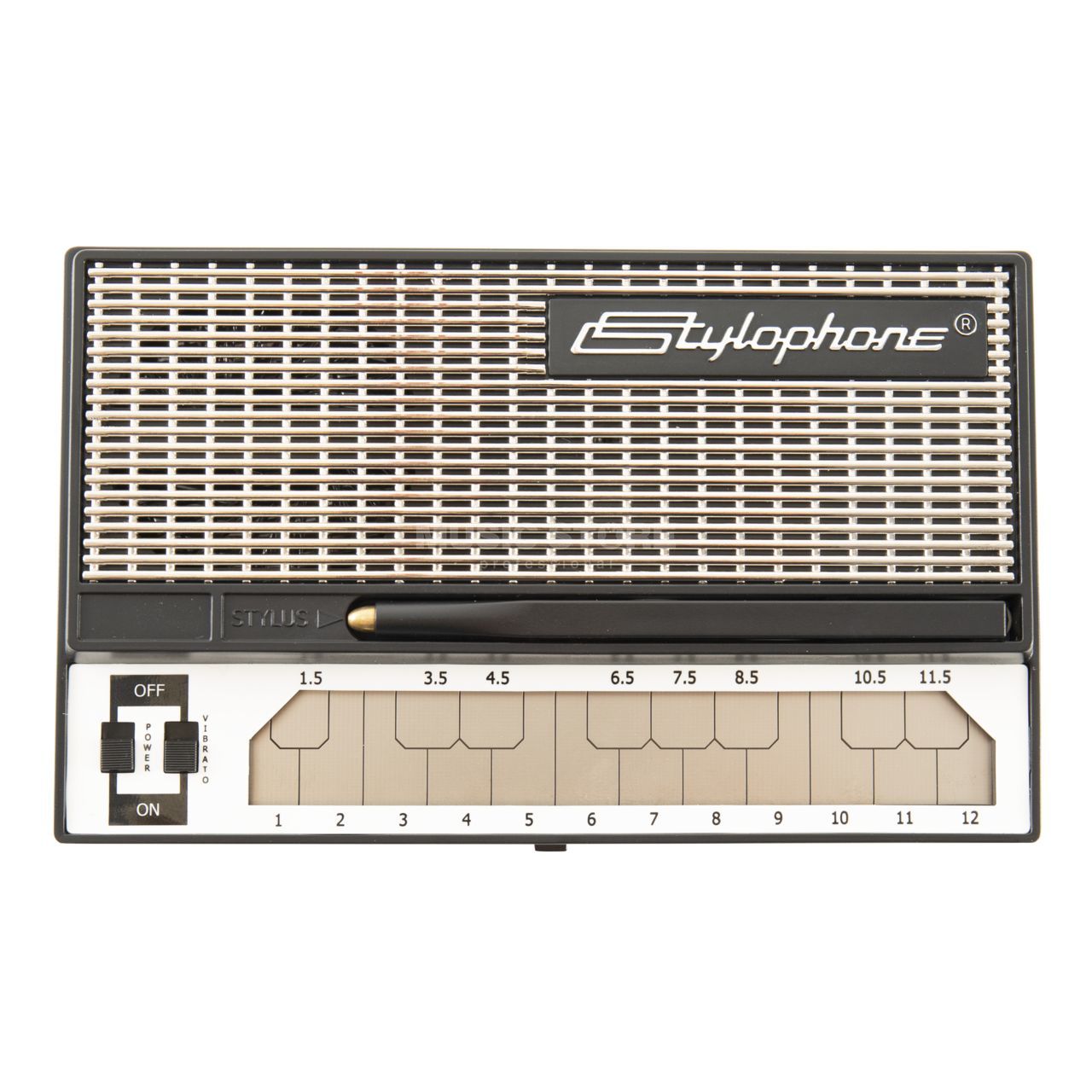
The Stylophone is a miniature analog synthesizer played with a stylus. Invented in 1967 by Brian Jarvis,[1] it entered production in 1968, manufactured by Dubreq in London. Some three million units were sold during its original run, mostly as children's toys, but it was also used by professional musicians such as John Lennon, Kraftwerk and David Bowie.[2] The Stylophone was relaunched in 2007 by the toy company Re:, in partnership with a rebuilt Dubreq, and has since been released in several new models.

Original models

[edit]

The Stylophone consists of a metal keyboard made of printed circuit board and is played by touching it with a stylus. Each note on the keyboard is connected to a voltage-controlled oscillator via a different-value resistor, and touching the stylus to the keyboard thus closes a circuit. The only other controls are a power switch and a vibrato control on the front panel beside the keyboard, and a tuning potentiometer on the rear.

The Stylophone was available in standard, bass and treble variants, with cabinet colors used to distinguish them. The standard model was black-and-white, the treble model was white and tuned an octave higher, and the bass model was beige-and-white and tuned an octave lower.[3] The standard version was the most common. There was also a larger version called the 350S with more notes on the keyboard, various voices, a wah-wah effect that was controlled by moving the hand over a photosensor, and two styluses.

In the mid-1970s, a new model appeared that featured simulated wood on the speaker panel and a volume control. However, production of the Stylophone ceased in 1975.

Entertainer Rolf Harris served for several years as the Stylophone's advertising spokesman in the United Kingdom and appeared on many "play-along" records sold by the manufacturer.[4]

2007 revival

[edit]
2007 relaunch Stylophone from Re:creation

In October 2007, 28 years after the Stylophone had ceased production, the toy company Re:creation, in partnership with Dubreq Ltd. (re‑formed in 2003 by Ben Jarvis, son of the original inventor), relaunched the Stylophone. The 2007 revival model, manufactured in China and officially called the S1, is a digital recreation that closely resembles the 1960s original but adds a volume control, audio throughput, and two additional sounds.[5] The Bass, Treble, and 350S models from the 1970s were not included in the relaunch.

Stylophone Beatbox

[edit]

In September 2009, Dubreq released the Stylophone Beatbox, the first percussion‑focused Stylophone model. It departs from the traditional box‑shaped design of earlier Stylophones, featuring a circular case with a 13‑pad touch‑sensitive keypad. The instrument offers three sound banks (drum, vocal beatbox, and bass), a tempo control, and a basic record/loop function that allows short sequences to be captured and replayed.[6][7]

Front view of the Stylophone Beatbox
Close‑up of the Beatbox keypad

Stylophone S2

[edit]

In December 2012, Dubreq released the Series 2 Stylophone, a limited edition, British‑made, true analogue synthesizer.[8]

Stylophone Gen X-1

[edit]

In January 2017, Dubreq released details of the Stylophone Gen X-1 portable analogue synthesizer.[9] It was designed and manufactured by Dubreq.[10] The Gen X-1 has additional controls for LFO, analog delay, low-pass filter, and envelope settings. It also includes sub-octave switches, and an input so it can be used as an effects unit.[11]

Stylophone GEN R-8

[edit]

In October 2019, Dubreq released the Stylophone GEN R-8, a limited edition, full‑analogue, metal‑cased Stylophone. Designed as a professional‑grade instrument, the GEN R-8 includes features more commonly found on higher‑end analogue synthesizers, such as dual VCOs, a multimode filter, an analogue delay, and extensive modulation options. It is considerably larger than the standard Stylophone models and was produced in a limited initial run of 500 units.[12]

Stylophone Analog Sound S1

[edit]

In July 2020, Dubreq released the Stylophone Analog Sound S1 as a replacement for the 2007 S1. The new model is visually similar to its predecessor but features less rounded corners and omits the auxiliary input. Internally, the digital sampled sounds were replaced by an analogue oscillator based on a 555 timer IC, and the tone selector offers three octave ranges. The resulting sound is much closer to that of the original 1970s Stylophones.[13]

Stylophone Bowie Limited Edition

[edit]

In September 2021, Dubreq launched a limited edition version of the Analog S1 as a tribute to the late David Bowie. This model features an all‑white finish, an official Bowie logo moulded into the chromed grille, and includes a colour‑printed booklet with photos, interviews, and tablature for a selection of Bowie's songs, including Space Oddity.[14][15]

Stylophone Beat

[edit]

In October 2023, Dubreq released the successor to the Stylophone Beatbox, the Stylophone Beat. Like the Stylophone Beatbox, it has a record and play button and the circular metal pad. But unlike the Beatbox, it is now more of a box shape, has four sound banks (rock, techno, hip hop, and beatbox), stay‑in‑time click track & tempo lock features, and can record multiple layers of beats with the ability to mute other sounds.

Stylophone Theremin

[edit]

On 8 January 2024, Dubreq released a Stylophone‑themed (pitch‑only) theremin. This theremin uses a slider for the different notes, unlike the other Stylophone models, which use a stylus. It has a three‑position switch which can be used to get the sound from the slider, the antenna, or a mix of both.

Stylosette

[edit]

In December 2024, Dubreq released the Stylosette, a cassette‑shaped miniature synthesizer with a 13‑key touch‑sensitive keyboard in place of the traditional stylus. The instrument is monophonic, includes built‑in vibrato and delay effects, and can be powered by two AA batteries.[16]

Stylophone CPM DS-2

[edit]

In January 2025, Dubreq released the Stylophone CPM DS-2, a compact portable analogue drone synthesizer. It features dual oscillators, sub‑oscillators, analogue filters, vintage‑style reverb, and Eurorack compatibility.[17]

Stylophone Gen X-2

[edit]

In August 2025, Dubreq introduced the Stylophone Gen X-2 as the successor to the Gen X-1. The Gen X-2 retains the portable analogue design and stylus keyboard of its predecessor but adds a multifunction tactile expression strip for real‑time control. It also expands connectivity with seven CV/Gate input and output jacks, allowing integration with external keyboards, sequencers, DAWs, and modular synthesizer systems.

Sound features include a sub‑oscillator with octave selection, pulse‑width modulation, and an envelope with attack, pitch, and decay controls. The Gen X-2 also carries over the Gen X-1’s low‑pass filter, LFO, and analogue delay, making it capable of producing basses, leads, and experimental tones. At launch, the Gen X-2 was priced at approximately £69.95 / $99.[18]

Stylophone CPM DF-8

[edit]

In November 2025, Dubreq introduced the Stylophone CPM DF-8, a stereo analogue dynamic multi‑filter unit with modulation and delay. It offers dual filter channels, multiple filter types, ADSR envelopes, and Eurorack compatibility.[19]

Stylophone Pink Special Edition

[edit]

Also in November 2025, Dubreq released a special edition of the original Stylophone finished in bright pink. The Stylophone Pink retains the classic stylus interface, built‑in speaker, headphone socket, and vibrato effect, but is distinguished by its cosmetic design.[20]

Stylophone VOICE

[edit]

In January 2026, Dubreq introduced the Stylophone VOICE, a portable multi-sampler designed for real-time sound manipulation and performance. Unlike previous Stylophone models, the VOICE allows users to record their own samples via a built-in microphone or auxiliary input and play them back using a stylus-operated keyboard. It features three sample playback voices, twelve onboard effects (including pitch shift, delay, and reverb), and a built-in sequencer with four pattern memory slots. The VOICE also includes integrated drum sounds, a two-octave stylus keyboard with transpose function, and a built-in speaker, making it a compact and accessible tool for experimental sound design and lo-fi music production.[21]

Stylophone OTF

[edit]

Announced in January 2026, the Stylophone On-The-Fly (OTF) is a real-time performance sequencer developed by Dubreq as part of its Stylophone Pro Range and Music Lab series. Unlike traditional step sequencers, the OTF is designed to be played live, with hands-on controls that respond instantly during playback. It features 8-step pattern programming with dynamic access to 16, 32, or 64-step sequences, and supports glide, ratchets, rests, ties, and controlled randomness per step.

The OTF includes full Eurorack CV, Gate, Sync, and MIDI connectivity, and can be linked with multiple units to form a modular multi-sequencer system. Additional features include loop recording up to 1024 steps, per-step gate outputs, summed gate out, and selectable pitch modes such as whole tone, blues, and Spanish scales. The device is housed in a compact enclosure with labeled performance controls and a minimalist interface. Stylophone launched a waitlist for updates, demos, and release information via its official website.[22]

[edit]

The Stylophone has been described as both a novelty toy and a cult synthesizer. Critics note its distinctive buzzing tone and portability made it appealing to children, while its use by artists such as David Bowie and Kraftwerk gave it credibility in professional music.[23] Modern reviews highlight the Gen X‑1 and GEN R‑8 as bridging the gap between toy and serious synthesizer, cementing the Stylophone’s reputation as an enduring icon of electronic music.[24]

Beyond critical reception, the Stylophone has appeared widely in popular culture:

References

[edit]
[edit]

See also

[edit]
Revisions and contributorsEdit on WikipediaRead on Wikipedia
from Grokipedia
The Stylophone is a compact, battery-powered , notable for its miniature design and innovative stylus-based interface, which allows users to play notes by touching a metal-tipped pen to a flat keyboard strip. Invented in by British engineer Brian Jarvis at Dubreq Studios in while repairing a for his niece, the instrument produces monophonic tones through a , where the stylus completes an electrical circuit to select pitches, generating a distinctive buzzing . Launched commercially in 1968 as the Stylophone 350, it quickly became a cultural phenomenon, selling over three million units worldwide by 1975 due to its affordability, portability, and appeal to both children and musicians. The original model featured a built-in speaker, volume and pitch controls, and a vibrato switch for tonal variation, making it one of the earliest accessible electronic instruments for hobbyists and performers. Its signature sound gained prominence in popular music when used it on his 1969 hit "" to evoke the isolation of , marking a pivotal moment in its adoption by professional artists. Other notable musicians, including , Kraftwerk, Pulp, and Belle & Sebastian, have incorporated the Stylophone into recordings across genres like pop, rock, and electronic music, often for its quirky, lo-fi . After declining popularity in the late 1970s amid advancing technology, the Stylophone was revived in 2007 by the original manufacturer Dubreq, leading to modern iterations like the Gen X-1 (2017) and Gen X-2 (2025), which retain the classic stylus mechanism while adding features such as delay effects and connectivity. Today, it endures as a beloved novelty instrument, inspiring enthusiast communities and limited-edition releases celebrating its legacy.

History

Invention and Early Development

The Stylophone was invented in 1967 by Brian Jarvis at Dubreq Studios in . The concept emerged when Jarvis, tasked with repairing an electronic for his niece, envisioned replacing traditional keys with a stylus-operated metal keyboard to create a more compact and accessible instrument. This innovation aimed to simplify playability while maintaining electronic sound generation, drawing on the limitations of existing toy instruments. Jarvis, an electrical with experience in , co-founded Dubreq Studios in 1967 alongside brothers Burt and Ted Coleman as a film production and specializing in sound effects and . Leveraging his expertise in audio for film, Jarvis hand-built the initial and filed a for the stylus-based mechanism on April 4, 1968, assigned to Moviecol Enterprises Limited, which described a battery-powered oscillator circuit activated by contact on a printed . The Stylophone launched in as an affordable, portable electronic instrument marketed primarily to children and beginners for its ease of use and low cost, priced at around £2 (equivalent to about £40 in 2023). Despite its toy-like positioning, it quickly appealed to musicians seeking a simple, battery-operated . By 1975, over three million units had been sold worldwide, marking significant early commercial success before production ceased that year.

Original Production Era

Following its debut in , the Stylophone entered a decade of robust production under Dubreq, a British company based in , where manufacturing took place at their studios. The instrument's simple design facilitated rapid scaling, with units assembled using a lightweight plastic casing and a distinctive metal strip keyboard played via . Each model featured a built-in speaker for immediate playback and was powered by a single 9-volt PP3 battery, enabling its portable, pocket-sized form factor measuring approximately 16 cm x 10 cm x 5 cm. Production expanded significantly during the , driven by strong market demand that saw over three million units sold worldwide by 1975. Exports reached key markets including , the , and , contributing to its status as a global phenomenon marketed primarily as an affordable novelty instrument for children and beginners. Its appeal was bolstered by positive reception in music publications, which highlighted its unique buzzing tone and ease of use, further amplifying sales through widespread availability in toy and music stores. In , Dubreq introduced the Stylophone 350S model as an of the original, featuring an expanded 3.5-octave metal keyboard spanning 44 notes—compared to the standard 20-note version—and new controls including modulation for added expressiveness. This variant maintained the core battery-powered, built-in speaker setup but offered enhanced playability, appealing to users seeking more versatility while preserving the instrument's compact plastic construction. The 350S's innovations reflected Dubreq's efforts to refine the line amid peak production, though it remained true to the original's accessible ethos.

Decline and Revival

By the mid-1970s, the initial surge in popularity of the Stylophone began to wane as the novelty of affordable electronic toys diminished amid growing market saturation. Production of the original models officially ceased in 1975, though remaining inventory continued to be sold through the early . During the and early , original Stylophones gained status as collectible items among musicians and enthusiasts, driven by for 1970s electronic music culture and the instrument's association with notable artists. Working units from this era became sought after in secondhand markets, reflecting renewed interest in analog synthesizers before the revival. The Stylophone was revived in 2007 through the efforts of Ben Jarvis, son of original inventor Brian Jarvis, who reformed Dubreq Ltd. in 2003 to relaunch the brand. The revival involved licensing agreements to update the design while preserving its analog essence, with manufacturing shifted to for cost efficiency. The relaunched S1 model debuted at the , emphasizing nostalgia marketing to capitalize on the instrument's retro appeal and its place in music history. Since 2007, Dubreq has expanded the Stylophone lineup under ongoing production, introducing innovative variants that blend classic features with modern enhancements. Key developments include the 2022 limited-edition collaboration with the estate, featuring a white design inspired by Bowie's use of the instrument on "." By 2025, the brand continues active development, with annual releases such as the 2024 model, which won Best in Show at NAMM 2024 for its touch-sensitive, antenna-controlled interface evoking the classic while maintaining portability. In 2025, Dubreq released the Gen X-2 with enhanced connectivity and the CPM DS-2 analogue drone synthesizer.

Design and Operation

Physical Components

The original Stylophone, introduced in , featured a compact housing designed for portability, measuring approximately 100 × 155 × 35 mm and weighing 0.25 kg. Its keyboard consisted of a touch-sensitive metal strip with 20 notes, allowing -based play across a limited range. The unit was powered by a single 9V PP3 battery and included a built-in speaker for unamplified output, with no headphone jack in the initial models. A was provided for interaction with the keyboard. Later models from the original production era, such as the Stylophone 350S released in the early , expanded on this design with a larger measuring about 318 × 89 × 292 to accommodate additional features, while maintaining plastic construction for durability. This variant required two 9V PP9 batteries for power and housed a larger built-in speaker behind a wooden grille, enhancing audio projection without external amplification. Revived versions, beginning with the 2007 reissue of the S-1, retained the pocket-sized form factor but introduced refinements for modern portability, with dimensions of 165 mm × 102 mm × 38 mm and a weight of 232 g. These models use three AA batteries for power, feature a built-in speaker paired with a 3.5 mm headphone jack, and employ a metal keyboard strip expanded to 35 notes across three octaves. Casing variations include white alongside new options like matte black, , and special editions with embossed designs, while durability was enhanced through stress-resistant materials and included carrying cases with internal pockets for the replaceable and accessories. Subsequent series, such as the Gen X, maintain similar compact builds with ergonomic tweaks like accessible battery compartments, ensuring continued emphasis on lightweight, battery-operated portability across eras.

Sound Production and Controls

The Stylophone employs monophonic analog synthesis, in which the player touches a conductive stylus to one of the metal strips on the keyboard printed circuit board, completing a circuit to ground and activating a voltage-controlled oscillator (VCO) tuned to the corresponding note's frequency via an associated resistor ladder network. This contact-based triggering produces a raw electronic tone without polyphony, as only one note can sound at a time, and the output volume remains fixed regardless of stylus pressure, which serves solely to establish electrical connection rather than imparting dynamic variation or velocity sensitivity. The core sound generation relies on a simple transistor-based relaxation oscillator circuit, typically configured as an RC (resistor-capacitor) network using components like a Darlington transistor pair for amplification, yielding a waveform that approximates a distorted square or sawtooth shape with some sine-like characteristics due to filtering elements, though the overall timbre is buzzy and lo-fi. In the standard model, the oscillator's frequency range spans approximately A2 (110 Hz) to A5 (880 Hz) across a 20-note keyboard layout, enabling coverage of three octaves when combined with the selector switch. Key controls shape the instrument's limited but expressive output. A vibrato switch or knob engages a low-frequency oscillator (LFO), often implemented as a phase-shift circuit operating at around 7 Hz, to modulate pitch and add a wavering effect that builds gradually for richer articulation. The pitch bend is achieved via a side-mounted lever or tuning knob, which adjusts the master oscillator frequency for glissando effects when the stylus is held on a note or for overall intonation correction. An octave selector switch provides three positions—typically labeled for bass (lower), classic (middle), and lead (higher) ranges—shifting the entire keyboard's pitch by octaves through altered resistor values in the VCO circuit, thus extending playability without expanding the physical keys. Some variants include a tone switch that applies basic RC filters to emulate instrument timbres like flute, violin, or brass, though the core models rely on the unfiltered oscillator tone for their signature nasal quality. Playing technique emphasizes precise stylus contact on the metal strips, arranged in a piano-style layout with white and black key equivalents, allowing for note-to-note slides (glissandi) by dragging the or discrete plucking for staccato effects, though legato is limited to adjacent notes due to . Since does not influence volume or , expression derives primarily from engagement, pitch bending, and octave shifts. For maintenance, regular cleaning of the keyboard strips with a soft cloth or mild metal polish prevents oxidation and contact issues that cause intermittent notes or crackling, ensuring reliable circuit completion over time.

Models

Original Models

The original Stylophone, launched in 1968 by British manufacturer Dubreq, was a compact, battery-powered featuring a 20-note metal keyboard spanning one and a half octaves from G3 to C5, played via a conductive for monophonic melodies with a single oscillator producing basic square-wave tones. It included a built-in speaker, volume control, and tuning knob, measuring approximately 13 cm in length and powered by a single 9V battery, making it highly portable and accessible for beginners. Early units were housed in a black-and-white plastic case, with later variations appearing in white, red, and blue to appeal to younger users. In 1971, Dubreq introduced the Stylophone 350 model, an expanded variant measuring about 30 cm long with a 44-note keyboard covering three and a half octaves for greater melodic range. It added advanced features such as modulation, a decay envelope for notes, an optional for filter effects, and a unique photo-sensor allowing light-based control over pitch and via a . The 350 retained the interface but included a second stylus for dual-note playing in some configurations, though it required two 9V batteries due to its larger size and enhanced circuitry. To extend the instrument's range, Dubreq released the Treble and Bass models in 1969, both maintaining the core 20-note and features of the standard but tuned differently for specialized use. The Treble variant pitched higher, covering C4 to C6 in a white case for brighter, upper-register melodies, while the Bass model pitched lower at C1 to C3 in a beige or reddish-brown case for deeper tones, though its lowest notes could exhibit slight intonation issues. These variants shared the same physical components and operation as the standard but were produced in smaller quantities, comprising under 10% of total output and now considered rare among collectors. Overall, Dubreq produced approximately 3.5 million original Stylophones between 1968 and 1979, with the standard model accounting for the majority—over 3 million units—driving its commercial success as an affordable entry-level instrument. The 350 model's limited run of fewer than 3,000 units, combined with the relative scarcity of Treble and Bass examples, highlights their status as less common variants in the original lineup.

2007 Reissue

In 2007, Ben Jarvis, son of the original inventor Brian Jarvis, reformed Dubreq in partnership with the toy company Re:creation to relaunch the Stylophone as the S1 model, closely replicating the standard design with a 20-note metal keyboard played via , switch, and volume control. The reissue used digital sampled sounds to emulate the original analog tones, with a three-position switch for selecting standard, bass, and high variants, and included an audio input for processing external signals, while retaining the PP3 battery power and built-in speaker. Manufactured in , it featured minor updates such as a slightly thicker casing for enhanced durability and an improved battery compartment to prevent common original-era issues, but no major new features were introduced beyond the tone selector and input jack. Priced affordably at around €25 upon release, the S1 was marketed through online retailers and music shops, quickly gaining traction among synth enthusiasts and collectors for its nostalgic appeal. The reissue revitalized interest in the instrument, resulting in multiple sold-out production runs and establishing a foundation for Dubreq's expanded lineup of Stylophone variants.

S1 and S2 Series

The Stylophone S2, introduced by Dubreq in 2013, is a monophonic analog synthesizer featuring a 37-note printed circuit keyboard with larger keys and octave shift capabilities spanning three octaves. It includes a voltage-controlled oscillator (VCO) with multiple waveforms, a resonant low-pass filter, a multi-waveform low-frequency oscillator (LFO) for modulation, and built-in analog delay for effects. Additional features include vibrato, a built-in speaker, headphone output, and battery power, emphasizing portability and creative sound design. In , Dubreq released an updated analog version of the S1, distinct from the 2007 digital reissue. This analog S1 is a compact monophonic replicating the original 1968 design more faithfully, with a 20-note stylus keyboard, 3-octave range via switches, effect, tuning control, built-in speaker, and headphone jack. Powered by three AA batteries, it produces the classic buzzing tone through an analog circuit, priced at around $50, appealing to beginners and nostalgia seekers. Variants within the series include the edition, released in 2023 as a cosmetic variant of the analog S1 featuring a rose-colored casing for aesthetic appeal, with identical technical specifications to the . The analog S1 and S2 have been praised for blending nostalgic play with modern analog synthesis, contributing to renewed interest in portable mini-synthesizers among electronic artists and hobbyists.

Gen X Series

The Gen X series marks a significant advancement in the Stylophone lineup, blending portable analog synthesis with experimental features tailored for modern musicians and producers. Introduced starting in 2017, these models expand on the classic Stylophone's compact design while incorporating enhanced sound-shaping tools, effects, and connectivity options that encourage creative exploration in both standalone and integrated setups. The Stylophone Gen X-1, launched in May 2017, is a battery-powered analog synthesizer featuring a two-octave (24-note) stylus-activated keyboard and a separate touch-sensitive sound strip for pitch bending and modulation. Its core sound engine includes a single square-wave oscillator with pulse-width modulation (PWM), sub-oscillator switches for added low-end depth, a resonant low-pass analog filter, an attack/decay (AD) envelope generator, and a low-frequency oscillator (LFO) offering square and triangle waveforms for vibrato or filter modulation. An integrated analog delay provides spatial effects, while the audio input jack allows external signals to be processed through the filter, delay, and LFO, functioning as a compact effects unit. Additional connectivity includes a 3.5mm audio output for headphones or external amplification, and it operates via four AA batteries with a built-in speaker for on-the-go use. Priced at around $80 upon release, the Gen X-1 emphasizes versatility and portability, enabling users to craft everything from gritty bass lines to experimental textures. Building directly on the Gen X-1's foundation, the Stylophone Gen X-2 was released on August 14, 2025, as an upgraded iteration with enhanced control and integration capabilities. It retains the analog synthesis core—including the oscillator, filter, , LFO, and delay—but introduces a multifunction touch-sensitive expression strip configurable for pitch bending, filter cutoff, or LFO intensity control, alongside an selection switch for broader range access without repositioning. The most notable expansions are the extensive ports (pitch CV in/out, gate in/out, and filter CV in), enabling seamless synchronization and control with modular synthesizers, DAWs, or external keyboards; this makes the Gen X-2 the first Stylophone fully compatible with standards, appealing to modular enthusiasts for both as a sound source and controller. It also features seven 3.5mm jacks for expanded I/O, including MIDI-to-CV adaptation potential via external converters. Powered similarly by four AA batteries with a built-in speaker, the Gen X-2 is priced at $99 and measures compactly at 11.5 x 5.5 x 1.5 inches, prioritizing experimental hybrid workflows in studio or live settings. The GEN R-8, debuted in October 2019 as a specialized variant within the series, shifts focus toward rhythm and sequencing in a more robust, boutique format. This limited-edition model features a three-octave touch-sensitive keyboard (fingertip-playable without ), dual voltage-controlled oscillators (VCOs) offering sawtooth, square, and PWM waveforms, plus sub-oscillator and generator for deep analog bass and percussive tones. It includes a British-made resonant , multi-waveform LFO, AD envelope, analog delay, and a 16-step sequencer for pattern creation and integration with external gear via 19 patch points and I/O. Housed in a durable enclosure, the GEN R-8 supports triggering and is compact yet powerful for beat-making, with its sequencer enabling looped phrases and sync options. Initial production was capped at 500 units, positioning it as a collector's item for experimental analog users. Priced at around $400, it bridges traditional Stylophone portability with professional modular experimentation. These models highlight the series' innovative push toward hybrid analog experimentation, particularly through compatibility in the Gen X-2 and GEN R-8, which opens doors for modular synth integration and appeals to users seeking tactile, portable tools beyond basic melody-making. The shared physical design—emphasizing battery operation and or touch interfaces—maintains the Stylophone's signature accessibility while elevating its role in contemporary electronic music production.

Special Editions and Variants

In recent years, Dubreq has expanded the Stylophone lineup with themed and limited-run models that incorporate unique aesthetics and functionalities while maintaining the brand's portable, analog ethos. These special editions often pay homage to cultural icons or explore experimental sound design, appealing to both musicians and collectors. The Bowie Limited Edition, released in 2021, is a tribute to David Bowie's use of the original Stylophone on his 1969 track "Space Oddity." Based on the S1 model, it features a distinctive white casing with an embossed Bowie logo and a spaceship-silver grille, alongside the standard analog oscillator, built-in speaker, and vibrato controls. It includes a full-color booklet with exclusive articles, archive photos, and insights into Bowie's career and affinity for the instrument. The Stylophone Beat, launched in 2023 as a successor to earlier s, functions as a hybrid pocket emphasizing beat creation over traditional melody play. It offers four sound banks—ROK, , HIPHOP, and BEATBOX—with 4 kits and 4 bass sounds, enabling users to trigger patterns via a touch-sensitive circular pad using the included , record loops up to 60 seconds, and adjust with quantization. Lacking a full sequencer, it focuses on layering and , with a built-in speaker, headphone output, and PC/Mac connectivity for further editing; a input is absent, but its looper supports spontaneous beatboxing-style performances. The Stylophone Theremin, introduced in 2024, reimagines the classic instrument in a compact, battery-powered form that integrates Stylophone's touch-sensitive principles with contactless play. It employs an analog oscillator controlled by hand proximity to a pitch antenna for eerie, wavering tones, complemented by a separate volume antenna, modulation, vibrato, and delay effects via rotary knobs. This blend allows for experimental soundscapes reminiscent of 1920s origins while adding modern portability and a built-in speaker. Other notable variants include the Special Edition, a vibrant punk-inspired re-coloring of the S1 with the same core features but in a bold pink casing for visual flair. The CPM DS-2, debuted at NAMM 2024, is a dual-oscillator analog drone synthesizer with sub-oscillators, multimode filters, an Ultra LFO for modulation, and onboard reverb, designed for sound design and compatibility in a semi-modular format. In 2025, the CPM DF-8 entered as a stereo analog dynamic multi-filter module with eight filter types, self-oscillating capabilities, noise generation, crunchy delay effects, and dynamic triggering, serving as a versatile rather than a polyphonic synth, with release scheduled for November 20, 2025. Special editions like the Bowie and have developed strong collectibility due to their thematic ties and scarcity, often reselling at premiums on secondary markets— for instance, the Bowie edition commands up to 50% above its original £34.95 retail price as of late 2025, driven by demand from synth enthusiasts and Bowie admirers.

Cultural Impact

Use in Music

The Stylophone's distinctive metallic tone and portability made it an appealing choice for early adopters in during the late 1960s. prominently featured the original Stylophone 350 model to craft the song's iconic bassline in "Space Oddity," released in 1969, helping to introduce the instrument to a wide audience. In the UK, contributed to its initial popularity through promotional campaigns and television appearances, where he demonstrated the Stylophone's ease of use and encouraged its adoption among amateur and professional musicians alike. During the 1970s and , the Stylophone appeared in electronic, ambient, and rock compositions, leveraging its simple analog sound for experimental effects. Kraftwerk employed it to generate unique sound effects on tracks like "The Model" from their 1978 album and "Pocket Calculator" from 1981's , enhancing their minimalist electronic landscapes. In the , continued using the original Stylophone 350 for melodic elements on "Ashes to Ashes" from the 1980 album Scary Monsters (and Super Creeps). The instrument experienced a revival in the 2000s and 2010s with the release of reissue models, attracting contemporary artists across indie and electronic genres. Modern electronic artists have incorporated reissues for their quirky timbre in various productions. Modern Stylophone models, such as the Gen X series, feature enhanced connectivity including CV/Gate outputs, allowing integration with modular systems and digital audio workstations (DAWs) for recording and processing via modifications or interfaces. The 2025 release of the Gen X-2 added octave selection and improved expression controls, further expanding its use in contemporary music production. The Stylophone has featured prominently in advertisements since its inception, with iconic television commercials showcasing entertainer demonstrating its simple interface and distinctive tones to promote it as an accessible musical toy. In 2019, the instrument appeared in a Christmas advertisement celebrating the retailer's 60th anniversary, highlighting its nostalgic appeal in a festive context. The 2020s saw the Stylophone model gain viral traction on through and official demonstrations, emphasizing its ethereal, non-contact playing style for ambient and experimental sounds. In television, the Stylophone was spotlighted in the BBC2 series I Love the 1970s (2000), where it was celebrated as a quintessential retro gadget emblematic of the era's popular culture. The instrument's cultural footprint extends to internet memes, particularly the 2019 "Let's Go" phenomenon, in which a short Stylophone riff transitions into a full song drop, exploding in popularity on platforms like Reddit and YouTube shortly after the S1 model's launch and inspiring countless recreations. Beyond media, the Stylophone has appeared in museum exhibits underscoring its historical significance, such as the 2011 "Oramics to Electronica" display at London's Science Museum, which positioned it as a key example of early accessible electronic music technology. More recently, the Stylophone Theremin was included in the Museum of Making Music's 2024 exhibition on innovative instruments. In educational contexts during the 2010s, it inspired DIY kits and projects, like the 2010 Make: magazine tutorial for building a custom analog version, promoting hands-on learning in electronics and sound design. The Stylophone embodies futurism through its compact, battery-powered design, which democratized technology and evoked visions of portable electronic innovation during the . This association has been explored in literature, including detailed historical accounts in online resources like The Secret Life of Synthesizers, which dissect its circuitry and cultural legacy.

References

Add your contribution
Related Hubs
User Avatar
No comments yet.