Hubbry Logo
ThereminThereminMain
Open search
Theremin
Community hub
Theremin
logo
8 pages, 0 posts
0 subscribers
Be the first to start a discussion here.
Theremin
Theremin
from Wikipedia

Theremin
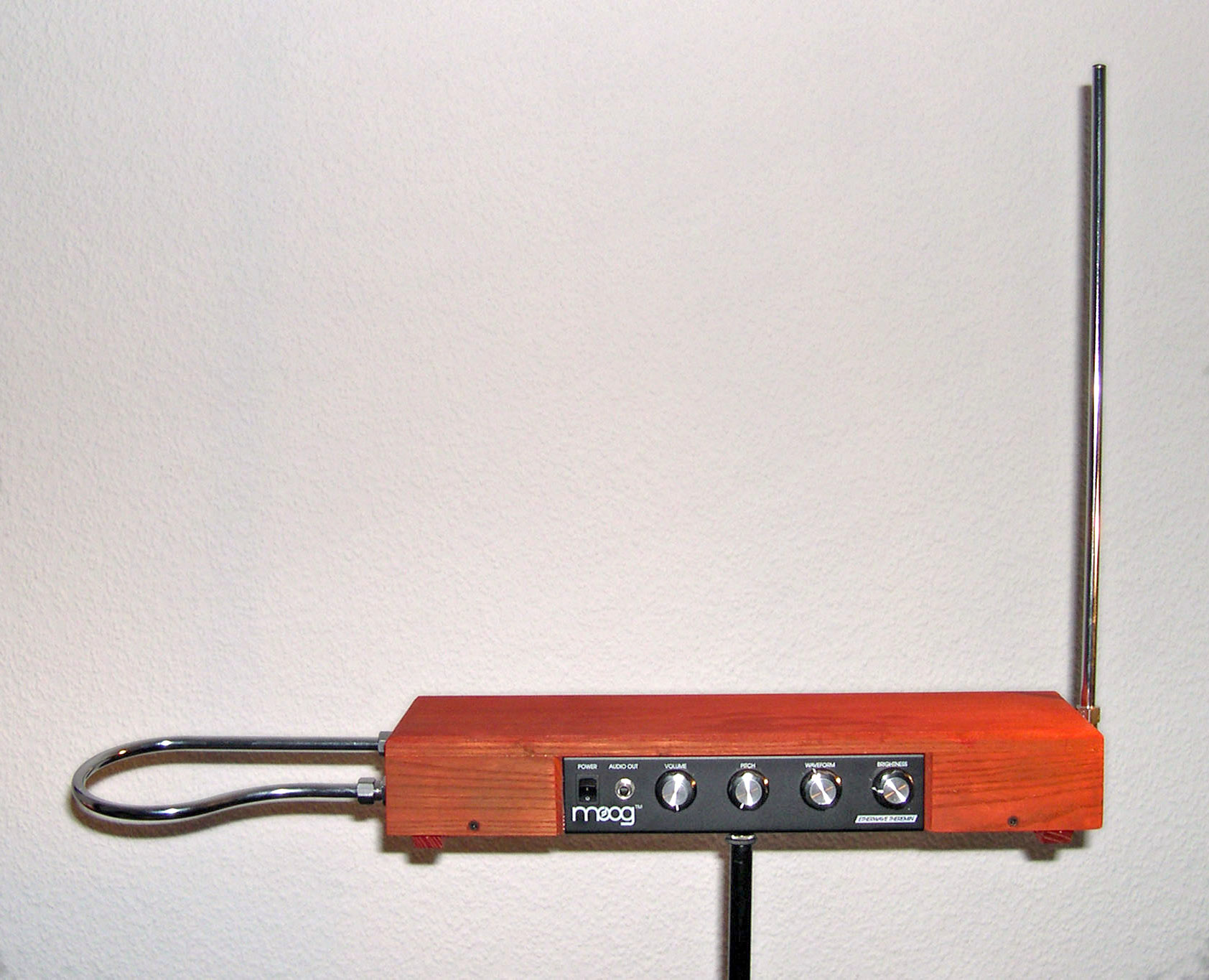
A Moog Etherwave, assembled from a theremin kit: the loop antenna on the left controls the volume while the upright antenna controls the pitch.
Electronic instrument
Hornbostel–Sachs classification531.1[1]
(Electrophone)
InventorLeon Theremin
Developed1920; patented in 1928

The theremin (/ˈθɛrəmɪn/; originally known as the ætherphone, etherphone, thereminophone[2] or termenvox/thereminvox) is an electronic musical instrument controlled without physical contact by the performer (who is known as a thereminist). It is named after its inventor, Leon Theremin, who patented the device in 1928.

The instrument's controlling section usually consists of two metal antennas that function not as radio antennas but rather as position sensors. Each antenna forms one half of a capacitor with each of the thereminist's hands as the other half of the capacitor. These antennas capacitively sense the relative position of the hands and control oscillators for frequency with one hand, and amplitude (volume) with the other. The electric signals from the theremin are amplified and sent to a loudspeaker.

The sound of the instrument is often associated with eerie situations. The theremin has been used in movie soundtracks such as Miklós Rózsa's Spellbound and The Lost Weekend, Bernard Herrmann's The Day the Earth Stood Still, and Justin Hurwitz's First Man, as well as in theme songs for television shows such as the ITV drama Midsomer Murders and the Disney+ series Loki, the latter composed by Natalie Holt. The theremin is also used in concert music (especially avant-garde and 20th- and 21st-century new music); for example, Mano Divina Giannone is a popular American thereminist[3] who along with his orchestra, The Divine Hand Ensemble, regularly holds such concerts. It is also used in popular music genres, such as rock.

Leon Theremin demonstrating and playing the theremin
Alexandra Stepanoff playing the theremin on NBC Radio

History

[edit]

The theremin was the product of Soviet government-sponsored research into proximity sensors. The instrument was invented in October 1920 by the Russian physicist Lev Sergeyevich Termen, known in the West as Leon Theremin.[4][5] After a lengthy tour of Europe, during which time he demonstrated his invention to packed houses, Theremin moved to the United States, where he patented his invention in 1928.[6] Subsequently, Theremin granted commercial production rights to RCA.

Although the RCA Thereminvox (released immediately following the stock market crash of 1929) was not a commercial success, it fascinated audiences in America and abroad. Clara Rockmore, a well-known thereminist, toured to wide acclaim, performing a classical repertoire in concert halls around the United States, often sharing the bill with bass-baritone Paul Robeson. Joseph Whiteley (1894–1984) performed under the stage name Musaire and his 1930 RCA Theremin can be seen, played and heard at the Musical Museum, Brentford, England.[7]

During the 1930s, Lucie Bigelow Rosen was also taken with the theremin and together with her husband Walter Bigelow Rosen provided both financial and artistic support to the development and popularisation of the instrument.[8][9]

In 1938, Theremin left the United States, though the circumstances related to his departure are in dispute. Many accounts claim he was taken from his New York City apartment by NKVD agents (preceding the KGB),[10] taken back to the Soviet Union and made to work in a sharashka laboratory prison camp at Magadan, Siberia. He reappeared 30 years later. In his 2000 biography of the inventor, Theremin: Ether Music and Espionage, Albert Glinsky suggested he had fled to escape crushing personal debts, and was then caught up in Stalin's political purges. In any case, Theremin did not return to the United States until 1991.[11]

The components of a modern Moog theremin, in kit form

After a flurry of interest in America following the end of the Second World War, the theremin soon fell into disuse with serious musicians, mainly because newer electronic instruments were introduced that were easier to play. However, a niche interest in the theremin persisted, mostly among electronics enthusiasts and kit-building hobbyists. One of these electronics enthusiasts, Robert Moog, began building theremins in the 1950s, while he was a high-school student. Moog subsequently published a number of articles about building theremins, and sold theremin kits that were intended to be assembled by the customer. Moog credited what he learned from the experience as leading directly to his groundbreaking synthesizer, the Moog. (Around 1955, a colleague of Moog's, electronic music pioneer Raymond Scott, purchased one of Moog's theremin subassemblies to incorporate into a new invention, the Clavivox, which was intended to be an easy-to-use keyboard theremin.)[12][13]

Since the release of the film Theremin: An Electronic Odyssey in 1993, the instrument has enjoyed a resurgence in interest and has become more widely used by contemporary musicians. Even though many theremin sounds can be approximated on many modern synthesizers, some musicians continue to appreciate the expressiveness, novelty, and uniqueness of using an actual theremin.[14]

Both theremin instruments and kits are available. The Open Theremin, an open hardware and open software project, was developed by Swiss microengineer Urz Gaudenz, using the original heterodyne oscillator architecture for a good playing experience,[15] combined with Arduino. Using a few extra components, a MIDI interface can be added to the Open Theremin, enabling a player to use their theremin to control different instrument sounds.[16]

The theremin's singular operation method has been praised for providing an accessible route to music-making for people with disabilities.[17]

Operating principles

[edit]
Block diagram of a theremin. Volume control in blue, pitch control in yellow and audio output in red.

The theremin is distinguished among musical instruments in that it is played without physical contact. The thereminist stands in front of the instrument and moves their hands in the proximity of two metal antennas. While commonly called antennas, they are not used as radio antennae for receiving or broadcasting radio waves, but rather act as plates of capacitors. The distance from one antenna determines frequency (pitch), and the distance from the other controls amplitude (volume). Higher notes are played by moving the hand closer to the pitch antenna. Louder notes are played by moving the hand away from the volume antenna.

Most frequently, the right hand controls the pitch and the left controls the volume, although some performers reverse this arrangement. Some low-cost theremins use a conventional, knob-operated volume control and have only the pitch antenna.

The theremin uses the heterodyne principle to generate an audio signal. The instrument's pitch circuitry includes two radio frequency oscillators set below 500 kHz to minimize radio interference. One oscillator operates at a fixed frequency. The frequency of the other oscillator is almost identical, and is controlled by the performer's distance from the pitch control antenna.

The performer's hand has significant body capacitance, and thus can be treated as the grounded plate of a variable capacitor in an L-C (inductance-capacitance) circuit, which is part of the oscillator and determines its frequency. In the simplest designs, the antenna is directly coupled to the tuned circuit of the oscillator and the 'pitch field', that is the change of note with distance, is highly nonlinear, as the capacitance change with distance is far greater near the antenna. In such systems, when the antenna is removed, the oscillator moves up in frequency.

To partly linearise the pitch field, the antenna may be wired in series with an inductor to form a series tuned circuit, resonating with the parallel combination of the antenna's intrinsic capacitance and the capacitance of the player's hand in proximity to the antenna. This series tuned circuit is then connected in parallel with the parallel tuned circuit of the variable pitch oscillator. With the antenna circuit disconnected, the oscillator is tuned to a frequency slightly higher than the stand-alone resonant frequency of the antenna circuit. At that frequency, the antenna and its linearisation coil present an inductive impedance; and when connected, behaves as an inductor in parallel with the oscillator. Thus, connecting the antenna and linearising coil raises the oscillation frequency. Close to the resonant frequency of the antenna circuit, the effective inductance is small, and the effect on the oscillator is greatest; farther from it, the effective inductance is larger, and fractional change on the oscillator is reduced.

When the hand is distant from the antenna, the resonant frequency of the antenna series circuit is at its highest; i.e., it is closest to the free running frequency of the oscillator, and small changes in antenna capacitance have greatest effect. Under this condition, the effective inductance in the tank circuit is at its minimum and the oscillation frequency is at its maximum. The steepening rate of change of shunt impedance with hand position compensates for the reduced influence of the hand being further away. With careful tuning, a near linear region of pitch field can be created over the central two or three octaves of operation. Using optimized pitch field linearisation, circuits can be made where a change in capacitance between the performer and the instrument in the order of 0.01 picofarads produces a full octave of frequency shift.[18]

The mixer produces the audio-range difference between the frequencies of the two oscillators at each moment, which is the tone that is then wave shaped and amplified and sent to a loudspeaker.

To control volume, the performer's other hand acts as the grounded plate of another variable capacitor. As in the tone circuit, the distance between the performer's hand and the volume control antenna determines the capacitance and hence natural resonant frequency of an LC circuit inductively coupled to another fixed LC oscillator circuit operating at a slightly higher resonant frequency. When a hand approaches the antenna, the natural frequency of that circuit is lowered by the extra capacitance, which detunes the oscillator and lowers its resonant plate current.

In the earliest theremins, the radio frequency plate current of the oscillator is picked up by another winding and used to power the filament of another diode-connected triode, which thus acts as a variable conductance element changing the output amplitude.[19] The harmonic timbre of the output, not being a pure tone, was an important feature of the theremin.[20] Theremin's original design included audio frequency series/parallel LC formant filters as well as a 3-winding variable-saturation transformer to control or induce harmonics in the audio output.[6]

Modern circuit designs often simplify this circuit and avoid the complexity of two heterodyne oscillators by having a single pitch oscillator, akin to the original theremin's volume circuit. This approach is usually less stable and cannot generate the low frequencies that a heterodyne oscillator can. Better designs (e.g., Moog, Theremax) may use two pairs of heterodyne oscillators, for both pitch and volume.[21]

Performance technique

[edit]
A robot playing the theremin

Important in theremin articulation is the use of the volume control antenna. Unlike touched instruments, where simply halting play or damping a resonator in the traditional sense silences the instrument, the thereminist must "play the rests, as well as the notes", as Clara Rockmore observed.[22]

If the pitch hand is moved between notes, without first lowering the volume hand, the result is a "swooping" sound akin to a swanee whistle or a glissando played on the violin. Small flutters of the pitch hand can be used to produce a vibrato effect. To produce distinct notes requires a pecking action with the volume hand to mute the volume while the pitch hand moves between positions.

Thereminists such as Carolina Eyck use a fixed arm position per octave, and use fixed positions of the fingers to create the notes within the octave, allowing very fast transitions between adjacent notes.[23]

Although volume technique is less developed than pitch technique, some thereminists have worked to extend it, especially Pamelia Kurstin with her "walking bass" technique[24] and Rupert Chappelle.

The critic Harold C. Schonberg described the sound of the theremin as "[a] cello lost in a dense fog, crying because it does not know how to get home".[25]

Uses

[edit]
RCA AR-1264 Theremin in Musical Instrument Museum, Phoenix, Arizona

Concert music

[edit]

The first orchestral composition written for theremin was Andrei Pashchenko's [de; ru] Symphonic Mystery, which premiered in 1924.[26] However, most of the sheet music was lost after its second performance.[27]

Other concert composers who have written for theremin include Bohuslav Martinů,[28] Percy Grainger,[28] Christian Wolff,[28] Joseph Schillinger,[28] Moritz Eggert,[29] Iraida Yusupova,[29] Jorge Antunes,[28] Vladimir Komarov,[28] Anis Fuleihan,[30][31] and Fazıl Say.[32]

Edgard Varèse completed the composition "Equatorial" for two theremin cellos and percussion in 1934. His work was a stated influence throughout the career of Frank Zappa,[33] who also composed for theremin.[34]

Maverick composer Percy Grainger chose to use ensembles of four or six theremins (in preference to a string quartet) for his two earliest experimental Free Music compositions (1935–1937) because of the instrument's complete 'gliding' freedom of pitch.[35][36]

Musician Jean-Michel Jarre used the instrument in his concerts Oxygène in Moscow in 1997 and Space of Freedom[37] in Gdańsk in 2005, providing also a short history of Leon Theremin's life.

The five-piece Spaghetti Western Orchestra use a theremin as a replacement for Edda Dell'Orso's vocals in their interpretation of Ennio Morricone's "Once Upon a Time in the West".[38]

A large-scale theremin concerto is Kalevi Aho's Concerto for Theremin and Chamber Orchestra "Eight Seasons" (2011), written for Carolina Eyck.[39]

Other notable contemporary theremin players include Pamelia Kurstin,[40] Peter Theremin, Natasha Theremin, Katica Illényi.[41] and Lydia Kavina,[42] Dutch classical musician Thorwald Jørgensen has been described as "one of the most important exponents of classical music on the theremin".[43] Carolina Eyck started playing the theremin at the age of seven and published the book The Art of Playing the Theremin in English and German when she was 19[44] and has since played with chamber and symphony orchestras in many countries.

In 2019 in Kobe, Japan, the Matryomin ensemble, a group of 289 theremin players that included Natasha Theremin, Masha Theremin and Peter Theremin, the daughter, granddaughter and great-grandson of the inventor, achieved a Guinness world record as the largest ensemble of the instrument. The name Matryomin is a portmanteau by its inventor of the words matryoshka and theremin.[45] The theremin concerto "Dancefloor With Pulsing" by the French composer Régis Campo was written for Carolina Eyck and premiered with the Brussels Philharmonic in 2018.[46]

[edit]

Theremins and theremin-like sounds started to be incorporated into popular music from the end of the 1940s (with a series of Samuel Hoffman/Harry Revel collaborations)[47] and has continued, with various degrees of popularity, to the present.

Lothar and the Hand People were the first rock band known to perform live with a theremin in November 1965. In fact, Lothar was the name they gave to their Moog theremin.[48]

The Beach Boys' 1966 single "Good Vibrations"—though it does not technically contain a theremin—is the most frequently cited example of the instrument in pop music. The song actually features a similar-sounding instrument invented by Paul Tanner called an Electro-Theremin.[49] Upon release, the single prompted an unexpected revival in theremins and increased the awareness of analog synthesizers.[50] In response to requests by the band, Moog Music began producing its own brand of ribbon-controlled instruments which would mimic the sound of a theremin.[50]

Frank Zappa also included the theremin on the albums Freak Out! (1966) and We're Only in It for the Money (1967).[34]

Jimmy Page of Led Zeppelin used a variation of the theremin (pitch antenna only) during performances of "Whole Lotta Love" and "No Quarter" throughout the performance history of Led Zeppelin, an extended multi-instrumental solo featuring theremin and bowed guitar in 1977, as well as the soundtrack for Death Wish II, released in 1982.[51]

Brian Jones of the Rolling Stones also used the instrument on the group's 1967 albums Between the Buttons and Their Satanic Majesties Request.[52]

Tesla guitarist Frank Hannon used a theremin in the band's song "Edison's Medicine" from the 1991 album Psychotic Supper.[53] Hannon is also seen using the instrument in the song's music video at the 2:40 mark.[54]

The Lothars are a Boston-area band formed in early 1997 whose CDs have featured as many as four theremins played at once – a first for pop music.[55][56]

Although credited with a "Thereman" [sic] on the track "Mysterons" from the album Dummy, Portishead actually used a monophonic synthesizer to achieve theremin-like effects, as confirmed by Adrian Utley, who is credited as playing the instrument;[57] on the songs "Half Day Closing", "Humming", "The Rip", and "Machine Gun" he has actually used a custom-made theremin.[58]

Page McConnell, keyboardist of the American rock band Phish, plays the theremin on rare occasions. His last notable performance was on 6 August 2017, the final evening of the band's 13-night residency at Madison Square Garden.[59]

When Simon and Garfunkel performed their song "The Boxer" during a concert at Madison Square Garden in December 2003, they utilized a theremin. The original recording of the song had featured a steel guitar and a piccolo trumpet in unison in the solo interlude, but for this performance, thereminist Rob Schwimmer played the solo.[60]

Film music

[edit]

Russian composer Dmitri Shostakovich was one of the first to incorporate parts for the theremin in orchestral pieces, including a use in his score for the film Odna (Russian: Одна, 1931, Leonid Trauberg and Grigori Kozintsev). While the theremin was not widely used in classical music performances, the instrument found great success in many motion pictures, notably, Spellbound, The Red House, The Lost Weekend (all three written by Miklós Rózsa, the composer who pioneered the use of the instrument in Hollywood scores), The Spiral Staircase, Rocketship X-M, The Day the Earth Stood Still, The Thing from Another World, Castle in the Air, and The Ten Commandments.[61] The theremin is played and identified as such in the Jerry Lewis movie The Delicate Delinquent. The theremin is prominent in the score for the 1956 short film A Short Vision,[62] which was aired on The Ed Sullivan Show the same year that it was used by the Hungarian composer Mátyás Seiber. More recent appearances in film scores include Monster House, Ed Wood, The Machinist[63] and The Electrical Life of Louis Wain[64] (2021), (last three featuring Lydia Kavina), as well as First Man (2018).

A theremin was not used for the soundtrack of Forbidden Planet, for which Bebe and Louis Barron built disposable oscillator circuits and a ring modulator to create the electronic tonalities used in the film.[65][66]

Los Angeles–based thereminist Charles Richard Lester is featured on the soundtrack of Monster House[67] and has performed the US premiere of Gavriil Popov's 1932 score for Komsomol – Patron of Electrification with the Los Angeles Philharmonic and Esa-Pekka Salonen in 2007.[68]

In Lenny Abrahamson's 2014 film, Frank, Clara, the character played by Maggie Gyllenhaal, plays the theremin in a band named Soronprfbs.[69]

Theatre and performing arts

[edit]

Charlie Rosen, orchestrator of the Broadway musical Be More Chill, credits the show as being the first on Broadway to have a theremin in its band.[70]

Television

[edit]
  • In May 2007, the White Castle American hamburger restaurant chain introduced a television advertisement[71] centered around a live theremin performance by musician Jon Bernhardt of the band The Lothars. It is the only known example of a theremin performance being the focus of an advertisement.[72]
  • Celia Sheen plays the theremin in the Midsomer Murders series.[73]
  • In October 2008, comedian, musician, and theremin enthusiast Bill Bailey played a theremin during his performance of Bill Bailey's Remarkable Guide to the Orchestra at the Royal Albert Hall, which has subsequently been televised. He had previously also written an article,[74] presented a radio show[75] and incorporated the theremin in some of his televised comedy tours.
  • Charlie Draper plays the theremin in the soundtrack (written by Natalie Holt) for TV series Loki on Disney+.[76][77][78]
  • In The Big Bang Theory episode from January of 2011, "The Bus Pants Utilization", Jim Parson's character Sheldon Cooper plays the theremin. Parsons did not feel he played it well.[79]

Video games

[edit]

The First Theremin Concert for Extraterrestrials

[edit]
Theremin performer Anton Kershenko and his young pupil at the Yevpatoria RT-70 radio telescope station

The First Theremin Concert for Extraterrestrials was the world's first musical METI broadcast dispatched from the Evpatoria deep-space communications complex in Crimea,[82] and was sent seven years before NASA's Across the Universe message. Seven different melodies were transmitted from audio-cassette recordings of the theremin being played by Lydia Kavina, Yana Aksenova, and Anton Kerchenko, all from the Moscow Theremin Center. These seven melodies were:

  1. "Egress alone I to the Ride" by E. Shashina
  2. Finale of the 9th Symphony by Beethoven
  3. The Four Seasons: "Spring" – Allegro by Vivaldi
  4. "The Swan" by Saint-Saëns
  5. "Vocalise" by Rachmaninoff
  6. "Summertime" by Gershwin
  7. Russian folk song "Kalinka"

They were played in succession six times over the span of three days from August to September 2001 during the transmission of Teen Age Message, an interstellar radio message.[82]

Similar instruments

[edit]
Museum visitor interacting with Artefact #VII at the Prince Consort Gallery, Victoria and Albert Museum, pictured in September 2024.[83]
  • The Ondes Martenot, 1928, also uses the principle of heterodyning oscillators, but has a keyboard as well as a slide controller and is touched while playing.[84]
  • The Electronde, invented in 1929 by Martin Taubman, has an antenna for pitch control, a handheld switch for articulation and a foot pedal for volume control.[85]
  • The Croix Sonore (Sonorous Cross), is based on the theremin. It was developed by Russian composer Nicolas Obouchov in France, after he saw Lev Theremin demonstrate the theremin in 1924.
  • The terpsitone, also invented by Theremin, consisted of a platform fitted with space-controlling antennas, through and around which a dancer would control the musical performance. By most accounts, the instrument was nearly impossible to control. Of the three instruments built, only the last one, made in 1978 for Lydia Kavina, survives today.
  • The Z.Vex Effects Fuzz Probe, Wah Probe and Tremolo Probe, using a theremin to control said effects. The Fuzz Probe can be used as a theremin, as it can through feedback oscillation create tones of any pitch.
  • The MC-505 by Roland by being able to use the integrated D-Beam-sensor like a theremin.
  • The Audiocubes by Percussa are light emitting smart blocks that have four sensors on each side (optical theremin). The sensors measure the distance to your hands to control an effect or sound.[86]
  • A three radio theremin (Super Theremin, スーパーテレミン) invented by Tomoya Yamamoto (山本智矢), composed of three independent radio sets. Radio set #1 is to listen and to record the signal at around 1600 kHz. Radio set #2 is tuned at 1145 kHz so that its local oscillator of around 1600 kHz is to be received by radio set #1. Radio set #3 is also tuned at 1145 kHz so that its local oscillator may produce the beat with radio set #2. The operator's hand movement around the bar antenna of radio set #3 may affect the local oscillator to produce tonal change.[87][non-primary source needed]
  • The Matryomin by Masami Takeuchi is a single-antenna theremin-type device mounted inside a matryoshka doll.[88]
  • The Chimaera is a digital offspring of theremin and touchless ribbon controller and based on distance sensing of permanent magnets. An array of linear Hall-effect sensors, each acting as an individual theremin in a changing magnetic field, responds to multiple moving neodymium magnets worn on fingers and forms a continuous interaction space in two dimensions.[89]
  • Artefact #VII by Ini Archibong, is a theremin nested in a "pod-like sculpture" made of Japanese Tsugaru Nuri lacquerware.[90][91][92]

See also

[edit]

References

[edit]

Further reading

[edit]
[edit]
Revisions and contributorsEdit on WikipediaRead on Wikipedia
from Grokipedia

The theremin is an early electronic musical instrument invented in 1920 by Russian physicist Léon Theremin (Lev Sergeyevich Termen), distinguished by its contactless control mechanism in which performers manipulate pitch and volume through hand and arm gestures near two protruding antennas.
Theremin developed the device during research on proximity sensors amid Russia's civil war, initially as an "aetherphone" prototype involving a simple wooden box with an antenna, later refined into the recognizable form using vacuum tubes and radio-frequency principles. The instrument operates on heterodyning, where two high-frequency oscillators—one fixed and one variable—affect the beat frequency audible as sound when the performer's body detunes the variable oscillator's circuits.
Publicly demonstrated in Leningrad in 1921 and introduced to the in 1927, the theremin gained patents in 1928 and inspired compositions from figures like while influencing electronic music and film scores through its ethereal, wavering tones. Its design as one of the earliest mass-producible electronic instruments marked a pioneering step in precursors, though its technical demands for precise gesture control limited widespread adoption beyond niche virtuosos.

History

Invention and Early Development

In 1920, Soviet physicist Lev Sergeyevich Termen (known in the West as Léon Theremin) was engaged in research at the Physico-Technical Institute in Petrograd on electronic proximity sensors designed to detect human presence through variations in electrical affecting high-frequency oscillator circuits. During these experiments, intended for applications such as burglar alarms, Termen discovered that the beat frequency generated by heterodyning two oscillators produced audible tones, with pitch varying precisely according to the distance of his hand from the apparatus—a serendipitous outcome of the underlying electromagnetic principles rather than deliberate musical design. Termen rapidly iterated on this accidental finding, configuring the device with a vertical rod antenna to modulate pitch via right-hand proximity and a horizontal for volume control with the left hand, enabling continuous pitch gliding and dynamic expression without physical contact. This refinement prioritized empirical validation of its controllability for melodic purposes, diverging from the original detection focus amid the Bolshevik emphasis on for state security and technological prestige during the post-Civil War reconstruction. By late 1920, Termen conducted initial demonstrations in Petrograd, performing adapted classical pieces to illustrate the instrument's viability as a novel sound generator. Vladimir Lenin, apprised of the device's potential as a symbol of Soviet ingenuity, arranged a 1922 Kremlin demonstration, after which Termen toured the to exhibit it as , underscoring its alignment with regime-driven scientific priorities over purely utilitarian security uses. In 1925, following further testing that affirmed its musical precision and stability, Termen filed a U.S. on December 5 (granted as U.S. 1,661,058 in 1928), which described the apparatus for sound generation via body-influenced electromagnetic fields. This legal step enabled the instrument's export to the West beginning in 1927, shifting emphasis from Soviet experimental origins to broader commercialization based on demonstrated performative capabilities.

Léon Theremin's Career and Soviet Imprisonment

Léon Theremin arrived in the United States in December 1927 following successful European demonstrations of his instrument, conducting tours and performances that garnered widespread acclaim from scientific and musical circles. In , he licensed production rights to the Radio Corporation of America (RCA), which manufactured around 500 factory-made theremins, demonstrated in major cities starting October 14, , and marketed aggressively as an accessible electronic instrument for home use. This partnership yielded substantial financial returns for Theremin, estimated in the tens of thousands of dollars annually, though Soviet authorities required him to remit funds and operate under their diplomatic oversight, positioning him effectively as a regime representative showcasing Bolshevik technological innovation abroad. Theremin's abrupt return to the Soviet Union in 1938 was compelled by state agents amid escalating internal purges, severing his American ties and personal relationships without explanation at the time. In early 1939, he faced arrest by the on fabricated charges of Trotskyist conspiracy and , including alleged plans to defect during his U.S. stay; convicted under Article 58 of the criminal code, he received an eight-year sentence to the in Siberia's remote region, a site notorious for its lethal forced labor conditions. This episode exemplified Stalin-era paranoia, which indiscriminately ensnared contributors to Soviet prestige like Theremin, prioritizing ideological conformity over empirical merit and stifling inventive autonomy through arbitrary repression. Exploiting Theremin's expertise, authorities redirected him from mine labor to confined "" design bureaus—secret prison labs—where he engineered surveillance and detection devices for military applications. Notably, in 1945, he devised "The Thing," a battery-free passive listening bug concealed within a wooden replica of the U.S. , gifted to Ambassador ; activated remotely by external signals, it transmitted conversations undetected from the embassy for seven years until British sweeps revealed it in 1952. Upon formal release around 1947, Theremin remained under internal exile in , compelled to labor in state institutes on classified projects like and electronic warfare systems well into the , with the regime claiming proprietary control over his prior inventions and restricting any independent dissemination. Theremin's isolation persisted until the Soviet collapse enabled limited mobility; he first traveled abroad in 1989, followed by a U.S. visit in 1991 at age 95, where he reunited with former associates and elaborated on decades of suppressed work in interviews and demonstrations. These late journeys exposed the Soviet system's protracted domination over his personal agency and intellectual output, as patents and prototypes developed under duress stayed sequestered, limiting global access until post-regime scrutiny.

Commercialization in the West and Initial Decline

Léon Theremin arrived in the United States in December 1927, where he demonstrated his instrument to prominent figures including composer and conductor , generating significant interest among musical elites. The first public performance in New York occurred in February 1928 at the House, showcasing the theremin's contactless control via hand movements near antennas, which produced tones astonishing early audiences for their violin-like quality. Theremin granted commercial rights to the Radio Corporation of America (RCA), which began production of the RCA Thereminvox in September 1929, priced at approximately $220—equivalent to a luxury item amid the contemporaneous radio boom targeting amateur enthusiasts. In the 1930s, virtuosa elevated the theremin's profile through concert tours and recordings, adapting classical works by composers such as Bach and Tchaikovsky for the instrument's ethereal , often performing at venues like . Despite such efforts, RCA's output remained limited to around 485–500 units by 1930, reflecting constrained as an expensive novelty rather than a staple for professional ensembles. The theremin's popularity waned by the 1940s due to its inherent intonation challenges, requiring precise hand positioning that deterred widespread orchestral adoption, compounded by economic pressures from the —which struck immediately after the 1929 launch—and World War II-era shortages of components like vacuum tubes. Low production volumes and sales figures underscored minimal commercial viability, as easier-to-play alternatives like keyboard-based synthesizers began emerging, further marginalizing the instrument in mainstream music.

Mid-20th Century Suppression and Limited Revival

Following Léon Theremin's forced return to the in 1938, public demonstrations and performances of the theremin were effectively prohibited amid Stalinist cultural policies that condemned electronic music as a decadent Western influence incompatible with . The instrument was banned from the of Music, with its director declaring that "electricity is not good for music," reflecting broader ideological directives that viewed modern electronic sounds as pernicious and reserved electricity's cultural role for state-approved uses. Theremin himself, after imprisonment in and brief labor, was assigned to a secret laboratory under the Ministry of Internal Affairs, where his expertise shifted to military research and development, including espionage devices like the passive listening bug known as "The Thing" deployed against the U.S. embassy in 1945. This confinement to classified projects, such as electromagnetic surveillance systems, ensured the theremin's dormancy in civilian and artistic contexts within the USSR, with no documented public revivals until the late Soviet era. In the United States, a niche revival emerged in the through individual electronics hobbyists, notably , who constructed his first theremin in 1949 as a high school student and began commercially producing and selling custom models by the mid-, including the Model 201. Moog's efforts, which continued into the 1970s with kits like the Etherwave, sustained limited interest among experimental musicians and pioneers, evidenced by sales of rebuilt original designs and integrations in early electronic compositions. The 1980s and 1990s saw sporadic rediscovery driven by electronic music enthusiasts rather than institutional support, culminating in Léon Theremin's return to the U.S. on September 23, 1991, at age 95, where he performed and was honored at events including . This visit, accompanied by his daughter Natalia, coincided with growing sales of reproduction theremins and was amplified by the 1993 documentary Theremin: An Electronic Odyssey, directed by Steven M. Martin, which detailed his life and invention, introducing the instrument to broader audiences through archival footage and interviews.

Technical Principles

Electromagnetic Sensing Mechanism

The Theremin's pitch control relies on heterodyning between a fixed-frequency radio oscillator and a variable-frequency oscillator, where the latter's frequency shifts due to capacitance variations induced by the performer's hand near the pitch antenna. The fixed oscillator typically operates at a stable radio frequency, such as around 285 kHz, while the variable oscillator, coupled to an LC circuit including the antenna, resonates at a slightly different frequency that tunes from approximately 282 kHz to 285 kHz depending on hand position. The beat frequency, calculated as the absolute difference between these two RF signals, produces an audible tone ranging from about 60 Hz to 2 kHz, directly corresponding to musical pitches when calibrated. This capacitance change occurs because the human body, acting as a conductive object, effectively alters the antenna's electrical field when brought into proximity, increasing the capacitance in the oscillator's circuit and thereby lowering its resonant frequency. The antenna functions as one plate of a , with the performer's body serving as the other plate relative to ground, modulating the circuit's parameters through without physical contact. Claims attributing the Theremin's sensitivity to non-physical phenomena, such as human "auras," lack empirical support and contradict the verifiable physics of , which depends solely on the body's and conductive properties interacting with the generated RF field. For volume control, a separate antenna connects to an oscillator circuit where hand proximity similarly modifies capacitance, but this detunes the oscillator to modulate the of the rather than its . In typical implementations, such as those using a 450 kHz oscillator linked to the volume antenna's , the degree of detuning influences a detector or , reducing output as the hand approaches and increases it when withdrawn. This exploits the same electromagnetic principles as pitch control, empirically tuned to the human body's field perturbation effects for precise variation.

Signal Generation and Processing

The Theremin produces its via mixing, where a fixed-frequency radio oscillator (typically operating around 200 kHz) and a (modulated by hand proximity to the pitch antenna) generate a beat in the audible range. This difference , ranging from approximately 60 Hz to 4 kHz or more, corresponds to the instrument's pitch output spanning three to five octaves. Early designs incorporated foot pedals or switches to scale the octave range by adjusting the reference oscillator's frequency or circuit capacitance, effectively shifting the beat frequency in discrete steps. For instance, doubling capacitance in the variable oscillator circuit halves its frequency, lowering the playable range by one octave. The heterodyne signal undergoes amplification through vacuum tube triode stages, such as the type 27 preamplifier and 71A oscillator/output tubes in RCA models, to achieve sufficient volume and some pitch stabilization. However, these analog components exhibit frequency drift due to thermal expansion and humidity effects on tube filaments and inductors, often requiring a 3-5 minute warm-up period and periodic retuning, with shifts up to several hertz per degree Celsius in uncontrolled environments. The processed is fed to a power stage for output to onboard speakers or external amplifiers, preserving the pure analog without digital synthesis or processing in original implementations. This direct analog path contributes to the Theremin's characteristic continuous tone but limits precision compared to later stabilized designs.

Antenna Configurations and Calibration

The Theremin employs a vertical straight rod antenna for pitch control and a horizontal loop antenna for volume control, with the pitch rod typically positioned to the right and the volume loop to the left of the performer. The antennas are mounted on the instrument's chassis, separated by distances on the order of the case width, approximately 20-60 cm, to limit cross-capacitance effects between the pitch and volume fields. Hand proximity to the pitch rod increases capacitance, raising the variable oscillator frequency and thus pitch, resulting in an inverse control relationship where closer approach yields higher notes. Calibration requires precise adjustment of the oscillators' components, often using variable to tune the fixed and variable frequencies for a linear response across the hand's working distance of roughly 60 cm, spanning about four octaves from low to high pitch. This process compensates for the non-linear variation with distance, achieved by selecting or trimming capacitor plates to match the desired frequency sweep. calibration similarly tunes the threshold where hand approach to the loop triggers oscillation onset, ensuring smooth amplitude control from silence to full output. Sensitivity settings are critical to balance responsiveness against interference from the performer's body or nearby objects, with empirical tests in controlled environments confirming stable intonation by establishing a zero-beat pitch when the player steps back beyond 1-2 meters. Adjustments via trimpots or registers reduce body effects, preventing unintended pitch shifts during position changes, as verified through field measurements showing interference radii up to 3 meters. Proper thus demands isolation from conductive materials and iterative tuning to achieve consistent performance linearity.

Design and Variants

Original 1920s-1930s Models

The RCA Theremin, model AR-1264, represented the first commercial production of Léon Theremin's invention, featuring a lacquered wooden cabinet with a sloping front, mounted on four thin legs for stability during performance. The cabinet enclosed vacuum tube-based electronics, including components derived from contemporary radio designs, and supported two protruding metal antennas: a vertical rod approximately 20 inches tall for pitch control and a horizontal loop for volume modulation. These antennas, often constructed from or similar conductive material, extended from the cabinet to enable non-contact gesture-based operation, with the overall instrument height reaching about 4 feet when including the stand or legs. Production commenced in 1929, with factory-made units first demonstrated in major U.S. music stores on October 14, 1929, and primary marketing occurring through 1930, though limited continued into the early 1930s. Estimates indicate approximately 500 units were built, emphasizing high build with hand-wired circuitry and robust wooden enclosures suited for live demonstrations and use. The design prioritized portability, allowing the instrument to be transported and set up on standard tables or stands without requiring extensive assembly, while operating on standard 105-125V at 50-60 Hz, drawing a maximum of 60 watts. Early prototypes explored variations such as knee-lever controls for to enhance expressivity, but production models standardized on antenna-based interfaces for and to Theremin's original concept. Priced at $175 for the assembled unit—excluding vacuum tubes and the recommended Model 106 electrodynamic , which added roughly $75—the instrument targeted affluent musicians and enthusiasts, resulting in low sales volumes and rarity even during its brief commercial peak from 1929 to 1933. This cost structure, combined with the need for skilled performers, restricted widespread adoption beyond demonstration circuits.

Post-War Reproductions and Modifications

Following , the scarcity of original Theremin instruments, coupled with restricted access to wartime-era designs, prompted hobbyists and electronics enthusiasts to reproduce and modify the device using available and components. , a high school student at the time, constructed his first Theremin in 1949 from a and began producing assembled units and kits in the early 1950s, drawing on RCA model designs. These early Moog reproductions, such as the Model 201, employed vacuum tubes carefully selected for enhanced oscillator stability over the originals, reducing drift and improving playability. By the , Moog offered kit versions like the Melodia, which established foundational circuitry later refined in subsequent models, with sales of these kits supporting his engineering studies through the decade. Modifications by users and builders addressed the instrument's intonation challenges, including the addition of pitch preview oscillators—auxiliary circuits providing a to guide hand positioning before full pitch engagement. This innovation, emerging in the amid performer feedback on the original's demanding , allowed for more precise scalar navigation without disrupting the primary heterodyne process. Such custom enhancements, often implemented via aftermarket wiring in hobbyist rebuilds, prioritized empirical adjustments to tube biasing and antenna resonance for consistent response across environmental variations. In the , post-war reproductions remained confined to state laboratories and were sparsely documented owing to technological secrecy under the regime, limiting broader replication efforts compared to Western initiatives. These lab variants, when produced, adhered closely to pre-war blueprints but incorporated minor shielding improvements for interference resistance, though verifiable production numbers and specifics are scarce due to archival restrictions.

Modern Analog and Digital Versions

The Moog Theremini, released in 2014, represents a hybrid analog-digital advancement that integrates for pitch quantization and auto-tuning, enabling performers to select scales and correction levels to enhance intonation precision while retaining the original theremin's non-contact gesture control. Its built-in tuner displays real-time note feedback on an LCD screen, and DSP handles volume signals for smoother output, addressing traditional analog instabilities like pitch flutter through adjustable parameters; community modifications, including a 2025 user fix by Kip Rosser, further mitigate erratic audio artifacts via tweaks and setup optimizations. Digital variants have expanded accessibility via MIDI integration for digital audio workstations, with devices like the Zeppelin Design Labs Altura MkII (updated in the 2020s) using dual proximity sensors to emulate theremin pitch and , transmitting NOTE ON/OFF and continuous controller data over for controlling virtual synthesizers without requiring analog heterodyning. Similarly, open-source projects such as the OpenTheremin V4 incorporate interfaces to generate protocol-compliant messages based on antenna proximity, facilitating hybrid setups in production environments. These digital adaptations prioritize seamless DAW compatibility over pure analog , appealing to electronic producers seeking gestural control without intonation hurdles. Educational kits have proliferated for STEM curricula, exemplified by the MicroKits Theremin Electronics Kit, which uses assembly to demonstrate sensing and oscillator principles without , targeting novices from ages 8 upward. Analog purist options persist through DIY builds like updated Moog Etherwave kits, featuring streamlined antennas and enhanced bass response for faithful replication of 20th-century designs. The global theremin market reflects rising adoption, valued at $8.7 million in and forecasted to reach $11.1 million by 2031 with a 3.3% , driven by niche electronic instrument demand in and hobbyist segments.

Performance Techniques

Hand Gesture Control and Intonation Challenges

The pitch of a theremin is controlled primarily by the right hand's proximity to the vertical pitch antenna, where bringing the hand closer increases capacitance, raising the output frequency, while withdrawing it lowers the pitch. This demands precise micro-gestures, often on the order of 1-1.5 cm per in a calibrated field spanning several octaves, requiring constant visual monitoring of hand position alongside auditory feedback for intonation. Muscle memory develops through repetitive scales and intervals, but the lack of tactile reference amplifies errors in pitch accuracy, particularly for beginners unaccustomed to gesture-based control without physical guides. A key challenge arises from the non-linear response curve of to distance, where pitch sensitivity varies across the field—sharper near the antenna and broader farther away—defying linear intuition and leading to frequent intonation drifts if not compensated by instrument calibration or performer adaptation. Overcoming this typically requires months of dedicated practice; experienced players report 6-12 months for basic proficiency in playing simple melodies in tune, emphasizing and slow, deliberate exercises to internalize the instrument's response. The performer's body position further complicates control, as any shift in stance or posture alters the electromagnetic field through incidental capacitance changes, potentially detuning notes mid-phrase. To mitigate field distortion, players adopt a rigid, fixed stance—often with feet shoulder-width apart for stability—minimizing extraneous movements and treating the body as an extension of the instrument's tuning. This constraint underscores the theremin's empirical demands for disciplined physical discipline alongside technical finesse.

Expressive Elements: Vibrato and Volume

Volume modulation on the theremin relies on the performer's left hand varying its distance from the horizontal , which alters the and thereby controls independently of pitch. Approaching the loop reduces output to near , while withdrawing the hand produces swells up to full intensity, enabling dynamic expression akin to on strings. This technique demands coordination, as abrupt proximity can mute notes precisely, facilitating effects or note separation to mitigate inherent glissandi. Vibrato emerges from subtle, rhythmic oscillations of the right hand near the vertical pitch antenna, typically at rates of 4 to 7 Hz to mimic natural or instrumental fluctuations. These movements, often executed via tremors, add emotional depth without disrupting intonation, with faster rates (around 6-7 Hz) yielding a shimmering quality and slower ones subtler undulations. Discipline in control prevents the effect from devolving into pitch instability, a common pitfall for novices. The instrument's continuous pitch field inherently generates , producing seamless glissandi between notes that enhance lyrical passages but risk sloppiness if hand transitions lack precision. Virtuosos counteract this by synchronizing left-hand volume cuts to "stop" tones abruptly, preserving discrete pitches amid the glide-prone mechanism. Recordings of , such as her 1930s and 1977 interpretations of works like Saint-Saëns's "The Swan," exemplify controlled and steady tones with minimal unintended wavering, achieved through rigorous technique refined under Léon Theremin's guidance. In contrast, amateur performances frequently display erratic oscillations exceeding intended rates, as observed in community analyses of beginner recordings, underscoring the discipline required for expressive clarity.

Training and Mastery Difficulties

The theremin's interface, which relies on non-contact gestures to modulate electromagnetic fields for pitch and volume, imposes significant barriers to training due to the complete absence of tactile or visual feedback inherent in traditional instruments. Performers must develop precise control through auditory perception alone, often struggling with intonation accuracy that demands exceptional and for infinitesimal hand movements. This results in a notoriously steep , with many beginners experiencing frustration from erratic pitch control akin to challenges in intonation but without string guidance. Low mastery rates stem from high initial dropout, as forum discussions among players reveal widespread abandonment after preliminary attempts, attributed to the instrument's unforgiving response to minor positional variances—deviations of millimeters can produce dissonant glissandi rather than discrete notes. Unlike keyed or fretted instruments, the theremin offers no fixed references, exacerbating inconsistencies in early practice and requiring hundreds of hours to approximate melodic fidelity. Contemporary training mitigates these issues through auxiliary aids, such as motorized guides that project dynamic visual markers for hand positioning, enabling learners to calibrate gestures against projected pitch lines. Stationary rulers or tape measures along the pitch antenna provide static benchmarks for mapping hand distances to octaves, while quantized digital theremins like the Theremini snap outputs to discrete notes, fostering rhythmic and articulative skills transferable to analog models. Strong sense is crucial, though , while advantageous for rapid note targeting, proves unnecessary for proficient play with diligent . Physically, the requirement for sustained, near-immobile arm extensions—typically with one hand hovering parallel to the vertical pitch antenna and the other modulating the horizontal volume loop—induces rapid in the shoulders, , forearms, and wrists. Player reports describe onset of and heaviness after short sessions, often necessitating breaks to prevent cramping or strain, which further hinders consistent practice and contributes to the instrument's reputation for demanding endurance alongside technical precision.

Applications

Classical and Experimental Composition

Edgard Varèse's Ecuatorial (1933–1934), one of the earliest significant classical works incorporating the theremin, features two theremins alongside bass soloist, mixed chorus, winds, percussion, and organ, drawing on Mayan ritual texts for a ritualistic, otherworldly timbre. The piece premiered in New York on April 15, 1934, with thereminist performing; Varèse revised it in 1961, substituting for theremins due to the instrument's scarcity and tuning inconsistencies in ensemble settings. This integration highlighted the theremin's potential for ethereal glissandi and sustained tones in avant-garde orchestration, though its pitch instability—stemming from capacitance-based control sensitive to performer proximity and environmental factors—posed challenges for precise intonation against fixed-pitch instruments. In the 1940s, composed Fantasia for Theremin, , , and (1944), commissioned specifically for and dedicated to , emphasizing the theremin's melodic expressiveness in chamber dialogue with acoustic strings and winds. Percy Grainger's Free Music No. 1 (ca. 1935–1936), scored for four theremins, explored microtonal glissandi and polyrhythms through ensemble interplay, leveraging beat frequencies from overlapping pitches to generate harmonic interference patterns akin to effects. Such experimental configurations demonstrated the theremin's capacity for novel timbral synthesis via interference, but orchestral adoption remained rare; the instrument's monophonic output, limited five-and-a-half-octave range (typically C2 to C7), and demand for virtuosic gesture precision hindered seamless blending and reliable tuning in large ensembles. Post-1950s experimental composers occasionally revisited the theremin for its raw electronic sonorities, though dedicated scores stayed niche, with fewer than two dozen major classical or works by the early prioritizing original theremin-specific notation over adaptations. Kalevi Aho's Concerto for Theremin and Orchestra (commissioned and premiered in the ) exemplifies later efforts to amplify its role, using amplification and tempered scaling to mitigate intonation drift while exploiting for dramatic contrast against symphonic forces. These compositions underscore causal constraints: the theremin's beat-frequency oscillators enable gliding pitches unbound by discrete keys, fostering experimental freedom but requiring performers to emulate violin-like accuracy, which has curtailed broader classical uptake despite its pioneering electronic expressivity. The theremin entered popular music through psychedelic rock ensembles in the mid-1960s, with pioneering its live use as a core band element starting in November 1965; the group named their theremin "Lothar" and integrated it alongside guitars, drums, and early Moog synthesizers for spacey, experimental tracks like "Machines." Brian Wilson of the Beach Boys commissioned Paul Tanner to perform on an electro-theremin—a slide-controlled variant mimicking theremin glissandi—for the 1966 single "Good Vibrations," which reached number one on the Billboard Hot 100 and popularized the instrument's wavering tones in mainstream pop-rock production. Led Zeppelin's adopted the theremin for live improvisations during "" performances in the early 1970s, such as at on July 27, 1973, where he manipulated it for feedback-heavy, violin-bow-like effects amid the band's high-volume rock sets. From the 1990s into the 2020s, indie and electronic acts sporadically incorporated the theremin for atmospheric textures; featured it on tracks like "Holes" from their 1998 album , evoking shoegaze-like drones within chamber-pop arrangements. In 2024, Vancouver-based musician Stephen Hamm released Songs for the Future under the moniker Theremin Man, using the instrument as the primary melodic voice across synth-driven songs like "Planet Earth," distributed via to blend retro electronics with contemporary indie production. Live band integration remains hindered by the theremin's pitch instability, exacerbated by stage conditions: heat from lighting fixtures raises ambient temperatures, while humidity variations alter capacitance fields, often requiring mid-set retuning to maintain intonation amid amplified rock environments.

Film, Television, and Sound Effects

The theremin's distinctive wavering tone, capable of mimicking human vocal inflections while remaining distinctly unnatural, made it ideal for scoring psychological dread and extraterrestrial motifs in mid-20th-century cinema. In Alfred Hitchcock's Spellbound (1945), composer Miklós Rózsa employed the instrument, played by Samuel Hoffman, to symbolize the protagonist's amnesia and hallucinatory states, pioneering its cinematic application for mental instability. Rózsa's score, integrating the theremin with orchestral elements, secured the Academy Award for Best Original Score at the 18th Oscars on March 7, 1946. This breakthrough spurred its prevalence in 1950s science fiction, where the theremin's glissandi evoked cosmic isolation and otherworldly threats, aligning causally with visual tropes of and technological hubris. Bernard Herrmann's soundtrack for The Day the Earth Stood Still (1951) utilized two theremins—operated by Hoffman and Paul Shure—alongside Hammond organs and studio electronics to heighten tension in scenes of interstellar arrival and menace, establishing the instrument as a staple for UFO and extraterrestrial . Similar deployments appeared in films like (1953) and (1951), reinforcing its association with invasion narratives through auditory cues of instability and the . In television, the theremin enhanced eerie atmospheres in , often as a for suspenseful or sequences rather than primary themes. For instance, The Outer Limits (1963–1965) frequently incorporated it to underscore alien encounters, though composers like Harry Lubin drew criticism for repetitive theremin motifs that verged on . This pattern contributed to the instrument's as an "alien" signifier, diminishing its perceived musical depth and perpetuating a gimmick-driven reputation in media production.

Contemporary Uses in Education and Media

Theremins serve as practical tools in STEM education for demonstrating principles of and , where hand proximity to antennas alters to control pitch and volume. Physics departments, such as at the University of Maryland, employ theremin demonstrations to illustrate beat frequency oscillators and capacitance changes in resonant circuits during lectures. Student projects, including those from Science Buddies, guide learners in building simple theremins to explore how antenna-hand distance affects and sound frequency, fostering hands-on understanding of electronic principles. In the 2020s, the availability of no-soldering DIY theremin kits, such as MicroKits models, has expanded accessibility for classroom and maker activities, with these kits featured at events like Maker Faire to promote electronic instrument construction. In media, theremins appear in digital formats that broaden engagement beyond physical instruments. The Theremin 30 podcast, hosted by Rick Reid, released monthly episodes throughout 2024, showcasing theremin performances from countries including , , and , alongside interviews with artists like Ernesto Mendoza. Virtual reality emulations, such as VRemin on and Simple Theremin for VR platforms, enable users to simulate theremin play using hand tracking or controllers, making the instrument accessible without hardware costs. Mobile apps like Yonac's Thereminator 2, updated in October 2024 for and macOS, provide pocket-sized theremin synthesis with waveform controls, supporting creative experimentation in media production. Community events in the 2020s emphasize education through DIY builds and shared performances, driving interest in theremin accessibility. The 13th International Thereminology Festival, scheduled online for 2025, includes workshops and seminars founded by Lev Theremin's family members since 2011, attracting over 60 participants for practical sessions. The Hands Off Festival in 2025 offers two days of theremin activities, including hands-on learning for all ages to encourage instrument exploration and construction. These gatherings, alongside New York Theremin Society workshops, promote theremin assembly using affordable kits, reflecting empirical growth in grassroots tied to .

Reception and Cultural Impact

Achievements in Innovation and Virtuosity

The theremin's touchless interface, relying on the performer's body to modulate electromagnetic fields, represented a foundational breakthrough in gesture-based electronic control, predating modern motion-sensing technologies by decades. This principle directly informed early applications, as Léon Theremin adapted similar capacitance detection for motion alarms and proximity systems, including installations at facilities like Alcatraz in the . Such innovations extended the instrument's heterodyning circuitry beyond music into practical and tools, demonstrating its versatility in detecting minute environmental changes without physical contact. In synthesizer development, the theremin exerted lasting influence through its emphasis on voltage-controlled and performer-instrument interaction; , who produced commercial theremin kits starting in 1954, drew from these elements to pioneer modular in the , crediting the device with inspiring his career in electronic sound generation. Moog's early focus on replicating and refining Theremin's designs—selling thousands of kits by the early —bridged vacuum-tube analog techniques to transistor-based instruments, laying groundwork for polyphonic control in later keyboards. Virtuosity peaked with performers like , whose technical precision on the instrument rivaled traditional strings; trained as a violinist, she adapted classical repertoire to achieve accurate intonation and nuanced through subtle hand positioning, as evidenced in her 1977 recording The Art of the Theremin, which featured renditions of works by composers such as and Pyotr Tchaikovsky. Rockmore's live demonstrations, including collaborations with orchestras in , refuted perceptions of the theremin as mere novelty by showcasing its capacity for expressive phrasing and dynamic control, influencing subsequent electronic performers. Her mastery, honed over decades, highlighted the instrument's potential for concert-hall legitimacy despite its intonation demands.

Criticisms of Sound and Practicality

Critics have described the theremin's timbre as indistinct and ghostly, with New York Times music critic Harold C. Schonberg likening it to "a cello lost in a dense fog, crying because it does not know how to get home." This characterization highlights the instrument's continuous-wave output, which lacks the harmonic richness and attack of string or wind instruments, often resulting in a disembodied, sinusoidal tone that blends poorly in ensembles. In the 1930s and 1940s, contemporary reviews frequently faulted theremin performances for overreliance on (portamento) and excessive , rendering the sound mannered and intrusive rather than melodic. Critics argued these techniques, while inherent to the instrument's gesture-based control, exaggerated its glissandi-prone nature, making precise diatonic playing challenging and contributing to an overall impression of novelty over musicality. Practical limitations further undermine the theremin's viability, particularly its intonation instability from thermal drift, capacitive interference by the performer's body or nearby objects, and field expansions during extended play. Unlike fretted instruments such as the guitar, which maintain fixed pitches via mechanical constraints, the theremin demands constant recalibration and isolation from audience or movement, rendering it unreliable for live stage use where proximity effects disrupt the pitch field. This environmental sensitivity, combined with its monophonic output and lack of tactile feedback, positions it as less practical for reliable performance compared to more robust acoustic or amplified alternatives.

Espionage Legacy and Soviet Context

Léon Theremin, after his forced return to the in 1938, was arrested amid Joseph Stalin's and sentenced to eight years of internal exile and hard labor in the system for alleged . During this period of coerced confinement, Theremin's scientific expertise was redirected from musical innovation to clandestine state security projects under (later ) oversight in secret laboratories, exemplifying the regime's prioritization of over civilian technological advancement. This diverted his talents, limiting opportunities for further theremin refinement or dissemination, as Soviet authorities restricted his contact with international collaborators and suppressed non-conformist inventions amid broader purges that claimed millions of lives and stifled . In these guarded facilities, Theremin developed "The Thing," a passive resonant cavity completed around 1945, which featured no internal battery or but used a silver-plated diaphragm and antenna to modulate external signals for audio . Concealed within a wooden of the of the —gifted to U.S. Ambassador on August 4, 1945—the device enabled undetected Soviet of the embassy's residential offices from 1945 until its discovery in 1952 by U.S. technicians via signal analysis, operating solely when interrogated by low-power 1.8 GHz transmissions from nearby vans. Its ingenious passivity evaded electronic detection for seven years, transmitting conversations up to 100 meters away without emitting signals otherwise, though the device's success stemmed from Theremin's coerced labor rather than voluntary innovation under the regime. Theremin's post-release tenure with the until 1966 further entrenched this focus, where he pioneered additional technologies amid ongoing , underscoring the Soviet system's causal role in repurposing individual ingenuity for totalitarian control at the expense of broader cultural or scientific exchange. Despite such adversities, Theremin demonstrated resilience by persisting in within constraints, though the regime's isolation tactics—rooted in purges that executed or imprisoned elites regardless of loyalty—delayed theremin's global adoption by confining its progenitor to domestic secrecy rather than fostering open dissemination. This context reveals not state-sponsored ingenuity but the stifling effects of coercive structures on personal agency and technological diffusion.

Enduring Influence on Electronic Instruments

The Theremin exerted a foundational influence on the development of analog synthesizers, particularly through its impact on Robert Moog's early career and designs. Moog constructed his first Theremin kit at age 14 in 1950 and began producing commercial Theremin kits in 1954 via R.A. Moog Co., which provided the financial basis and technical experimentation leading to his voltage-controlled synthesizer modules by 1964. The instrument's heterodyning oscillators, which generate sound through beat frequencies, informed the oscillator circuits in Moog's synthesizers, enabling precise control over pitch and waveform that revolutionized electronic music composition. Beyond circuitry, the Theremin's capacitance-based, touchless control anticipated gesture-oriented interfaces in modern electronic instruments. Performers modulate pitch and by varying hand proximity to antennas, a principle echoed in digital controllers using sensors like those in Microsoft Kinect for virtual Theremin emulation and broader gestural synthesis manipulation. This lineage extends to modular systems where body movement translates to signals for real-time adjustment, preserving the Theremin's emphasis on spatial over physical contact. Culturally, the Theremin's wavering, continuous tones became emblematic of futuristic and alien soundscapes in 1950s science fiction films, shaping the perceptual link between electronic timbres and otherworldliness that permeates production. Synthesized recreations of its glissandi appear in wavetable oscillators and effects pedals, influencing EDM's ethereal leads and atmospheric pads. A persistent community sustains this heritage, with events such as the Thereminology Festival drawing over 60 performers in 2021 and the 2012 Guinness World Record for the largest Theremin ensemble involving 289 participants in .

Comparable Instruments

Electrostatic and Capacitive Alternatives

The Ondes Martenot, invented by Maurice Martenot in 1928, employs a sliding metal ring along a taut wire positioned over a resistive strip to control pitch continuously, converting linear position into variable electrical resistance that modulates an oscillator's . This contact-based mechanism provides tactile and visual feedback, enabling performers to achieve precise intonation more reliably than the Theremin's non-contact sensing, where hand proximity introduces variability from minor movements or environmental factors. The instrument's design facilitated its adoption in classical compositions, such as Olivier Messiaen's Fête des belles eaux (1937), where the controlled glissandi and stable pitches supported complex harmonic structures. The Trautonium, developed by Friedrich Trautwein in 1930, utilizes a finger-pressed wire suspended above a resistive metal strip to determine pitch through contact point resistance, while varying on the wire generates subharmonics and alters via neon tube oscillators. This approach sacrifices the Theremin's full contactlessness for enhanced expressivity, as the physical allows dynamic control over and volume in a single gesture, reducing unintended pitch fluctuations observed in air-gap methods. Empirical comparisons by early performers highlighted the Trautonium's lower error rates in sustained notes, attributable to the wire's haptic guidance, though it demanded finger strength for sustained play compared to the Theremin's effortless waving. Both instruments demonstrate trade-offs in capacitive and electrostatic alternatives: while forgoing pure gesture control, their resistive-contact interfaces empirically minimized detuning from capacitance drift—common in Theremin circuits due to body capacitance variations of 10-50 pF—yielding intonation accuracy within 1-2 cents for trained players versus the Theremin's typical 5-10 cent deviations without aids. These designs prioritized causal stability in pitch generation over the Theremin's ethereal but finicky field perturbation, influencing subsequent electronic instrument ergonomics.

Derivative Designs and Modern Emulations

The Syn-Ket, developed by Italian engineer Paolo Ketoff in the late 1950s and refined by 1963, represented an early derivative design prioritizing performance stability over the Theremin's gesture-based control. Featuring finger-operated wheels for pitch and modulation—rather than antennas—this monophonic synthesizer enabled precise intonation suitable for live settings, addressing the Theremin's inherent susceptibility to hand-position variance. John Eaton extensively performed on it, integrating and filter controls to produce expressive tones with reduced flutter from environmental interference. Modern hardware emulations include affordable analog clones, such as Behringer's Behremin, announced in November 2020 as a $99 reproduction of the Moog Theremin design. As of early 2025, prototypes incorporate oscillators for authentic beat-frequency generation, aiming to democratize access while maintaining vacuum-tube-era fidelity, though production delays persist. Digital hybrids like the D-Lev Theremin, introduced in DIY builds around and refined through 2024, enhance precision via microcontroller-based linearization of sensing, minimizing pitch instability without altering gestural input. Software emulations further improve usability by leveraging device sensors for simulated control. The Thereminator app, initially released for in 2010 and updated as Thereminator 2 in October 2024, employs touch interfaces and data to mimic antenna proximity, with built-in waveform synthesis and effects for stable, portable play. These tools often incorporate quantization algorithms—evident in Moog's 2014 Theremini hardware, which applies scale-snapping to counter flutter, a common analog pitch waver—allowing novices to achieve accurate intonation through computational correction rather than solely manual finesse.

References

Add your contribution
Related Hubs
User Avatar
No comments yet.